
Defining the Missions: Sledgehammers, Teachers, and Scalpels

Army Rangers vs Green Beret vs Delta Force: The Pros and the Cons of Each is one of the most searched comparisons for anyone considering an elite military career — and for good reason. These three units are very different in what they do, how you get in, and what life looks like once you’re there.
Here’s a quick breakdown:
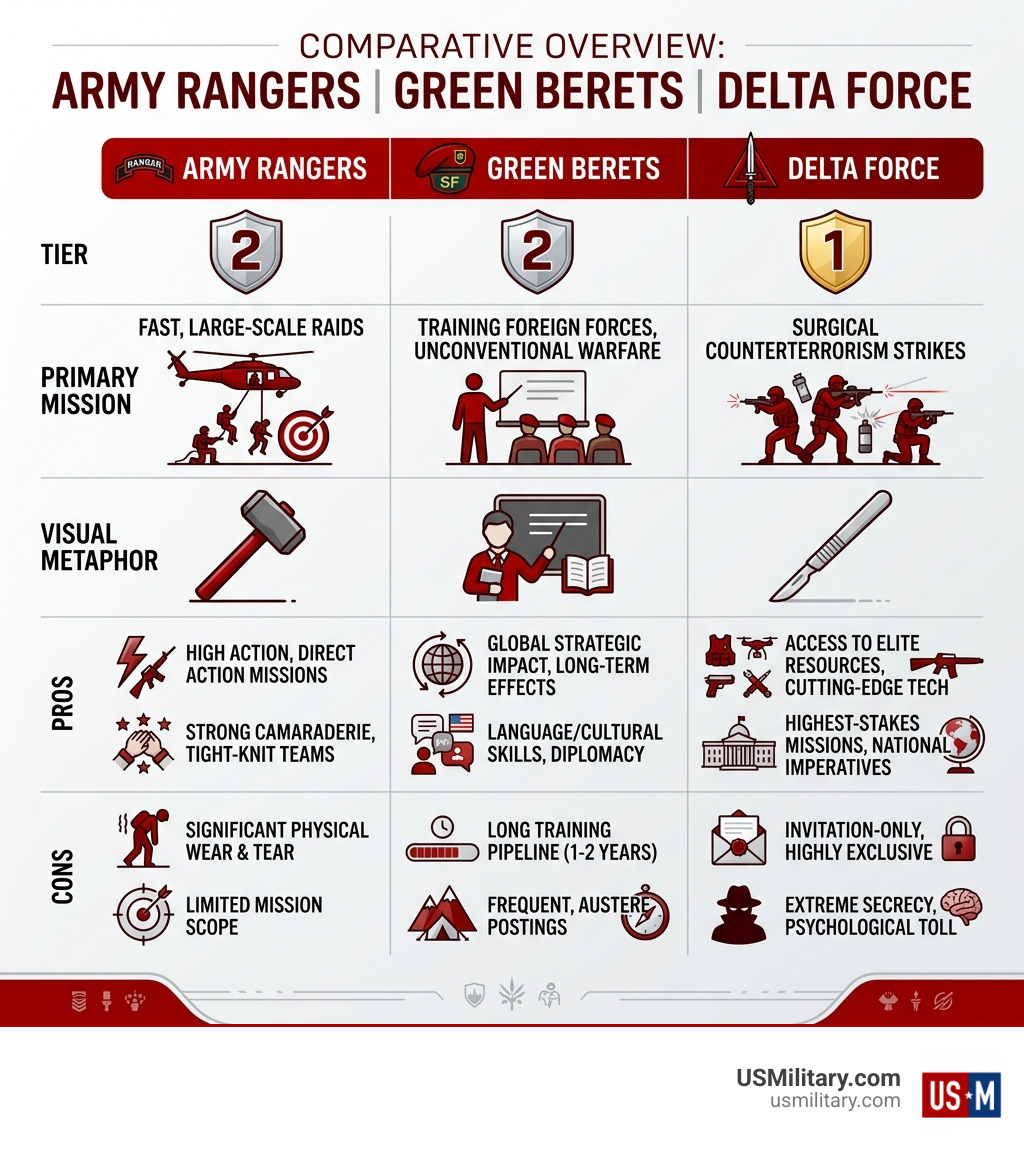
| Unit | Tier | Best Known For | Biggest Pro | Biggest Con |
|---|---|---|---|---|
| Army Rangers | Tier 2 | Fast, large-scale raids | High action, strong camaraderie | Physical wear, limited mission scope |
| Green Berets | Tier 2 | Training foreign forces, unconventional warfare | Strategic impact, language/cultural skills | Long pipeline (1-2 years), austere postings |
| Delta Force | Tier 1 | Surgical counterterrorism strikes | Elite resources, highest-stakes missions | Invitation-only, extreme secrecy, psychological toll |
Think of it this way: Rangers are the sledgehammer, Green Berets are the teachers, and Delta Force is the scalpel. Each plays a distinct role — and each has real trade-offs worth knowing before you commit.
I’m Larry Fowler, publisher of USMilitary.com, and I’ve spent nearly two decades helping active-duty service members and veterans navigate complex military career decisions — including the Army Rangers vs Green Beret vs Delta Force: The Pros and the Cons of Each. In the sections below, I’ll walk you through everything you need to make an informed choice.
Essential Army Rangers vs Green Beret vs Delt Force: The Pros and the Cons of Each terms:
- army ranger vs green beret
- delta special forces
- how to become Ranger
When we look at the 2026 military landscape, the roles of these units are more specialized than ever. While all three are part of the U.S. Army Special Operations Command (USASOC), their daily “jobs” couldn’t be more different.
The 75th Ranger Regiment is the Army’s premier large-scale direct-action raid force. We often call them the “sledgehammer” because when the military needs an airfield seized behind enemy lines or a massive infrastructure target neutralized, they send the Rangers. They move fast, hit hard, and are often the first “boots on the ground” in a major conflict. You can learn more about their specific duties in our guide on What Do Army Rangers Do 2/.
The Special Forces (Green Berets), on the other hand, are the “teachers” or “force multipliers.” Their primary mission is Unconventional Warfare (UW) and Foreign Internal Defense (FID). Instead of just kicking down the door themselves, they are trained to go into a country, learn the language, and train a local guerrilla army to fight for their own freedom. This requires a level of diplomacy and cultural nuance that is unique in the special ops world. For a deeper dive into these distinctions, check out Differences Army Ranger Vs Green Beret/.
Finally, we have Delta Force (1st SFOD-D), the “scalpel.” Operating under the Joint Special Operations Command (JSOC), Delta is a Tier 1 Special Missions Unit. They handle the most sensitive, high-stakes missions: hostage rescue, counter-terrorism, and hunting high-value targets (like the missions that took out major terrorist leaders in the early 2000s). They are the “shadow warriors” who officially don’t exist in most public records. We’ve covered their mysterious history in The Shadow Warriors Everything You Need To Know About Delta Force/.
Army Rangers vs Green Beret vs Delta Force: The Pros and the Cons of Each
Choosing a path isn’t just about which unit sounds the coolest; it’s about which lifestyle and mission set you can sustain for a career. In April 2026, the operational tempo for all three remains high, but the nature of that work varies.
| Feature | Army Rangers | Green Berets | Delta Force |
|---|---|---|---|
| Unit Size | ~3,500 personnel | ~6,600 personnel | <1,000 (operational) |
| Tier Status | Tier 2 | Tier 2 | Tier 1 |
| Primary Focus | Direct Action / Raids | Unconventional Warfare | Counter-terrorism |
| Team Size | Platoon/Company (30-100+) | 12-man ODA (A-Team) | Small squads/troops |
| Recruitment | Initial enlistment (Option 40) | Initial or mid-career (18X) | Invitation-only (E-4/E-5+) |
One of the biggest questions we get is, Green Beret vs Delta Force: Who’s More “Elite”? . The truth is that “elite” is subjective. If you want to be the best at small-unit tactics and teaching, the Green Berets are the pinnacle. If you want to be at the absolute top of the Tier 1 food chain for surgical strikes, it’s Delta.
Pros and Cons of the 75th Ranger Regiment
The Pros:
- High Operational Tempo: If you want to “do your job” frequently, the Rangers are for you. They deploy often and are the primary choice for rapid-response missions.
- Unmatched Camaraderie: The Ranger Regiment has a unique “armed frat” atmosphere. Because the force is younger, there is an incredible bond built through shared physical hardship.
- Clear Career Path: You can join the Rangers straight out of basic training via an Option 40 contract. This is the fastest way to get into the special operations community.
The Cons:
- Intense Physical Demands: The “Ranger way” is hard on the body. High injury rates are common due to the constant airborne operations and heavy rucking.
- Limited Mission Scope: Rangers are experts at direct action. If you are looking for a job that involves complex diplomacy or long-term strategic planning, you might find the “kick-in-the-door” mission set a bit narrow over time.
- Strict Discipline: Life in the Regiment is very “by the book.” Standards are checked constantly, and there is little room for the “relaxed” grooming standards often seen in other special ops units.
To see if you have what it takes, read Can You Qualify An Elite Army Ranger/ or explore their current global footprint in Are Army Rangers Operating In Iran Now 101/.
Pros and Cons of the Special Forces (Green Berets)
The Pros:
- Strategic Impact: As a Green Beret, you aren’t just a soldier; you’re a diplomat. You have the chance to change the course of a region by building partnerships.
- Advanced Training: You will become a master of a specific MOS (Medical, Weapons, Engineering, or Communications) and learn a foreign language.
- Autonomy: Green Berets operate in 12-man Operational Detachment Alphas (ODAs). These teams are designed to be completely self-sufficient in hostile territory.
The Cons:
- Long Training Pipeline: The “Q Course” can last anywhere from 56 to 95 weeks. It is an intellectual and physical grind that requires immense patience.
- Teaching vs. Fighting: A common frustration for some is that you spend more time teaching others how to fight than doing the fighting yourself.
- Austere Environments: Green Berets often live in very remote, primitive conditions for months at a time while working with partner forces.
For those torn between branches, we’ve compared them to other elite units in Green Beret Vs Navy Seals/ and Navy Seal Vs Army Green Beret/.
Pros and Cons of Delta Force (1st SFOD-D)
The Pros:
- Tier 1 Resources: Delta has access to the best equipment, the largest budgets, and the most advanced technology in the world.
- The Ultimate Challenge: This is the “Major Leagues” of special operations. You are working with the absolute best of the best from every branch.
- Surgical Precision: Missions are often high-stakes and clandestine, requiring a level of skill and stealth that other units simply don’t specialize in.
The Cons:
- Extreme Secrecy: Your achievements will likely never be known by the public. This “quiet professional” lifestyle can be difficult for families.
- High Attrition: Even for seasoned Rangers and Green Berets, the failure rate at Delta selection is incredibly high.
- Psychological Toll: The nature of Tier 1 missions — often involving hostage rescue and counter-terrorism — carries a heavy mental burden.
We dive deeper into how they compare to other branches in Everything You Need To Know About Marines Vs Army Special Forces/.
Selection and Training: RASP, the Q-Course, and the Long Walk

The path to these units is paved with sweat and heavy rucksacks. Each has a selection process designed to find a very specific type of person.
- Army Rangers (RASP): The Ranger Assessment and Selection Program is an 8-week “smoke session.” It focuses on physical endurance, mental toughness, and basic soldiering skills. It is shorter than the others but incredibly intense.
- Green Berets (SFAS and Q Course): It starts with Special Forces Assessment and Selection (SFAS), a 24-day test of your ability to work in a team while exhausted. If you pass, you head to the Q Course, which includes MOS training, language school, and the famous “Robin Sage” unconventional warfare exercise.
- Delta Force (Selection and OTC): You don’t just “join” Delta. You are usually invited or apply after serving in another elite unit. Selection takes place in the mountains of West Virginia and culminates in “The Long Walk” — a 40-mile solo ruck march over rough terrain with a 45-pound pack. If you survive that, you still have to pass the Commander’s Board and the 6-month Operator Training Course (OTC).
For a look at another elite Army path, see How To Become A Night Stalker In The Army/. You can also see a broader comparison in The differences between America’s top special operators .
Cultural Differences and Unit Synergy
While they have different missions, these units often work together. In a typical mission, you might see Green Berets training a local force, Rangers providing the Quick Reaction Force (QRF) or perimeter security, and Delta Force performing the actual “hit” on the target.
The Army Rangers vs Green Beret vs Delta Force: The Pros and the Cons of Each also includes a “feeder” relationship. The Ranger Regiment is the primary recruiting pool for Delta Force. Many young soldiers start as Rangers to get high-level tactical experience, then move to Delta when they are older and more experienced.
The Ranger “Lead the Way” Ethos
The 75th Ranger Regiment is defined by discipline. They are the masters of small unit tactics and airborne assaults. Their culture is built on the “Ranger Creed,” which emphasizes being more technically and tactically proficient than any other soldier. This “Lead the Way” attitude makes them the ultimate choice for forcible entry operations. For a visual comparison of these paths, we recommend this video: Army Rangers vs Green Berets – Which Path Should You … .
Quiet Professionals and Shadow Warriors
Green Berets and Delta operators share a more “mature” culture. Because they often operate in small teams or undercover, they value adaptability and regional expertise over rigid military protocol. Green Berets are the “Quiet Professionals” who win hearts and minds, while Delta operators are the “Shadow Warriors” who handle the missions that the government can’t talk about.
Frequently Asked Questions about Army Special Operations
Can a Ranger join Delta Force?
Yes, absolutely. In fact, the Ranger Regiment is one of the top sources for Delta recruits. Delta looks for experienced special operators who have already proven they can handle high-stress combat environments.
Which unit is more elite: Green Berets or Rangers?
Neither is “more” elite; they are just different. A Ranger is more elite at large-scale direct action and airfield seizures. A Green Beret is more elite at unconventional warfare and cultural immersion. It’s like asking if a professional sprinter is “more elite” than a marathon runner — they are both top-tier athletes, but they train for different races.
What is the difference between the Ranger Tab and the Ranger Scroll?
This is a common point of confusion. The Ranger Tab is earned by graduating from Ranger School, a 61-day leadership course open to many soldiers in the Army. The Ranger Scroll (and the tan beret) is worn only by members of the 75th Ranger Regiment who have passed RASP. You can have a Tab without being in the Regiment, but every leader in the Regiment eventually must earn the Tab.
Conclusion
At USMilitary.com, we know that choosing between the Army Rangers vs Green Beret vs Delta Force: The Pros and the Cons of Each is a life-altering decision. Whether you want the high-octane life of a Ranger, the strategic depth of a Green Beret, or the Tier 1 precision of Delta Force, the U.S. Army offers a path to the very top.
Beyond the service, these units offer incredible career paths and veteran transitions. The leadership skills, discipline, and specialized training you receive will make you a prime candidate for high-level roles in the private sector or government agencies once you hang up the uniform.

Ready to compare these Army legends to the Navy’s finest? Take a look at our guide: Compare Army Delta Force vs Navy SEALs. Whatever path you choose, remember the words of the Ranger Creed: “I will always endeavor to uphold the prestige, honor, and high esprit de corps of my Ranger Regiment.”
We are here to support you every step of the way, from your first enlistment contract to your post-service financial planning and VA benefits. Explore our resources to find the path that fits your goals for 2026 and beyond.
Learn more about elite military careers at USMilitary.com
Support our mission and find great resources