

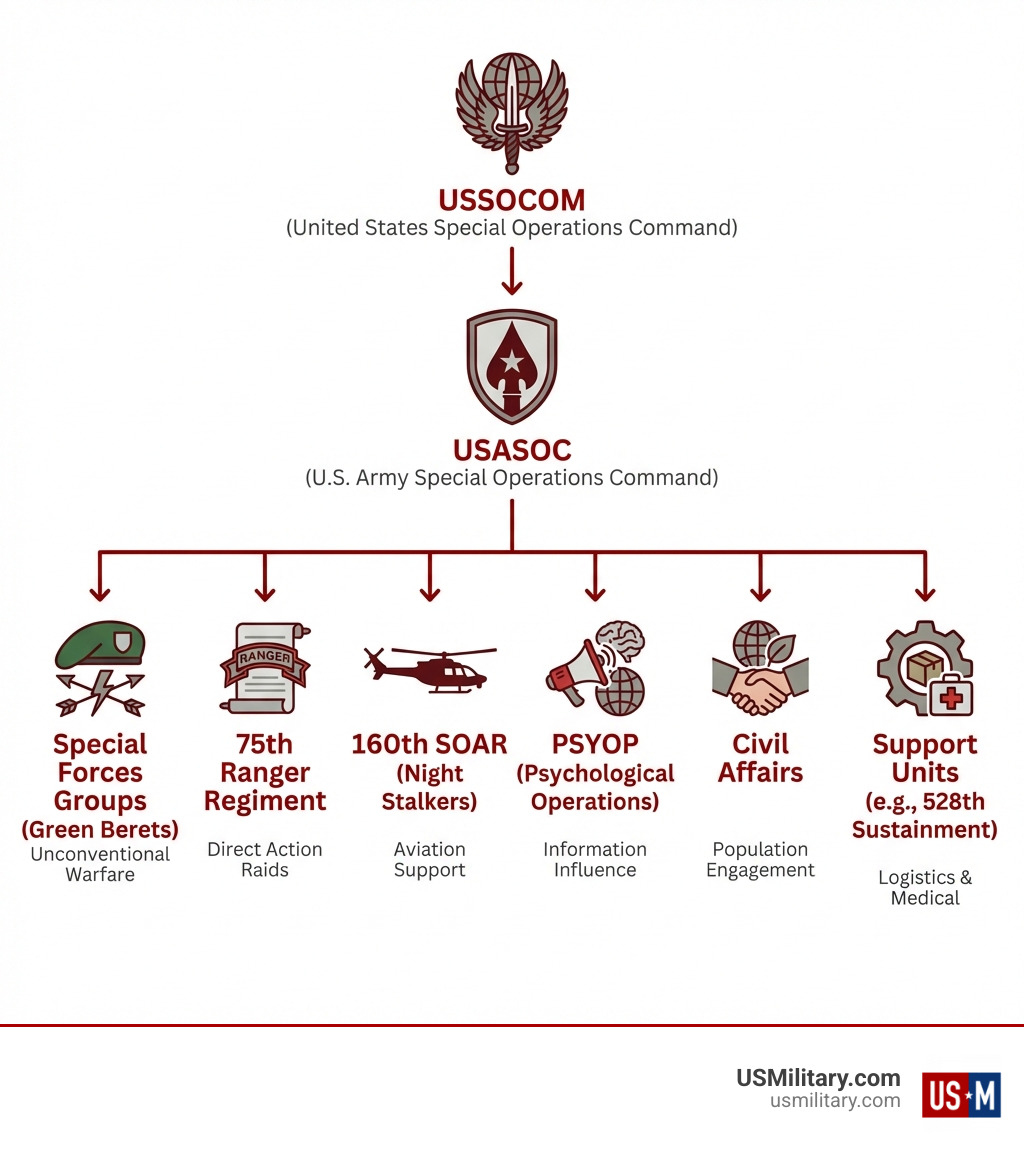
US Army SOF (Special Operations Forces) represents the most elite, highly trained units within the United States Army, specifically organized to conduct unconventional warfare, counterterrorism, and other specialized missions that conventional forces cannot accomplish. These forces operate under the United States Army Special Operations Command (USASOC) and include the legendary Green Berets, Army Rangers, Night Stalkers, and specialized support units.
Key Components of US Army SOF:
- Special Forces (Green Berets) – 7 groups specializing in unconventional warfare and foreign internal defense
- 75th Ranger Regiment – Premier light infantry force conducting direct action raids and airfield seizures
- 160th SOAR (Night Stalkers) – Elite aviation regiment providing specialized helicopter support
- Psychological Operations (PSYOP) – Units focused on influencing foreign audiences and information operations
- Civil Affairs Brigade – Specialists in human terrain analysis and population engagement
- 528th Sustainment Brigade – Provides logistics, medical, and signal support to SOF units
These “Quiet Professionals” trace their lineage back over 200 years to unconventional warfare pioneers like Revolutionary War’s Francis Marion and World War II’s Office of Strategic Services. Officially established in 1952, US Army SOF has evolved into a force of approximately 33,000 personnel who deploy globally to protect American interests.
What sets Army SOF apart is its unique approach to warfare. Rather than relying solely on overwhelming firepower, these soldiers are trained as “soldier-diplomats” who master foreign languages, understand cultural complexities, and work “by, with, and through” local forces to achieve strategic objectives. Their core missions include unconventional warfare, foreign internal defense, direct action, counterterrorism, and special reconnaissance.
The path to joining these elite units is deliberately challenging. Candidates must demonstrate exceptional physical fitness, mental toughness, and adaptability through rigorous selection processes. The Special Forces Qualification Course (Q-Course) alone typically lasts 55-95 weeks, changing selected soldiers into highly specialized operators.
The Core Components of the US Army SOF
When we talk about US Army SOF, we’re referring to a collection of highly specialized units, each with a distinct role but all united under the banner of the United States Army Special Operations Command (USASOC). These are the forces that operate in the shadows, often unseen, but always impactful. They are the tip of the spear, ready to tackle challenges that require a unique blend of skill, discretion, and adaptability.
USASOC, headquartered at Fort Bragg, North Carolina, is the largest of the service components within the U.S. Special Operations Command (USSOCOM). It commands active-duty and Army Reserve special operations forces and provides training oversight for Army National Guard SOF. With an allocated strength of approximately 33,000 personnel, USASOC controls seven major subordinate elements, providing about 70% of the special operations personnel in Central Command’s theater.
Let’s explore some of the primary components that make up this incredible force:
Special Forces (The Green Berets)
Perhaps the most iconic members of the US Army SOF are the Special Forces, affectionately known as the “Green Berets.” This elite group is comprised of 7 Special Forces groups, with five active duty groups and two Army National Guard (ARNG) Special Forces groups. Each of these groups typically has a regional alignment, meaning they specialize in the language, culture, and political landscape of specific parts of the world. This deep regional expertise allows them to forge strong relationships and operate effectively in complex environments.
The cornerstone of the Special Forces is the Operational Detachment Alpha (ODA), or “A-Team.” This is a 12-soldier team, where each member is cross-trained in multiple disciplines. This means that if one member is incapacitated, another can step in to fill their role, ensuring mission continuity. ODAs are mature, intense, and highly-trained operators, often described as ‘quiet professionals’ who operate autonomously. They are considered the ‘most trusted force in America’s Army’, capable of conducting the full spectrum of special operations.
Their training is comprehensive, covering advanced weapons, language proficiency, demolitions, combat medicine, military free-fall, and advanced combat tactics. This rigorous preparation ensures that every Green Beret is a master of their craft and ready for any challenge.
To learn more about these legendary soldiers, you can explore their history and impact: More about the Green Berets.
75th Ranger Regiment
The 75th Ranger Regiment is another integral part of the US Army SOF. This premier light infantry force is renowned for its ability to conduct direct action raids, airfield seizures, and special reconnaissance missions. Their lineage dates back to the 1700s, with roots in frontiersman Robert Rogers’ unit and his “28 Rules of Ranging,” which emphasized unconventional yet effective battle tactics. Modern Rangers still uphold these principles, specializing in raids and missions deep inside enemy territory.
The Rangers are a four-time volunteer force, meaning soldiers volunteer for the Army, then for Airborne School, then for the Ranger Assessment and Selection Program (RASP), and finally for assignment to the Ranger Regiment. This rigorous selection process ensures that only the most dedicated and capable individuals earn the right to wear the Ranger tab. They are known for their lethal, agile, and versatile capabilities, making them crucial for large-scale, joint forcible entry operations and precision targeting.
Find more about the history and modern operations of these formidable warriors: The Army Rangers.
160th Special Operations Aviation Regiment (SOAR)
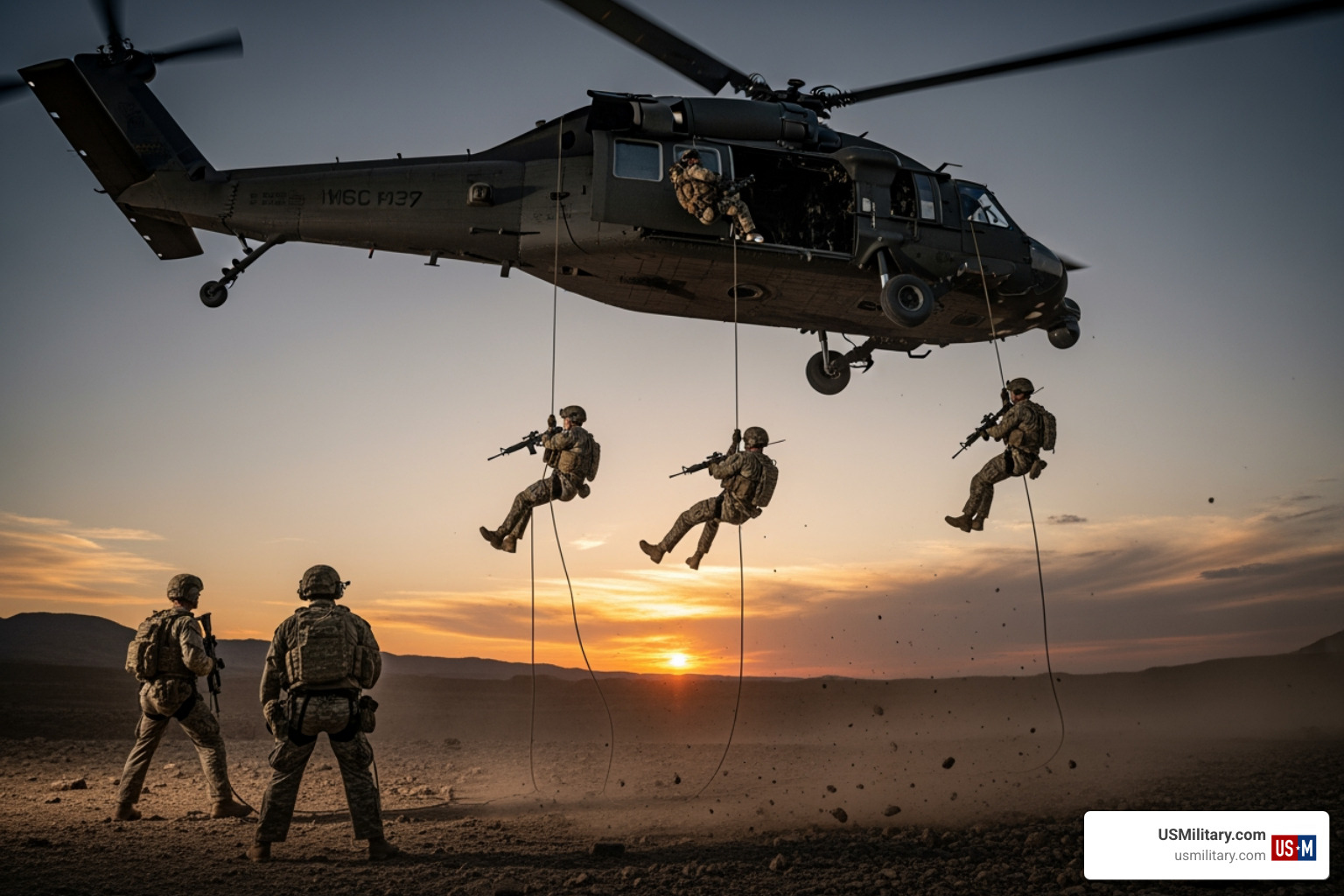
Known as the “Night Stalkers,” the 160th Special Operations Aviation Regiment (SOAR) is the Army’s premiere night fighting aviation force. Officially activated in June 1990, these elite soldiers run international nighttime operations from specialized helicopters. If you’ve seen images of special operations forces being inserted or extracted under the cover of darkness, chances are the Night Stalkers were at the controls.
Their fleet includes specialized aircraft like the MH-60K/L Black Hawk and the A/MH-6 Little Bird, which are modified for precision special operations missions. The Night Stalkers provide critical aviation support to all US Army SOF units, enabling them to reach their objectives stealthily and swiftly, regardless of time or weather conditions. Their motto, “Night Stalkers Don’t Quit,” perfectly encapsulates their dedication and relentless pursuit of mission success.
The Mission Set: What Special Forces Do
The missions undertaken by US Army SOF are as diverse as they are challenging. These forces are often referred to as “force multipliers” because their unique training and capabilities allow a small team to achieve strategic effects typically requiring much larger conventional units. They operate on the principle of “by, with, and through,” meaning they often work alongside and empower indigenous forces and local populations rather than solely relying on direct intervention.
This approach heavily relies on their exceptional language skills and cultural expertise. US Army SOF soldiers are not just warriors; they are “soldier-diplomats” who can steer complex political, economic, and cultural landscapes. They are required to learn a foreign language as part of their training and must maintain knowledge of the regions in which they are deployed. This deep understanding allows them to build trust, provide effective training, and foster long-term stability.
The Five Principal Missions
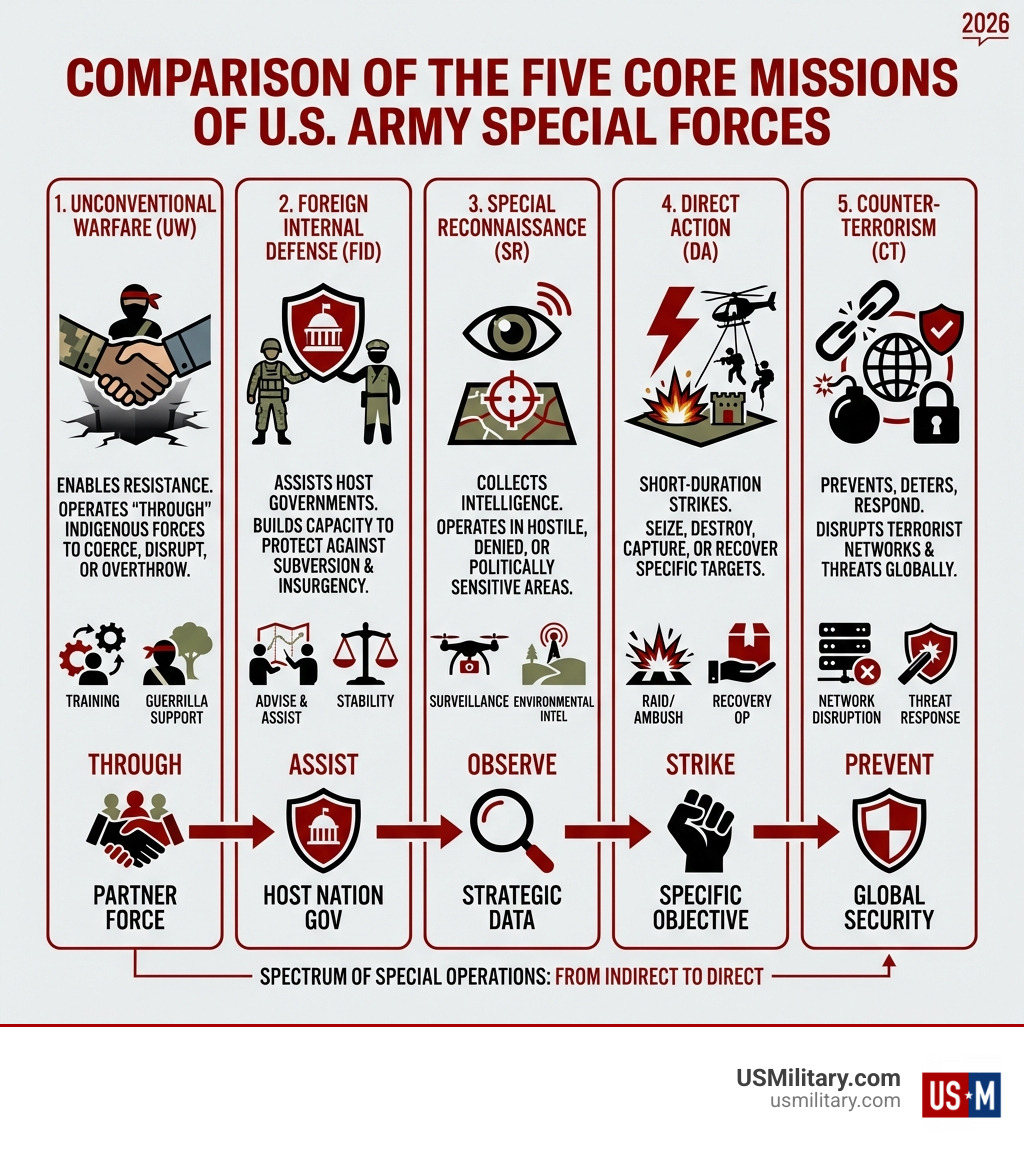
The core missions of the US Army SOF are doctrinally defined and form the bedrock of their operational philosophy. These five principal missions are:
- Unconventional Warfare (UW): This is arguably the defining mission of the Green Berets. It involves enabling a resistance movement or insurgency to coerce, disrupt, or overthrow a government or occupying power by operating “through” indigenous forces. This can include training, advising, and assisting guerrilla forces.
- Foreign Internal Defense (FID): In contrast to UW, FID focuses on training and assisting foreign military and police forces to protect their own governments from internal threats like insurgency, subversion, and terrorism. It’s about building partner capacity and preventing instability.
- Direct Action (DA): These are short-duration strikes and other small-scale offensive actions conducted in hostile, denied, or politically sensitive environments. DA missions are designed to seize, destroy, capture, recover, or inflict damage on designated personnel or material.
- Counterterrorism: This involves actions taken to prevent, deter, and respond to terrorism. US Army SOF plays a critical role in disrupting terrorist networks, capturing or eliminating high-value targets, and preventing attacks.
- Special Reconnaissance (SR): SR involves acquiring information concerning the capabilities, intentions, and activities of an actual or potential enemy. This is often conducted in denied or hostile areas, relying on stealth and advanced observation techniques to gather vital intelligence.
While these are the five principal missions, US Army SOF soldiers are versatile and often engage in a broader range of activities.
The Unique Role of US Army SOF in Modern Warfare
Beyond the core five, the US Army SOF also undertakes numerous secondary missions that are crucial for national security and global stability. These include:
- Combat Search and Rescue (CSAR): Recovering isolated personnel, particularly downed aircrew, in hostile territory.
- Counter-narcotics: Disrupting illegal drug production and trafficking networks that often fund terrorist or insurgent groups.
- Hostage Rescue: Executing complex operations to free captives held by hostile forces.
- Humanitarian Assistance: Providing aid and support in disaster zones or conflict-affected areas, often working with local populations.
- Humanitarian Demining: Clearing landmines and unexploded ordnance to make areas safe for civilians.
- Peacekeeping Operations: Supporting multinational efforts to maintain peace and stability in volatile regions.
- Manhunts: Tracking and apprehending high-value targets, such as wanted warlords or terrorists.
These diverse missions highlight the adaptability and multifaceted nature of the US Army SOF. Their ability to operate across the full spectrum of conflict, from direct combat to diplomatic engagement, makes them an indispensable asset in modern warfare.
The Path of a Warrior: Selection and Training
The journey to becoming a member of US Army SOF is not for the faint of heart. It demands an extraordinary level of commitment, resilience, and aptitude. The selection and training process is deliberately arduous, designed to identify individuals with the mental toughness, physical fitness, and team-oriented mindset required to succeed in the most challenging environments. We often say that the people are our greatest weapon system, and nowhere is this more evident than in the rigorous process of forging a Special Operations soldier.
Candidates must meet incredibly high standards. For enlisted members, this typically includes being between 20-36 years old, a U.S. citizen, a high school graduate, and possessing a General Technical (GT) score of 110 or above on the ASVAB. They must also qualify for Airborne or Ranger School, pass a demanding Physical Fitness Test, and be eligible for a secret security clearance. For officers, requirements include specific ranks (first lieutenant or captain) and a Defense Language Aptitude Battery (DLAB) score of 85 or higher, along with eligibility for a top-secret clearance.
The Special Forces Qualification Course (Q-Course)
The heart of Special Forces training is the Special Forces Qualification Course, or “Q-Course,” conducted at the U.S. Army John F. Kennedy Special Warfare Center and School (USAJFKSWCS) at Fort Bragg, North Carolina. SWCS is the Army’s Special Operations Center of Excellence, responsible for developing and training the next generation of US Army SOF.
The Q-Course is an intensive, multi-phase program that usually lasts between 55 and 95 weeks, depending on the soldier’s chosen Military Occupational Specialty (MOS) and foreign language capability. During this time, candidates undergo specialized training in:
- MOS Training: Each candidate specializes in a particular skill set, such as weapons, engineering, medical, or communications.
- Language School: All Special Forces soldiers are required to learn a foreign language and maintain knowledge of the political, economic, and cultural complexities of their assigned regions. The Foreign Language Initial Acquisition Program at SWCS trains over 1,500 soldiers annually in 17 core languages.
- Survival Training: Candidates learn survival, evasion, resistance, and escape (SERE) techniques.
- Robin Sage Exercise: The culmination of the Q-Course, Robin Sage is a realistic, unconventional warfare exercise that tests all the skills learned throughout the course in a simulated conflict environment.
This comprehensive training ensures that every Green Beret is not only proficient in their technical skills but also possesses the crucial language and cultural understanding necessary to operate effectively as “soldier-diplomats” worldwide.
Key Career Fields (MOS)
Within the Special Forces, soldiers specialize in various Military Occupational Specialties (MOS), each critical to the success of the 12-man ODA. These roles ensure that every team is self-sufficient and capable of handling a wide array of challenges. Here are some of the key career fields:
- 18A (Special Forces Officer): The team leader, responsible for the overall mission planning, execution, and well-being of the ODA. Officers must demonstrate exceptional leadership and tactical acumen.
- 18B (Special Forces Weapons Sergeant): Experts in a vast array of small arms, crew-served weapons, and foreign weapons systems. They are responsible for the team’s firepower and marksmanship training.
- 18C (Special Forces Engineer Sergeant): Proficient in both offensive and defensive demolitions, construction, and breaching techniques. They can build or destroy infrastructure as needed.
- 18D (Special Forces Medical Sergeant): Highly skilled combat medics, often considered the most proficient trauma medics in the military. They are capable of providing advanced medical care in austere environments.
- 18E (Special Forces Communications Sergeant): The team’s communications specialists, responsible for establishing and maintaining secure communications with higher headquarters and other units in the field.
- 18X (Special Forces Candidate): This is not an MOS itself but a direct-entry program for civilians or soldiers from other branches who volunteer for Special Forces. They enter the pipeline as 18X candidates and receive their specific MOS during the Q-Course.
These specialized roles, combined with cross-training, create a truly versatile and formidable fighting force, ready to face any challenge our nation encounters.
Forging a Legacy: History and Notable Operations
The history of US Army SOF is a mix woven with courage, innovation, and an unwavering commitment to freedom. Their legacy is built upon the contributions of unconventional warriors who preceded them and the countless operations they’ve undertaken to protect U.S. interests globally.
Historical Evolution of US Army SOF
The roots of US Army SOF can be traced back to World War II, particularly to organizations like the Office of Strategic Services (OSS). The OSS conducted clandestine operations behind enemy lines, pioneering many of the techniques that would later be adopted by Special Forces. Colonel Aaron Bank, a veteran of the OSS, is often regarded as the “Father of Special Forces” for his instrumental role in establishing the 10th Special Forces Group.
The Special Forces were officially established in 1952. However, it was President John F. Kennedy who truly championed and liftd their status. Recognizing the need for forces capable of countering communist insurgencies, Kennedy authorized the distinctive green beret for exclusive wear by the U.S. Army Special Forces in 1961. This act transformed the green beret from an unofficial symbol into a powerful emblem of excellence, a badge of courage, and a mark of distinction. We even saw a green beret placed on President Kennedy’s coffin, a testament to his connection with these elite soldiers.
The Vietnam War saw the Green Berets play a critical role, conducting unconventional warfare, counterinsurgency, and advising indigenous forces. Their actions during this period cemented their reputation as skilled and adaptable warriors. The Special Forces branch was officially established as a basic branch of the United States Army on April 9, 1987, further solidifying their unique identity within the military. This same year, the United States Special Operations Command (USSOCOM) was created, bringing all special operations forces under a unified command structure.
You can dig deeper into their rich heritage here: History of the Special Forces.
Relationship with National Security and Key Engagements
US Army SOF has consistently been at the forefront of national security efforts, often operating in the most challenging and sensitive environments. Their close relationship with intelligence agencies, particularly the CIA, has been a defining characteristic, tracing back to their OSS lineage. This collaboration allows for seamless integration of intelligence gathering and direct action.
Some notable historical operations and engagements involving the US Army SOF include:
- Vietnam War: Extensive involvement in counterinsurgency, unconventional warfare, and advisory roles, earning them numerous accolades and showcasing their unique capabilities.
- Operation Enduring Freedom (Afghanistan): Following the tragic events of 9/11, the US Army SOF were among the first forces deployed to Afghanistan. Operations like “Jawbreaker” and “Task Force Dagger” saw Green Berets working with CIA elements and Afghan Northern Alliance forces to rapidly destabilize the Taliban regime, leading to the swift overthrow of the government. They were instrumental in the initial invasion and subsequent counterterrorism efforts.
- Iraq War: US Army SOF played a crucial role in the invasion of Iraq and subsequent counterinsurgency operations, rooting out insurgents and training Iraqi security forces.
- Hunt for Joseph Kony: Green Berets were deployed to Central Africa to advise and assist local forces in the hunt for Joseph Kony, the leader of the Lord’s Resistance Army (LRA), demonstrating their ongoing commitment to combating global threats.
- Global War on Terrorism: For nearly two decades, the US Army SOF has been continuously deployed, conducting counterterrorism operations, foreign internal defense, and security force assistance missions across the globe. Their experience in combating violent extremist organizations (VEOs) has been unparalleled.
Today, as the strategic landscape shifts towards great power competition, the US Army SOF continues to adapt, leveraging its hard-won experience and integrating new technologies to address emerging threats and maintain its vital role in protecting our nation’s interests.
Frequently Asked Questions about US Army SOF
We understand that special operations can be complex, with many terms and units that might seem similar but have distinct differences. Here, we address some of the most common questions we receive about US Army SOF.
What is the difference between Special Forces and other Army Special Operations units?
This is a great question that often causes confusion! The term “Special Forces” specifically refers to the U.S. Army’s Green Berets. They are a unique branch within the Army, known for their proficiency in unconventional warfare, foreign internal defense, and language/cultural expertise.
“Army Special Operations units,” on the other hand, is a broader umbrella term that includes the Special Forces, but also encompasses other elite Army units like:
- The 75th Ranger Regiment (light infantry, direct action).
- The 160th Special Operations Aviation Regiment (SOAR) (aviation support).
- Psychological Operations (PSYOP) units (information influence).
- Civil Affairs (CA) units (civilian population engagement).
All these units fall under the United States Army Special Operations Command (USASOC). So, while all Special Forces are Army Special Operations, not all Army Special Operations units are Special Forces. Think of it like this: all squares are rectangles, but not all rectangles are squares!
How long does it take to become a Green Beret?
The path to becoming a Green Beret is extensive and demanding, reflecting the high level of skill and dedication required. After initial Army basic training and advanced individual training, candidates must successfully complete Special Forces Assessment and Selection (SFAS).
Once selected, they enter the Special Forces Qualification Course (Q-Course), which is the longest and most comprehensive training pipeline in the Army. The Q-Course typically lasts between 55 and 95 weeks, or roughly 13 to 22 months. This duration depends on the specific Military Occupational Specialty (MOS) the candidate is training for and their foreign language proficiency. This doesn’t include the time spent in initial Army training or any prerequisite courses like Airborne School. So, from initial entry into the Army to earning the coveted Green Beret, it can easily take two to three years, or even longer, of continuous training.
Can women join the Green Berets?
Yes, women can and do join the Green Berets. In 2015, all military occupational specialties (MOS) were opened to women, including those in Special Operations Forces. The first woman officially graduated from the Special Forces Qualification Course (Q-Course) and joined the Green Berets in July 2020. This was a significant milestone, marking a new chapter in the history of the US Army SOF.
While she was the first to graduate as a Green Beret, women have served in various support roles within Special Operations for many years, often in challenging and dangerous capacities. The standards for entry into the Green Berets remain unchanged for all candidates, regardless of gender, ensuring that only the most qualified individuals earn the right to wear the beret.
Conclusion
As we’ve explored, US Army SOF represents the pinnacle of military excellence, embodying a unique blend of combat prowess, intellectual acumen, and cultural sensitivity. From the legendary Green Berets, with their unparalleled skills in unconventional warfare and foreign internal defense, to the rapid response capabilities of the 75th Ranger Regiment and the critical aviation support provided by the Night Stalkers, these units are indispensable to our national security.
The “Quiet Professionals” of the US Army SOF operate on a global stage, often unseen, but always impactful. Their commitment to working “by, with, and through” local partners, coupled with their mastery of languages and cultures, allows them to achieve strategic objectives in ways conventional forces cannot. The rigorous selection and training processes ensure that only the most adaptable, resilient, and intelligent individuals earn the right to join their ranks, changing them into the soldier-diplomats our nation relies upon.
Their legacy is a testament to continuous innovation and an unwavering commitment to defending freedom and American interests, from the battlefields of Vietnam to the mountains of Afghanistan and beyond. At USMilitary.com, we recognize and honor the vital role these elite soldiers play. Their dedication, sacrifice, and unique capabilities ensure that the US Army SOF will continue to stand as a formidable force, ready to face the challenges of today and tomorrow.
Learn more about Army Special Operations careers and opportunities