
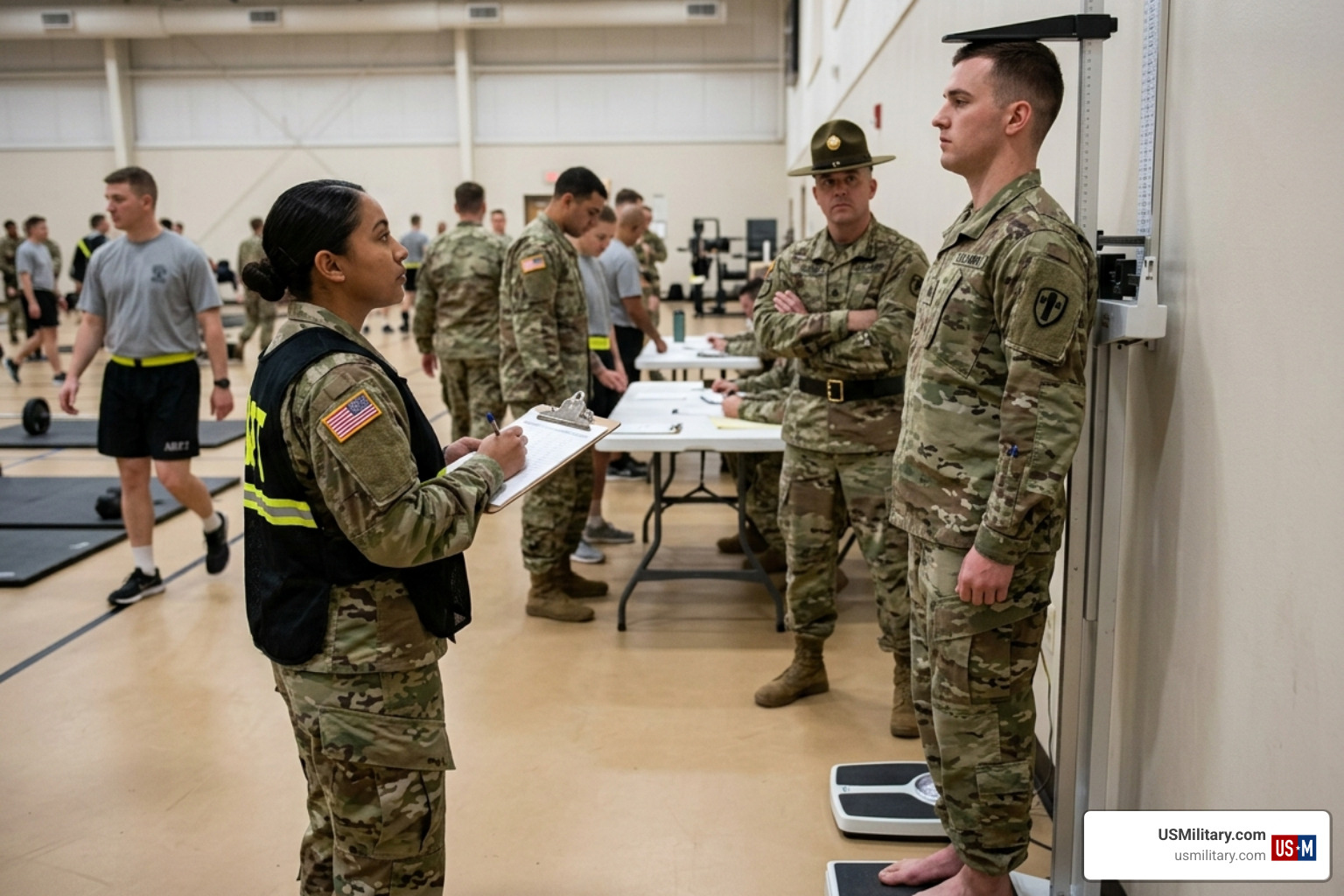
The Army standard for height and weight sets the physical baseline every recruit and soldier must meet to serve. Here is a quick snapshot of the core requirements:
| Category | Men | Women |
|---|---|---|
| Minimum height | 60 in (5’0″) | 58 in (4’10”) |
| Maximum height | 80 in (6’8″) | 80 in (6’8″) |
| Minimum weight | BMI of 19 | BMI of 19 |
| Maximum weight | Varies by height and age | Varies by height and age |
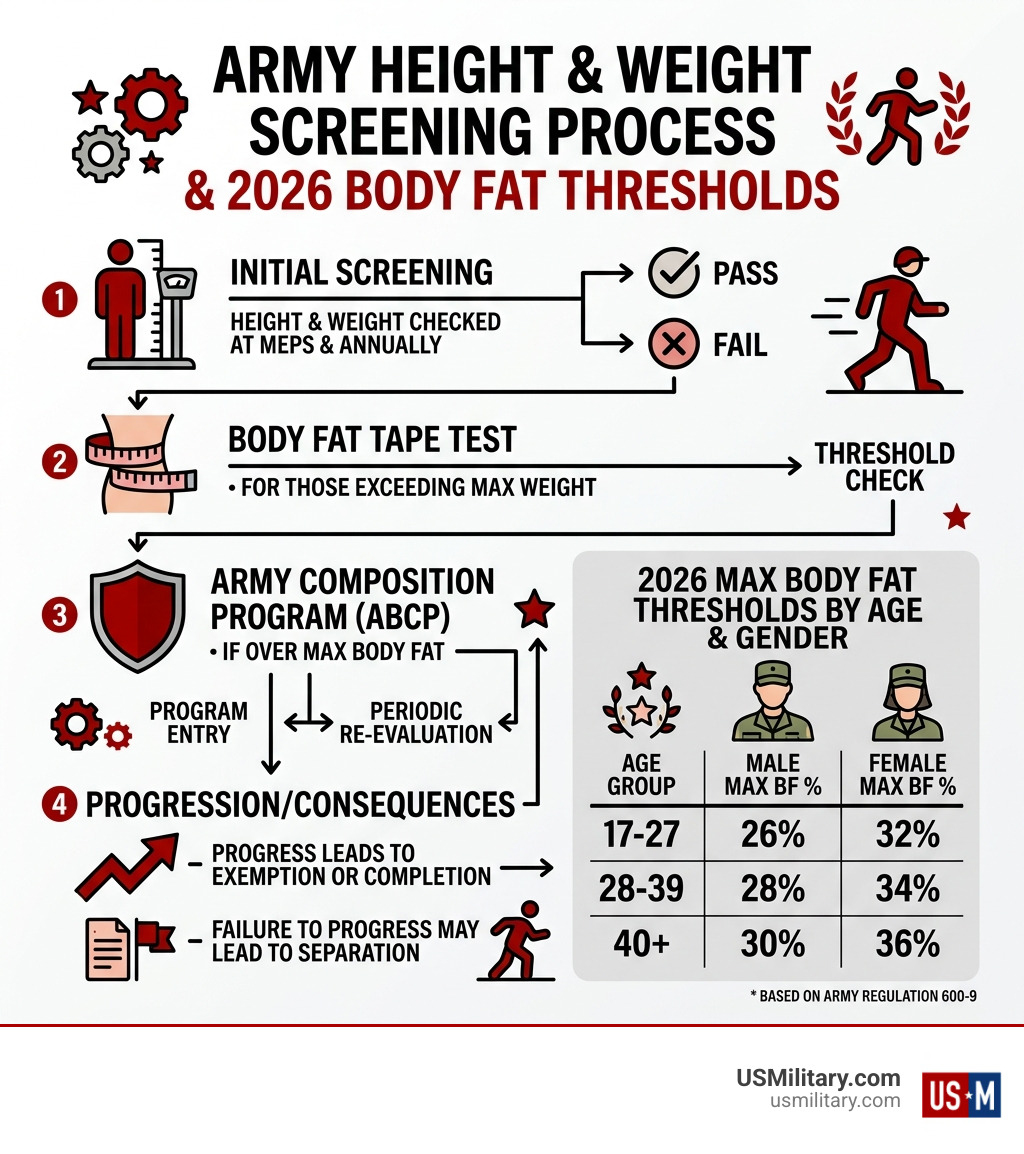
| Max body fat (17-27) | 26% | 32% |
| Max body fat (28-39) | 28% | 34% |
| Max body fat (40+) | 30% | 36% |
If you exceed the maximum weight for your height, you are not automatically disqualified. The Army will conduct a body fat tape test before making a final call.
These standards are governed by Army Regulation 600-9 (AR 600-9), the Army Body Composition Program. They apply to recruits at MEPS, active duty soldiers, and Reserve and Guard members alike. The goal is simple: ensure every soldier is physically ready to train, fight, and serve.
Failing to meet these standards has real consequences — from delayed enlistment to flagging, promotion blocks, and even separation from service. But there are also support programs and recent policy updates (including a 2025 exemption tied to the new Army Fitness Test) that give soldiers more options than ever before.
I’m Larry Fowler, publisher of the USMilitary.com & USArmy.com Network since 2007, and I’ve spent nearly two decades helping recruits and veterans navigate complex military requirements — including the Army standard for height and weight — so they can make informed decisions about their service. Let’s walk through everything you need to know.
Minimum and Maximum Army Standard for Height and Weight
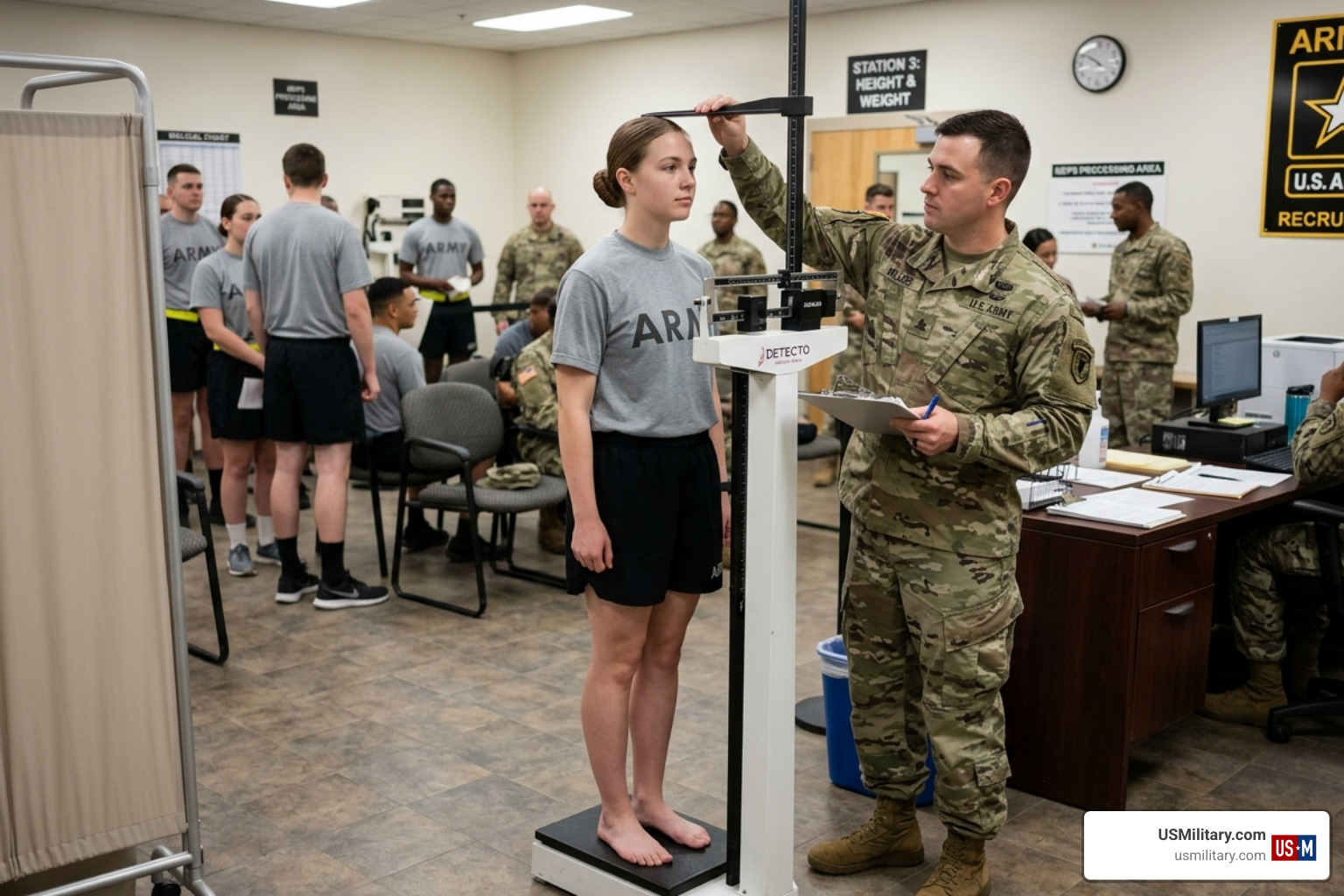
Before you can raise your right hand and take the oath, you have to pass through the Military Entrance Processing Station (MEPS). This is where the Army standard for height and weight first meets reality. For men, the height requirement generally ranges from 60 to 80 inches. For women, the minimum is slightly lower at 58 inches, while the maximum remains 80 inches.
These limits aren’t just arbitrary numbers. They exist because the Army operates in a world of standardized equipment. If you are 6’9″, you might find it impossible to fit safely inside a Bradley Fighting Vehicle or an Apache cockpit. On the flip side, being under the minimum height can make it difficult to handle standard-issue gear or complete the rigorous physical tasks required in basic training.
It is also important to note that the Army looks at the “floor” as well as the “ceiling.” For initial procurement (enlistment), the Army requires a minimum weight that results in a Body Mass Index (BMI) of at least 19. This ensures that recruits have enough mass to withstand the physical toll of ruck marches and combat conditioning. According to the official Eligibility & Requirements to Join, failing to meet these basic height or weight marks can stop an enlistment in its tracks. However, for those who are close to the marks, medical waivers or specific occupational exceptions are sometimes granted on a case-by-case basis.
Understanding the Army Standard for Height and Weight by Age
The Army understands that a 40-year-old Sergeant First Class has a different metabolism than a 17-year-old Private. Because of this, the screening tables are broken down into four distinct age groups: 17–20, 21–27, 28–39, and 40+. As you move into older age brackets, the maximum allowable weight for your height increases slightly.
For example, a 70-inch (5’10”) male aged 17–20 has a maximum screening weight of 180 lbs. If that same soldier is in the 28–39 age group, his maximum allowable weight jumps to 190 lbs. These “retention standards” are designed to be realistic while still demanding a professional appearance and a high level of fitness. If you exceed the weight for your age group, don’t panic—that’s when the body fat assessment kicks in.
2026 Updates to the Army Standard for Height and Weight
As we move through 2026, the Army has implemented some of the most significant policy shifts in decades. The most exciting change for the “gym rats” and high-performers is the AFT Performance Exemption. Under Army Directive 2025-17, any soldier who scores a 465 or higher on the Army Fitness Test (AFT)—with at least 80 points in each of the six events—is completely exempt from the body fat tape test, regardless of what the scale says.
This update acknowledges that muscle weighs more than fat. If you are a powerhouse who can max out your deadlift and crush the two-mile run, the Army no longer cares if your BMI is technically “overweight.” Additionally, the Army is moving toward more modern screening methods, including a potential shift to a waist-to-height ratio (WHtR) of less than 0.55 as a primary screening tool later this year. These changes reflect a more scientific approach to combat readiness, especially for those in physically demanding combat MOS roles like Infantry or Armor.
Body Fat Assessments and the Tape Test
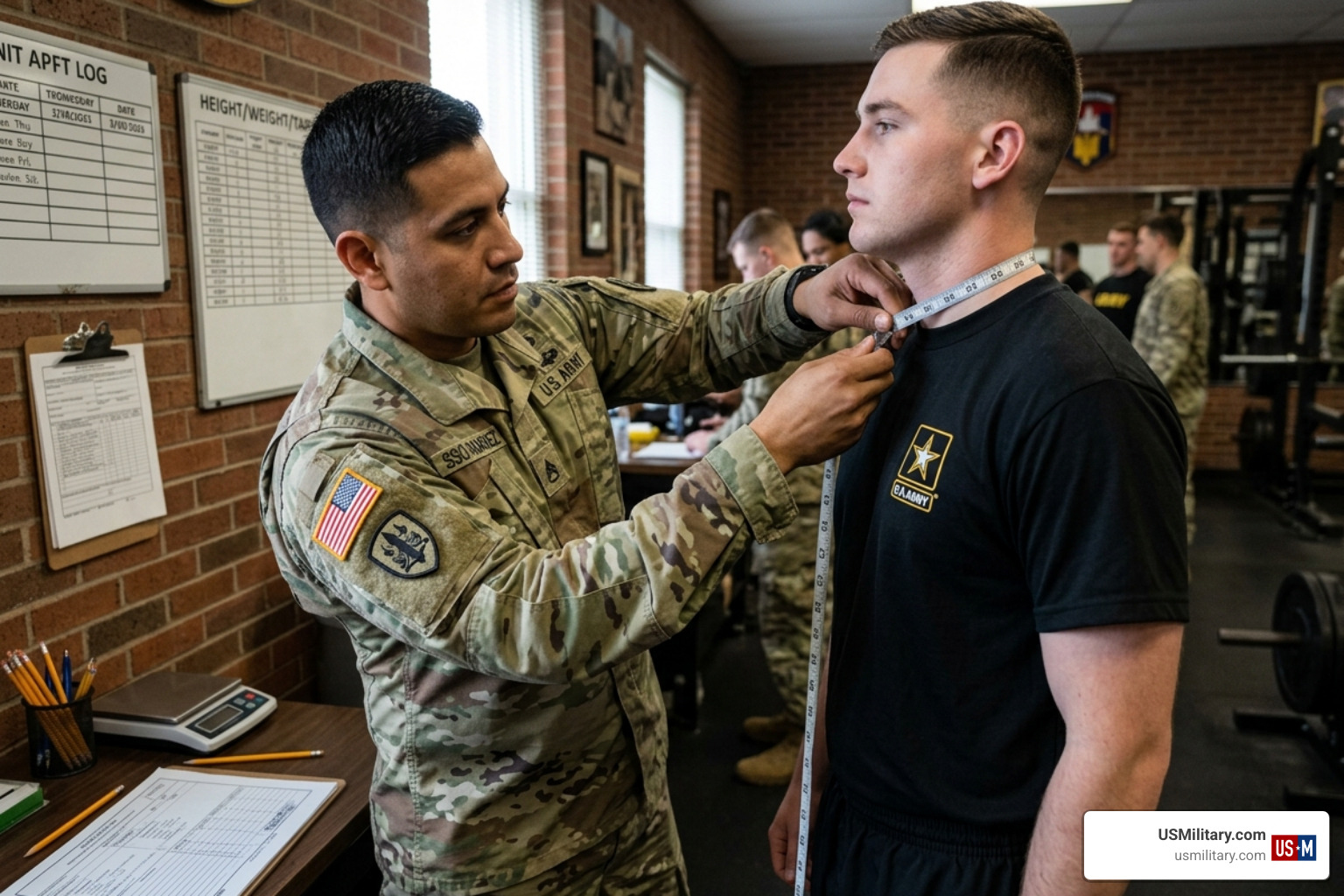
So, what happens if the scale says you’re over the limit? In the civilian world, “overweight” is often a final judgment. In the military, it’s just the beginning of a more detailed look. If you exceed the screening weight for your height and age, you will undergo a body fat assessment, commonly known as the “tape test.”
The procedure for the tape test has been simplified recently. Currently, the Army uses a one-site circumference-based measurement. For males, this involves a measurement around the abdomen at the navel. For females, the measurement is also taken at the waist. This data is then plugged into a formula to estimate your body fat percentage. While no method is 100% perfect, the Army relies on this system as the official standard under The Army Body Composition Program.
Maximum Allowable Body Fat Percentages
The maximum allowable body fat percentages are more generous than the weight tables because they account for muscle mass. Here is how the thresholds break down for 2026:
- Males: 17–27 years (26%), 28–39 years (28%), 40+ years (30%).
- Females: 17–27 years (32%), 28–39 years (34%), 40+ years (36%).
The Department of Defense (DoD) sets an overarching goal of 18% for men and 26% for women, but the Army allows for the higher percentages listed above to accommodate various body types. To ensure fairness, measurements must be taken by trained personnel of the same gender whenever possible. If you pass the tape test, you are considered “in standards,” even if you are 20 pounds over the screening table weight.
Navigating the Army Body Composition Program (ABCP)
If you exceed both the weight table and the body fat percentage for your age, you will be enrolled in the Army Body Composition Program (ABCP). We know—the word “enrolled” makes it sound like a fun club, but it’s actually a formal administrative process designed to get you back into fighting shape.
Once enrolled, you will be “flagged.” This administrative action prevents you from attending professional schools, getting promoted, or reenlisting until you meet the standards again. However, the Army doesn’t just leave you to figure it out on your own. You’ll receive nutritional counseling, a medical evaluation to rule out underlying conditions, and help developing a Soldier Action Plan.
To remain in good standing while in the ABCP, you must show “satisfactory progress.” The Army defines this as:
- A loss of 3 to 8 pounds per month, OR
- A 1% reduction in body fat per month.
Failure to meet these goals for three non-consecutive months can lead to serious career consequences. On a brighter note, new recruits are given a 180-day grace period from their entry date to meet retention standards before they can be officially enrolled in ABCP.
Consequences of Failing to Meet Standards
We have to be honest: the consequences of failing the army standard for height and weight are significant. A “flag” is a major hurdle in a military career. It stops your career progression dead in its tracks. You can’t receive awards, you can’t be promoted to the next rank, and you won’t be allowed to transfer to “cool” assignments like Airborne or Ranger school.
If a soldier fails to make progress in the ABCP, the commander is required to initiate administrative separation (discharge) or a bar to reenlistment. The Army invests a lot of money in your training, and they want to keep you, but physical readiness is non-negotiable for national security.
Preparation Tips for Recruits and Active Duty
Whether you are a civilian looking to join or a soldier trying to stay off the “fat boy program” (as it’s colloquially known), preparation is key. If you’re a recruit who is slightly over the limit, you might be eligible for the Future Soldier Preparatory Course at Fort Jackson. This 90-day program has a 90% success rate and helps recruits lose up to 8% body fat before they even start Basic Training.
For everyone else, here are the gold standards for staying in compliance:
- Hydration: Drink at least 8 glasses of water a day. Dehydration can lead to water retention and poor performance.
- Portion Control: Use smaller plates and ensure half of your plate is filled with vegetables.
- Consistent Monitoring: Don’t wait for the semi-annual weigh-in. Use an Army height and weight calculator monthly to see where you stand.
- Strength Training: Focus on compound movements like squats and deadlifts. More muscle mass increases your metabolic rate, making it easier to keep the fat off.
Recommended Preparation Exercises:
- Push-ups: Aim for at least 42 (male) or 19 (female) to build upper body endurance.
- Planks and Leg Raises: A strong core is essential for a good tape measurement.
- Interval Training: Mix 30-second sprints with 60-second walks to torch calories faster than steady-state running.
Frequently Asked Questions about Army Standards
What happens if I exceed the maximum weight for my height?
If you exceed the weight on the screening table, you will immediately be measured for body fat using the tape test. If your body fat percentage is within the allowable limit for your age, you are good to go! If you exceed the body fat limit as a recruit, you may be sent to the Future Soldier Preparatory Course. If you are already active duty, you will be enrolled in the ABCP.
Are there exemptions for high-performing athletes?
Yes! As of 2025-2026, if you score a 465 or higher on the AFT (with at least 80 points in each event), you are exempt from the body fat assessment. This is a huge win for muscular soldiers who previously struggled with the tape test despite being in peak physical condition. Medical waivers are also available for specific conditions like pregnancy or recovery from surgery.
How often are soldiers required to be weighed?
Soldiers are screened for height and weight at least once every six months. However, commanders can direct a weigh-in at any time if they feel a soldier does not present a professional military appearance. Weigh-ins are also required before attending military schools or being considered for promotion.
Conclusion
The Army standard for height and weight is about more than just looking good in a uniform; it’s about being a lethal, resilient, and capable member of the world’s finest fighting force. Whether you are just starting your journey at MEPS or you are a seasoned NCO, staying within these standards is a vital part of your professional development.
At USMilitary.com, we are dedicated to being your central hub for military-related guidance. From understanding your VA benefits to navigating the latest changes in Army policy, we are here to support our service members and veterans. Staying fit is a lifelong mission—let’s make sure you’re ready for whatever comes next.