
Here’s What You Need to Know First
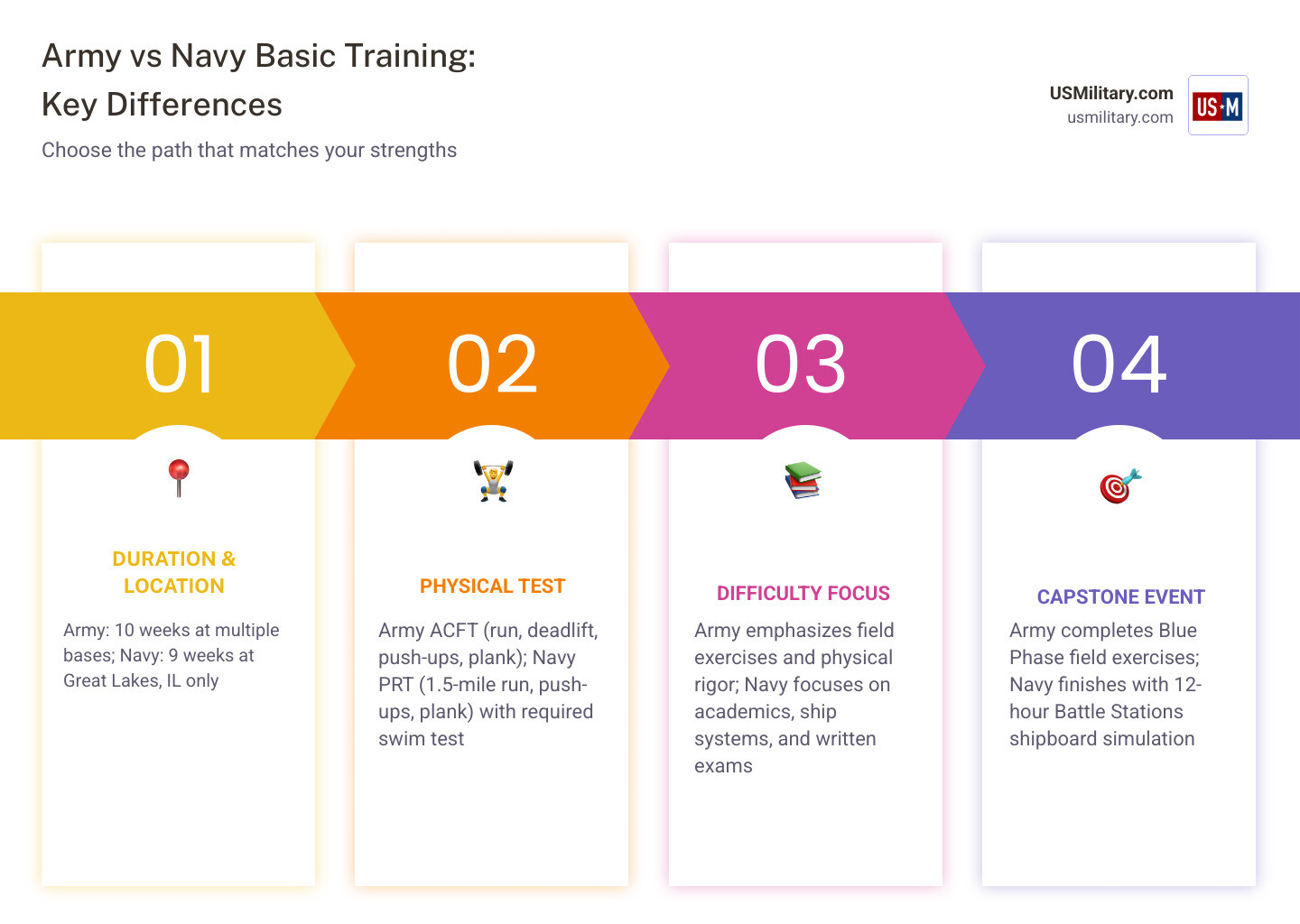
When comparing army vs navy basic training, the short answer is: it depends on your strengths. The Army is harder physically. The Navy is harder academically. Neither is easy.
Here is a quick side-by-side to answer the most common questions:
| Category | Army Basic Training | Navy Boot Camp |
|---|---|---|
| Duration | 10 weeks | 9 weeks |
| Location | Multiple U.S. bases | Great Lakes, IL only |
| Physical Test | ACFT (run, deadlift, push-ups, plank, more) | PRT (1.5-mile run, push-ups, plank) |
| Swim Requirement | Minimal | Required — must pass to graduate |
| Academic Load | Moderate | High (ship systems, damage control, exams) |
| Capstone Event | Blue Phase field exercises | Battle Stations (12-hour shipboard simulation) |
| Physical Difficulty | Very High | Moderate-High |
| Mental/Academic Difficulty | Moderate | High |
Every year, thousands of people trying to decide between the two branches want to know which training is tougher. The honest answer is that both will challenge you — just in very different ways. If you hate running and rucking in the mud, the Army will feel brutal. If you can’t swim or struggle with written tests, the Navy will feel brutal.
Understanding the real differences before you ship out can help you prepare smarter and choose the right branch for your strengths.
I’m Larry Fowler, publisher of USMilitary.com, and I’ve spent nearly two decades helping recruits, active-duty members, and veterans navigate exactly these kinds of decisions — including the army vs navy basic training question that comes up constantly among prospective enlistees. Let’s break it all down so you know exactly what to expect.
If we strip away the myths, the yelling, and the internet comment-section bravado, the biggest difference is simple:
- Army basic training is more field-focused and physically punishing
- Navy boot camp is more controlled, more technical, and more academic
- The Navy adds a swim requirement that changes everything for weak swimmers
- The Army spends more time on combat tasks, weapons, land movement, and outdoor hardship
Here is the practical takeaway: the Army usually feels harder on your body, while the Navy often feels harder on your brain and nerves.
| Factor | Army | Navy |
|---|---|---|
| Running endurance | Higher emphasis | Moderate emphasis |
| Rucking and field time | Heavy emphasis | Limited |
| Swimming | Little emphasis | Essential |
| Classroom testing | Moderate | Heavier |
| Tactical combat skills | Major focus | Limited |
| Shipboard emergency training | Minimal | Major focus |
| Weather exposure | Frequent | Lower overall |
Is Army vs. Navy basic training a question of physical or overall difficulty?
That is really the heart of the debate. Many people ask which branch is “harder” as if there is one scoreboard. There is not.
If we only judge physical punishment, the Army usually wins that contest. Recruits deal with more running volume, more field problems, more time carrying gear, and more discomfort outdoors.
If we judge overall pressure, the answer gets more personal. Navy recruits may not ruck as much, but they still face constant inspections, learning, close-quarters living, and mandatory water survival skills. For someone who is uncomfortable in water, Navy boot camp can go from “not too bad” to “please get me off this pool deck” very quickly.
The short verdict on whether Navy boot camp is easier than the Army
Our honest verdict in 2026:
- Army basic training is generally harder physically
- Navy boot camp is generally harder academically and for non-swimmers
- Neither branch is universally easier
- The best fit depends on whether you are better at endurance, outdoor hardship, technical learning, and water confidence
If you want a broader branch comparison beyond boot camp alone, see Army Vs Navy Which Is Best For You.
Army vs Navy Basic Training: Duration, Locations, and Training Structure
One reason this comparison matters is that the two branches build recruits in very different environments.
How long is army vs navy basic training in 2026?
As of 2026:
- Army Basic Combat Training lasts 10 weeks
- Navy boot camp lasts 9 weeks
That week difference is not huge on paper, but it matters. An extra week of Army training often means more time building field skills, discipline, weapons proficiency, and physical endurance.
Both branches also include reception or processing tasks at the front end. That means your first days are not all dramatic obstacle courses and heroic music. They are often paperwork, immunizations, gear issue, haircuts, medical checks, and learning how fast life can move when someone else controls the schedule.
Where Army and Navy recruits go for basic training
Army recruits can be sent to several U.S. training locations, including:
- Fort Jackson, South Carolina
- Fort Leonard Wood, Missouri
- Fort Sill, Oklahoma
- Fort Benning, Georgia
- Fort Knox, Kentucky
Navy recruits all go to one place:
- Recruit Training Command, Great Lakes, Illinois
That single-site Navy model creates a more standardized experience. Army training can feel slightly different depending on the installation, climate, and training focus. Great Lakes gives the Navy one central pipeline.
For a general branch overview, Boot Camp overview is a useful reference.
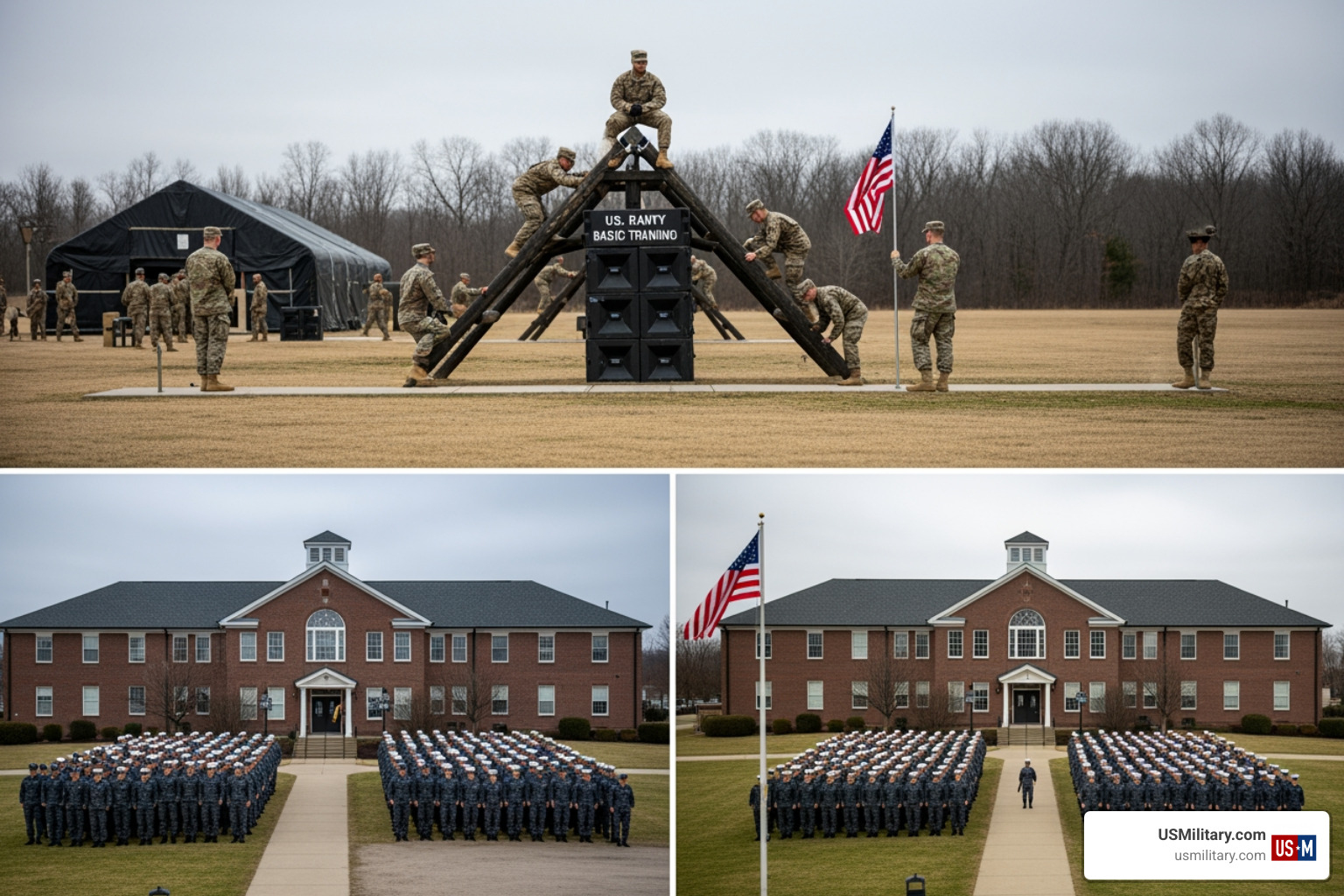
Climate matters more than some people expect. Army recruits may deal with heat, cold, rain, mud, and long outdoor days depending on season and location. Navy recruits at Great Lakes still face stress and physical demands, but much more of training happens in structured facilities rather than prolonged field conditions.
Key phases and weeks of Army and Navy basic training
Army basic training is commonly described in phases:
- Yellow Phase
- Red Phase
- White Phase
- Blue Phase
In simple terms:
- Yellow Phase starts the transition from civilian life
- Red Phase emphasizes discipline, fitness, drill, and initial soldier skills
- White Phase builds marksmanship, confidence, and tactical training
- Blue Phase focuses on field application, teamwork, and final testing
You can learn more in our Army Boot Camp guide.
Navy boot camp also moves week by week, though the language is less color-coded. It generally includes:
- Initial processing
- Early indoctrination and military basics
- Seamanship and core Navy instruction
- Hands-on firefighting, damage control, and shipboard skills
- Final evaluations and Battle Stations
- Graduation, often called Pass-in-Review
Our Navy Boot Camp page covers that path in more detail.
The Navy’s capstone event is Battle Stations, a roughly 12-hour final evaluation built around multiple shipboard scenarios. It is one of the clearest examples of how Navy boot camp is designed around fleet life rather than land combat.
Physical Fitness and Daily Life: PT, Running, Rucking, and Swimming
This is where the comparison gets real fast.
How Army and Navy fitness requirements compare before graduation
Army recruits train toward the Army Combat Fitness Test, or ACFT. The research highlights these major events:
- 2-mile run
- Deadlift
- Standing power throw
- Hand-release push-ups
- Sprint-drag-carry
- Plank
That is a broad test of endurance, power, muscular stamina, and work capacity. It rewards all-around fitness, not just jogging ability.
Navy recruits work toward the Physical Readiness Test, or PRT, which centers on:
- Push-ups
- Plank
- 1.5-mile run
For ages 17 to 19, the research notes these Navy standards:
- Male push-ups: 46 in 2 minutes
- Female push-ups: 20 in 2 minutes
- Male 1.5-mile run: 12:15
- Female 1.5-mile run: 14:45
On paper, the Navy test looks simpler. In practice, the swim requirement and strict standards still trip people up.
Daily routines, PT volume, and what a normal day feels like
Both branches run on early mornings, tight timelines, inspections, and the constant feeling that you are somehow behind even when you are exactly on time.
A typical training day in either branch usually includes:
- Early wake-up
- Personal hygiene and fast compartment or bay cleanup
- Chow
- PT or drill
- Instruction blocks
- More drill, skills training, or inspections
- Evening routines and prep for the next day
The difference is what fills those training blocks.
Army days tend to include more outdoor movement, tactical instruction, weapons work, and physically tiring field tasks. Navy days tend to include more classroom learning, compartment standards, shipboard instruction, and practical emergency-response training.
Sleep is limited in both. Meals are fast in both. And yes, “relaxing” is not really on the menu.
Why swimming changes the answer for many recruits
This is the biggest wildcard in the whole army vs navy basic training conversation.
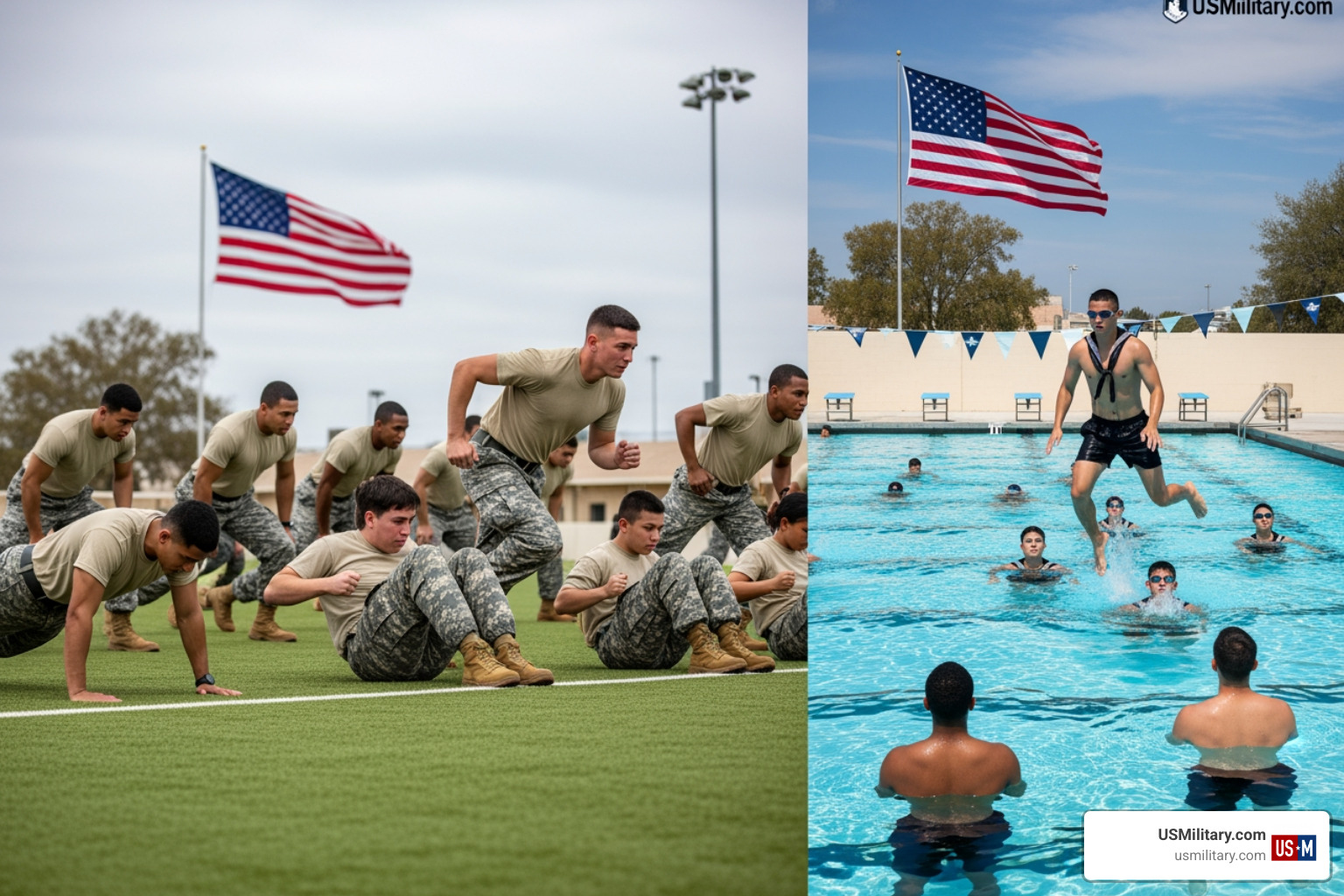
Navy recruits must pass a swim test to graduate. According to the research, that includes:
- A 50-yard swim
- A 5-minute prone float
- Clothing inflation or related water survival skills
The important point is this: you do not have to arrive as a great swimmer, but you do have to leave able to meet the standard.
For confident swimmers, this is just one more task. For weak swimmers, it can become the hardest part of boot camp. Water confidence is different from gym fitness. Someone who crushes push-ups may still panic in the pool.
Army training generally does not put the same weight on swimming. So if you are physically fit but uncomfortable in water, the Army may feel more manageable in that one category.
Living conditions, inspections, discipline, and stress levels
Army and Navy recruits both live under close supervision, but the environments feel different.
Navy recruits live in large barracks spaces often referred to as “ships.” These are climate-controlled and highly organized. That does not make them easy. It just means the hardship is more about precision, cleanliness, time pressure, and constant correction.
Army recruits often spend more time in open-bay barracks plus outdoor training areas and field environments. Weather exposure becomes part of the training experience. Mud, rain, cold mornings, and carrying gear can wear people down fast.
Discipline in both branches is strict. The style differs:
- Army drill sergeants emphasize urgency, toughness, and combat readiness
- Navy RDCs emphasize precision, order, military bearing, and shipboard standards
Both branches use confidence chamber training with CS gas, according to the research. That is memorable in the worst way, but it is part of learning confidence under stress.
Mental, Academic, and Technical Demands
People often underestimate how much learning happens in basic training. It is not just exercise with louder instructions.
Why Navy boot camp often feels harder mentally and academically
Navy boot camp asks recruits to absorb a lot of branch-specific knowledge quickly. That includes:
- Rank structure and chain of command
- Navy customs and heritage
- The 11 General Orders of a Sentry
- Core values
- Basic shipboard organization
- Firefighting concepts
- Damage control
- Seamanship basics
The research also points to written tests and inspection-heavy standards. Precision matters. Folding gear correctly matters. Stowing items correctly matters. Knowing the right answer when called on matters.
That combination can feel mentally exhausting, especially for recruits who do not enjoy classroom learning or memorization.
Why Army basic training often feels harder physically and tactically
Army basic training is not light on mental stress, but its mental challenge is usually tied more closely to physical discomfort and tactical performance.
Army recruits spend more time on:
- Marksmanship
- Field exercises
- Battle drills
- Land navigation or map-related basics
- Team movement
- Obstacle and confidence events
- Endurance under rough conditions
In other words, the Army often teaches through doing while tired, dirty, and under pressure. That is a different kind of mental load. Less desk, more dirt.
If you want a useful comparison of PT culture and test expectations, our The Truth About Army And Marine Corps Pt Tests article adds helpful context.
What recruits are allowed or prohibited from bringing
This is one area where people overpack and regret it immediately.
In both branches, recruits should generally bring essentials such as:
- Government-issued photo ID
- Social Security card
- Orders and required paperwork
- Prescription medications in original packaging
- Limited hygiene basics if instructed
- Banking information if needed
- Required medical or immunization records
Common prohibited or restricted items include:
- Weapons of any kind
- Tobacco or nicotine products
- Alcohol
- Nonprescription drugs
- Obscene material
- Gambling items
- Large amounts of cash
- Expensive jewelry
- Unapproved food or candy
- Most unnecessary electronics or valuables
The exact list can change, so always confirm with your recruiter and official branch guidance. A good general prep resource is Military basic training resources.
A quick practical list:
Must-bring basics
- ID documents
- Social Security card
- Orders
- Prescription eyewear or meds
- Small amount of cash if allowed
- Personal contact info
Leave-at-home items
- Fancy watches
- Extra clothes
- Sentimental valuables
- Tobacco and vapes
- Snacks
- Anything you would be sad to lose
Rule of thumb: if it makes life more comfortable, there is a decent chance basic training does not want it.
What Happens After Graduation and How to Choose the Better Fit
Basic training is only the start. What happens next should matter just as much as what happens during those first weeks.
After Army basic training: AIT, OSUT, and first assignments
After Army basic training, most recruits move to Advanced Individual Training, or AIT, where they learn their Military Occupational Specialty.
Some career fields use OSUT, or One Station Unit Training, which combines basic training and job training into one longer pipeline. Infantry is the classic example.
After that, recruits receive orders to:
- An active-duty unit
- A Reserve unit
- A National Guard unit
The exact path depends on contract type and job. For a closer look at infantry follow-on life, see Day In The Life Of Army Infantry Training.
After Navy boot camp: A School and fleet life
After Navy boot camp, many Sailors go to A School, where they learn the technical skills tied to their rating, which is the Navy term for job field.
Depending on the rating, a Sailor may go to:
- Immediate A School
- A holding period before class starts
- A direct assignment if that career path does not require lengthy schooling
After training, they head to a first command, which could be:
- A ship
- A shore installation
- A support command
- Another training pipeline
This is one reason some recruits accept a more academic boot camp: the Navy often leads directly into technical training that is just as structured.
How to prepare for Army or Navy basic training without guessing
This is where smart preparation beats internet mythology every time.
If you are preparing for the Army, focus on:
- Running endurance
- Leg strength
- Core strength
- Carrying load safely
- Recovery from high-volume physical work
- Comfort exercising outdoors in bad weather
If you are preparing for the Navy, focus on:
- 1.5-mile run pace
- Push-ups and planks
- Water confidence and basic swim ability
- Memorization and test readiness
- Attention to detail
For both branches:
- Handle personal affairs before shipping out
- Set up bill pay and family contacts
- Fix sleep habits early
- Arrive as fit as possible
- Learn rank structure, customs, and basic terminology
- Ask your recruiter for the current packing list
- Expect limited communication, especially early on
If you are also comparing other branches, these may help:
- What To Expect Air Force Basic Training
- Which Military Branch Has The Easist Bootcamp
- Air Force Vs Navy
Frequently Asked Questions About Army vs Navy Basic Training
Is Navy boot camp easier than Army basic training for most people?
For most people, Navy boot camp is easier physically but not necessarily easier overall.
Choose that answer carefully, though. If someone is a strong runner, likes outdoor training, and hates water, the Navy may actually feel harder. If someone is a good swimmer, learns fast in class, and dislikes rucking, the Navy may feel more manageable than the Army.
So the better answer is:
- Easier physically for many people: Navy
- Easier overall for everyone: no
Do both Army and Navy basic training use gas chamber training?
Yes. The research indicates both branches use confidence chamber training with CS gas.
The point is not misery for its own sake, even if it may feel that way in the moment. It is designed to build trust in protective equipment and teach recruits to function under stress.
Which branch should you choose if you want the best fit, not just the easiest boot camp?
Choose based on the life you want after training.
Ask yourself:
- Do we want land-based combat-oriented training and a wider range of Army-style jobs?
- Do we prefer shipboard life, technical ratings, and Navy culture?
- Are we more comfortable in field conditions or structured indoor environments?
- Are we okay with required swim qualification?
- Do we want a branch where academics play a larger role right away?
Boot camp is temporary. Your branch culture, job, duty stations, and long-term lifestyle last much longer.
If you are still comparing service paths, these related reads may help:
Conclusion
So, is Navy boot camp actually easier than the Army?
Usually, it is easier on the body and harder on the brain. The Army tends to be the tougher choice for raw physical grind, field time, and outdoor hardship. The Navy tends to be tougher for swimming, precision, inspections, and academic pressure.
That means the smartest question is not “Which boot camp is easiest?” It is “Which branch fits me best?”
If we prepare honestly, train for the right challenges, and choose based on long-term goals instead of short-term fear, we give ourselves a much better shot at success.
For a broader comparison across branches, visit More info about x services.