
How to become an army ranger is a question that requires understanding two distinct paths: earning the Ranger Tab through Ranger School or serving in the elite 75th Ranger Regiment. Here’s the quick answer:
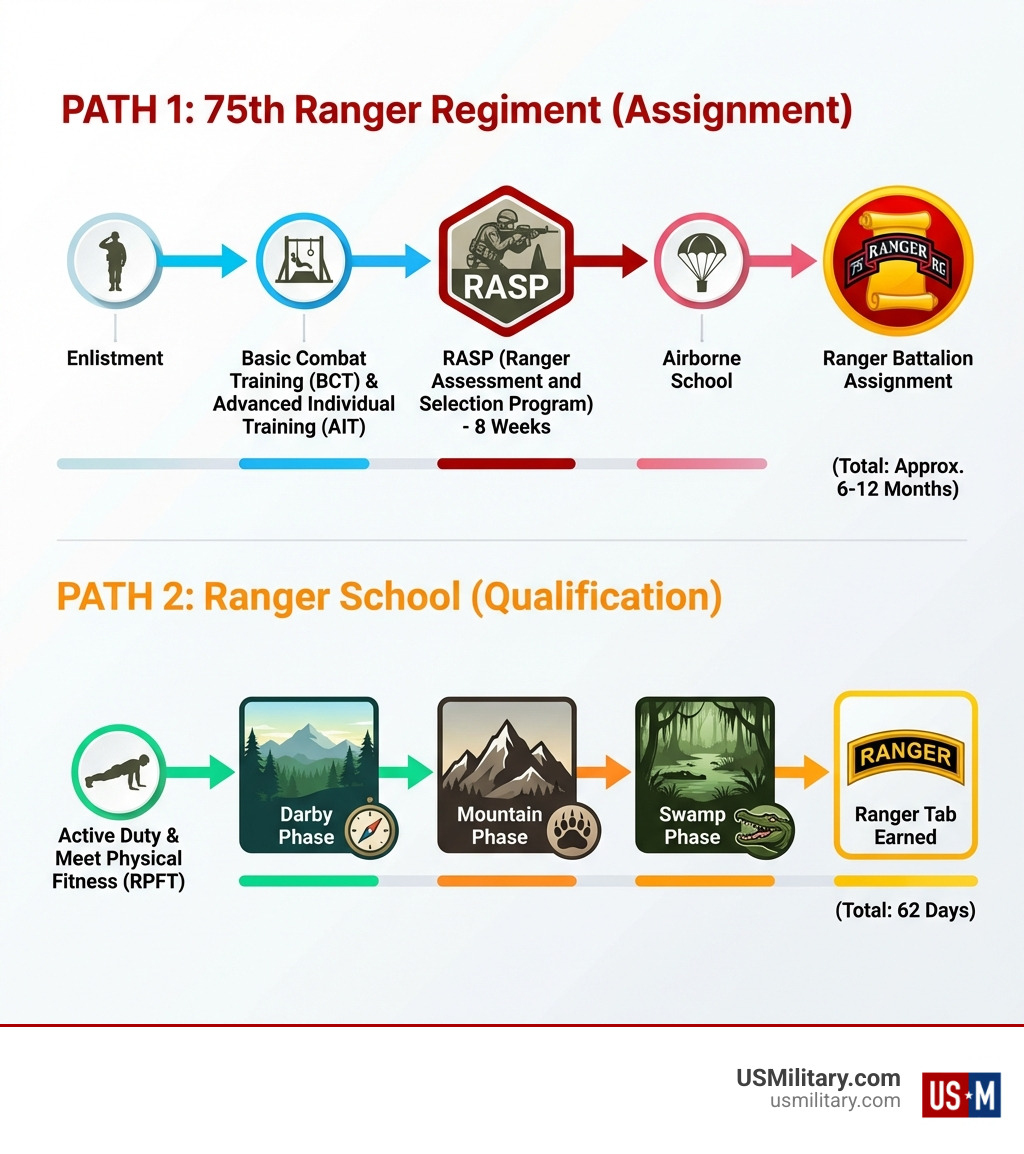
Path to the 75th Ranger Regiment:
- Meet basic requirements (U.S. citizen, Active Duty, GT score 105+)
- Complete Basic Combat Training (BCT) and Advanced Individual Training (AIT)
- Pass Ranger Assessment and Selection Program (RASP) – 8 weeks
- Complete Airborne School
- Receive assignment to one of three Ranger Battalions
Path to Ranger School (Ranger Tab):
- Be on Active Duty in any branch
- Meet physical fitness standards (RPFT)
- Attend 62-day Ranger School at Fort Benning
- Complete three phases: Darby, Mountain, and Swamp
- Graduate and earn the Ranger Tab
Army Rangers represent the pinnacle of military service. The 75th Ranger Regiment operates as an elite Special Operations force conducting direct-action raids, airfield seizures, and special reconnaissance missions. They embody the motto “Rangers Lead the Way” – a tradition born on Omaha Beach during D-Day and proven in conflicts from Mogadishu to Afghanistan.
The journey demands exceptional physical fitness, mental toughness, and unwavering commitment. Whether you’re pursuing the prestigious Ranger Tab through the grueling 62-day leadership course or seeking assignment to the Regiment itself through RASP, the standards remain extraordinarily high. These warriors are capable of deploying anywhere in the world with just 18 hours’ notice.
The physical demands are extreme. During training, candidates face sleep deprivation (averaging 3.5 hours per night), severe calorie restriction (approximately 2,200 calories daily while burning thousands more), and constant physical challenges including 12-mile ruck marches carrying 65-90 pounds of equipment. Historically, graduation rates hover around 50%, with many candidates recycling through phases multiple times before succeeding.
I’m Larry Fowler, publisher of the USMilitary.com Network, and since 2007 I’ve helped thousands of service members and veterans steer military career paths, including how to become an army ranger, through accurate, up-to-date information from official sources and accounts. This guide synthesizes official Army recruiting data, historical records, and current requirements to provide you with a complete roadmap to Ranger qualification.
What is an Army Ranger? The Difference Between the Tab and the Scroll
When we talk about an “Army Ranger,” it’s easy for confusion to creep in. Many people use the term interchangeably, but there’s a crucial distinction. We’re actually discussing two related, but distinct, concepts: earning the coveted Ranger Tab and serving in the elite 75th Ranger Regiment, which awards the Ranger Scroll. One is a qualification, the other is an assignment to a specific unit. Let’s break it down.
The 75th Ranger Regiment: An Elite Special Operations Force
The 75th Ranger Regiment is a premier light infantry special operations unit within the U.S. Army. If you’re looking to serve in a unit that epitomizes the phrase “Rangers Lead the Way,” this is it. These are the warriors who conduct complex, high-stakes missions, often under the cover of darkness and with little notice. Their primary mission involves direct-action operations, special operations raids, airfield seizures, and special reconnaissance deep inside enemy territory.
Being a member of the 75th Ranger Regiment is more than just a job; it’s a way of life defined by unwavering commitment, rigorous training, and a constant state of readiness. The Ranger Creed, which we’ll explore later, isn’t just words—it’s the guiding principle for every Ranger in this elite force. These units are capable of deploying anywhere in the world with just 18 hours’ notice, a testament to their readiness and lethality.
Ranger School: The Army’s Premier Leadership Course
Ranger School, on the other hand, is a 62-day leadership course administered by the U.S. Army Training and Doctrine Command (TRADOC). Its purpose is to develop functional skills for units engaged in close combat and direct fire battles. When soldiers graduate from Ranger School, they earn the Ranger Tab, a small but powerful piece of cloth that signifies they’ve completed one of the toughest leadership courses in the world.
Earning the Ranger Tab is a qualification, not an assignment. It means you’ve demonstrated the leadership, physical endurance, and mental fortitude required to lead small unit tactics under extreme stress. While it’s a mandatory requirement for officers and NCOs assigned to the 75th Ranger Regiment, it’s also open to qualified personnel from other U.S. military branches, including the Marine Corps, Air Force, Navy, and Space Force, as well as allied nations.
Here’s a quick comparison to clarify the difference:
| Feature | Ranger School | 75th Ranger Regiment |
|---|---|---|
| Purpose | Leadership training, small unit tactics | Special Operations missions, direct action |
| Length | 62 days | Continuous assignment (after 8-week RASP) |
| Outcome | Ranger Tab | Ranger Scroll (unit membership) & Tan Beret |
| Who Attends | Any qualified service member (various ranks/MOSs) | Soldiers specifically selected for Ranger battalions |
| Affiliation | TRADOC (training course) | U.S. Army Special Operations Command (SOCOM) |
| Primary Goal | Earn a qualification | Serve in an elite combat unit |
The Path to the 75th Ranger Regiment: How to Become an Army Ranger
So, you’ve decided you want to be part of the best. You’re ready to learn how to become an army ranger and wear that distinctive tan beret. For those aiming to join the 75th Ranger Regiment, the journey is demanding but incredibly rewarding. It involves meeting stringent eligibility requirements and successfully navigating the Ranger Assessment and Selection Program (RASP). This path is open to enlisted soldiers, officers, and warrant officers, typically through an in-service volunteer process or, for new recruits, via an Option 40 contract.
Basic Eligibility Requirements
Before we even get to the specialized training, there are fundamental criteria everyone must meet. Think of these as your entry ticket to even consider becoming a Ranger.
- U.S. Citizen: This is non-negotiable. You must be a U.S. citizen to join the 75th Ranger Regiment.
- Active Duty Status: All applicants must be serving on active duty in the U.S. Army and volunteer for assignment to the Regiment.
- ASVAB General Technical (GT) Score: Enlisted soldiers typically need a GT score of 105 or higher. For the Regiment, a GT score of 100 or higher is generally required, though waivers can be considered.
- Secret Security Clearance: A minimum Secret clearance is required. For officers, a Top Secret clearance is often needed.
- Airborne Qualification: You must qualify for and volunteer to attend the Basic Airborne Course. If you’re not already Airborne qualified, you’ll go after RASP.
- Physical Standards (PULHES): A PULHES physical profile of 111221 or better is typically required, indicating no significant physical limitations.
- Character Requirements: We’re looking for individuals of impeccable character. This means no pending Uniform Code of Military Justice (UCMJ) actions and no drug or alcohol-related incidents within the last 24 months.
The Gateway: Ranger Assessment and Selection Program (RASP)
The Ranger Assessment and Selection Program (RASP) is the mandatory 8-week gateway to the 75th Ranger Regiment, held at Fort Benning, Georgia. This course replaced the Ranger Indoctrination Program (RIP) and Ranger Orientation Program (ROP) to provide a more comprehensive assessment. It’s designed to push you to your limits, physically and mentally, and ensure you possess the attributes necessary for service in the Regiment.
RASP is divided into two levels:
- RASP 1: This is for junior noncommissioned officers and enlisted soldiers (pay grades E-1 through E-5). Many fresh recruits who complete Basic Combat Training (BCT) and Advanced Individual Training (AIT) will attend RASP 1 before joining a Ranger Battalion.
- RASP 2: This level is for senior noncommissioned officers, officers, and warrant officers.
During RASP, you’ll face a gauntlet of physical tests designed not just to measure strength, but sustained endurance under duress. Expect events like:
- An 800-meter run
- 30 dead-stop push-ups
- A 100-meter sprint
- Lifting 16 40-pound sandbags onto a 68-inch platform
- A 50-meter farmer’s carry with two 40-pound water cans
- A 50-meter movement drill (25m high crawl, 25m rush)
- Another 800-meter run, all within 14 minutes.
- Followed by a four-mile run in 32 minutes and six chin-ups.
Beyond the physical, RASP is a masterclass in mental toughness. You’ll experience rigorous “smoke” sessions – intense physical training used for corrective action and instruction – and operate in an “environment of the unknown” that constantly tests your adaptability and resilience. Training areas like Cole Range are specifically designed to push you to your breaking point. Phase 2 of RASP also includes vital skills like marksmanship, breaching, and fostering superior teamwork.
Application Process for Enlisted, Officers, and Warrant Officers
So, how does one actually apply?
- Enlisted Soldiers: Your first step is often to speak with an Army Recruiter. If you’re already in the Army, you’ll work with your unit’s career counselor. You’ll need to submit your Soldier Record Brief (SRB) to the Regiment’s recruiting detachment.
- Officers and Warrant Officers: The process is a bit more involved. You’ll typically apply through the AIM 2.0 portal (https://aim.hrc.army.mil). Key components of an officer application include:
- A One-Page Letter of Intent.
- Letters of Recommendation (minimum from Rater and Senior Rater).
- All Officer Evaluation Reports (OERs) and Academic Evaluation Reports (AERs).
- Current APFT or ACFT Score Card.
- A DA Form 4187 endorsed by your Brigade Commander or first O6 in your Chain of Command.
- A completed RASP 2 Pre-Screening Questionnaire.
- A current Ranger Physical (within 18 months, stamped ‘AIRBORNE RANGER’).
Officers also need to consider branch manager concurrence and time on station requirements (minimum 12 months for PCS). The Regiment looks for a minimum of 18-24 months of utilization time from its officers. If attending your next Professional Military Education (PME) would prevent this, your application might be rejected.
For the most up-to-date information and to submit inquiries, we recommend contacting the official recruiting channels:
- Enlisted: 75recruit@socom.mil
- Officer: 75officerrecruit@socom.mil
- You can also find more details and official forms at the Official recruiting information page.
Conquering Ranger School: The Premier Leadership Gauntlet
Whether you’re an aspiring 75th Ranger Regiment member or simply seeking the ultimate leadership challenge, Ranger School is a crucible unlike any other. This 62-day course, administered by TRADOC, is renowned for its intensity and its ability to forge leaders capable of operating under the most extreme conditions. It’s a test of grit, ingenuity, and small unit tactics, with a historical graduation rate hovering around 50%.
The Grueling Phases of Ranger School
Ranger School is broken down into three distinct phases, each designed to test different skill sets and mental resolve in varying environments:
- Darby Phase (Fort Benning, Georgia): Often called the “Benning Phase,” this initial stage focuses on developing your physical and mental toughness, along with fundamental Ranger skills. You’ll be tested on land navigation, patrolling techniques, and basic combat operations. This phase includes the infamous Malvesti Field Obstacle Course and the “Darby Queen” obstacle course. The Ranger Assessment Phase (RAP) at the beginning of Darby historically accounts for 60% of student failures, emphasizing its brutal efficiency.
- Mountain Phase (Dahlonega, Georgia): Here, the training shifts to the rugged terrain of the Appalachian Mountains. This phase is all about military mountaineering, including knot tying, belaying, climbing, and rappelling (abseiling). You’ll conduct complex combat patrol missions, often under cold weather conditions, emphasizing leadership in a difficult, unforgiving environment.
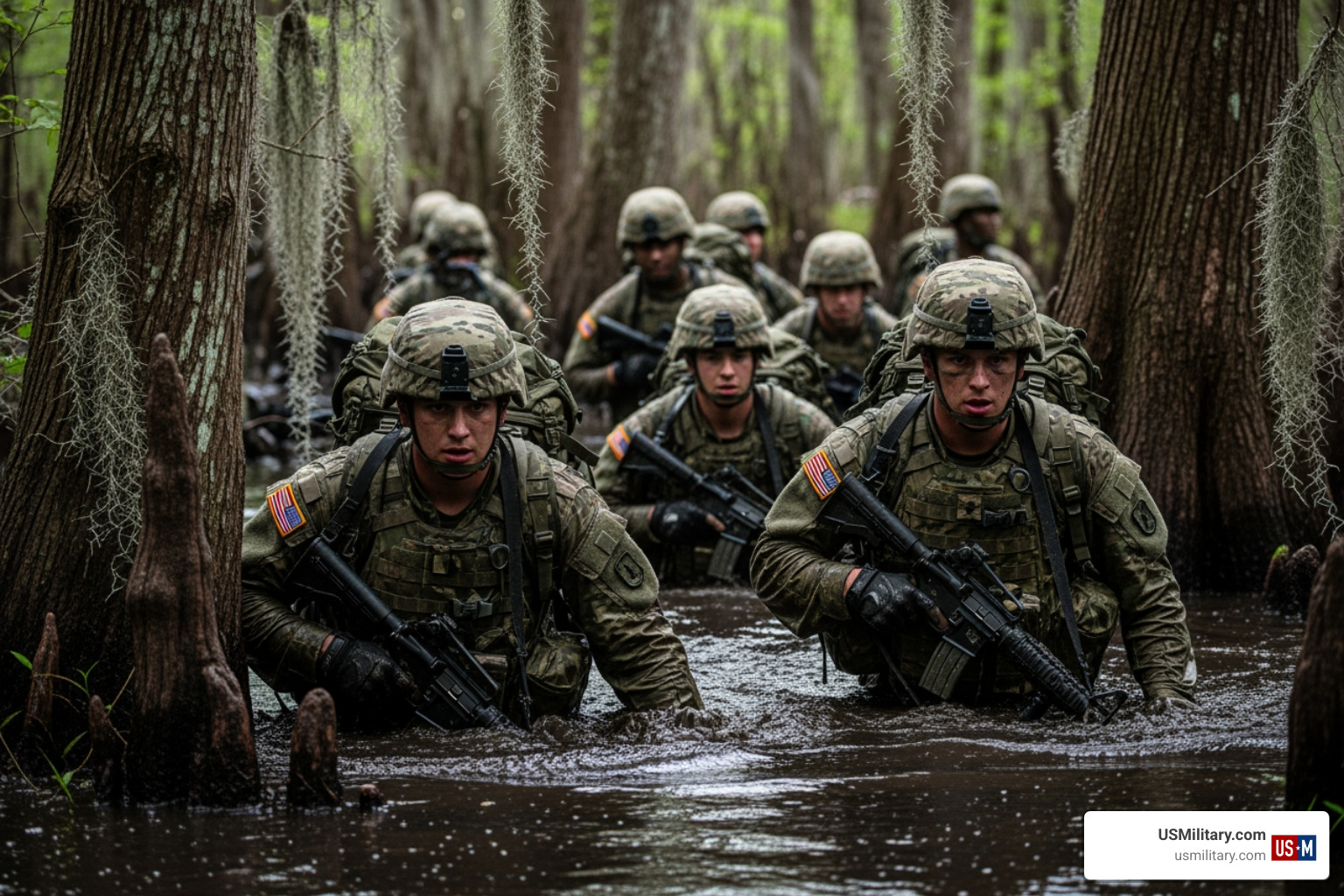
- Swamp Phase (Eglin Air Force Base, Florida): The final phase takes you to the coastal swamps and bayous of Florida. This is where you’ll face the challenges of waterborne operations, small boat movements, and navigating through dense, unforgiving terrain. Raids and ambushes are conducted in this environment, pushing students to their physical and mental limits through prolonged exposure to harsh conditions and sleep deprivation. It’s not uncommon for students to experience hypothermia here.
Surviving the Physical and Mental Gauntlet
Ranger School is not just physically demanding; it’s a profound test of your mental and emotional resilience.
- Ranger Physical Fitness Test (RPFT): The traditional RPFT requires a minimum of 49 push-ups in 2 minutes, 59 sit-ups in 2 minutes, 6 pull-ups, and a 5-mile run in 40 minutes or less.
- 12-mile Ruck March: A critical test is completing a 12-mile ruck march with a 35-pound rucksack (plus water and weapons) in under 3 hours. This is a common hurdle where many fall short.
- Combat Water Survival Test (CWST): This involves a 35-foot tower jump and demonstrates your ability to operate in and around water.
- Sleep and Calorie Deprivation: Prepare for minimal sleep, averaging around 3.5 hours per day. You’ll subsist on approximately 2,200 calories daily, often two or fewer meals, while expending thousands more. This leads to significant extreme weight loss, with students typically losing 25-30 pounds during the course.
- Mental Resilience: The constant physical exertion, lack of sleep, and calorie deficit push you to your absolute breaking point. Maintaining mental alertness and the will to continue is paramount. Our research indicates that military folk wisdom suggests the physical toll is like “years of natural aging.”
Here are some of the key challenges you’ll face:
- Dehydration and Malnutrition: Constant battle against the elements and lack of food.
- Exhaustion: Chronic sleep deprivation degrades cognitive function and physical performance.
- Injuries: Common ailments include trench foot, heatstroke, frostbite, fractures, tissue tears, and nerve damage from the relentless pace.
- Leadership Stress: You’ll rotate through graded leadership positions, and your performance will be under constant scrutiny from instructors and peers.
- Peer Evaluations: These are crucial. If your peers consistently rate you poorly, you can be disqualified, regardless of your physical performance.
- Recycling: It’s not uncommon for students to “recycle,” meaning they repeat a phase due to injury or failure to meet standards. Many who recycle eventually graduate, demonstrating ultimate perseverance.
Life and Career in the 75th Ranger Regiment
Graduating RASP and earning your tan beret means you’ve successfully learned how to become an army ranger within the 75th Ranger Regiment. You’ve joined the ranks of the U.S. Army’s premier light infantry force, a unit that stands ready for deployment anywhere in the world with just 18 hours’ notice. Life in the Regiment is intense, demanding constant readiness and a high operational tempo. However, it’s also a brotherhood (and now sisterhood) built on trust, excellence, and shared hardship.
Rangers are stationed at three primary locations in the United States: Fort Benning, Georgia (home to Regimental Headquarters and 3rd Battalion), Hunter Army Airfield, Georgia (1st Battalion), and Joint Base Lewis-McChord, Washington (2nd Battalion). When not deployed, the focus is on continuous physical fitness and individual training, ensuring every Ranger is prepared for the next mission. We know that family support is crucial, and the Regiment prides itself on having excellent Soldier & Family Readiness Groups to keep families informed and supported during deployments and training exercises.
Authorized MOSs and How to Become an Army Ranger in a Support Role
While the image of an Army Ranger often conjures up an Infantryman (11B), the 75th Ranger Regiment is a complex organization that requires a wide array of Military Occupational Specialties (MOSs) to function effectively. It’s not just about direct combat; it’s about supporting that combat with the best possible personnel.
Here are some of the key MOS categories authorized for hire in the 75th Ranger Regiment:
- Infantry (11B/11C): The backbone of the Regiment, directly involved in combat operations.
- Fire Support Specialist (13F): Critical for coordinating indirect fire.
- Combat Medic (68W): Providing vital medical care in austere environments.
- Cyber Operations (17C): Protecting networks and conducting cyber missions.
- Intelligence Analyst (35F/G): Gathering and analyzing crucial battlefield intelligence.
- Logistics (e.g., 92Y – Unit Supply Specialist, 92A – Automated Logistical Specialist): Ensuring the Regiment has everything it needs to operate.
- Communications (e.g., 25B – Information Technology Specialist, 25C – Radio Operator-Maintainer): Maintaining secure and reliable communication lines.
- Engineers (12B – Combat Engineer): Mobility, counter-mobility, and survivability operations.
- Other Support Roles: The Regiment also hires for various other support MOSs, including human resources, psychological operations, and financial management, all contributing to the overall mission.
These support roles are just as critical as the direct combat roles. If you’re wondering how to become an army ranger but your MOS isn’t direct infantry, don’t despair! The Regiment needs talented individuals across the spectrum of Army careers.
Career Progression and Advanced Opportunities
Joining the 75th Ranger Regiment isn’t just about the initial challenge; it’s about a career path filled with advanced training and leadership opportunities. Rangers are continually developed to be the best.
- Leadership Development: The Regiment actively promotes leadership at all levels, encouraging NCOs and officers to pursue every opportunity to lead.
- Advanced Military Schools: Opportunities abound for advanced training, such as Jumpmaster School, Ranger Sapper Leader Course (RSLC), and various specialized technical courses relevant to your MOS. These schools improve your skills and make you more competitive for advancement.
- Regimental Reconnaissance Company (RRC): For those with exceptional skills and a desire for even more specialized missions, the RRC offers advanced reconnaissance and special operations roles. Individuals with prior Long-Range Surveillance (LRS) experience are often highly sought after for these elite teams.
- Continued Professional Development: The Regiment emphasizes continuous learning, both formal and informal, ensuring its members remain at the cutting edge of military operations.
Frequently Asked Questions about Becoming an Army Ranger
We get a lot of questions about this topic, and it’s great to see so many motivated individuals interested in learning how to become an army ranger. Let’s address some of the most common ones.
Can women become Army Rangers?
Yes, absolutely! Ranger School officially opened its doors to women permanently in 2015. The first two women, Captain Kristen Marie Griest and First Lieutenant Shaye Lynne Haver, graduated in August 2015, making history and proving that gender is no barrier to earning the Ranger Tab. Since then, many other women from various branches, including the Air Force and Army Reserve, have successfully completed the grueling course.
For the 75th Ranger Regiment, the first woman passed RASP II in 2017, demonstrating that women can also serve in direct combat roles within the Regiment. The Army’s policy is clear: all MOSs and positions are open to all genders, provided they meet the same rigorous physical and mental standards. We believe this ensures the best possible talent serves in our elite units.
Do you have to go to Ranger School to be in the 75th Ranger Regiment?
This is a common point of confusion. Here’s the clarification:
- RASP is mandatory for entry into the 75th Ranger Regiment. If you want to wear the tan beret and the Ranger Scroll, you must pass the Ranger Assessment and Selection Program.
- Ranger School (to earn the Ranger Tab) is not initially required for junior enlisted soldiers entering the 75th Ranger Regiment. They first go through RASP and are assigned to a Ranger Battalion.
- However, for NCOs and Officers in the 75th Ranger Regiment, earning the Ranger Tab through Ranger School is typically required for promotion and to hold key leadership positions. Many enlisted Rangers will attend Ranger School later in their career to further their professional development and leadership capabilities. The Regiment encourages all its members to pursue the Ranger Tab.
So, while you don’t necessarily need the Tab to enter the Regiment as a junior enlisted soldier, it becomes increasingly important as you progress in your career and aspire to leadership roles within the unit.
What is the difference between U.S. Army Rangers and Canadian Rangers?
This is an excellent question that highlights the differences in military structures and national defense needs. While both are called “Rangers,” their missions, training, and roles are quite distinct.
- U.S. Army Rangers (75th Ranger Regiment): These are a highly specialized, elite direct-action special operations force within the U.S. Army. Their primary mission is to conduct high-risk combat operations, including raids, airfield seizures, and special reconnaissance, often in hostile environments globally. They are expeditionary, meaning they deploy rapidly and operate far from home. Their training is focused on small-unit combat leadership and special operations tactics.
- Canadian Rangers: These are a unique sub-component of the Canadian Army Reserve. They live and work in Canada’s remote, isolated, and coastal regions, primarily in the North. Their role is to provide a military presence, conduct sovereignty patrols, report unusual activities, and offer local expertise and assistance during domestic operations (like search and rescue) or emergencies. They are lightly equipped, self-sufficient, and operate within their local communities. While they are soldiers, their mission is fundamentally different from the U.S. Army Rangers, focusing on surveillance, community support, and maintaining Canadian sovereignty in vast, sparsely populated areas rather than direct-action combat missions abroad. They are not a special operations force.
In short, U.S. Army Rangers are combat-focused special operators, while Canadian Rangers are a community-based reserve force focused on territorial surveillance and support in remote regions.
Your Journey to “Lead the Way”
Starting on the path to become an Army Ranger, whether by earning the coveted Ranger Tab or serving in the elite 75th Ranger Regiment, is a monumental undertaking. It demands an unwavering commitment to excellence, extreme physical and mental resilience, and a deep-seated desire to “Lead the Way.” We’ve covered the rigorous eligibility requirements, the intense selection and training programs like RASP and Ranger School, and the incredible career opportunities that await those who succeed.
This journey is not for the faint of heart, but for those who answer the call, it offers unparalleled opportunities for personal growth, leadership development, and service in one of the most respected military units in the world. The Army Ranger community is an elite brotherhood and sisterhood built on shared sacrifice and an unbreakable bond.
If you’re ready to explore this challenging yet incredibly rewarding path, USMilitary.com is here to provide you with comprehensive resources and guidance. Your journey to become an Army Ranger starts with preparation and knowledge.
Find out if you are Ranger Ready with The Ultimate Guide to Joining the Army’s Toughest