
Can The Army Draft Green Berets, Rangers, or Delta Force During Wartime is one of the most searched questions when draft talk heats up — and the short answer is: not directly.
Here is what you need to know fast:
| Question | Quick Answer |
|---|---|
| Can draftees be assigned directly to Green Berets? | No — SF requires voluntary assessment and a 55–95 week qualification course |
| Can draftees be assigned directly to Rangers? | No — the 75th Ranger Regiment requires voluntary RASP selection |
| Can draftees be assigned directly to Delta Force? | No — Delta requires prior special operations experience and voluntary selection |
| Can the president draft people into elite units by executive order? | No — reinstating the draft requires an act of Congress |
| Could draftees eventually volunteer for these units after induction? | Yes — but they must still pass all standard selection requirements |
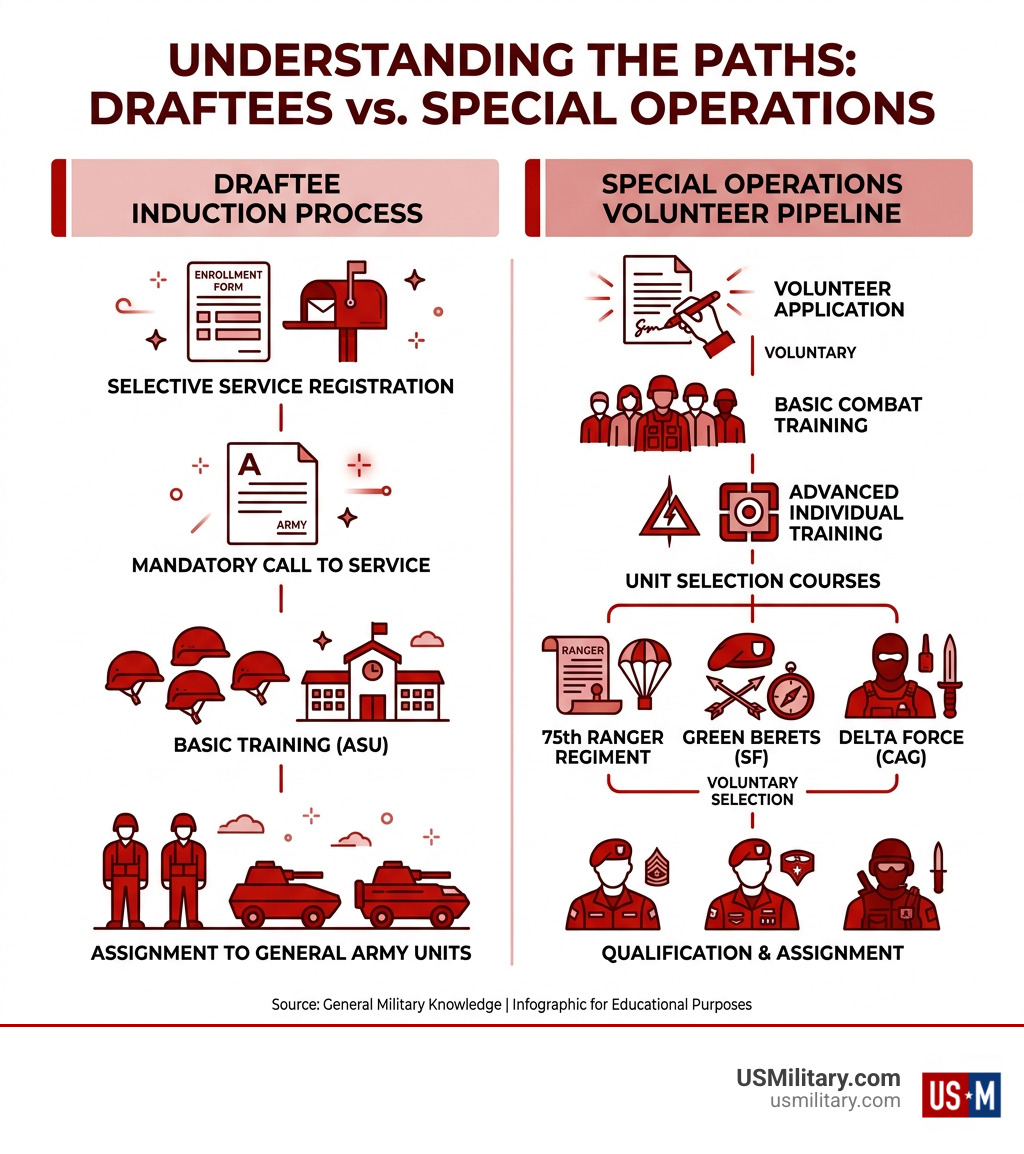
The U.S. military draft has been inactive since 1973. If it were ever reinstated, draftees would enter the general Army pool — not elite special operations units. Units like the Green Berets, Rangers, and Delta Force are built entirely on volunteers who pass some of the most demanding selection processes in the world.
These are not units you get assigned to. They are units you earn your way into.
I’m Larry Fowler, publisher of the USMilitary.com Network since 2007 and a longtime resource for active-duty service members and veterans navigating complex military questions — including whether Can The Army Draft Green Berets, Rangers, or Delta Force During Wartime? is even legally or practically possible. In the sections below, I’ll walk you through the legal framework, historical precedents, and real-world selection barriers that answer this question completely.
Basic Can The Army Draft Green Berets, Rangers, or Delta Force During Wartime? glossary:
- Who gets pulled first in a draft?
- What Disqualifies You From A Military Draft?
- Does the US currently have a military draft
- Who is first to go in a military draft?
Can The Army Draft Green Berets, Rangers, or Delta Force During Wartime?
Under current law, the U.S. military operates via the Selective Service Act. This provides the legal authority for the government to maintain a registry of names to be used in the event of a national emergency. However, understanding how the military draft works is key to realizing why elite units are shielded from direct conscription.
If a draft were activated, the Selective Service System lottery process would begin. This process uses a random drawing of birthdates to determine the order in which men are called for induction. Once a person is inducted, they are sent to Basic Combat Training (BCT) and assigned a Military Occupational Specialty (MOS) based on the needs of the Army and their own physical and mental qualifications.
The Army cannot legally “force” a draftee into a Special Operations position because these roles are strictly “volunteer-only.” While the government has the authority for involuntary induction into the general infantry or support roles, it does not have the authority to bypass the voluntary nature of Special Forces, Rangers, or Delta Force. These units rely on a specific psychological profile—one that includes the internal drive to volunteer for extreme danger.
Can The Army Draft Green Berets, Rangers, or Delta Force During Wartime for Support Roles?
While the “operators”—the guys kicking down doors or living in the jungle—must be volunteers, what about the people who fix their trucks, cook their meals, or manage their communications?
Every elite unit, from the 75th Ranger Regiment to the 1st Special Forces Operational Detachment-Delta, requires a massive support tail. These non-combat MOS roles include:
- Logistics and supply specialists
- Maintenance and mechanical repair
- Intelligence analysts
- Signal and communication technicians

Technically, the Army could assign a draftee to a support role within a Special Operations Command (SOCOM) unit. However, even support personnel in units like the Rangers often have to go through a version of the selection process (such as RASP 1 or 2) to ensure they can keep up with the unit’s high operational tempo. In a wartime scenario, specialized skills found in the civilian world—like advanced cybersecurity or mechanical engineering—might see draftees funneled into these high-tier support roles, but they would still not be considered “Green Berets” or “Rangers” in the traditional sense.
Legal Realities: Can The Army Draft Green Berets, Rangers, or Delta Force During Wartime via Executive Action?
A common myth is that the President can simply sign an executive order to start drafting people into Delta Force. In reality, the legal hurdles are significant. Reinstating the draft requires an Act of Congress, not just a presidential signature.
Furthermore, the current US draft age limits are strictly 18 to 25. Most operators in elite units are older; for example, the average age of a Green Beret is 31, and a Delta operator is often 35. This age gap alone creates a practical barrier. While the Department of Defense can change internal regulations regarding unit manning during a national emergency, they cannot legally compel a draftee to undergo the specialized, voluntary training required for “Tabbed” or “S-qualified” status without completely rewriting military law.
The Selection Process: Why Draftees Can’t Just “Join” Elite Units
The biggest reason we can answer “no” to the question of direct drafting is the assessment process. You don’t just “join” these units; you survive them. There are massive Green Beret vs. Ranger differences, but they share one thing: a brutal selection pipeline.
A draftee arriving at a MEPS station is a blank slate. To become a Green Beret, they would first have to volunteer for Special Forces Assessment and Selection (SFAS). This is a 24-day “job interview” designed to break a soldier down physically and mentally.
| Unit | Selection Course | Duration | Primary Focus |
|---|---|---|---|
| Rangers | RASP (Ranger Assessment and Selection Program) | 8 weeks | Direct action, physical stamina, discipline |
| Green Berets | SFAS & Q-Course | 1–2 years | Unconventional warfare, languages, teaching |
| Delta Force | OTC (Operator Training Course) | 6 months+ | High-tier counter-terrorism, precision shooting |
Even if the Army “drafted” someone into these units, the selection process acts as a natural filter. If a soldier doesn’t want to be there, they will simply “VW” (Voluntarily Withdraw). You cannot force a human being to have the mental fortitude required to pass a 40-mile ruck march in the middle of the night or to learn a difficult foreign language like Arabic or Mandarin under extreme stress.
Psychological screening is also a major factor. Units like Delta Force look for specific personality traits—high intelligence, low impulsivity, and extreme self-reliance. Draftees are a random cross-section of the population, whereas elite units are the top 1% of the 1%.
Historical Precedents: How Elite Units Expanded in Past Conflicts
History shows us that when the U.S. needs more elite troops, it doesn’t draft them—it recruits more heavily from the existing volunteer pool.
- WWII Rangers: The original Rangers were all volunteers from existing infantry units. They weren’t draftees; they were soldiers who wanted a tougher mission.
- The Vietnam Buildup: During the 1960s, Special Forces personnel peaked at 13,000 men across seven SF Groups. To reach this number, the Army didn’t lower standards or draft people; they expanded the “18X” type programs and pulled from the best of the regular Army.
- The 1980s Expansion: In the early 1980s, active-duty special operations forces rose from 11,600 to nearly 15,000. By 1987, the total force (including National Guard and Reserves) reached over 21,000. This growth was fueled by increased funding—which jumped from $500 million in 1981 to $1.5 billion by 1990—and a massive push for volunteers.
Historically, the Delta Force operator history shows that even Tier 1 units expanded by pulling from the “best of the best” in the Rangers and Green Berets, rather than looking to the general public. The reserve and National Guard components have also been vital. Today, two of the seven Special Forces groups are National Guard units, providing a surge capacity of highly trained, prior-service volunteers that no draft could ever replicate.
Practical Challenges of Training Draftees for Tier 1 Units
The “SOF Truths” are a set of principles that govern special operations. One of the most important is: Quality is better than Quantity. Another is: Special Operations Forces cannot be mass-produced.
If the Army tried to draft people directly into these units, they would face several insurmountable practical challenges:
- Training Duration: It takes roughly two years to make a Green Beret. A standard draft enlistment is usually only two years total. By the time a draftee finished the “Q-Course,” their time in service would be over.
- Language Proficiency: Green Berets are required to be fluent in a regional language. This requires months of intensive study that most draftees simply wouldn’t be prepared for.
- Operational Security (OPSEC): Tier 1 units like Delta Force are “black” units. The Army often refuses to even disclose the unit of a member who is killed in action. Integrating draftees—who may not have the same level of commitment or security clearance—would be a nightmare for maintaining secrecy.
Specialized training for Tier 1 units like Delta Force includes the Operator Training Course (OTC), which covers precision marksmanship and advanced demolitions. This isn’t just “soldiering”; it’s a craft that takes years of dedication. You can’t rush it, and you certainly can’t force it on someone who didn’t ask for it.
Frequently Asked Questions about Drafting Elite Forces
Can a draftee volunteer for Special Forces after induction?
Yes. If a draft were reinstated, a draftee would enter the Army as a regular soldier. Once they have completed Basic Training and reached the rank of E-3 or higher, they could theoretically submit a packet to attend SFAS or RASP. However, they would still have to meet all the high-bar requirements, including the ASVAB GT score of 110+ and the physical fitness standards.
Are there age limits that prevent draftees from joining Rangers?
While the draft age usually ends at 25, the 75th Ranger Regiment generally looks for younger, highly athletic soldiers, often in their early 20s. A draftee who is 24 or 25 might find the physical toll of RASP more difficult than an 18-year-old volunteer, but as long as they meet the Army’s standard age requirements for the MOS, they could volunteer.
Has anyone ever been drafted directly into Delta Force?
No. Delta Force (1st SFOD-D) was founded in 1977, four years after the draft ended. It is a Tier 1 Special Mission Unit that recruits almost exclusively from within the Army’s existing elite units (Rangers and Green Berets). There is no “civilian-to-Delta” pipeline, let alone a “draftee-to-Delta” one.
Conclusion
At USMilitary.com, we strive to provide the most accurate and up-to-date information for those considering a career in the armed forces or those simply curious about military policy. Whether you are looking for military career guidance or trying to understand what is the US military draft?, it’s important to separate Hollywood myths from Pentagon reality.
The question of Can The Army Draft Green Berets, Rangers, or Delta Force During Wartime? ultimately comes down to the soul of these units. They are elite because every man and woman in them chose to be there. They chose the extra rucking, the sleepless nights, and the dangerous missions. A draft can provide the “muscles” of an army—the hundreds of thousands of infantry and support troops needed for large-scale war—but it can never provide the specialized “brain and heart” found in Special Operations.
If you want to wear the Green Beret or the Tan Beret, you don’t have to worry about a lottery number. You just have to worry about whether you have the grit to volunteer.