
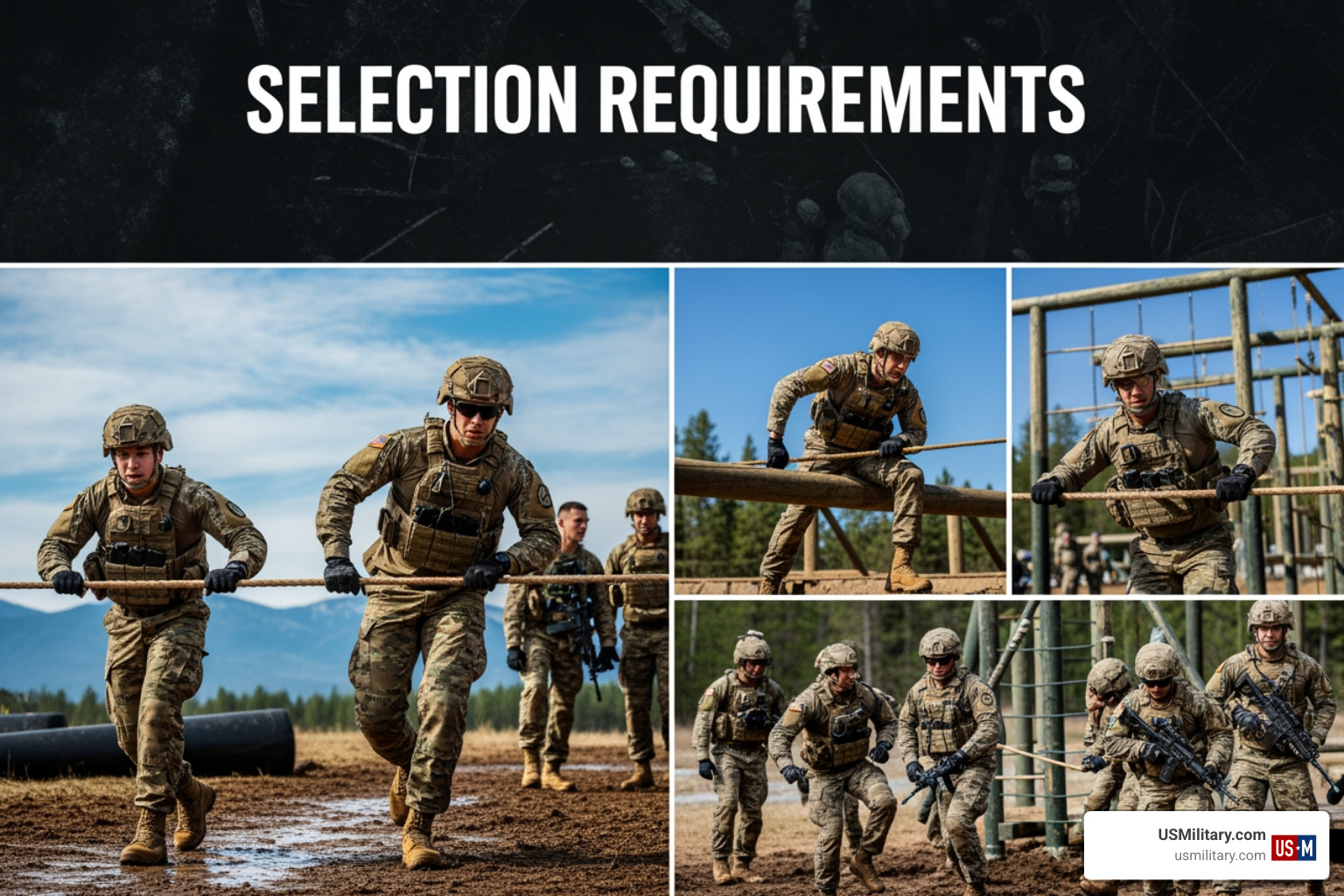
Army Delta Force Selection Requirements demand that candidates meet strict eligibility standards before even attempting one of the military’s most grueling assessment courses. At minimum, you must be a U.S. citizen between ages 22 and older, hold rank E-4 through E-8 (or O-3 to O-4 for officers), score 110+ on the ASVAB General Technical test, maintain at least 2.5 years of service remaining, qualify for Secret clearance, show a clean disciplinary record, and complete Airborne training or volunteer for it.
Quick Overview: Key Delta Force Selection Requirements
- Rank: E-4 to E-8 enlisted or O-3 to O-4 officers
- Age: Minimum 22 years old
- ASVAB: GT score of 110 or higher
- Service: 2.5+ years remaining on contract
- Clearance: Eligible for Secret security clearance
- Record: No court-martials or Article 15s
- Airborne: Qualified or willing to attend training
- Selection: 4-week course at Camp Dawson, West Virginia
- Success Rate: Only 10-13% pass (12-16 out of 120 candidates)
- Training: 6-month Operator Training Course after selection
The 1st Special Forces Operational Detachment-Delta operates in complete secrecy. Their missions remain classified, their members unidentified, and their training modeled after the British SAS. Selection happens twice yearly with classes of roughly 120 candidates—yet only a dozen or fewer graduate. The process tests physical endurance through increasingly brutal ruck marches, including the infamous 40-mile “Long Walk” with a 45-pound pack over steep terrain with no known time limit. But physical strength alone won’t carry you through. Delta Force selection breaks down candidates psychologically through isolation, ambiguity, and relentless testing of character under exhaustion.
Most candidates fail not from physical inability but from mental surrender. The course demands self-reliance, integrity, and the quiet humility to keep pushing when every instinct screams to quit. Even those who pass selection face a six-month Operator Training Course covering advanced marksmanship, close-quarters combat, demolitions, tradecraft, and executive protection before earning a spot in one of Delta’s operational squadrons.
I’m Larry Fowler, publisher of the USMilitary.com Network, and since 2007 I’ve worked with thousands of active-duty soldiers and veterans exploring elite career paths, including Army Delta Force Selection Requirements. This guide breaks down exactly what it takes to join America’s most secretive Tier 1 unit—from basic eligibility through the selection gauntlet to operator training and beyond.
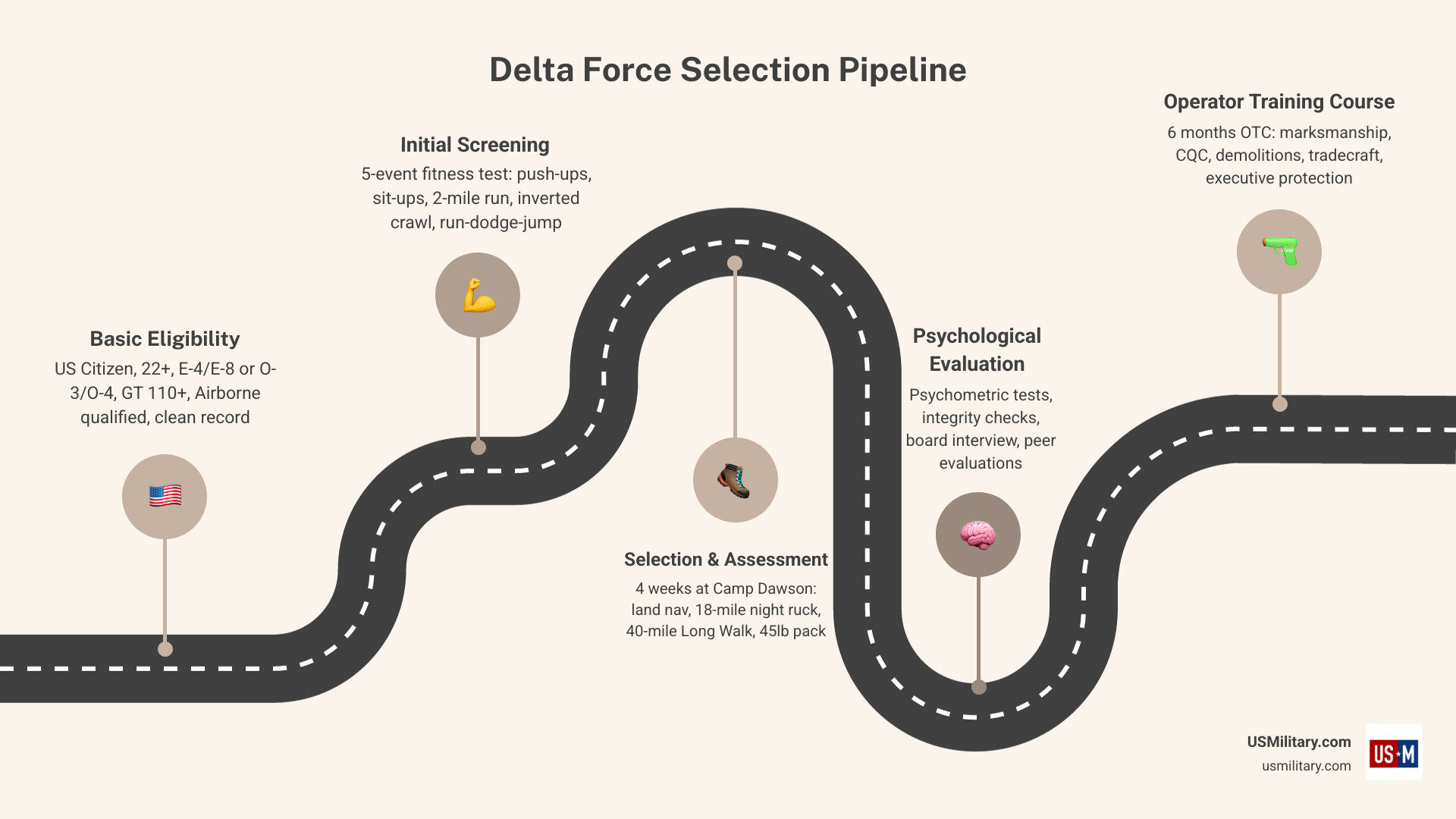
Army Delta Force Selection Requirements Word Guide:
Basic Army Delta Force Selection Requirements
To even get a foot in the door for 1st SFOD-D, you have to be more than just a good soldier; you have to be a professional with a spotless record. We often hear from young recruits who want to go “straight to Delta,” but the reality is that Delta Force does not recruit civilians directly. You must already be in the Army and have a proven track record of excellence.
Core Eligibility Criteria
The basic Army Delta Force Selection Requirements serve as a high-level filter to ensure only the most mature and capable soldiers apply.
- U.S. Citizenship: You must be a citizen of the United States.
- Age: Candidates must be at least 22 years old. This requirement ensures a level of emotional and physical maturity that younger soldiers may not yet possess.
- Rank: For enlisted personnel, you must be in the grades of E-4 to E-8. For officers, the unit looks for Captains (O-3) or Majors (O-4).
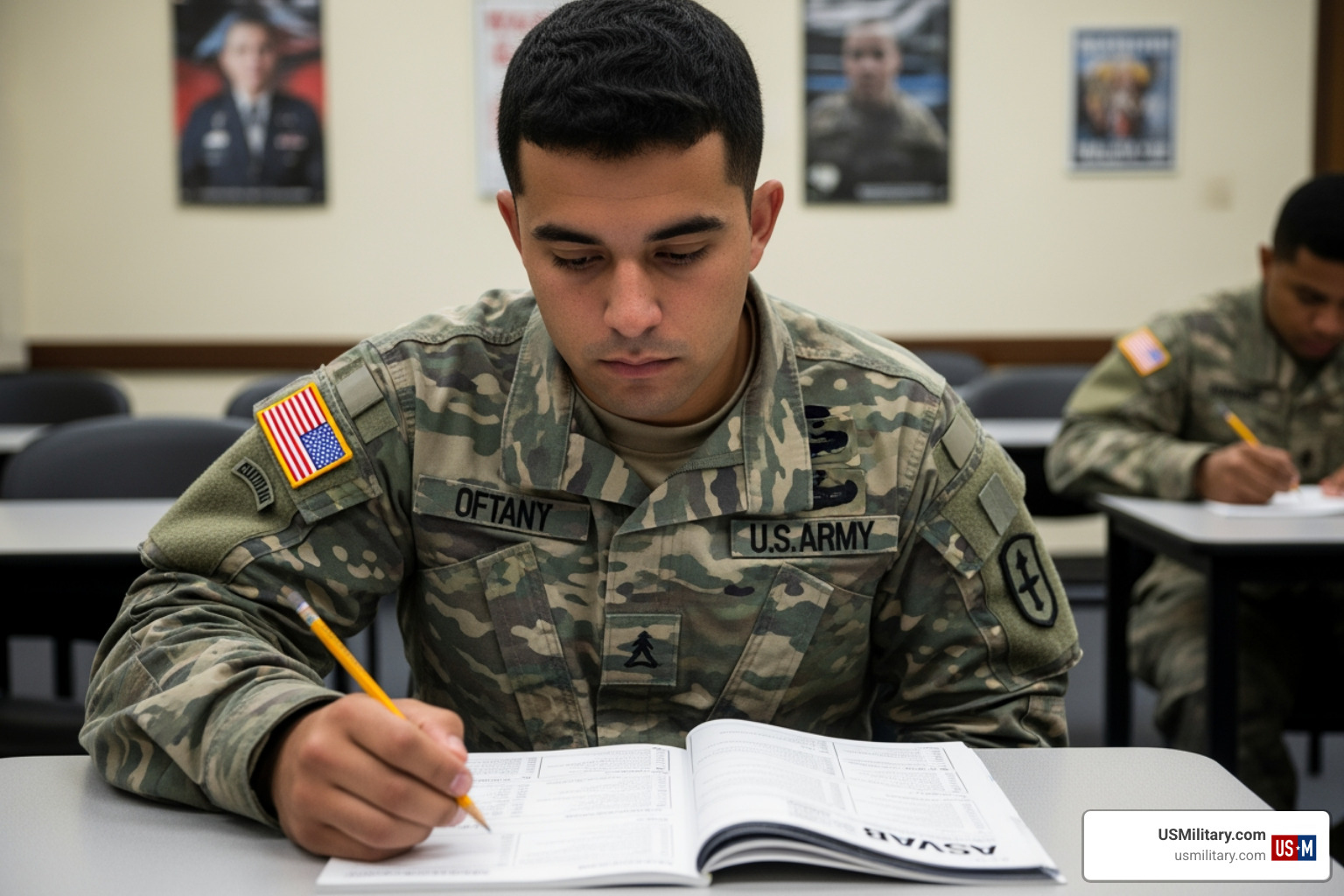
- GT Score: A minimum General Technical (GT) score of 110 on the ASVAB is mandatory. There are no waivers for this; if you don’t have the score, you’ll need to retake the ASVAB before applying.
- Service Remaining: You must have at least 2.5 years of service remaining on your contract at the time of application.
- Security Clearance: You must be eligible for a Secret security clearance, though most operators will eventually require a Top Secret/SCI clearance.
- Disciplinary Record: Your record must be “clean.” This means no history of recurring disciplinary action, no court-martials, and no Article 15s. The unit is looking for “quiet professionals,” not troublemakers.
- Airborne Qualification: You must be Airborne qualified or volunteer to attend Army Jump School.
For a deeper look at general entry standards, you can review the Detailed eligibility criteria for the U.S. Army or consult the official GoArmy recruitment portal.
Physical Fitness Standards and Initial Screening
Once you meet the administrative Army Delta Force Selection Requirements, the real “fun” begins. Before you ever set foot in the woods of West Virginia, you have to pass an initial physical screening. This isn’t your standard Army Combat Fitness Test (ACFT); it is a high-intensity evaluation designed to see if you have the explosive power and endurance required for Tier 1 operations.
The 5-Event Physical Fitness Test
Candidates are tested in their standard Battle Dress Uniform (BDU) and boots. This adds weight and resistance, making even “simple” exercises significantly harder.
- Push-ups: Testing upper body strength and endurance.
- Sit-ups: Core stability is vital for carrying heavy rucksacks.
- 2-Mile Run: A test of cardiovascular efficiency.
- Inverted Crawl: This unusual event tests agility and total body coordination.
- Run-Dodge-Jump: A functional movement test that simulates navigating a chaotic battlefield.
The Swim Test
In addition to the land-based events, candidates must complete a 100-meter swim while wearing their full uniform and boots. This is a pass/fail event. If you panic in the water or cannot complete the distance, your journey ends right there.
Medical Qualifications
Because Delta Force operators often engage in High Altitude Low Opening (HALO) jumps and SCUBA operations, candidates must pass a specialized physical. This includes a high-altitude chamber test to ensure your body can handle the pressure changes associated with elite insertion methods.
| Event | Minimum Standard | Competitive Score |
|---|---|---|
| Push-ups (2 min) | 40+ | 80+ |
| Sit-ups (2 min) | 40+ | 80+ |
| 2-Mile Run | < 16:00 | < 13:00 |
| 100m Swim | Completion | Strong/Fluid |
| Inverted Crawl | Pass | Rapid/Agile |
The Selection and Assessment Process (S&A)
If you survive the initial screening, you are invited to the Selection and Assessment (S&A) course held at Camp Dawson, West Virginia. This is where the Army Delta Force Selection Requirements transition from paper to pain. The course lasts roughly four weeks and is modeled after the British SAS selection process, a legacy of Delta’s founder, Col. Charlie Beckwith.
The Environment of Isolation
The most striking thing about S&A is the silence. Candidates are often forbidden from speaking to one another. There is no coaching, no “hooaah” motivation from instructors, and very little feedback. You are given a set of instructions and a destination. Whether you make it or not is entirely up to you. This “integrity testing” ensures that the men who pass are self-reliant and don’t need a supervisor to tell them to keep moving.
Mental Resilience Training
While the physical demands are extreme, the psychological pressure is the true “gatekeeper.” We see many elite athletes fail here because they cannot handle the ambiguity. You will rarely know how much further you have to go or what the time limit is. This uncertainty is designed to find those who possess a “special operations mindset”—the ability to perform at 100% even when the end is nowhere in sight.
Land Navigation and Army Delta Force Selection Requirements
Land navigation is the heart of Delta selection. It isn’t just about finding a point on a map; it’s about doing it alone, at night, over some of the most unforgiving terrain in the Appalachian Mountains, while carrying a heavy load.
The Appalachian Gauntlet
Candidates are issued a map and a compass—no GPS allowed. They must navigate through dense brush, steep ravines, and rocky outcrops. This phase tests your ability to think under pressure. If you make a mistake and “bust” a point, you might spend hours wandering in the dark, burning precious energy.
- 18-Mile Night Ruck: One of the early milestones is an 18-mile ruck march conducted at night with a 40-pound rucksack.
- Increasing Loads: As the weeks progress, the weight of the rucksack increases, and the distances grow longer.
- Solo Navigation: You are your own navigator, your own medic, and your own motivation.
The Long Walk and Final Endurance
The culmination of the S&A course is “The Long Walk.” This is a legendary 40-mile ruck march over the most brutal terrain the course has to offer. Candidates carry a 45-pound pack (which often feels like 100 pounds by the end) and must complete the trek within a secret time limit.
Psychological Uncertainty
The “Long Walk” is as much a mental test as a physical one. You aren’t told where the finish line is. You might walk for 20 hours, crest a hill, and see another mountain in front of you. This is where most “psychological quits” happen. Candidates who are physically capable of finishing simply give up because they can’t handle the “not knowing.”
The 10% Pass Rate
Statistics show that out of a starting class of 120, only about 12 to 16 will finish the Long Walk. That is a staggering 90% attrition rate. Most who fail do so because of injury or because they simply decided they had had enough.
Psychological Evaluation and the Selection Board
Finishing the Long Walk does not mean you are a Delta operator. In fact, for many, the hardest part is just beginning. After the physical gauntlet, you face the Selection Board.
Psychometric Testing and Character Assessment
Delta Force isn’t looking for “Rambo.” They are looking for mature, intelligent, and adaptable individuals. You will undergo a battery of psychological exams to test your mental flexibility and stress inoculation. We look for “quiet professionals” who display humility. Arrogance is a quick way to get “VW’d” (Voluntary Withdrawal) or dropped by the board.
The Board Interview
You will sit before a panel of senior Delta operators and a psychologist. They will grill you on your performance, your life choices, and your motivations. They may try to provoke you or catch you in a lie. They are looking for honesty, the ability to admit mistakes, and a personality that fits the “Unit” culture. Peer evaluations from earlier in the course are also heavily weighted; if your fellow candidates didn’t like working with you, the board will know.
For more on the history of these elite standards, see our guide on Requirements to join the Army.
Operator Training Course (OTC) and Beyond
Passing selection earns you a “golden ticket” to the Operator Training Course (OTC). This is a six-month intensive program where you learn the actual tradecraft of a Tier 1 operator.
Advanced Combat Skills
OTC is where the “Unit” builds the “Operator.” The training is divided into several specialized blocks:
- Marksmanship: You will fire tens of thousands of rounds, moving from stationary targets to instinctive shooting at multiple moving targets.
- Close Quarters Combat (CQC): This includes room clearing and “shoot house” exercises using live ammunition. Instructors often play the role of hostages to build trust and precision.
- Demolitions: Learning how to breach doors and obstacles using specialized explosives.
- Tradecraft: This is where Delta separates itself from other units. You learn espionage skills like dead drops, surveillance, and blending into civilian environments.
- Executive Protection: Training in high-stakes protective services for VIPs in hostile zones.
Operational Assignment
Upon graduation from OTC, you are assigned to one of the “Sabre Squadrons” (A, B, C, or D). Here, you will continue to train alongside some of the most experienced soldiers in the world, maintaining a level of readiness that is truly “Sine Pari” (Without Equal).
Preparing for Army Delta Force Selection Requirements
If you are reading this and thinking about applying, you need a plan. You cannot “show up in shape” for Delta; you have to be a tactical athlete.
Rucking Progression
Start now. Your feet and joints need to be conditioned for the “Long Walk.”
- Start with 35 pounds for 5-8 miles.
- Work up to 60-pound loads.
- Aim for a 15-minute-per-mile pace over varied terrain.
Land Navigation Practice
Don’t rely on your phone or a GPS. Buy a high-quality lensatic compass and a topographic map of a local state park. Spend your weekends finding points in the woods. If you can’t navigate when you’re tired and hungry, you won’t pass S&A.
Mental Visualization
We recommend stress-inoculation techniques. Visualize the “Long Walk.” Imagine your feet are blistering and the rain is pouring down. How will you react? Building mental resilience before you arrive is just as important as your squat max.
Frequently Asked Questions about Delta Force Selection
What is the attrition rate for Delta Force Selection?
The attrition rate is notoriously high, often exceeding 90%. In a typical class of 120 candidates, usually only 12 to 14 will complete the selection process. In some cases, a class might start with 120, see 16 pass selection, and only have 8 make it through the final Operator Training Course (OTC). Failures are usually due to psychological “quits” or overuse injuries like stress fractures.
Who can volunteer for Delta Force?
While Delta primarily recruits from the 75th Ranger Regiment and Army Special Forces (Green Berets), they technically accept volunteers from all branches of the U.S. military, provided they meet the Army’s enlistment criteria. Most candidates come from combat arms backgrounds because they already possess the foundational skills in rucking and small-unit tactics. You can learn more about the path from the Rangers by reading How to become an Army Ranger.
Are there different requirements for officers and NCOs?
Yes. Enlisted candidates (NCOs) must be between the ranks of E-4 and E-8. Officers must be at the rank of Captain (O-3) or Major (O-4). Officers are also required to have at least 12 months of successful command experience and be a college graduate. Both groups must have an impeccable professional record and meet the same physical standards during the S&A course.
Conclusion
Meeting the Army Delta Force Selection Requirements is a feat that very few soldiers ever achieve. It is a path reserved for the “one percent of the one percent”—those who are willing to push past every physical and mental limit in service to the nation. From the initial 5-event fitness test to the soul-crushing “Long Walk” and the secretive Operator Training Course, every step is designed to find the “quiet professional.”
At USMilitary.com, we are proud to support the men and women who aspire to these elite ranks. Whether you are just starting your journey or are a seasoned veteran looking for your next challenge, excellence is the only standard that matters. If you believe you have what it takes to stand “Sine Pari,” your first step is ensuring you meet the basic Requirements to join the Army.
The road is long, and the finish line is unknown—but for those who make it, the reward is a place among the most elite warriors in human history. Stay focused, stay humble, and keep rucking.