
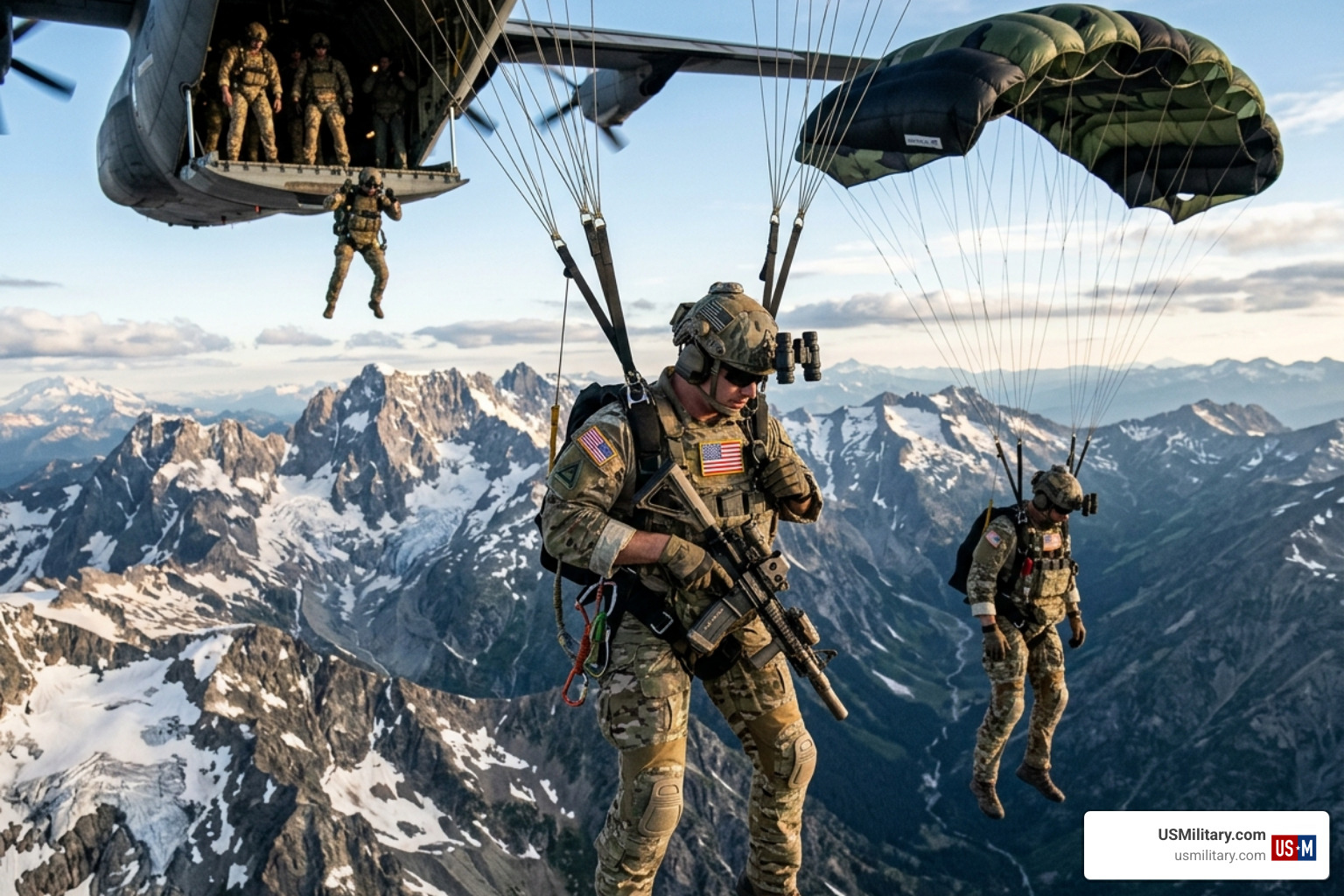
How Army Delta Force Became the Army’s Most Elite Force is a story built on crisis, vision, and relentless standards that almost no soldier can meet.
Here is the short answer:
- Founded in response to crisis — Colonel Charlie Beckwith established Delta Force on November 19, 1977, after 1970s terrorism exposed a dangerous gap in U.S. counter-terrorism capabilities.
- Modeled after the best — Beckwith patterned the unit directly after the British Special Air Service (SAS), where he had served as an exchange officer.
- Brutal selection filters the best of the best — Roughly 9 out of 10 candidates fail. Only a small fraction of those who pass selection survive the six-month Operator Training Course (OTC).
- Forged through real missions — From the failed Operation Eagle Claw in 1980 to the 2019 raid that killed ISIS leader Abu Bakr al-Baghdadi, Delta Force sharpened its edge through the hardest operations in U.S. military history.
- Tier 1 status under JSOC — Delta Force operates under the Joint Special Operations Command (JSOC) alongside SEAL Team 6, executing missions that no other unit is tasked to handle.
- Constantly evolving — The unit has expanded from direct action and hostage rescue into cyber warfare, counter-WMD operations, and complex urban combat.
Delta Force’s motto says it plainly: Sine Pari — Without Equal.
I’m Larry Fowler, publisher of USMilitary.com and a longtime resource for active military members and veterans navigating service-related decisions. Through nearly two decades of covering elite military units and veteran affairs, I’ve tracked how Army Delta Force became the Army’s most elite force — and what it means for those considering a path in special operations. Read on for the full story, from the unit’s founding all the way to its most recent confirmed operations in 2026.
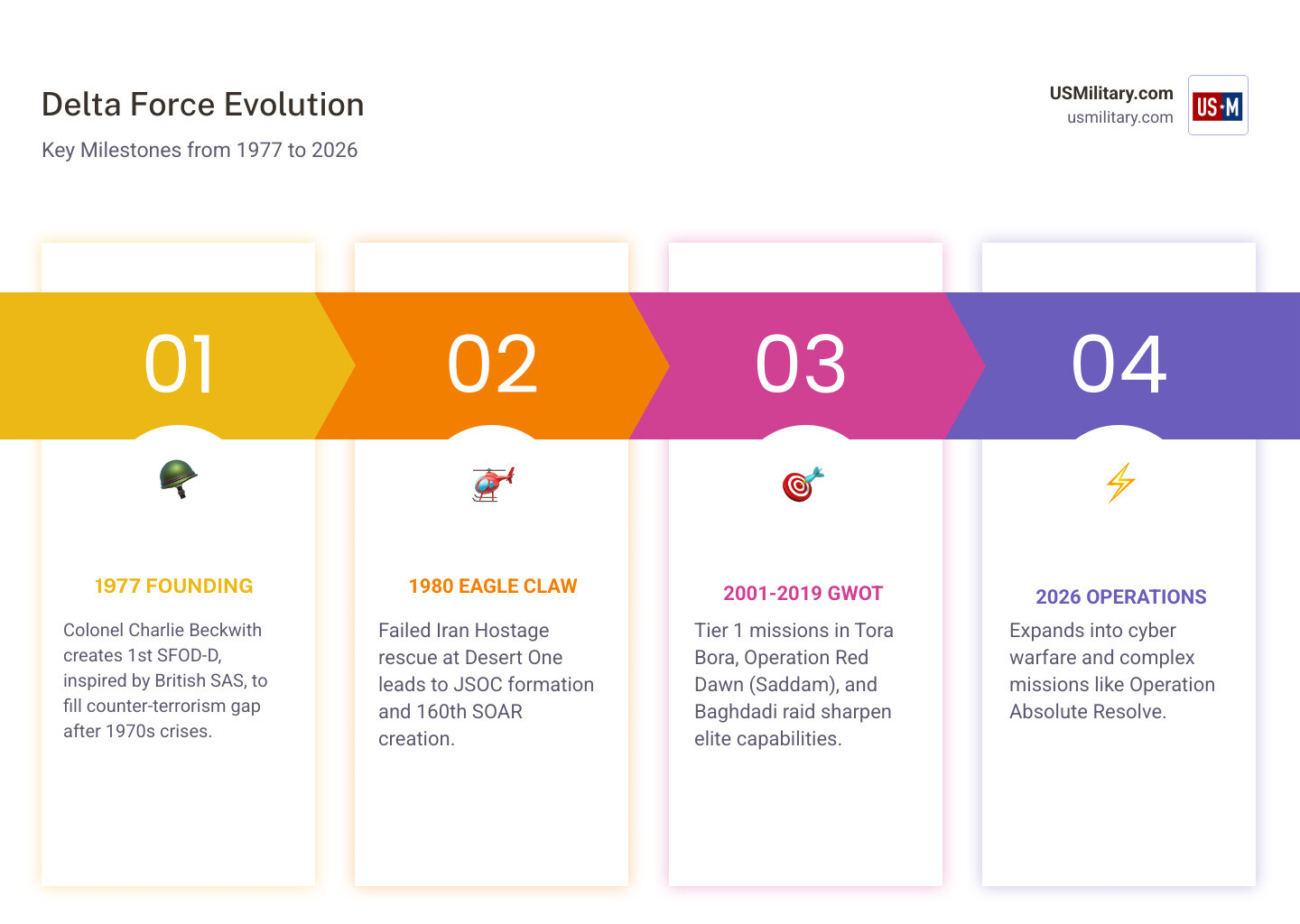
Must-know How Army Delta Force Became the Army’s Most Elite Force terms:
The Origins of 1st SFOD-D: How Army Delta Force Became the Army’s Most Elite Force
The birth of Delta Force was not a smooth process. In the mid-1970s, the world was reeling from a wave of high-profile terrorist attacks, including airline hijackings and the 1972 Munich Olympics massacre. While European nations had specialized units like the British SAS or the German GSG 9, the United States lacked a dedicated, full-time counter-terrorism force.
Colonel Charles “Chargin’ Charlie” Beckwith saw this gap clearly. Having served as an exchange officer with the British 22 Special Air Service (SAS) during the Malayan Emergency, Beckwith was convinced the U.S. Army needed a “force of doers” rather than just teachers. He spent years lobbying the Pentagon, often facing resistance from traditionalists who felt existing Special Forces were enough.
In 1977, Beckwith and his staff drafted what became known as the “Robert Redford Paper.” This foundational document outlined the four-phase selection process and estimated it would take 24 months to build a mission-ready unit. On November 19, 1977, the 1st Special Forces Operational Detachment-Delta (1st SFOD-D) was officially established at Fort Liberty (then Fort Bragg), North Carolina. While Delta was being stood up, a temporary unit called “Blue Light” was created to provide interim counter-terrorism capabilities, but it was eventually disbanded once Delta became fully operational in late 1979. How the Army’s Delta Force Became Feared is a testament to Beckwith’s stubborn vision to create a scalpel in a world of sledgehammers.
Early Operations: How Army Delta Force Became the Army’s Most Elite Force Through Trial
We often learn more from failure than success, and for Delta Force, the ultimate trial by fire was Operation Eagle Claw in 1980. Tasked with rescuing 52 American hostages from the U.S. Embassy in Tehran, the mission ended in tragedy at a remote site known as Desert One. A combination of mechanical failures, extreme dust storms, and a helicopter collision resulted in the deaths of eight American service members and the mission’s cancellation.
While the failure was devastating, it was the catalyst that truly defined how Army Delta Force became the Army’s most elite force. The disaster exposed critical flaws in how the U.S. military conducted joint special operations. In the aftermath, the Department of Defense realized that Delta needed dedicated, world-class support. This led directly to the creation of the 160th Special Operations Aviation Regiment (SOAR), known as the “Night Stalkers,” and the formation of the Joint Special Operations Command (JSOC) to coordinate Tier 1 units.
Throughout the 1980s and early 90s, Delta refined its tradecraft in operations like Urgent Fury in Grenada and Just Cause in Panama. In Panama, Delta successfully rescued Kurt Muse from the Modelo Prison in Operation Acid Gambit, a textbook display of the precision and speed Beckwith had envisioned.
Global War on Terror: How Army Delta Force Became the Army’s Most Elite Force in the 21st Century
The terrorist attacks of September 11, 2001, pushed Delta Force into a relentless operational tempo that has lasted for decades. In the early days of Operation Enduring Freedom, Delta operators were among the first on the ground in Afghanistan, famously hunting high-value targets in the cave complexes of Tora Bora.
In Iraq, the unit spearheaded the hunt for the “Deck of 52.” On December 13, 2003, Delta Force operators, supported by the 4th Infantry Division, executed Operation Red Dawn, which resulted in the capture of Saddam Hussein. The operational pace in Iraq was so intense that by 2009, it was estimated that 50% of deployed operators had received at least one Purple Heart.
More recently, Delta has continued to eliminate global threats. In 2019, during Operation Kayla Mueller, Delta operators raided a compound in Syria, leading to the death of ISIS leader Abu Bakr al-Baghdadi. Most remarkably, as of April 2026, reports indicate that Delta Force played a pivotal role in Operation Absolute Resolve. On January 3, 2026, the unit successfully captured Venezuelan President Nicolás Maduro and his wife, demonstrating that even 48 years after its founding, “The Unit” remains the tip of the spear for American foreign policy.
The Crucible: Selection and Training Standards
If you want to understand how Army Delta Force became the Army’s most elite force, you have to look at the “Long Walk.” Selection is held twice a year at Camp Dawson, West Virginia, and it is designed to find the breaking point of even the most elite Rangers and Green Berets.
The attrition rate is staggering—roughly 90% of candidates fail. The process begins with standard physical fitness tests but quickly moves into grueling land navigation. Candidates must navigate difficult terrain alone, carrying rucksacks that increase in weight, with no feedback on whether they are meeting the time limits.
The climax is “The Long Walk,” a 40-mile (64-km) trek through the mountains with a 45-pound (20-kg) rucksack. It is as much a mental test as a physical one. After the physical phase, candidates face a battery of psychological exams and a daunting board interview. The goal is to find soldiers who are mature, intelligent, and capable of independent thought under extreme stress.

Those few who pass then enter the six-month Operator Training Course (OTC). This is where they learn the specific skills of a Delta operator:
- Advanced Marksmanship: Shooting thousands of rounds until accuracy is instinctive.
- Demolitions and Breaching: Learning how to enter any structure quickly.
- Tradecraft: CIA-style skills including surveillance, dead drops, and blending into civilian populations.
- Executive Protection: High-stakes security for diplomats and generals.
For those interested in the specifics of the journey, you can find More info about Army Delta Force Selection Process on our platform.
Delta Force Eligibility Requirements:
- Rank: Enlisted E-4 through E-8; Officers O-3 or O-4.
- Age: 21 years or older.
- Experience: At least 2.5 years of service remaining.
- Qualifications: Airborne qualified or volunteer for training.
- Testing: ASVAB GT score of 110 or higher.
- Security: Ability to obtain a Secret security clearance and no history of disciplinary action.
Organizational Structure and Specialized Capabilities
Delta Force is organized into a structure that allows for maximum flexibility and secrecy. While the Pentagon rarely acknowledges its existence, declassified information and accounts from former members like Eric Haney and Larry Vickers give us a clear picture of its composition.
The unit is divided into several squadrons:
- Assault Squadrons (A, B, C, and D): These are the primary “Saber” squadrons responsible for direct action and hostage rescue. Each is divided into three troops: two assault troops and one reconnaissance/sniper troop.
- E Squadron: The aviation element, working closely with the 160th SOAR but maintaining its own specialized clandestine aviation capabilities.
- G Squadron: Often referred to as the “Clandestine” squadron, these operators specialize in advanced reconnaissance and “low-visibility” operations where they blend into the local population.
- Combat Support Squadron: Provides the technical, medical, and logistical backbone that allows operators to function in the most remote corners of the world.
One of the most modern additions is the Computer Network Operations Squadron (CNOS), nicknamed the “Digital Devils.” This group ensures that Delta stays ahead in the realm of cyber warfare, integrating electronic sabotage and intelligence gathering into physical raids. This integration of high-tech and high-impact is a core reason how Army Delta Force became the Army’s most elite force.
The Combat Development Directorate is another secret weapon. This group constantly tests and modifies gear. Delta was among the first to adopt the HK416 rifle, a weapon they helped design to be more reliable than the standard M4 in harsh environments.
Comparing Tier 1 Assets: Delta Force vs. Other Units
We often get asked how Delta compares to the 75th Ranger Regiment or the Green Berets. While all are elite, they serve different purposes. The Rangers are the Army’s premier light infantry raid force—the “sledgehammer.” The Green Berets (Special Forces) specialize in unconventional warfare and training foreign partners—the “teachers.”
Delta Force, along with the Navy’s DEVGRU (SEAL Team 6), is a Tier 1 Special Mission Unit. They are the “scalpel.” While they recruit heavily from the Rangers (roughly 70% of Delta operators come from the Regiment) and Special Forces, the missions they take on are often directed by the President or the Secretary of Defense and involve the highest levels of national security risk.
| Feature | Army Rangers | Green Berets | Delta Force |
|---|---|---|---|
| Primary Mission | Large-scale raids/Airfield seizure | Unconventional warfare/Training | Counter-terrorism/HVT capture |
| Recruitment | Direct enlistment (Option 40) | Direct or from within Army | Only from within the military |
| Tier Status | Tier 2 | Tier 2 | Tier 1 |
| Focus | Combat power/Sledgehammer | Language/Culture/Teaching | Precision/Scalpel |
Frequently Asked Questions about Delta Force
Is Delta Force the same as the Navy SEALs?
No. While both have elite Tier 1 elements (Delta for the Army and SEAL Team 6/DEVGRU for the Navy), they belong to different branches. Delta Force recruits primarily from the Army but can accept candidates from any branch. SEALs are Navy-specific. Their training and “culture” differ, with Delta often noted for its “quiet professional” approach and ability to blend into civilian environments.
What is the success rate for Delta Force selection?
The success rate is typically around 10%. In a starting class of 120 candidates, it is common for only 12 to 14 to complete the selection process. Of those who pass selection, even fewer will successfully graduate from the six-month Operator Training Course (OTC).
Was Delta Force involved in the capture of Nicolás Maduro in 2026?
Yes. According to military reports and declassified briefings following Operation Absolute Resolve, Delta Force operators executed the high-stakes extraction of Nicolás Maduro and his wife on January 3, 2026. This operation underscored the unit’s continued role as the primary tool for high-value target (HVT) apprehension.
Conclusion
At USMilitary.com, we believe that understanding the history and grit of our most elite units helps us appreciate the sacrifices made by all service members. How Army Delta Force Became the Army’s Most Elite Force is not just a story of better gear or bigger budgets—it’s a story of a culture that refuses to accept anything less than perfection.
From the rugged mountains of West Virginia during “The Long Walk” to the digital battlefields of modern cyber warfare, Delta Force remains Sine Pari. Whether they are rescuing hostages, capturing dictators, or preventing the next global threat, these “Quiet Professionals” continue to define the pinnacle of American military excellence.
If you are a veteran or an active-duty member looking for more information on elite career paths or VA benefits like Aid & Attendance, we are here to help. You can also Compare Army Delta Force vs Navy SEALs to see which path might be right for you.