

How Were Army Rangers and Delta Force Used in the AF-15 Pilot Rescue is one of the most searched questions since details of this remarkable operation emerged. Here’s the short answer:
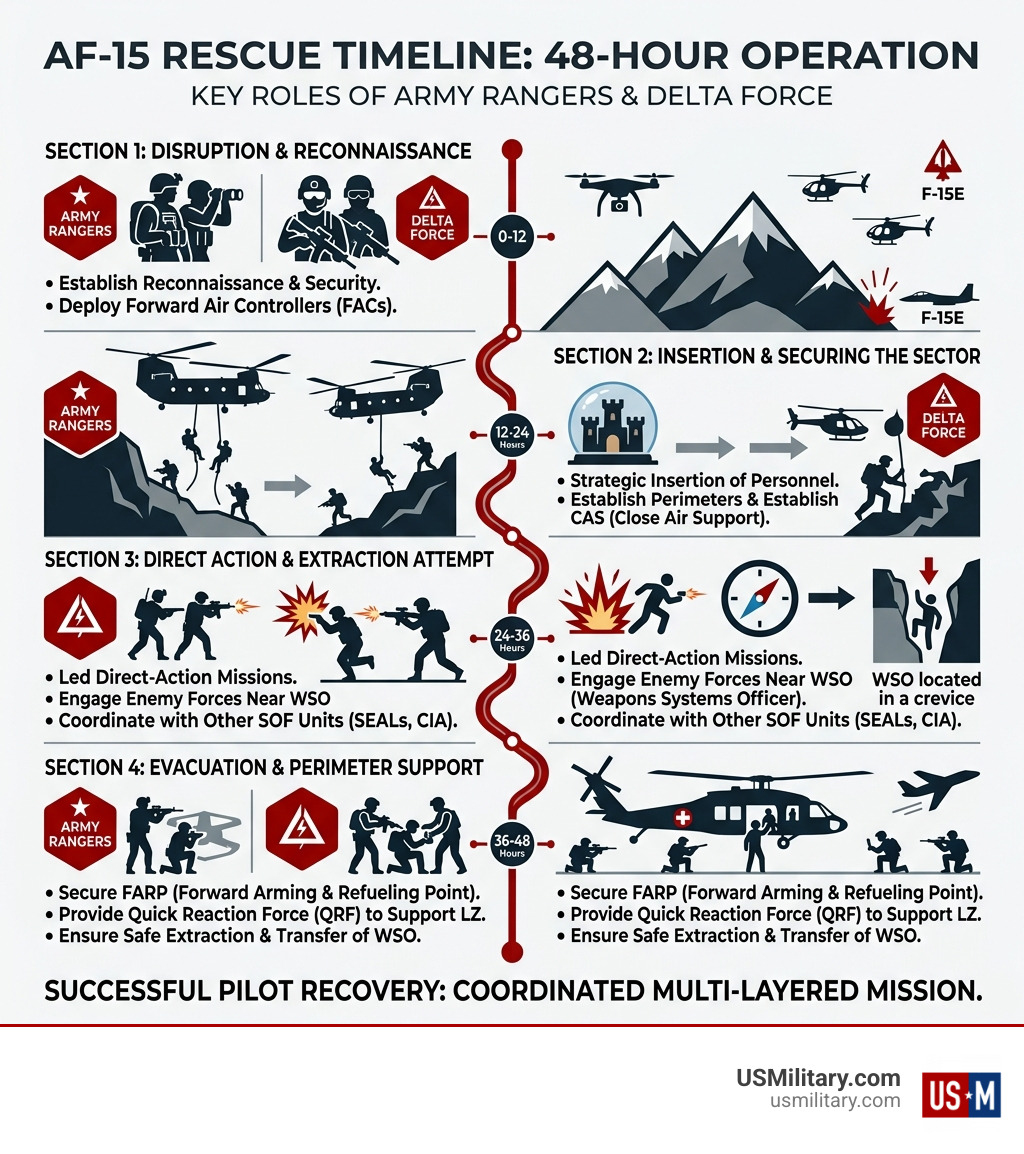
- Army Rangers secured the perimeter, provided reconnaissance, and served as a Quick Reaction Force (QRF) to protect the extraction site inside Iran.
- Delta Force led direct-action operations, engaged IRGC forces closing in on the downed airman, and provided security at the Forward Arming and Refueling Point (FARP).
- Both units worked alongside SEAL Team 6, the 160th SOAR (Night Stalkers), and CIA operatives in a coordinated, multi-layered rescue mission.
- The operation involved roughly 100–200 special operations troops and dozens of aircraft over approximately 48 hours.
- The mission extracted a wounded F-15E Weapons Systems Officer (WSO) from a rocky mountain crevice over 2,100 meters high in southwestern Iran.
This was no ordinary rescue. President Trump called it “one of the most daring Search and Rescue Operations in U.S. History.” And based on what we know, that’s not an exaggeration.
The WSO survived alone — armed with only a pistol — hiding in a crevice on a mountain ridge for nearly two days while Iranian forces hunted him. What followed was a race against time involving elite commandos, CIA deception tactics, aircraft deliberately destroyed to prevent capture, and firefights with Iranian Revolutionary Guard forces.
I’m Larry Fowler, publisher of USMilitary.com, and I’ve spent nearly two decades covering U.S. military operations, special forces career paths, and the units that execute the most dangerous missions in the world. Understanding how Army Rangers and Delta Force were used in the AF-15 pilot rescue is exactly the kind of high-stakes operational story this network exists to break down clearly. Let’s walk through everything we know.
Know your How Were Army Rangers and Delta Force Used in the AF-15 Pilot Rescue terms:
- army ranger vs green beret
- delta special forces
- how to become Ranger
The Context of the F-15E Shootdown and Initial Recovery
The drama began when a U.S. Air Force F-15E Strike Eagle, likely from the 48th Fighter Wing, was struck by Iranian fire. This marked a significant escalation in the conflict, as it was the first crewed U.S. fighter jet lost to enemy fire since the war began on February 28, 2026. As the aircraft succumbed to damage, both crew members—the pilot and the Weapons Systems Officer (WSO)—were forced to eject into the rugged, hostile terrain of southwestern Iran.
The initial recovery of the pilot was a “hot” Combat Search and Rescue (CSAR) mission. Within approximately six hours of the shootdown, a force including HH-60W Jolly Green II helicopters and A-10 Warthogs moved in. Despite coming under heavy fire, they successfully extracted the pilot. However, the WSO remained missing, separated from his colleague and deep in enemy territory.
While the pilot’s rescue was an incredible feat of bravery, the search for the WSO quickly transitioned from a standard CSAR mission into a high-tier Joint Special Operations Command (JSOC) raid. The area was swarming with Iranian Revolutionary Guard Corps (IRGC) forces, making a second daylight helicopter rescue too risky. This set the stage for a massive, 48-hour effort involving the most elite “Tier One” assets in the American arsenal. You can read more about the initial phases in our article on How Seal Team 6 Rescued F 15 Pilot and the broader US special forces rescue second F-15 airman from Iran.
How Were Army Rangers and Delta Force Used in the AF-15 Pilot Rescue
When the mission shifted to the recovery of the WSO, the complexity skyrocketed. We saw a massive integration of units that usually only work together on the highest-priority national security objectives. The operation was “planned and rehearsed” under the cover of darkness to minimize the risk that had plagued the first rescue.

The primary question remains: How Were Army Rangers and Delta Force Used in the AF-15 Pilot Rescue? The answer lies in the specialized “lanes” each unit occupies. While they are both elite, their roles during this 36-to-48-hour window were distinct but complementary. Delta Force (The Unit) focused on the precision extraction and direct engagement with high-threat Iranian forces, while the Army Rangers provided the “heavy lifting” in terms of security and tactical support.
To understand these “Shadow Warriors,” it helps to look at The Shadow Warriors Everything You Need To Know About Delta Force and our breakdown of What Do Army Rangers Do 2.
Tactical Roles of Army Rangers in the AF-15 Pilot Rescue
In an operation of this scale, the 75th Ranger Regiment acts as the premier light infantry force capable of seizing and holding territory in the middle of a hornet’s nest. During the AF-15 rescue, the Rangers’ primary responsibilities included:
- Perimeter Security: Once the extraction site and the Forward Arming and Refueling Point (FARP) were established, Rangers set up a “steel ring” around the area. This prevented Iranian ground reinforcements from reaching the rescue teams.
- Quick Reaction Force (QRF): If any element of the mission went sideways—such as a helicopter going down—the Rangers were the designated muscle ready to fly in and break contact.
- Airfield Seizure and Force Protection: Reports indicate that Rangers helped secure the “dusty strip” used for the MC-130J landings. They managed road craters and diversions to keep Iranian vehicles at a distance.
- Reconnaissance: Ranger elements provided eyes on the ground to monitor Iranian troop movements near the mountain ridge where the airman was hiding.
The Rangers’ ability to manage large-scale security while Tier One units perform surgical extractions is a hallmark of JSOC operations. For those curious about how their training stacks up, check out Army Ranger School Vs Navy Seal Training or the differences in Green Berets Vs Army Rangers.
Delta Force Direct Action and Extraction in the AF-15 Pilot Rescue
While the Rangers held the door open, Delta Force went inside. Delta’s role was focused on the most dangerous and technically difficult part of the mission: getting the wounded WSO off that 2,100-meter mountain.
- Mountain Extraction: Delta operators, known for their expertise in unconventional environments, were the ones who actually reached the rocky crevice. They had to confirm the airman’s identity and provide immediate tactical medical care for his serious wounds.
- Direct Engagement: Footage from the region allegedly showed fierce clashes between U.S. forces and the IRGC near Dehdasht. Delta Force was at the tip of the spear during these engagements, using superior night-vision technology and fire support to “smoke check” enemy groups closing in on the airman.
- FARP Security: Delta provided the high-end security at the refueling point, ensuring that the MH-6 Little Birds could land, refuel, and relaunch within minutes.
Delta’s involvement ensured that the “needle in a haystack”—a wounded man hiding in a mountain crack—was recovered despite being hunted by enemy forces offering bounties for his capture. You can dive deeper into the rivalry and cooperation between these units in Delta Force Vs Seals 2 and Army Delta Forces Vs Navy Seals.
Establishing the FARP and Overcoming Operational Challenges
One of the most technically impressive parts of the mission was the establishment of a Forward Arming and Refueling Point (FARP) deep inside Iranian territory. This wasn’t a permanent base; it was a “pop-up” airfield created on a dusty, austere strip of land.
Air Force Special Tactics Squadrons (STS) used imagery and geospatial tools like AutoCAD to pre-survey the site. Once the MC-130Js landed, Combat Controllers (CCTs) used dirt bikes to inspect the runway and set up infrared-only lighting. This allowed the MH-6 Little Birds from the 160th SOAR to ferry the rescue teams and the airman to the larger transport planes.
Operational Challenges and Asset Destruction
The mission was not without its failures. The terrain in Iran is unforgiving, and the “known-unknown” of soil strength proved to be a major obstacle.
- Stuck in the Sand: Two MC-130J aircraft became bogged down in the soft sand of the improvised runway.
- Mechanical Failures: In addition to the transport planes, four MH-6 Little Bird helicopters were damaged or suffered mechanical issues during the high-altitude, high-heat operations.
- Denial of Assets: To prevent sensitive technology from falling into Iranian hands, U.S. forces made the difficult decision to destroy the stranded aircraft. They were bombed by U.S. fighter jets after the personnel had been cross-loaded onto three replacement aircraft called in to finish the extraction.
This logistical nightmare is a reminder of the risks involved in Army Special Forces Careers. For a quick look at how the roles were split, see the table below:
| Responsibility | Primary Unit | Support Unit |
|---|---|---|
| Perimeter Security | Army Rangers | Special Tactics Squadron |
| Direct Action / Extraction | Delta Force | SEAL Team 6 |
| Aerial Insertion/Extraction | 160th SOAR | Air Force Special Tactics |
| FARP Management | Special Tactics | Army Rangers |
| Intelligence / Deception | CIA | JSOC Intelligence |
The CIA Deception Campaign and Location Technology
While the commandos were the muscle, the CIA provided the “brain” for the operation. To give the rescue teams a window of opportunity, the CIA launched a sophisticated deception campaign. They spread false information within Iran—including rumors that a ground convoy had already evacuated the airman—to divert Iranian search teams away from the actual mountain ridge.
To find the WSO, the CIA used “unique agency technology” to detect intermittent signals from the airman’s signaling device. He had been trained in SERE (Survival, Evasion, Resistance, and Escape) to use his beacon only sparingly to avoid detection by Iranian direction-finding equipment. The CIA pinpointed him in a 7,000-foot-high crevice and used high-resolution surveillance to confirm his identity before the “Night Stalkers” moved in. This level of coordination is why Navy Seals Vs Army Rangers Hardest Training Revealed often highlights the intelligence-sharing capabilities of these elite units.
Frequently Asked Questions about the AF-15 Rescue
Which units were involved in the rescue?
The operation was a massive joint effort. It included SEAL Team 6 (DEVGRU), Delta Force, and the 75th Ranger Regiment. They were supported by the 160th Special Operations Aviation Regiment (Night Stalkers), Air Force Special Tactics Squadrons, and the CIA. Overall, about 100 to 200 special operations personnel were directly involved in the ground and air components inside Iran.
Why were U.S. aircraft destroyed during the mission?
During the extraction, two MC-130J Commando II aircraft became stuck in the sand at the improvised landing strip. Additionally, four MH-6 Little Bird helicopters were damaged or experienced mechanical failures. To prevent the Iranian military from capturing sensitive U.S. technology and to deny them a propaganda victory, U.S. forces deliberately destroyed these assets before leaving the area.
How long did the WSO evade capture?
The Weapons Systems Officer (WSO) evaded capture for approximately 48 hours. He spent this time hiding in a rocky crevice on a mountain ridge over 2,100 meters (approx. 7,000 feet) high. He was seriously wounded but used his SERE training to stay hidden and communicate intermittently with rescuers until Delta Force and the Rangers reached his position.
Conclusion
The successful recovery of the F-15E crew is a testament to the “No One Left Behind” ethos that defines the American military. By answering How Were Army Rangers and Delta Force Used in the AF-15 Pilot Rescue, we see a picture of unparalleled tactical synergy. The Rangers provided the impenetrable shield, Delta Force provided the surgical strike, and the CIA provided the cloak of deception.
Though the mission resulted in the loss of several high-value aircraft, the preservation of American lives remains the ultimate metric of success. This operation will undoubtedly be studied for decades as a masterclass in joint special operations.
At USMilitary.com, we are proud to provide the resources and information our service members and veterans need to stay informed on these critical developments. Whether you’re looking for VA disability information or exploring the paths to join these elite units, we are your central hub for military guidance.
If you’re interested in how these units compare for your own career path, don’t miss our guide to Compare Army Delta Force vs Navy SEALs. For more on this mission, you can also view the Inside the daring mission to rescue a U.S. airman downed in Iran report.