
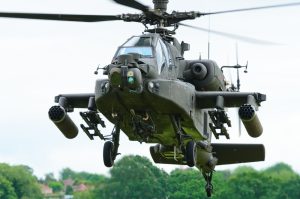
How Army Special Forces May Be Used In Today’s Attacks on Iran is one of the most pressing military questions of 2026. Here’s a quick breakdown:
Key roles Special Forces could play in Iran operations:
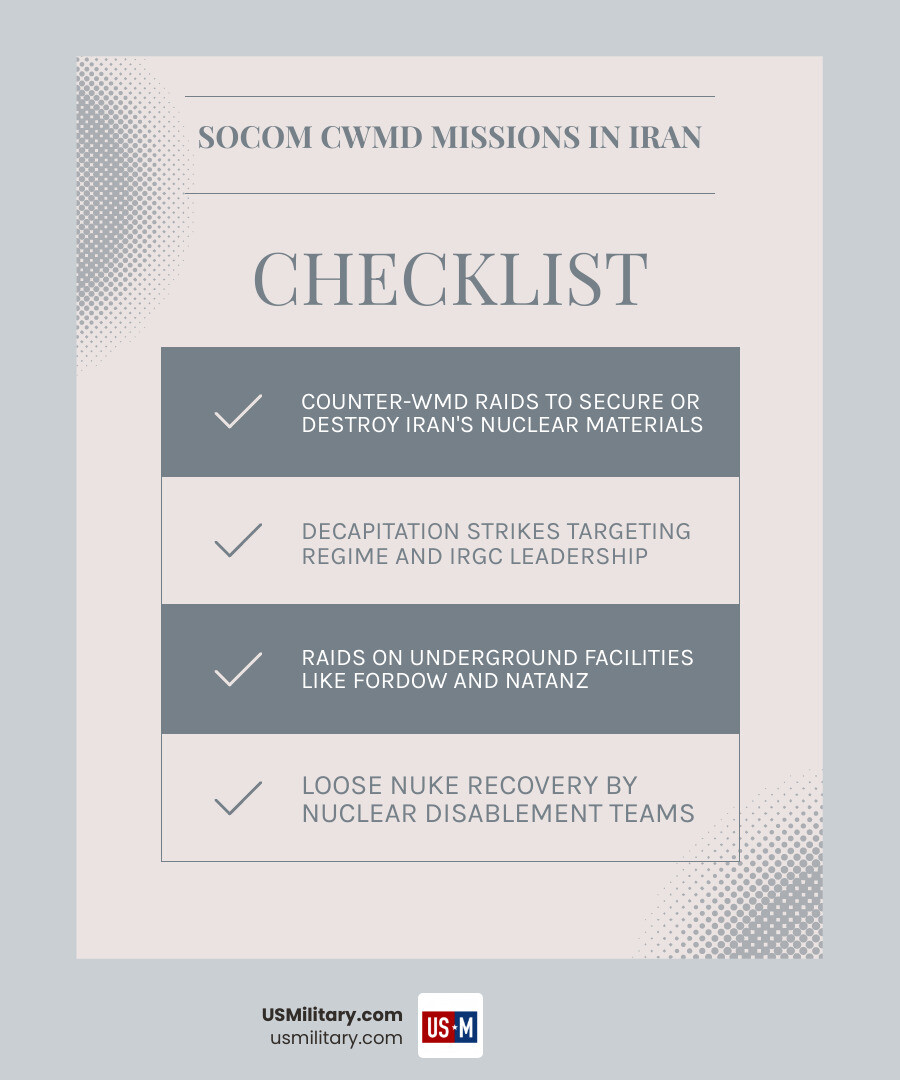
- Counter-WMD raids – Securing or destroying Iran’s nuclear materials before they can be dispersed
- Decapitation strikes – Targeting senior Iranian regime and IRGC leadership
- Underground facility raids – Assaulting hardened sites like Fordow and Natanz alongside units like the 75th Ranger Regiment
- Loose nuke recovery – Deploying Nuclear Disablement Teams (NDTs) to locate, secure, or disable enriched uranium stockpiles
- Proxy network disruption – Neutralizing Iran-backed militia networks across the region
- Intelligence and reconnaissance – Supporting broader air campaigns with on-the-ground targeting data
The stakes are enormous. As of May 2025, the IAEA confirmed Iran held close to 901 pounds of uranium enriched to 60% purity — enough raw material for multiple nuclear weapons if further processed. Meanwhile, the U.S. has assembled its largest military presence in the Middle East since 2003, yet analysts note a critical gap: no significant ground or special operations forces are currently confirmed in the theater.
That gap matters. Air power alone cannot secure nuclear materials. It cannot confirm destruction of underground sites. And it cannot prevent a collapsing regime from dispersing weapons-grade material to proxy groups or rogue actors.
That’s where Army Special Forces come in.
I’m Larry Fowler, publisher of USMilitary.com, and I’ve spent nearly two decades covering U.S. military operations, force structure, and the specialized units trained for exactly the kind of high-stakes scenarios now unfolding around Iran — making how Army Special Forces may be used in today’s attacks on Iran a topic I’ve followed closely through training exercises, policy shifts, and real-world deployments. In the sections ahead, we’ll break down every key mission type, unit, and risk factor in plain language so you have the full picture.
How Army Special Forces May Be Used In Today’s Attacks on Iran helpful reading:
- army ranger vs green beret
- green beret vs navy seal
- Should I join the Marines or the Army Special Forces
The Strategic Role of Special Operations in Counter-WMD Missions
When we talk about nuclear threats, most people think of massive bombers or intercontinental missiles. But the reality of modern warfare is much more surgical. In 2016, the Department of Defense made a pivotal move by designating U.S. Special Operations Command (SOCOM) as the lead entity for the Counter Weapons of Mass Destruction (CWMD) mission. This was a job previously held by STRATCOM, the folks in charge of our nuclear silos.
Why the change? Because “loose nukes” aren’t a problem you solve with a bigger bomb; you solve it with elite soldiers who can pick a lock, hack a terminal, and secure a canister of uranium in total darkness.
Within the Army, the heavy lifting for this mission falls to the 20th CBRNE Command (Chemical, Biological, Radiological, Nuclear, and Explosives). Specifically, the Army maintains three Nuclear Disablement Teams (NDTs). These aren’t just soldiers; they are scientists in uniform, trained to exploit and disable nuclear infrastructure under fire.
The urgency is real. Recent IAEA reports indicate Iran has a stockpile of nearly 901 pounds of 60% enriched uranium. To put that in perspective, about 92.5 pounds is enough to create weapons-grade material for one nuclear bomb. This means Iran is sitting on enough material for roughly nine or ten weapons. Counter WMD Initiatives in National Security have highlighted that special operators have been training for years to prevent this material from being moved or hidden during a conflict. Whether it’s a Special Forces Medical Sergeant providing care during a high-stakes raid or an NDT technician disabling a centrifuge, every role is critical to preventing a nuclear catastrophe.
How Army Special Forces May Be Used In Today’s Attacks on Iran
If the U.S. moves beyond air strikes, the primary objective for Special Forces will be “decapitation”—not just of the nuclear program, but of the regime’s ability to fight back. We’ve seen this play out recently in other theaters. In early 2026, the capture of Venezuelan leader Nicolás Maduro proved that U.S. special operations can reach into a defended capital and extract a high-value target with surgical precision.
Decapitation and Leadership Strikes
In Iran, this would involve targeting the Supreme Leader or top commanders of the Islamic Revolutionary Guard Corps (IRGC). By removing the “head” of the snake, the U.S. aims to cause a collapse in command and control, preventing a coordinated Iranian response.

The 160th Special Operations Aviation Regiment (SOAR), known as the “Night Stalkers,” would be the taxi service for these missions. Their specialized helicopters are designed to fly low and fast, evading the very air defenses that might shoot down a standard fighter jet. Operation Absolute Resolve: A Detailed Analysis shows us that these strikes rely on a massive intelligence-to-action ratio—sometimes hundreds of hours of surveillance for a mission that lasts only minutes.
Neutralizing Proxies and Missiles
Army Special Forces, particularly Delta Force operators, are also experts at disrupting proxy networks. Iran relies heavily on groups like Hezbollah and various militias in Iraq and Yemen. Special Forces can conduct “sabotage” missions, destroying missile launch sites or drone factories before they can be used to retaliate against U.S. bases or allies.
Precision Raids on Hardened Underground Facilities in Today’s Attacks on Iran
A challenge in Iran is that their most dangerous assets are buried deep underground. Sites like Fordow and Natanz are carved into mountains and protected by meters of reinforced concrete. While the U.S. has “bunker buster” bombs, they don’t always finish the job.
This is where the 75th Ranger Regiment comes in. In 2024, Rangers partnered with NDT 1 for a training exercise that simulated a raid on a mock underground nuclear site. The goal? To fight their way into a facility, hold it against enemy counter-attacks, and allow the specialists to disable the equipment inside.
There are significant differences between Army Rangers and Green Berets. While Green Berets might work with local Iranian dissidents to gather intelligence, the Rangers are the “hammer” used to smash through the front door of a hardened target. They train specifically for “Hard Target Defeat,” using specialized explosives and tactics to navigate the labyrinthine tunnels of a pulse radiation facility or a centrifuge hall.
Securing Loose Nukes and Nuclear Material Extraction in Today’s Attacks on Iran
The nightmare scenario for U.S. planners is not just a nuclear Iran, but a fragmented Iran where nuclear material goes missing. If the regime begins to collapse under the weight of U.S.-Israeli strikes, there is a high risk that enriched uranium could be moved to secret locations or sold to terrorists.
Securing 901 pounds of uranium is no small feat. However, 880 pounds of highly-enriched material can actually fit into just three or four industrial cylinders. This makes it dangerously easy to hide in the back of a civilian truck.
Special Forces would use specialized sensors, including “backpack radiation detectors,” to track these materials in real-time. Analytical reports on Iran’s layered defenses suggest that Iran has built a complex shield of mines and missiles to keep U.S. forces away, but Special Forces are designed to slip through these cracks. Once a “hot” target is identified, NDT 1 and SOF units would be tasked with the “recovery and extraction” of the material, likely using heavy-lift helicopters to fly the canisters out of the country before they can be weaponized.
Key Units and Specialized Capabilities for Iranian Operations
To understand how Army Special Forces may be used in today’s attacks on Iran, we have to look at the specific tools in the shed.
- Delta Force (1st SFOD-D): The primary “Direct Action” unit. If there is a high-value target to be captured or a specific piece of nuclear technology to be destroyed, Delta gets the call. You can find everything you need to know about Delta Force on our site, but suffice it to say, they are the best in the world at close-quarters battle.
- Green Berets (Special Forces Groups): Their role is often “Unconventional Warfare.” They are likely already in contact with Iranian dissident groups, helping to guide air strikes and preparing the ground for larger operations.
- 160th SOAR (Night Stalkers): As mentioned, they provide the insertion. Learning how to become a Night Stalker involves mastering the art of flying in zero-visibility conditions—a must for the mountainous terrain of Iran.
- 75th Ranger Regiment: The premier light infantry raid force. They provide the security perimeter and the “muscle” for large-scale raids on nuclear sites.
These units don’t work in isolation. They are part of the Joint Special Operations Command (JSOC), which integrates satellite intelligence, cyber warfare, and ground truth to create a “kill chain” that can react in seconds.
Risks, Challenges, and Lessons from Operation Absolute Resolve
We shouldn’t pretend these missions are easy or without cost. The recent raid in Venezuela, while successful, showed how quickly things can go wrong. During that operation, an MH-47 Chinook carrying Delta Force commandos came under heavy fire. The pilot was shot three times in the leg but managed to keep the bird in the air to complete the mission.
In Iran, the risks are even higher. Unlike Venezuela, Iran possesses sophisticated S-300 air defense systems and a much larger military. Former U.S. Military Leaders Warn of Risks, noting that Iran’s geography—vast deserts and rugged mountains—provides endless places for the regime to hide assets.
Iranian Countermeasures:
- GPS Jamming: Iran has shown a high capability for electronic warfare, which can mess with drone navigation and SOF communications.
- The Basij Militia: This is a “people’s army” potentially millions strong. Even if the regular army is defeated, Special Forces could face a massive, decentralized insurgency in every city.
- Strait of Hormuz: Iran has threatened to mine this vital waterway. Any SOF mission near the coast would have to contend with “fast boats” and shore-based anti-ship missiles.
Frequently Asked Questions about Special Forces in Iran
Can Army Special Forces achieve regime change in Iran alone?
No. While a decapitation strike can remove key leaders, the Iranian regime is incredibly robust. Between the IRGC, the regular army, and the Basij militia, there are over a million people dedicated to the regime’s survival. Special Forces can create the opportunity for change, but true regime change would likely require a massive internal uprising by the Iranian people, supported by a sustained air campaign.
What is the specific role of Nuclear Disablement Teams (NDTs)?
NDTs are part of the 20th CBRNE Command. Their job isn’t to blow things up—it’s to safely take them apart. In an Iran scenario, they would enter a captured nuclear facility to “exploit” the site (gather intelligence) and then “disable” it (make sure the centrifuges never spin again). They are the technical experts who ensure that “neutralized” actually means neutralized.
How does the 2026 Venezuela raid inform potential Iran operations?
Operation Absolute Resolve proved that the U.S. can successfully integrate “Suppression of Enemy Air Defenses” (SEAD) with a high-speed helicopter raid. It showed a 1,200:1 intelligence-to-action ratio, meaning the U.S. had a near-perfect “pattern of life” on the target before moving in. However, Iran is a much larger and more capable adversary, meaning the “luck” we had in Venezuela might not hold.
Conclusion
At USMilitary.com, we believe that understanding the “how” and “why” of military operations is essential for every service member and veteran. How Army Special Forces May Be Used In Today’s Attacks on Iran isn’t just a headline; it’s a look into the future of asymmetric warfare. Our strategic readiness depends on these elite units and their ability to handle the world’s most dangerous materials in the world’s most dangerous places.
As the situation in the Middle East continues to evolve, the eyes of the world will be on the Green Berets, the Rangers, and the Night Stalkers. If you’re interested in how these elite Army units stack up against other branches, be sure to compare Army Delta Force vs Navy SEALs to see the unique strengths each brings to the fight. Stay safe, stay informed, and thank you for your service.