
Overview of Military Childcare Fee Assistance and MCCYN

When on-installation child care facilities are unavailable due to long waitlists or distance, the Department of Defense (DoD) provides financial assistance to offset civilian child care costs. Military childcare fee assistance bridges the financial gap between what service members pay at installation Child Development Centers (CDCs) and the higher prices charged by civilian child care centers.
The primary mechanism for this support is the Military Child Care in Your Neighborhood (MCCYN) program. Funded by the DoD, MCCYN subsidizes off-base child care by paying fee assistance directly to approved community-based providers. This ensures military families receive consistent, affordable, high-quality care for children ages 6 weeks through 12 years.
Who Qualifies for Military Childcare Fee Assistance?
Eligibility for MCCYN and branch-specific fee assistance programs is based on sponsor status, family situation, and proximity to military child care facilities. To qualify, families generally fit into one of the following sponsor categories:
- Active Duty Soldiers and Service Members: Active duty members of the Army, Navy, Air Force, Marine Corps, Space Force, and Coast Guard.
- Guard and Reserve Components: National Guard and Reserve personnel activated under Title 10 or Title 32 orders for 30 consecutive days or more.
- DoD Civilians: Full-time Department of Defense civilian employees (subject to branch-specific funding and local eligibility parameters).
- Gold Star Spouses: Surviving spouses of service members who died while on active duty.
Geographic location is a critical eligibility factor. Families living outside a 15-mile radius or a 20-minute drive from an installation child care facility qualify for off-base fee assistance. If you reside within that 15-mile catchment area, you must request care at the installation CDC first. If on-post care is unavailable, you must obtain an official Statement of Non-Availability (SNA) or waitlist verification before receiving off-base fee assistance.
Additionally, the sponsor’s child must be enrolled in the Defense Enrollment Eligibility Reporting System (DEERS). Spouses must also meet minimum work or school activity requirements, which we detail later in this guide. To learn more about branch benefits, review the official Military Child Care in Your Neighborhood (MCCYN) portal and check our guide on Military Support Benefits for Single Parents.
Differences Between MCCYN and MCCYN-PLUS Programs
While both programs subsidize off-base child care, they differ in provider accreditation requirements:
- Standard MCCYN: Requires civilian child care centers to hold national accreditation from a DoD-approved agency (such as the National Association for the Education of Young Children). Family Child Care (FCC) homes must hold national accreditation or meet state licensing standards.
- MCCYN-PLUS: Introduced as a program expansion in select states where accredited civilian child care is limited. MCCYN-PLUS allows families to use non-accredited, state-licensed child care centers, provided the facility participates in its state’s Quality Rating and Improvement System (QRIS) at an approved tier level.
MCCYN-PLUS expands off-base child care access in areas where finding nationally accredited facilities is difficult, allowing families to receive fee assistance without sacrificing safety standards.
How to Apply for Fee Assistance via MilitaryChildCare.com and CCAoA

Applying for military childcare fee assistance requires navigating two linked systems: MilitaryChildCare.com (MCC) and the Child Care Aware of America (CCAoA) portal.
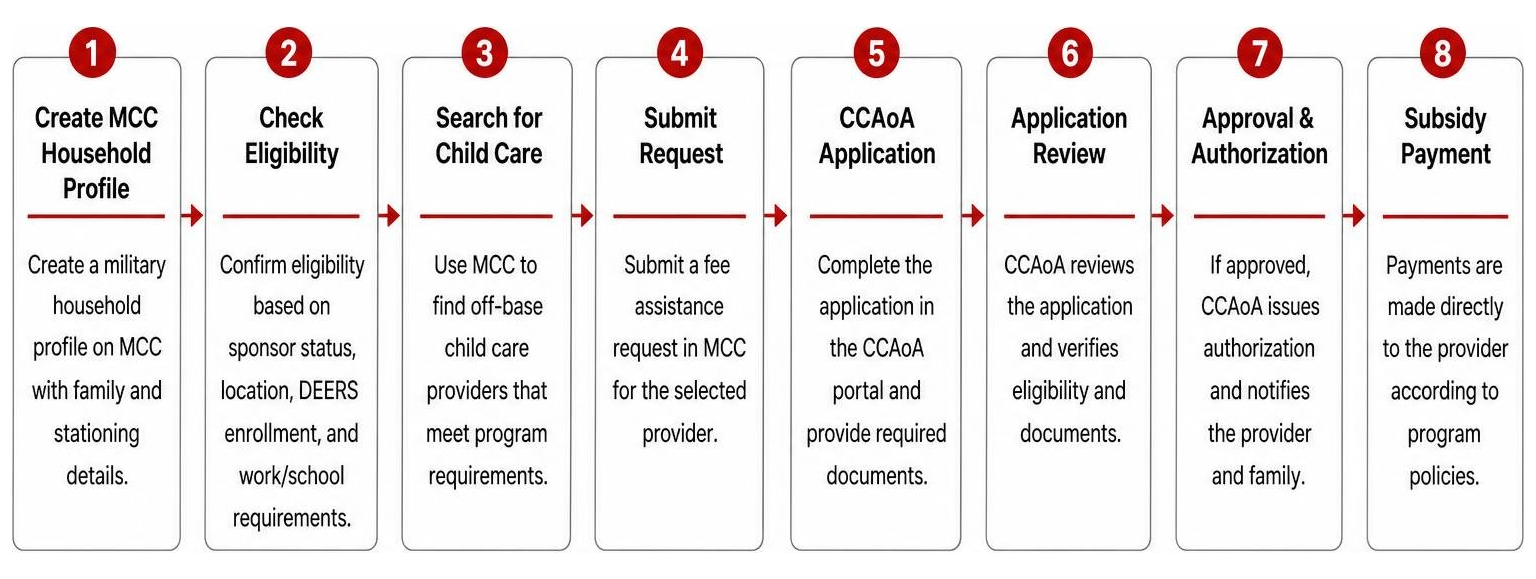
Step-by-Step Army Fee Assistance Application Process
Army families and other military branches follow a sequential, multi-step application workflow:
- Create a Household Profile on MCC: Go to MilitaryChildCare.com and establish a military household profile with your family and stationing details.
- Submit a Request for Care (RFC): Search for community-based MCCYN fee assistance programs in your area and submit an RFC directly on MCC.
- Receive and Accept an Offer: Once a fee assistance space or slot opens, MCC issues an official offer via email. You must log in and accept this offer within 2 business days.
- Complete the CCAoA Portal Application: After accepting the offer, log in to the Child Care Aware of America enrollment portal to complete your financial profile, upload required documents, and link your selected child care provider. Access the Army Fee Assistance portal to finalize your records.
Understanding these steps ensures your service member family receives maximum coverage. Read more about spouse eligibility and benefits in our guide on Benefits Being Military Spouse.
Time-Sensitive Steps: The 2-Day Acceptance and 90-Day Deadlines
When navigating the application process, watch out for two strict deadlines:
- The 2-Business-Day Offer Acceptance Window: When an offer of fee assistance is issued through MilitaryChildCare.com, you have exactly 2 business days from the email timestamp to accept it. If you fail to respond in time, the offer expires automatically, your request is canceled, and you must reapply.
- The 90-Day Application Completion Deadline: From the date you submit your initial application packet on the CCAoA portal, you have 90 calendar days to upload all required supporting documentation from both yourself and your child care provider. If your application remains incomplete at 90 days, your profile will be deactivated, and you risk forfeiting retroactive subsidy payments.
Required Documents and Community Provider Eligibility Criteria
To maintain compliance and verify eligibility for military childcare fee assistance, families and providers must submit specific documentation.
Required Documents for Sponsors and Spouses
Both the service member sponsor and spouse/domestic partner must verify their eligibility status:
Sponsor Documentation
- Active Duty / Reservist: Recent Leave and Earnings Statement (LES) dated within the last 90 days. Activated Guard/Reserve personnel must attach Title 10 or Title 32 military orders showing active duty status for 30+ consecutive days.
- DoD Civilian: Latest SF-50 (Notification of Personnel Action) and recent CLES (Civilian Leave and Earnings Statement).
Spouse / Domestic Partner Verification
- Employed Spouse: Paystubs covering the most recent 30 consecutive days. Spouses must work a minimum of 25 hours per week for full-time fee assistance eligibility, or 16 to 24 hours per week for part-time fee assistance.
- Student Spouse: Official school enrollment verification showing course load. Full-time undergraduate status requires at least 12 credit hours per semester; graduate status requires at least 9 credit hours.
- Job-Seeking Spouse: Spouses actively looking for work can request a one-time 90-day temporary certification period, giving them time to find employment while receiving fee assistance.
For comprehensive paperwork guidelines, check our Military Spouse Benefits Complete Guide.
Community Provider Requirements and Locating Child Care
Not every off-base child care center qualifies for government subsidies. To participate in MCCYN, civilian community providers must meet strict criteria:
- Hold a current, valid state child care license.
- Undergo annual state licensing inspections with clean health and safety records.
- Complete background check clearances for all facility staff and caregivers.
- Maintain national accreditation or state QRIS ratings (for MCCYN-PLUS).
If you are struggling to locate an eligible provider in your area, visit Child Care Financial Assistance for Military Families – ChildCare.gov or call Child Care Aware of America at 1-800-424-2246 for personalized family placement assistance.
Calculating Your Subsidies and Understanding Parent Fees
The Department of Defense uses a standardized formula to determine how much fee assistance your provider receives and how much you pay out of pocket.
Calculating Your Military Childcare Fee Assistance Amount
Your monthly financial obligation equals your designated DoD Parent Fee plus any civilian provider costs that exceed the DoD Provider Rate Cap.
- Total Family Income (TFI): The DoD calculates TFI by combining gross household wages, special pay, and non-locality BAH (Reserve Component/Transit BAH rate), alongside BAS for both adults. Non-locality BAH is used so parent fees remain uniform regardless of where a family is stationed.
- DoD Parent Fee Tiers: Total Family Income falls into 1 of 11 income categories (Categories I through XI). Category I covers incomes from $1 to $45,000, while Category XI covers incomes of $160,001 and above.
- Provider Rate Cap: The DoD caps community fee assistance at $1,800 per child per month (effective January 2024). The Army Fee Assistance subsidy caps at $2,000 per child per month, provided the monthly subsidy difference is at least $20.
| Total Family Income Category | Income Range | Full-Time Basic Parent Fee (Monthly) | Full-Time High-Cost Parent Fee (Monthly) | School-Age Basic Parent Fee (Monthly) |
|---|---|---|---|---|
| Category I | $1 – $45,000 | $234 | $242 | $126 |
| Category V | $77,501 – $90,000 | $450 | $468 | $243 |
| Category X | $138,001 – $160,000 | $845 | $879 | $456 |
| Category XI | $160,001+ | $932 | $970 | $503 |
To calculate exact contributions, review the official Fee Assistance Cost | MCC Central calculator.
Practical Calculation Examples
- Example 1 (Within Rate Cap): A family in Norfolk, VA with a TFI of $148,000 (Category X) has a DoD parent fee of $845 per month. Their community child care center charges $1,500 per month. Since $1,500 is within the $1,800 provider rate cap, the family pays their standard $845 parent fee, and fee assistance covers the remaining $655.
- Example 2 (Above Rate Cap): If that same family selects a provider charging $2,000 per month ($200 above the $1,800 rate cap), fee assistance covers $955 ($1,800 cap minus $845 fee). The family pays their standard $845 fee plus the $200 excess, bringing their total monthly out-of-pocket cost to $1,045.
Additional Resources: Army Respite Care and Alternative Options

Beyond full-time and part-time monthly care, military branches offer specialized child care relief for unique circumstances.
Army Respite Care Eligibility and Allowance
The Army Respite Care program provides hourly child care assistance for service members facing demanding operational cycles or medical recovery:
- Monthly Allocation: Up to 16 hours of no-cost hourly child care per child per month.
- Qualifying Criteria: Available to active duty Soldiers, rotational forces, deployed personnel, and service members assigned to Wounded Warrior transition units.
- Usage: Respite care hours give parents dedicated time for medical appointments, personal errands, or rest outside of full-time work schedules. Care must be delivered by licensed, background-checked respite providers.
DCFSA and Off-Post Assistance Options
Service members can combine DoD fee assistance with pre-tax tax advantages:
- Dependent Care Flexible Spending Account (DCFSA): Service members can set aside up to $5,000 per year in pre-tax earnings to pay for eligible dependent care expenses, including preschool, child care centers, and summer day camps.
- Simultaneous Usage: You can use a DCFSA alongside DoD fee assistance because the tax code treats pre-tax payroll deductions and military fee assistance subsidies differently.
For more details on service benefits, explore our breakdown on More Than Just a Job Essential Active Duty Benefits for Service Members.
Frequently Asked Questions About Military Childcare Fee Assistance
What happens if I miss the 2-business-day acceptance window on MilitaryChildCare.com?
If you miss the 2-business-day deadline, the system automatically cancels the offer and deactivates your care request. You will need to log back into MilitaryChildCare.com, submit a new Request for Care, and return to the waitlist.
Can I use a Dependent Care FSA alongside military childcare fee assistance?
Yes. Service members can use a Dependent Care Flexible Spending Account (DCFSA) alongside military childcare fee assistance. The DCFSA lets you pay out-of-pocket child care costs (such as your DoD parent fee or rate cap overages) using up to $5,000 in pre-tax earnings.
How does my Total Family Income affect my monthly out-of-pocket childcare fees?
Your Total Family Income (TFI) determines your assigned DoD Parent Fee Category (Categories I through XI). Higher TFI tiers pay a higher monthly parent fee, while lower income categories receive higher subsidy rates to keep child care affordable across all ranks.
Conclusion
Securing affordable, reliable child care is crucial for military readiness and family well-being. By leveraging military child care fee assistance through the MCCYN and MCCYN-PLUS programs, families can save thousands of dollars each year on off-base child care costs.
To maximize your benefits, create your household profile on MilitaryChildCare.com, track time-sensitive offer notifications, submit required documents within 90 days, and pick approved community providers. For more guidance on active-duty entitlements and financial support, visit USMilitary.com VA Benefits and Military Resources.