
Military enlistment bonus programs are one of the most powerful financial incentives available to people joining the armed forces today. Depending on your branch, job, and contract length, you could walk away with tens of thousands of dollars — sometimes much more.
Here’s a quick look at what’s currently on the table:
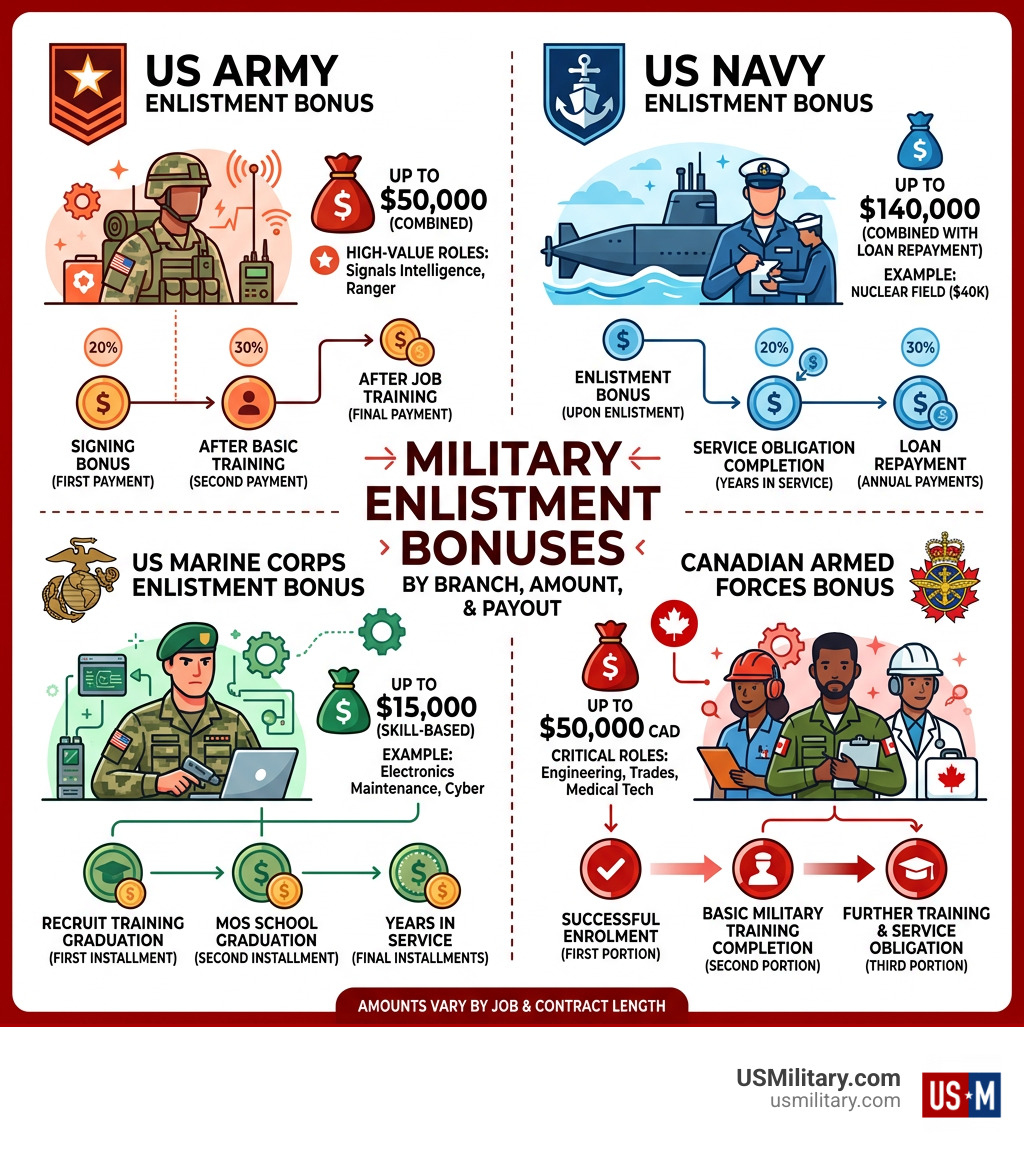
| Branch | Max Enlistment Bonus | Notable High-Value Role |
|---|---|---|
| US Army | Up to $50,000 (combined) | Signals Intelligence, Ranger |
| US Navy | Up to $140,000 (combined with loan repayment) | Nuclear Field ($40K) |
| Marine Corps | Up to $15,000 (skill-based) | Electronics Maintenance, Cyber |
| Canadian Armed Forces | Up to $50,000 CAD | Engineering, Trades, Medical Tech |
A few things worth knowing upfront:
- Bonuses are tied to specific jobs in high demand — not every role qualifies
- Most are paid in installments, not one lump sum
- You must complete your service obligation or repay the unearned portion
- Amounts change regularly based on recruiting needs and military priorities
The military isn’t just handing out cash to be generous. These bonuses exist because roles in fields like cyber operations, biomedical electronics, and skilled trades are critically understaffed. In Canada, for example, biomedical electronics technologists are only at 55% staffing levels. In the US, the Navy needs nuclear-trained sailors badly enough to offer $40,000 just for that one rating.
I’m Larry Fowler, publisher of USMilitary.com — a network I’ve been running since 2007 to help active duty members, recruits, and veterans navigate benefits like the military enlistment bonus with confidence. Over the years, this platform has connected hundreds of thousands of people with the information and recruiters they need to make smart service decisions.
Read on for a full breakdown of every major bonus program, by branch, eligibility, and payout schedule.
Common Military enlistment bonus vocab:

At its core, a Military enlistment bonus is a recruitment tool used by the Department of Defense (DoD) to ensure the military has the right people in the right places. According to DoD Instruction 1304.31, these bonuses are technically referred to as the Enlisted Bonus Program (EBP). They aren’t just “free money”—they are a strategic investment in personnel.
The military uses a complex set of criteria to decide who gets a bonus and how much. This includes:
- Skill Criticality: Is this a job that is vital to national security but hard to fill? (Think Cyber Operations or Nuclear Technicians).
- Manpower Requirements: Is the career field currently staffed at 95% or lower?
- Civilian Market Demand: Does the military have to compete with high-paying private-sector jobs for these same skills?
When you sign your contract, you are agreeing to a specific service obligation, usually between three and six years. To learn more about how these incentives are categorized, you can read more info about enlisted military job incentives.
It is important to remember that these bonuses are budget-dependent. Each branch receives a specific allocation of funds for recruitment each fiscal year. Once those funds are exhausted or the recruitment goals for a specific job are met, the bonus might vanish overnight. This is why we always recommend talking to a recruiter as soon as you find a role that interests you.
Branch-Specific Opportunities and High-Demand Roles
Every branch has its own “pain points”—occupations that are notoriously difficult to keep staffed. In the current recruiting climate, technical trades and cyber operations are at the top of the list.
While the U.S. and Canada share similar struggles in filling these roles, the specific occupations can vary. For those looking north of the border, you can check out the full list of eligible occupations in the CAF. Currently, 54 non-commissioned member occupations and eight officer roles offer signing bonuses in the Canadian Armed Forces (CAF). These include critical shortages in plumbing and heating technicians (60% staffed) and biomedical electronics technologists (55% staffed).
In the U.S., the focus is heavily on high-tech and high-intensity roles. Let’s break down the specific opportunities in the American branches.
US Army Military Enlistment Bonus
The Army is currently offering some of the most flexible bonus structures we’ve seen. Qualified active-duty recruits can stack different incentives to reach a maximum of $50,000.
Some of the standout Army bonuses include:
- Quick Ship Bonus: If you are ready to head to Basic Training within 30 days of enlisting, you could earn up to $10,000 on top of other incentives.
- High-Demand MOS: Jobs like 35P (Signals Intelligence Voice Interceptor) can command up to $40,000.
- Ranger Bonus: Signing up for a Ranger contract can net you an additional $20,000.
- Civilian Acquired Skills: If you already have a certification or trade skill that the Army needs, you may qualify for a bonus of up to $45,000.
The Army also recently utilized a 5000 bonus for new training brigade to help stand up specific units. Whether you are interested in combat arms or technical support, the Army’s “combination” approach allows you to maximize your payout.
US Navy Military Enlistment Bonus
The Navy has made headlines recently by offering a massive total incentive package of up to $140,000. This isn’t all cash upfront; it is a combination of the Enlisted Bonus (EB) and the Student Loan Repayment Program (LRP).
Key Navy highlights:
- Nuclear Field (NUC-NF): One of the most demanding academic paths in the military comes with a $40,000 bonus.
- Special Operations: If you have the grit for EOD or AIRR, you’re looking at $30,000. These often require “Elevated Physical Screening Test” (EPST) scores—basically, you have to be in elite shape before you even ship.
- Shipping Bonuses: Depending on when you agree to head to boot camp, the Navy may offer between $10,000 and $30,000 just for “shipping” during a specific window.
- Prior Service: If you’ve served before, the Navy Reserve offers affiliation bonuses for those who bring their experience back to the fleet.
You can view the most current Navy Enlistment Bonus rates to see which ratings (jobs) are currently paying the most.
Marine Corps and Air Force Incentives
The Marine Corps tends to offer lower cash bonuses than the Navy or Army, but they are highly targeted toward “Force Design” priorities. For FY26, the Marines are focusing on technical and cyber roles.
- Electronics Maintenance (BY/QY): $15,000 bonus.
- Cyber and Crypto Operations (DG/QQ): $15,000 bonus.
- Shipping Bonuses: Ranging from $5,000 to $10,000 for those who ship to Recruit Training during specific months.
The Air Force and Air National Guard also provide significant incentives. A unique feature of the Air National Guard is their payout structure—often paying out $50,000 in equal $10,000 installments over five years. This provides a steady “second income” for citizen-airmen.
For the most official breakdown of Marine incentives, check the FY26 Marine Corps Enlistment Incentive Programs message.
Eligibility Criteria and Payout Schedules
Getting a Military enlistment bonus isn’t as simple as signing your name and getting a check the next day. There are strict hurdles you must clear first.
General Eligibility Requirements:
- Education: Most bonuses require at least a high school diploma.
- Test Scores: You must achieve a certain score on the ASVAB (Armed Services Vocational Aptitude Battery) to qualify for high-demand technical roles.
- Physical Standards: For Special Operations or combat roles, you must pass rigorous physical screenings.
- Contract Length: Many of the largest bonuses require a 5-year or 6-year commitment.
How the Money Reaches Your Pocket:
In the U.S. military, you almost never get the full bonus in a lump sum immediately. The standard structure is:
- Initial Payment: Usually 50% of the total bonus is paid after you successfully complete both Basic Training and your advanced technical training (A-School or MOS School).
- Installments: The remaining 50% is typically paid out in annual increments over the remainder of your contract.
U.S. vs. Canadian Payout Comparison:
In Canada, the structure is slightly different. For a $50,000 CAD allowance:
- $10,000 is paid after Basic Military Qualification.
- $20,000 is paid once you are fully qualified in your trade.
- $20,000 is paid after completing six years of continuous service.
The “Catch”: Repayment Penalties
If you fail to complete your service obligation—whether due to misconduct, failing a drug test, or simply leaving the military early—you will likely be required to repay the “unearned” portion of your bonus. The military is very efficient at recouping these funds, often by garnishing your final paychecks.
Beyond the Cash: Additional Military Incentives
While a Military enlistment bonus is the most visible incentive, it is often just the tip of the iceberg. Smart recruits look at the total “compensation package.”
Student Loan Repayment
If you already have college debt, the military’s Loan Repayment Program (LRP) can be worth more than a cash bonus. The Navy, for example, offers up to $65,000 in loan repayment. When combined with an enlistment bonus, this is how sailors reach that $140,000 incentive cap.
Education and the GI Bill
The Post-9/11 GI Bill is arguably the greatest wealth-building tool in the military. It covers 100% of tuition at public universities, provides a monthly housing allowance, and gives you a stipend for books. Some members even choose to serve in specific roles, like becoming a cash bonus as an imagery analyst in the National Guard, to balance civilian education with military service.
Accelerated Promotion
Did you know you can enter the military at a higher rank? If you have college credits, were an Eagle Scout, or participated in JROTC, you could enlist as an E-2 or E-3. This means a higher base salary from day one, which adds up to thousands of dollars over a four-year contract.
ABLE Accounts for Veterans
A recent and significant change as of January 1, 2026, is the expansion of ABLE accounts. These are tax-advantaged savings accounts for individuals with disabilities. The “ABLE Age Adjustment Act” raised the onset age for disability from 26 to 46, making an estimated one million more veterans eligible to save up to $20,000 a year tax-free without losing their VA benefits.
The Athlete Path: RMC and the Kane Sisters
For those looking at officer paths, the Royal Military College (RMC) in Canada offers a unique model. Recruits like the Kane sisters—who were recruited for their fencing skills—receive a free education, a guaranteed job upon graduation, and a pension, all while competing in collegiate sports. It’s a reminder that “incentives” aren’t always just cash; they are about long-term job security and debt-free living.
Frequently Asked Questions about Military Enlistment Bonuses
Do I have to pay back my bonus if I leave early?
Yes. If you do not fulfill the terms of your contract (the “service obligation”), the military will calculate the “unearned” portion of your bonus and require you to pay it back. For example, if you received $20,000 for a 4-year contract but left after 2 years, you would likely owe $10,000 back to the government.
Are military bonuses paid in one lump sum?
Rarely. Most Military enlistment bonus payments are split. You typically receive the first half after finishing your job-specific training, with the rest paid out in annual installments. Always check your specific contract for the payout schedule.
Can prior service members receive a new enlistment bonus?
Yes, in many cases. If you are a veteran “affiliating” with the Reserves or enlisting back into Active Duty in a “critically undermanned” role, you may be eligible for a prior service bonus. The Navy and Army both have specific programs for this.
Conclusion
A Military enlistment bonus can be a life-changing sum of money, providing the down payment for a home, a fund for starting a business, or a safety net for your family. However, these bonuses are tools for the military to fill their most difficult roles. You should never pick a job only for the money—you have to do that job every day for the next several years!
At USMilitary.com, we want to see you succeed. Whether you are eyeing a $50,000 Army bonus or a $140,000 Navy incentive package, the best first step is to get the facts. Talk to a recruiter, ask for the “Statement of Understanding” in writing, and make sure you understand the commitment you are making.
Your future starts with a single conversation. If you’re ready to explore your options, we can help you find a military recruiter near me to get the latest, most accurate bonus numbers for your area.