
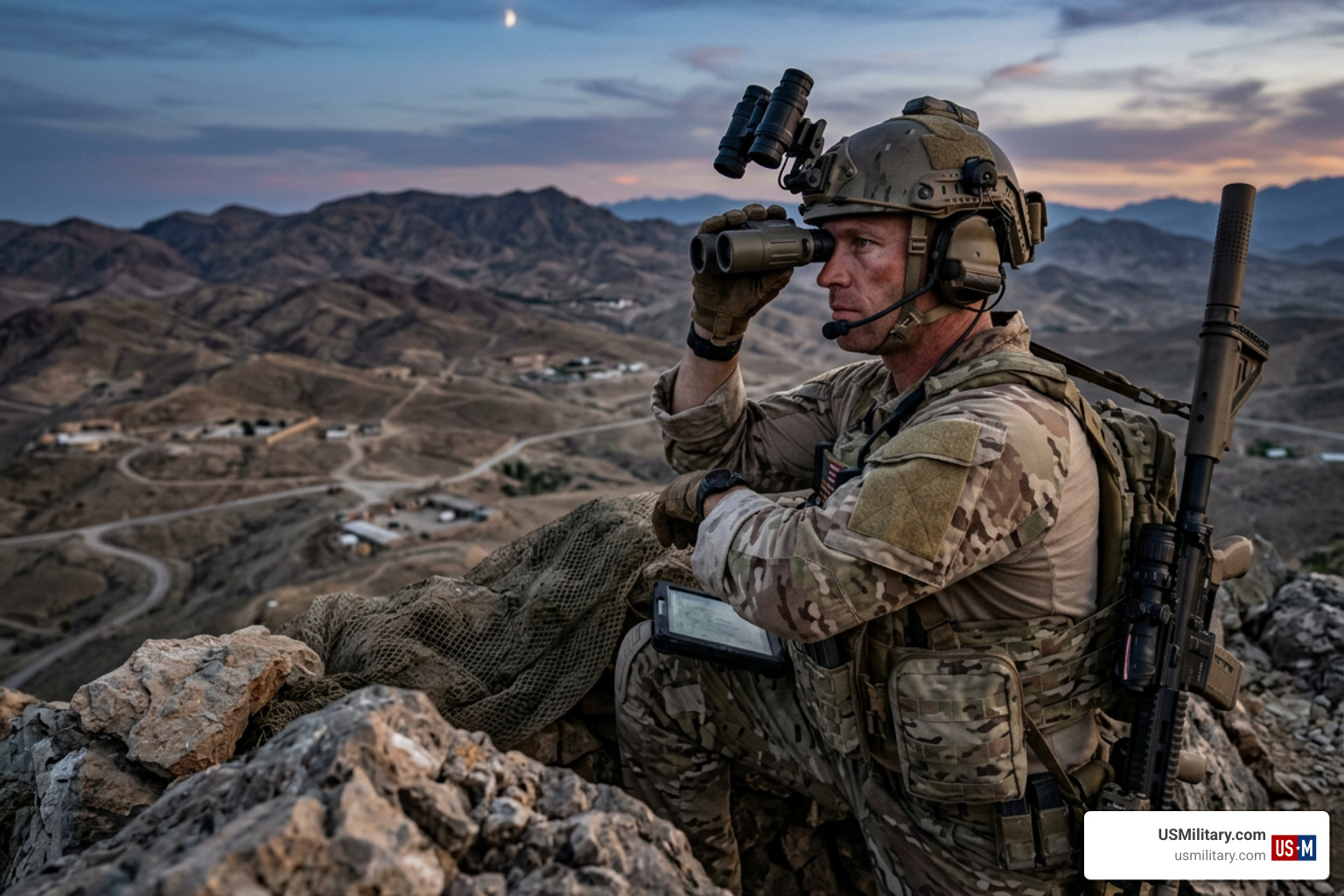
How to think like Army Delta Force operator comes down to a core set of mental habits that the world’s most elite soldiers use every day. Here’s a quick breakdown:
- Discipline over talent – Consistent routines beat raw ability every time
- Adapt fast – Make decisions with incomplete information and adjust on the fly
- Stay aware – Constantly read your environment for threats and opportunities
- Embrace failure – Use setbacks as data, not defeat
- Lead by example – Actions speak; words don’t
- Think as a team – No lone wolves; trust and collaboration win missions
- Never stop learning – The best operators are always students
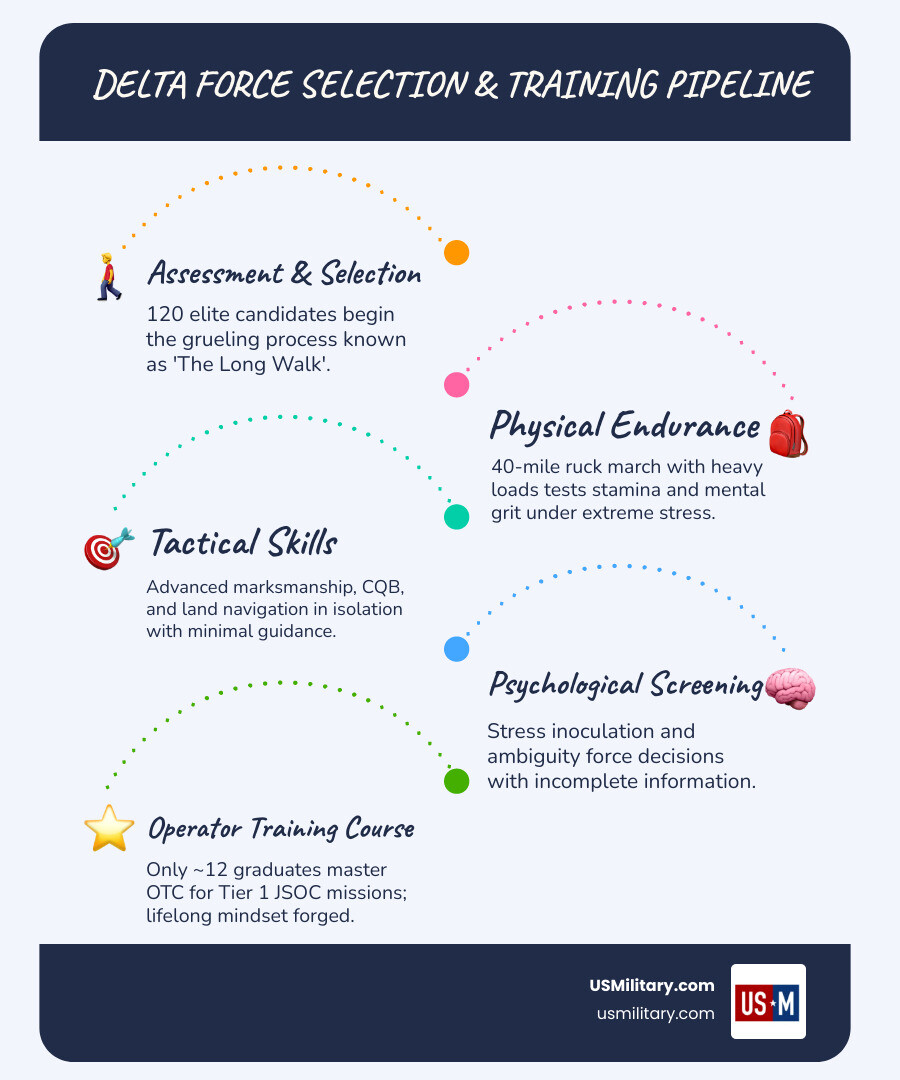
Delta Force – officially known as the 1st Special Forces Operational Detachment-Delta (1st SFOD-D) – is the U.S. Army’s most elite Tier 1 counterterrorism unit. It operates under JSOC, runs classified missions, and accepts only a tiny fraction of candidates who attempt selection. Out of a class of roughly 120, as few as a dozen may make it through.
But here’s the thing: the mental framework that gets operators through that gauntlet isn’t locked away in a classified document. It’s a set of learnable habits – and they work just as well in business, leadership, and everyday life as they do on a combat mission.
I’m Larry Fowler, publisher of USMilitary.com and a longtime resource for active-duty service members and veterans navigating military life. My work across the military community has given me a deep appreciation for the mindset that separates operators like those in Delta Force – and understanding how to think like Army Delta Force operator is something I’ve seen change lives well beyond the battlefield. Read on and I’ll walk you through exactly how it’s done.
Quick How To Think Like Army Delta Force Operator terms:
- Delta Force gear
- delta special forces
- covert operations training
The Foundation: Discipline and the “No-Fail” Mission Prep
In elite operations, there is a common saying: “Professionals are predictable.” This doesn’t mean they are easy to beat; it means they have mastered their routines so thoroughly that their performance is guaranteed. When we look at how to think like Army Delta Force operator, the first pillar is an obsession with discipline over raw talent.

While talent is a nice starting point, it is discipline that carries an operator through “The Long Walk”—the brutal 40-mile ruck march that serves as the climax of Delta selection. Talent might help you run fast, but discipline keeps you moving when your feet are bleeding and your mind is screaming to quit. This mindset shifts the focus from “being the best” to “doing the work.”
Meticulous Preparation for “No-Fail” Scenarios
To an operator, a “no-fail” mission—like a high-stakes hostage rescue—requires preparation that borders on the fanatical. This involves:
- The 24-Hour Rule: Operators are taught to carry enough gear to survive at least 24 hours beyond the planned mission length. This includes extra water, batteries, and night vision, even if the “plan” says they’ll be back by dinner.
- Routine as a Weapon: By turning essential tasks into second-nature habits, operators free up their cognitive bandwidth to solve complex problems under fire.
- The Kobe Bryant Factor: Much like the late NBA legend, Delta operators build unshakeable confidence through the sheer volume of their preparation. They don’t hope they will succeed; they know they will because they have already played out every failure scenario in training.
Understanding inside the kit: Delta Force’s essential equipment shows that every ounce of gear is selected with a purpose. This level of detail is the hallmark of an elite mindset. Excellence isn’t an act; it’s a habit born from the discipline of doing the small things right, every single time.
How To Think Like Army Delta Force Operator: Mastering Adaptability
If discipline is the foundation, adaptability is the engine. In combat, plans rarely survive the first few seconds of engagement. As Mike Tyson famously noted, “Everyone has a plan ’til they get punched in the mouth.” To how to think like Army Delta Force operator, you must learn to embrace the “punch” and adjust instantly.
The 70% Solution
One of the most critical mental models used by Tier 1 operators is the “70% solution.” In high-stakes environments, waiting for 100% intelligence or a perfect plan usually means the window of opportunity has closed. Operators are trained to take action once they have about 70% of the information they need. They rely on their logic and experience to fill the gaps while moving forward.
This requires a unique balance of logic over emotion. While an untrained person might freeze due to the ambiguity of a situation, an operator uses tactical psychology to remain flexible. They understand the difference between a Green Beret vs Ranger approach and apply the specific level of aggression or finesse required for the current problem.
Adaptability means:
- Freezing the Escape Routes: If a plan fails, you don’t panic; you secure the perimeter and reassess.
- Managing the “Squirters”: In tactical terms, “squirters” are enemies fleeing the scene. In life, these are the unexpected side effects of a problem. An operator stays calm enough to address these without losing sight of the main objective.
- Valuing Ground Truth: Operators prioritize what they see with their own eyes over what a distant headquarters tells them.
Tactical Psychology: Focus and Situational Awareness
Situational awareness is often the difference between success and disaster. For a Delta operator, this isn’t just “looking around”—it’s a high-level cognitive process of identifying, processing, and comprehending critical elements in the environment.
Recognizing Baseline Variance
Every environment has a “baseline”—the normal state of affairs. To how to think like Army Delta Force operator, you must train your brain to spot “variances” from that baseline. If you are in a crowded market and the birds suddenly stop chirping, or the local shopkeepers begin closing their doors early, that is a variance. Recognizing these small clues allows the most feared special forces operators in the US military to react before a crisis even begins.
| Feature | High-Stress Decision Making | Calm Delta Operator Decision Making |
|---|---|---|
| Focus | Tunnel vision / Panic | Expanded situational awareness |
| Breathing | Shallow and rapid | Controlled tactical breathing |
| Information | Overwhelmed by “noise” | Filters for “ground truth” |
| Action | Reactive / Emotional | Proactive / Logical |
Maintaining Focus: How To Think Like Army Delta Force Operator in High-Stress Situations
When the pressure hits, the human body naturally wants to go into “fight or flight” mode. Operators use stress inoculation and emergency conditioning to override these instincts.
- Visualization: By vividly imagining a crisis—including the smells, sounds, and sensations—operators “battle-proof” their minds. When the real emergency happens, the brain feels like it has been there before, reducing the shock.
- Mental Triggers: Many operators use a “trigger” image—like their family or a specific goal—to ignite a surge of focus when they are at their physical and mental limits.
- Cognitive Control: Using techniques like box breathing (inhale 4, hold 4, exhale 4, hold 4), they manually lower their heart rate to keep their thinking clear and logical.
The Growth Mindset: Embracing Failure and Lifelong Learning
One of the biggest misconceptions about Delta Force is that they are “perfect” soldiers who never make mistakes. In reality, the unit is designed to find people who are comfortable being vulnerable and admitting when they’ve messed up.
The selection process is designed to dismantle the ego. If a candidate is too arrogant to admit a mistake during a land navigation exercise, they are usually sent home. This is because, in a real-world mission, an ego can get people killed. Learning who is Kevin Holland? Former Navy SEAL’s heroic journey to Delta Force highlights the resilience required to move between elite units and constantly prove one’s worth through performance rather than talk.
Why a Student Mindset is Critical to How To Think Like Army Delta Force Operator
The “Quiet Professional” is, above all else, a lifelong student. Even the most senior operators are constantly seeking out subject matter experts to learn new skills, whether it’s a new language at the Defense Language Institute or a new breaching technique.
- Post-Mission Debriefs: Every operation, successful or not, ends with a “hot wash” or After Action Review (AAR). Operators brutally critique their own performance to find areas for improvement.
- Intellectual Curiosity: Delta operators are often highly educated, scoring 110 or higher on the ASVAB GT section. They are expected to understand the political, cultural, and technological nuances of their mission area.
- Self-Correction: The ability to realize you are on the wrong path and pivot without emotional attachment to the old plan is a hallmark of the elite mindset.
Leadership and Teamwork: Beyond the Lone Wolf Myth
Hollywood loves the “lone wolf” hero, but in the 1st SFOD-D, that guy is a liability. Missions are won by small, highly integrated teams where trust is the primary currency.
The Alpha Who Can Follow
While every operator is an “alpha” in terms of capability and drive, they must also be able to collaborate. Leading by example means being the first one to clean the weapons or pack the rucks, regardless of rank. This builds a culture of accountability where every member feels responsible for the success of the others.
We see this in Navy SEAL DEVGRU operators: The most elite units as well—the shared mission always comes before individual glory.
Key Teamwork Principles:
- Trust Your Subordinates: Give them the objective and the resources, then get out of their way.
- Manage Your Boss: Keep your leadership informed and confident so they can provide the support you need.
- Logic Over Hierarchy: If a junior member has a better, more logical plan for a breach, the team listens. Results matter more than stripes on a sleeve.
Frequently Asked Questions about Delta Force Mindset
What is the attrition rate for Delta Force selection?
The attrition rate is famously high. While the Army doesn’t release official numbers, it is widely reported that out of a starting class of about 120 candidates, usually only 12 to 15 will graduate. The “Long Walk” alone—a 40-mile solo ruck march over mountainous terrain with no set time limit or finish line provided to the candidate—breaks the psychological endurance of many who are physically fit but mentally unprepared for the uncertainty.
Can a civilian apply the Delta Force thinking process to business?
Absolutely. The “70% solution” is a game-changer in the business world. Instead of “analysis paralysis,” a leader who thinks like an operator makes a move, monitors the results, and adjusts. Furthermore, the focus on discipline and “no-fail” routines can help any professional achieve higher levels of consistency and reliability.
What is the difference between Delta Force and SEAL Team 6 mindsets?
While both are JSOC Tier 1 units, their origins differ. Delta was modeled after the British SAS and has a heavy focus on land-based counterterrorism, hostage rescue, and “tradecraft” (operating undercover). SEAL Team 6 (DEVGRU) has its roots in maritime operations. Both require elite mental toughness, but Delta selection often emphasizes solo endurance and psychological evaluations in a “silent” environment. You can read more about their history in special operations during the Cold War.
Conclusion
Learning how to think like Army Delta Force operator isn’t about becoming a “tough guy”—it’s about becoming a “smart guy” who refuses to quit. It is the application of extreme discipline, the courage to be adaptable, and the humility to never stop learning. Whether you are facing a challenge in your career, your fitness, or your personal life, these five methods provide a roadmap for resilience.
At USMilitary.com, we are dedicated to providing the resources and insights that help our community excel, both in and out of uniform. If you’re ready to dive deeper into the differences between these elite units, be sure to compare Army Delta Force vs Navy SEALs to see which mindset fits your path. Remember: the strongest muscle you have is the one between your ears. Use it like an operator.