
The Cognitive Foundation: ASVAB Scores and Mental Aptitude
Is Intelligence a Factor on Becoming Army Delta Force? Yes — and it may matter more than you think.
Here’s a quick breakdown:
| Intelligence Factor | How It’s Measured |
|---|---|
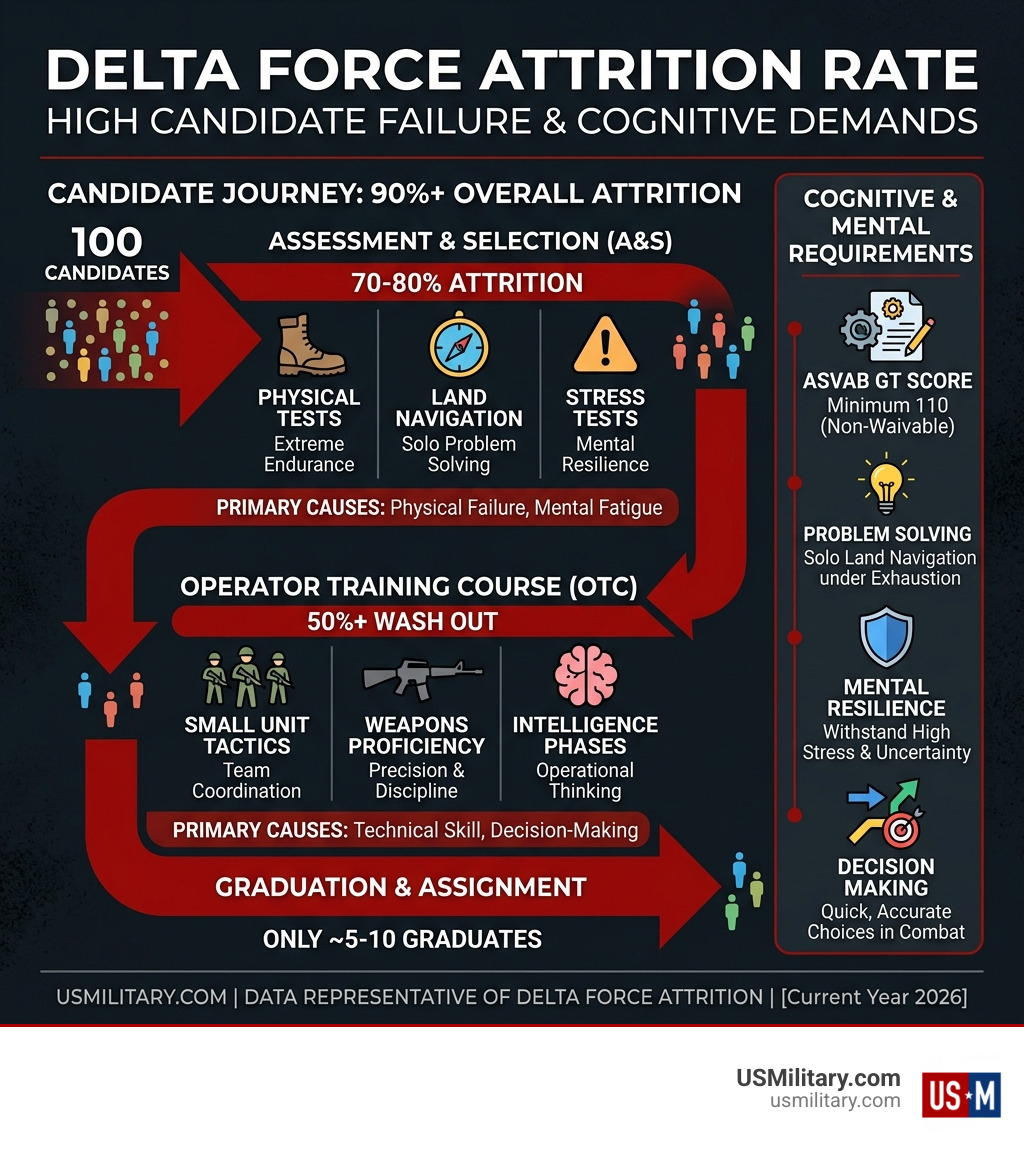
| Cognitive aptitude | Minimum ASVAB GT score of 110 (non-waivable) |
| Mental resilience | Psychological evaluations and stress testing during selection |
| Problem-solving | Solo land navigation under physical exhaustion |
| Decision-making | Commander’s board interview and integrity checks |
| Operational intelligence | Demonstrated throughout the 6-month Operator Training Course |
Delta Force is widely considered the most elite unit in the U.S. military. Roughly 9 out of 10 candidates fail selection — and of those who survive, another 50% wash out of the Operator Training Course. That means only about 5% of all candidates ever earn the title of Delta Force Operator.
Physical toughness gets most of the attention. But the mental and cognitive demands are just as brutal — and just as decisive.
I’m Larry Fowler, publisher of USMilitary.com, and through 15+ years of connecting military personnel with the resources they need, I’ve seen why understanding is intelligence a factor on becoming Army Delta Force matters to anyone seriously considering this path. Read on for a full breakdown of exactly what Delta Force looks for — and how you can prepare.
Basic Is Intelligence a Factor on Becoming Army Delta Force terms:
When we talk about the elite tiers of the military, many people picture Rambo-style physical dominance. While you certainly need to be in the best shape of your life, the gatekeeper is often a standardized test. To even be considered for the 1st Special Forces Operational Detachment-Delta (1st SFOD-D), you must meet specific Army Delta Force Qualifications. Chief among these is a General Technical (GT) score of 110 or higher on the ASVAB.
This isn’t just a suggestion; it is a non-waivable requirement. The GT score measures word knowledge, paragraph comprehension, and arithmetic reasoning. In special operations, this score serves as a baseline for “trainability.” The Army needs to know that if they spend hundreds of thousands of dollars training you in demolitions, high-speed driving, or foreign languages, you have the cognitive “bandwidth” to absorb and apply that information under fire.
Beyond the raw numbers, the unit looks for a specific type of mental evaluation. They aren’t just looking for “smart” people; they are looking for people who can use their brains when their bodies are screaming for them to quit. This is why many candidates come from specialized roles like those found in army-human-intelligence-asset-jobs, where processing complex information is part of the daily grind.

Is Intelligence a Factor on Becoming Army Delta Force Selection?
The selection process, often held in the rugged mountains of West Virginia, is designed to strip away the “mask” every soldier wears. While the physical toll of marching 18 to 40 miles with a heavy rucksack is legendary, the mental tax is what usually breaks people.
So, is intelligence a factor on becoming Army Delta Force during this phase? Absolutely. Consider the land navigation portion. Candidates are given coordinates and must find their way through dense, unfamiliar terrain alone. There is no GPS, and there is no “following the guy in front of you” because communication between candidates is strictly forbidden. You have to think your way through the woods while suffering from sleep deprivation and calorie deficits.
If you want to know more about the nuts and bolts of the process, you can see how-does-delta-force-selection-work. One of the most “intelligent” parts of the selection is the psychological board. After weeks of physical torture, you sit before a board of Delta operators and a psychologist. They will poke, prod, and try to find a crack in your personality. They are checking for integrity, humility, and the ability to remain calm under social and mental stress. If you are arrogant or try to “game” the psych tests, the board will see right through it. They want “quiet professionals,” not ego-driven athletes.
Is Intelligence a Factor on Becoming Army Delta Force Operations?
Once an operator is in the field, intelligence shifts from “passing a test” to “staying alive and completing the mission.” Delta Force missions—counterterrorism, hostage rescue, and direct action—are rarely straightforward. They are “no-fail” missions where the variables change by the second.
Problem-solving and adaptability are the primary cognitive tools of an operator. When a helicopter crashes during a raid, or a target isn’t where they were supposed to be, the operator can’t wait for a manual. They have to make a decision in a split second that balances the lives of their teammates against the success of the mission. This is how the Army finds out who has what it takes to join Delta Force; they look for the guy who doesn’t freeze when the plan falls apart.
Is Intelligence a Factor on Becoming Army Delta Force Long-Term Success?
Passing selection is just the beginning. The real “schooling” happens during the six-month Operator Training Course (OTC). This is where candidates learn the tradecraft that separates Delta from almost every other unit. We aren’t just talking about shooting—though they do a lot of that. We’re talking about CIA-style espionage, lock-picking, bomb-making, and advanced tradecraft.
The intelligence required here is more akin to a spy than a traditional soldier. Operators learn how to blend into foreign cities, conduct surveillance, and set up “dead drops.” This requires a high level of social intelligence and the ability to learn complex technical skills quickly. For a deeper look at the unit’s broader role, check out our page on army-delta-force.
Long-term success in the unit depends on a commitment to continuous learning. An operator might spend months learning a difficult language or mastering new digital encryption tools. If you aren’t a “student of the game,” you won’t last long in the unit. Mental toughness isn’t just about rucking; it’s about the discipline to study your craft every single day.
Practical Intelligence vs. Formal Education
A common question we get is: “Do I need a college degree to join Delta?” The short answer is no—unless you are an officer. For enlisted soldiers (E-4 to E-8), the unit prioritizes practical intelligence over academic credentials.
While a degree can certainly help with cognitive development, Delta Force values the “street smarts” and tactical wisdom gained through years of NCO experience. Most recruits come from the 75th Ranger Regiment or Special Forces Groups (Green Berets). You can read about the differences in their backgrounds here: army-ranger-vs-green-beret. These soldiers have already proven they can operate in high-stress environments.
| Feature | Academic Intelligence | Tactical/Practical Intelligence |
|---|---|---|
| Focus | Theory, research, and formal logic | Real-time problem solving and “battle feel” |
| Validation | Degrees, GPA, and certifications | Mission success, peer reviews, and survival |
| Environment | Controlled, predictable (classroom) | Chaotic, high-stakes (combat zone) |
| Delta Value | Helpful for officers/planning | Essential for every single operator |
This emphasis on practical intelligence goes back to the unit’s founder, Charles Beckwith. Inspired by his time with the British SAS, Beckwith wanted a unit of “thinkers” who were also “doers.” He didn’t care if you could quote Shakespeare; he cared if you could fix a radio with a paperclip or navigate a squad through a jungle without a map.
Teamwork Intelligence and Squadron Structure
No operator is an island. While selection is an individual effort, the actual job is entirely about the team. This requires a very specific kind of “teamwork intelligence”—the ability to read your teammates’ intentions without a word being spoken.
In a Delta squadron, the hierarchy is often flatter than in the “Big Army.” Because everyone is highly trained and intelligent, a junior operator might have a better idea for a breach than a senior officer, and that idea will be heard. This requires a high level of interpersonal skill and the humility to put the mission above your rank. Peer evaluations are a huge part of the process; if your teammates don’t trust your brain or your attitude, you’re out.
The communication required during a high-speed room clearing (CQC) is a form of collective intelligence. Every member of the stack is processing the room’s geometry, the location of hostages, and the position of their teammates simultaneously. You can learn more about how these roles are structured in special-forces-army-operations-careers.
Frequently Asked Questions about Delta Force Intelligence
Can you join Delta Force without a high IQ or college degree?
While the Army doesn’t officially administer an “IQ test” for Delta, the ASVAB GT score of 110 acts as a proxy. You don’t need to be a Mensa member, but you do need to be significantly above average in your ability to solve problems and process information. As for a college degree, it’s mandatory for officers (O-3 to O-4) but not for enlisted members. What matters most is “operational excellence.” If you are an army-sf-engineer-sergeant, your ability to solve complex demolition problems is more valuable than a diploma.
How has the emphasis on intelligence evolved since the unit’s founding?
When Charles Beckwith founded Delta in 1977, the focus was on counter-terrorism and hostage rescue. Today, the “battlefield” includes cyber warfare, advanced signals intelligence (SIGINT), and drone technology. This means the modern operator has to be more tech-savvy than their predecessors. An army-special-forces-weapons-sergeant today isn’t just a master of firearms; they are also a master of the technology that helps those firearms find their mark.
What role does psychological resilience play in the 5% success rate?
Psychological resilience is the “glue” that holds intelligence together under pressure. You can be the smartest person in the world, but if you panic when you’re tired, your IQ drops to zero. This is why the washout rates are so high. The “Long Walk” (the final 40-mile march) isn’t just a test of your legs; it’s a test of your mind’s ability to keep your body moving. Even highly skilled personnel, like us-army-special-forces-medical-sergeants-make-a-difference, find that Delta selection pushes their mental endurance to a breaking point they’ve never experienced before.
Conclusion
So, is intelligence a factor on becoming Army Delta Force? It is the deciding factor. The military can build your muscles and teach you how to shoot, but it is much harder to teach someone how to be a creative, resilient, and high-speed problem solver in the middle of a crisis.
Delta Force operators are the “quiet professionals” of the American military. They represent the perfect marriage of physical grit and cognitive elite standards. If you think you have what it takes—both in your rucksack and in your head—the path is open, but the gate is narrow.
For more information on the first steps toward this elite career, visit our page on the requirements to join the Army. Whether you’re just starting your journey or looking to transition into special operations, USMilitary.com is here to provide the resources you need to serve with honor.
Click here to see if you qualify for Army enlistment and start your journey toward the elite!