
Transitioning from the Draft to the All-Volunteer Force
#
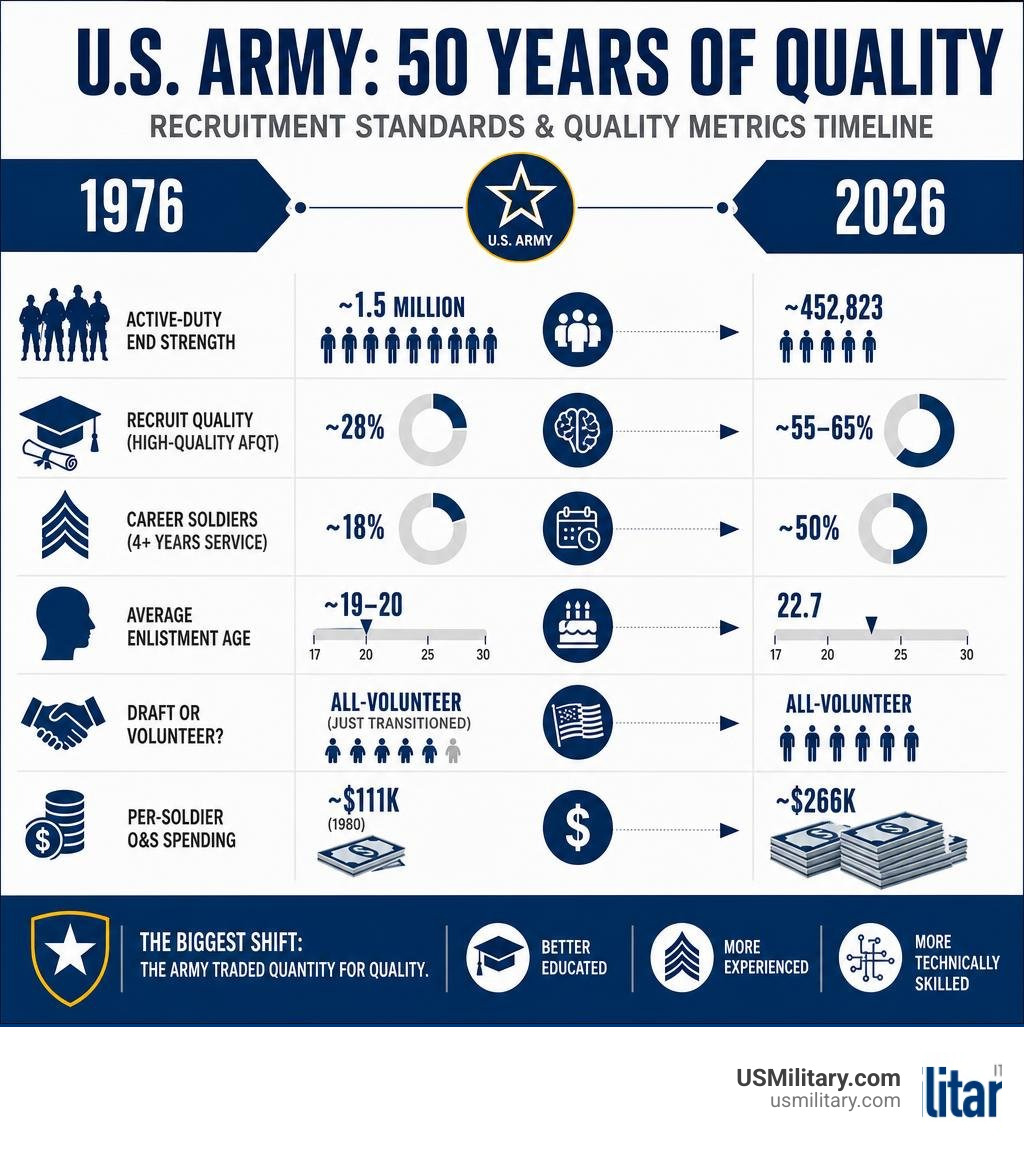
Is the quality of Army soldiers the same as 50 years ago? The short answer is: no — but not in the way most people expect. Today’s soldiers are, on average, better educated, more experienced, and more technically skilled than their 1970s counterparts. However, the Army is also significantly smaller, faces serious recruiting challenges, and is wrestling with new concerns about discipline and readiness.
Here’s a quick breakdown:
| Factor | 1976 | 2026 |
|---|---|---|
| Active-duty end strength | ~1.5 million | ~452,823 |
| Recruit quality (high-quality AFQT) | ~28% | ~55-65% |
| Career soldiers (4+ years service) | ~18% | ~50% |
| Average enlistment age | ~19-20 | 22.7 |
| Draft or volunteer? | All-Volunteer (just transitioned) | All-Volunteer |
| Per-soldier O&S spending | ~$111K (1980) | ~$266K |
The biggest shift: The Army traded quantity for quality. Fifty years ago, the force was larger but plagued by drug abuse, racial tensions, low morale, and a flood of reluctant draftees fresh off Vietnam. Today’s force is smaller, more professional, and career-oriented — but it’s struggling to fill its own reduced ranks.
I’m Larry Fowler, publisher of USMilitary.com, and I’ve spent nearly two decades helping active-duty soldiers, recruits, and veterans navigate military career decisions and benefits. Tracking how the quality of Army soldiers has changed over 50 years is central to the guidance this platform has provided since 2007. In the sections below, we’ll break down exactly what changed, what improved, and what’s still a concern.
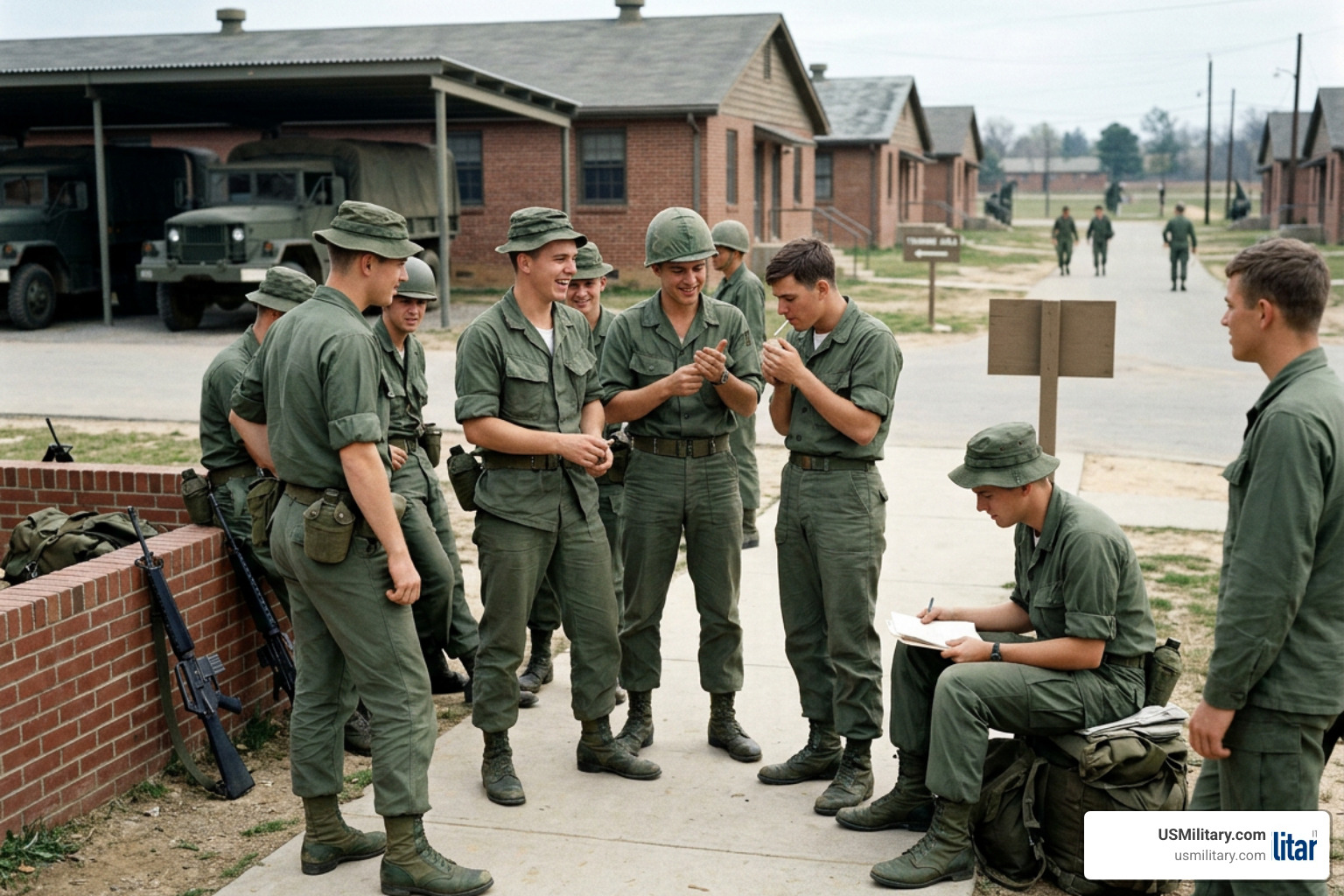
To understand today’s soldier, we have to look back at the institutional crisis of the mid-1970s. When the draft officially ended in 1973, the U.S. Army was in a state of profound transition. Decades of conscription had created a rotating door of young men who did not want to be there.
By the early 1970s, this reliance on conscripts, combined with the domestic fallout of the Vietnam War, pushed the Army to its lowest point of the century. Drug abuse was rampant, with a 1971 Department of Defense survey showing that 51% of troops had used marijuana and nearly 28% had used heroin. The “fragging” crisis—where soldiers attacked their own officers—reached hundreds of documented cases. Racial tensions boiled over in major riots at military prisons, and high-profile leadership corruption scandals tarnished the institution’s reputation.
When the Gates Commission recommended shifting to an All-Volunteer Force (AVF), critics worried that we could never recruit enough qualified citizens without conscription. Many asked: Will The Quality Along With Expectations Rise Of An Army Soldier During A Military Draft?
The transition was incredibly rocky. In the late 1970s, pay stagnated, recruiting budgets were cut, and the Army struggled to find quality volunteers. However, as detailed in historical analyses of Fixing a Broken Army, a series of sweeping reforms—including zero-tolerance drug policies, realistic training centers, the “Big Five” modernization programs, and substantial pay raises under the Reagan administration—gradually turned the “hollow Army” into the premier professional force that dominated the 1991 Gulf War.
Is the Quality of Army Soldiers the Same as 50 Years Ago in Education and Aptitude?
When comparing the cognitive and educational baseline of the force, today’s soldiers are vastly superior to those of 50 years ago.
In the late 1970s, the Army faced a massive quality crisis. A major miscalibration of the Armed Services Vocational Aptitude Battery (ASVAB) test went unnoticed for years, accidentally letting in tens of thousands of recruits who scored far below the legal minimums. In 1977, only about 28% of recruits were considered “high quality” (meaning they held a high school diploma and scored above the 50th percentile on the Armed Forces Qualification Test).
Today, the standard is much higher. The share of high-quality recruits regularly hovers between 55% and 65%. Furthermore, the modern enlisted force is highly educated; a quarter of senior non-commissioned officers (NCOs) now hold college or technical degrees, a statistic unheard of in 1976. For a complete breakdown of what it takes to join today, check out An Essential Guide To Army Eligibility Requirements.
Demographics and the Rising Average Age of Recruits
The demographic makeup of the Army has also shifted. Today’s recruits are starting their military journeys later in life.
According to recent data, the Average age of new Army recruits up from previous years has reached 22.7 years old in fiscal year 2026. This is a notable increase from the 2010s average of 21.1 and the 2000s average of 21.7.
Why are older recruits signing up? Part of it is a deliberate effort to expand the recruiting pipeline to college students, trade workers, and older professionals who may have deferred their interest in service. To combat historic recruiting shortfalls, the military has adjusted its entry limits. This explains What’s behind the US army’s decision to raise enlistment age to 42?—a policy shift designed to capture mature, skilled applicants who can easily adapt to the high-tech demands of modern warfare.
Training, Fitness, and Discipline: 1976 vs. 2026
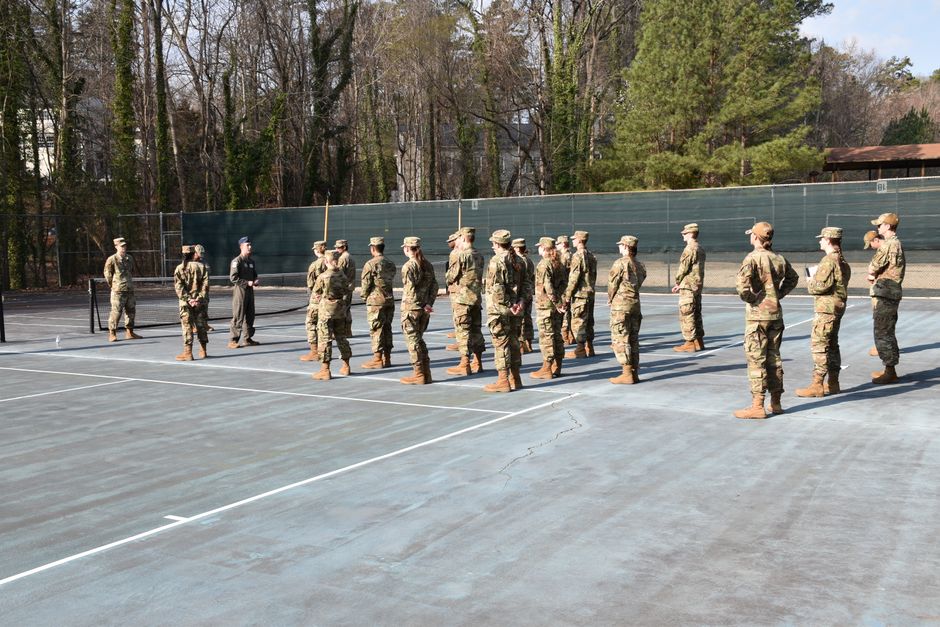
Entering Army Boot Camp today is a very different psychological and physical experience than it was 50 years ago. In 1976, training was largely designed to break down a conscript’s civilian identity through sheer friction. Today, training focuses on building technical proficiency, physical resilience, and cognitive adaptability.
However, this transition hasn’t been without friction. In recent years, senior NCOs and officers have raised concerns about a “sense of entitlement” among Gen Z recruits, noting a tendency to question orders and a lack of basic discipline.
Let’s look at how the training standards compare across the decades:
| Training Element | 1976 Standards | 2026 Standards |
|---|---|---|
| Primary Fitness Test | Army Physical Fitness Test (APFT) – 3 events | Army Combat Fitness Test (ACFT) – 6 events |
| Discipline Focus | Rigid compliance, heavy yelling, drill & ceremony | Tactical discipline, peer leadership, values-based |
| Culminating Event | Standard field training exercises | “The Forge” – 81-hour continuous tactical exercise |
| Weapons Focus | Iron sights qualification (M16A1) | Backup iron sights & advanced optics (M4/M7) |
| Remedial Entry | Direct entry or quick discharge | Future Soldier Prep Course (academic & fitness prep) |
Evolution of Physical Fitness Standards and the ACFT
For decades, the Army measured fitness using the APFT (push-ups, sit-ups, and a 2-mile run). While this tested basic endurance, it did not measure the actual physical demands of combat, such as dragging a wounded comrade or lifting heavy artillery shells.
On October 1, 2020, the Army Combat Fitness Test (ACFT) became the official test of record. The ACFT features six events: the 3-Repetition Maximum Deadlift, Standing Power Throw, Hand-Release Push-Up, Sprint-Drag-Carry, Plank, and a 2-Mile Run. This shift requires a much higher level of functional strength and athletic preparation. To keep up with these changes, the military maintains strict Army Height And Weight Standards to ensure soldiers maintain operational readiness throughout their careers.
Redesigning Basic Combat Training to Restore Discipline
To address complaints from unit commanders about “sloppy” attitudes among new arrivals, the Army launched a major redesign of Army Basic Training. This came after surveying 27,000 leaders who overwhelmingly requested a renewed focus on discipline, work ethic, and military bearing.
The redesign brought back traditional elements like drill and ceremony, integrating them into daily movements. It also introduced three progressive field training exercises (FTXs):
- The Hammer: Focuses on basic survival and tactical skills.
- The Anvil: Tests small-unit tactics and endurance.
- The Forge: An intense 81-hour culminating event requiring a 40-mile tactical road march under load.
Because many modern recruits struggle to meet entry standards out of high school, the Army also introduced the Future Soldier Prep Course. In FY 2023, 24% of the 55,000 Army recruits participated in this prep course to bring their academic scores or physical fitness up to standard before starting basic training.
Technology, Modernization, and the Cost of Force Quality
A soldier from 1976 stepping onto a modern battlefield would be completely bewildered by the sheer volume of technology integrated into the lowest tactical levels. Fifty years ago, communication was limited to heavy, short-range radios, and land navigation relied entirely on paper maps and compasses.
Today, a squad leader has access to real-time satellite tracking, night-vision optics, and drone feeds. However, this high-tech modernization has drastically changed the financial reality of maintaining the force. We dive deep into these quality-of-life and budget trade-offs in our analysis: Everything You Need To Know About Is The Quality Of Active Military Life Getting Better In 2026?
According to reports on Is the U.S. Military Getting Smaller and Older?, the Pentagon has made a conscious choice to prioritize a highly trained, highly paid, and highly equipped soldier over raw numbers.
Is the Quality of Army Soldiers the Same as 50 Years Ago in Technical Capability?
The answer is a resounding no—today’s soldiers must possess a level of technical literacy that was unimaginable in the 1970s.
Modern ground combat is heavily defined by drone warfare, electronic warfare (EW), and cyber security. Soldiers are no longer just marksmen; they are operators of complex systems. They must troubleshoot encrypted communication networks, deploy tactical unmanned aerial vehicles (UAVs), and operate advanced optics.
Because of this, the demand for highly specialized personnel has surged. This has led to an increase in Army Jobs That Require Security Clearance, as even junior enlisted soldiers frequently handle sensitive data and proprietary technology on the front lines.
The Trade-off Between Force Size and Per-Troop Spending
To maintain this highly technical force, the Army has shrunk dramatically. Active-duty United States Army end strength fell from approximately 1.5 million in 1975 to 452,823 in 2025.
Why? Because keeping a modern soldier housed, fed, trained, and equipped is incredibly expensive. Operations and support (O&S) spending per active-duty service member grew from about $50,000 in 1955 to $266,000 in 2016 (in constant dollars), and that number has only climbed higher. The Army has traded the massive, cheap conscript divisions of the Cold War for a compact, elite force of career professionals.
Is The Quality Of Army Soldiers The Same As 50 Years Ago?
When we weigh all the evidence, is the quality of Army soldiers the same as 50 years ago?
The consensus among military historians, veteran leaders, and data analysts is that today’s volunteer soldier is fundamentally superior in professionalism, education, and adaptability to the average soldier of 1976. The All-Volunteer Force transformed the Army from a high-turnover conscript system—where only 3% to 4% of draftees served until retirement—into a highly stable, career-oriented force where roughly 18% of soldiers serve 20+ years.
However, as discussed in The State of the US Army, this smaller, highly specialized force is stretched thin. While individual soldier quality is incredibly high, the Army faces structural challenges, including a lack of mass, aging combat vehicle fleets, and an recruitment environment where only 23% of American youth even meet the physical and academic standards to enlist.
The Moral Component and Fighting Spirit
While technical and physical metrics favor the modern soldier, some traditionalists worry about the “moral component” of fighting power.
In discussions on How the army can rediscover its fighting spirit, critics argue that a highly bureaucratic, risk-averse culture has crept into military leadership. Fifty years ago, tactical training was inherently dangerous and less regulated. Today, some argue that safety regulations, administrative tasks, and social programs have occasionally distracted from the core mission of building raw lethality and small-unit cohesion. However, defenders of the modern system point out that a smarter, healthier soldier is ultimately a more resilient and lethal asset on the battlefield.
Operational Demands and Combat Readiness
The operational tempo of the modern soldier is also vastly different. In the late 1990s, garrison life in places like Germany could feel stagnant and neglected. As recalled in When Deployment Felt Like Relief: The Pre-9/11 Army We Pretend to Forget, soldiers sometimes preferred humanitarian deployments to Bosnia or Kosovo simply to escape deteriorating barracks and a lack of clear mission purpose.
Post-9/11 funding changed everything. Decades of continuous combat operations in Iraq and Afghanistan forged a highly experienced, combat-tested NCO corps. Today’s soldiers are backed by superior equipment, better medical care, and tactical doctrines designed around real-world combat lessons—making them far more prepared for deployment than the transition-era force of 1976.
Frequently Asked Questions
Why did the U.S. Army transition to an all-volunteer force?
The transition in 1973 was driven by the domestic unpopularity of the Vietnam War draft, high desertion rates, and systemic discipline issues within the conscripted force. The goal was to create a highly professional, motivated, and career-oriented military. To see what it takes to join this professional force today, check out the modern Requirements To Join The Army.
How has the average age of Army recruits changed?
The average enlistment age has risen to 22.7 years old in FY 2026, up from an average of 21.1 in the 2010s. This is due to expanded recruiting efforts targeting older, college-educated, or technically skilled candidates. If you’re thinking of joining, make sure you ignore the myths and read about the Top 10 Lies Military Recruiters Tell Prospects Today.
What is the Future Soldier Prep Course?
Introduced to combat recruitment shortfalls, the Future Soldier Prep Course helps applicants who fall slightly short of academic or physical standards. It provides up to 90 days of targeted coaching to help them meet the benchmarks before starting basic training. It has been a massive success, helping the military maintain quality standards during a period of historic recruiting challenges. Read more about how the service is adapting in Army Recruiting Breaking Records.
Conclusion
Is the quality of Army soldiers the same as 50 years ago? No—it is significantly higher. Today’s soldiers are smarter, healthier, more technically capable, and far more professional than the draftees and struggling volunteers of the mid-1970s.
However, this high quality comes at a price. The U.S. Army is smaller and more expensive to run than ever before, and recruiting the next generation of tech-savvy, physically fit warriors remains a monumental challenge.
At USMilitary.com, we are committed to providing the resources, news, and benefits information our service members need to succeed. Whether you are preparing for Army Basic Training or planning your transition to civilian life, we are here to support you every step of the way.