
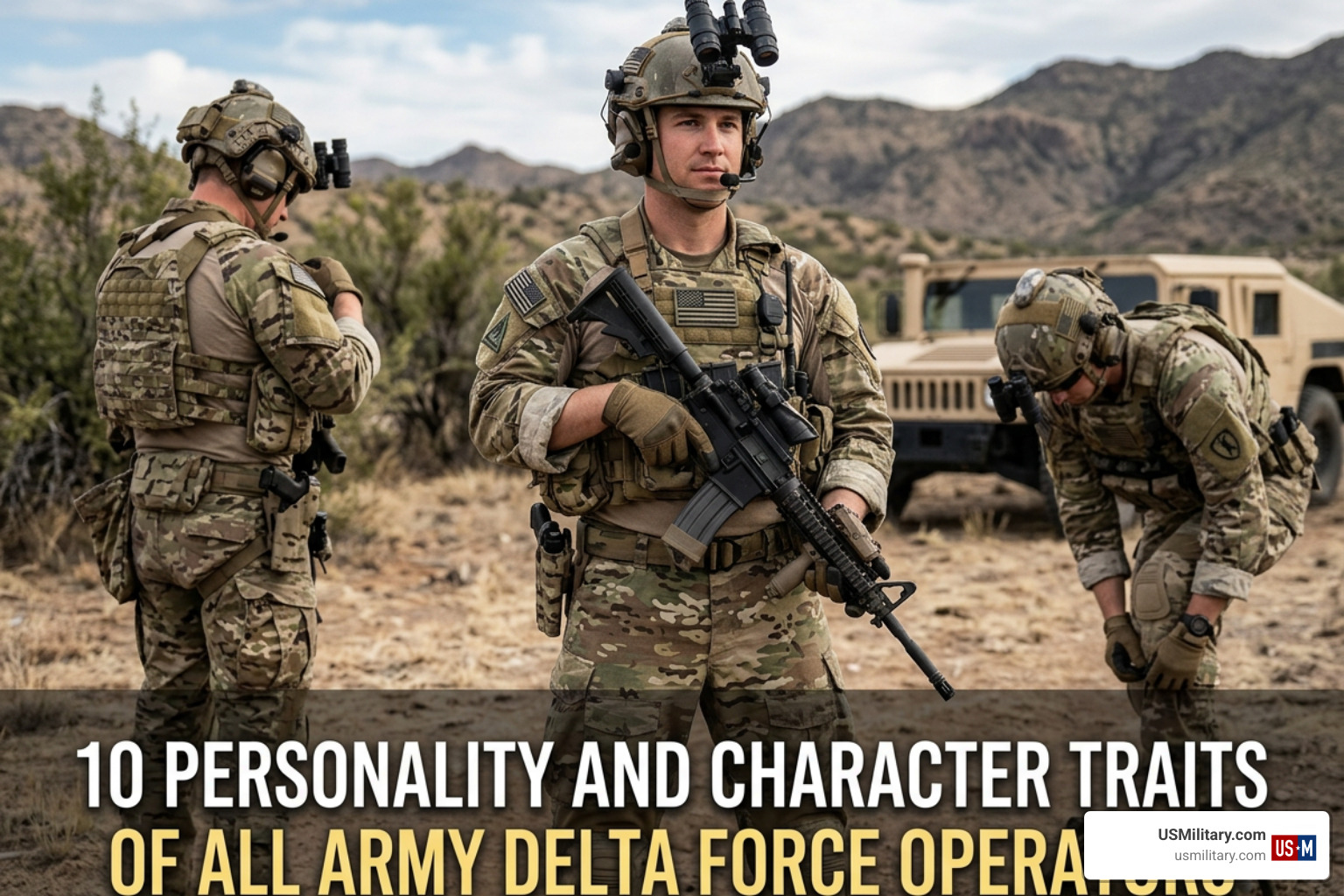
The 10 personality and character traits of all army delta force operators are the defining qualities that separate those who make it through one of the world’s most grueling military selection processes from those who don’t:
- Stress Resistance – Performing at full capacity under extreme physical and mental pressure
- Extreme Competitiveness – Approaching every task with a full-throttle, refuse-to-lose intensity
- Self-Reliance – Independent problem-solving with minimal guidance or support
- Hyper Self-Criticism – A relentless drive to identify and correct personal weaknesses
- Stoicism – Enduring hardship and suffering without complaint
- Mental Toughness – Consistently performing at the upper range of ability regardless of circumstances
- Decisiveness – Making fast, sound decisions under extreme pressure
- Teamwork – Elevating the group even while excelling individually
- Adaptability – Adjusting rapidly to changing and unpredictable environments
- Integrity – Maintaining trustworthiness and accountability in every situation
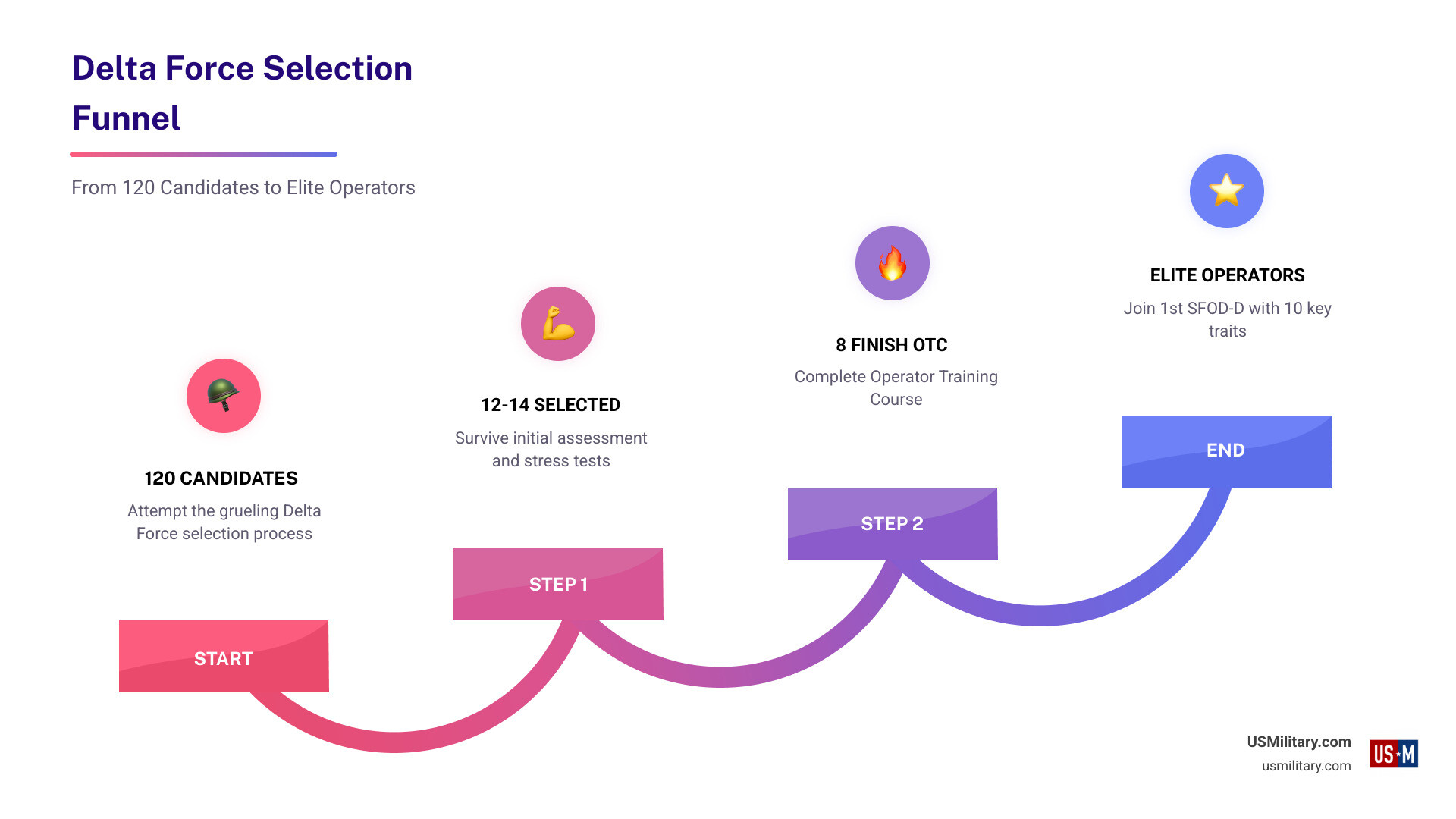
Delta Force — officially the 1st Special Forces Operational Detachment-Delta (1st SFOD-D) — is widely regarded as the most elite fighting force in the U.S. military. Out of roughly 120 candidates who attempt selection, only 12 to 14 complete it. Of those, just 8 finish the full Operator Training Course.
What separates those 8 from the rest? It’s rarely the biggest or fastest athlete. Research from Special Operations selection consistently shows that mentally tough “average guys” outlast physically elite candidates who quit when things get hard.
“The way out is mental.” — A BUD/S instructor quoted in Special Operations Mental Toughness
In short: the body gets you in the door. The mind gets you through.
I’m Larry Fowler, publisher of USMilitary.com, and through nearly two decades of covering elite military careers and special operations pathways, I’ve spent considerable time researching the 10 personality and character traits of all army delta force operators to help people like you understand what it truly takes to reach this level. Read on for a deep dive into each trait and what it really looks like in action.
Simple 10 personality and character traits of all army delta force operators glossary:
The 10 Personality and Character Traits of All Army Delta Force Operators

When we look at the elite tier of the U.S. Army, we aren’t just looking at physical specimens. We are looking at a specific psychological profile. Whether they are navigating the mountains of Afghanistan or conducting a high-stakes hostage rescue in a denied urban area, these operators share a foundational DNA.
How Stress Resistance Shapes the 10 Personality and Character Traits of All Army Delta Force Operators
Stress resistance isn’t just about “keeping cool”; it’s about the physiological ability to suppress the “fight or flight” response and replace it with “assess and act.” In army-delta-force selection, this is often tested through what operators call the “Wet Sock Theory.”
The theory suggests that while many candidates can perform at 100% when they are dry, fed, and rested, the true operator is the one who can still perform at 95% when they are soaking wet, freezing, and haven’t slept in three days. In selection, those who excel in “wet run” scenarios—performing under extreme discomfort—consistently outperform the “dry run” champions who lack the same resilience.
To maintain this level of performance, operators utilize “arousal control.” This involves techniques like 4×4 breathing (inhale for four, hold for four, exhale for four, hold for four) to lower the heart rate and clear the mind. By mastering their own biology, they can enter a state of emotional suppression where fear exists but does not dictate action. As explored in the reflective essay What’s It Mean to Be “Elite?”, being elite isn’t about status; it’s about possessing superior expertise and the influence to execute when the stakes are highest.
Why Competitiveness is Essential to the 10 Personality and Character Traits of All Army Delta Force Operators
If you go for a “casual” jog with a Delta operator, don’t be surprised if it ends in a full-blown sprint. For these individuals, there is no such thing as a “friendly” game. They approach every task—from cleaning a weapon to rucking 40 miles—at full-throttle intensity.
This extreme competitiveness drives them to outperform their peers constantly. In the comparison of delta-force-vs-seals, we see that while the units have different missions, the “refuse-to-lose” mentality is universal. Selection is designed with increasing performance objectives; the bar doesn’t stay still. It moves higher every day. An operator doesn’t just want to pass; they want to be the best person on the field. This internal engine is what keeps them moving when 90% of their class has already quit.
Self-Reliance and the Stoic Mindset in Special Operations
One of the most distinct 10 personality and character traits of all army delta force operators is an almost obstinate sense of self-reliance. These are individuals who hate asking for help. They believe that given a blueprint and enough time, they can rewire a house, fix a humvee, or build a thermonuclear device.
Independent Problem-Solving
During the “Long Walk”—a 40-mile solo land navigation course that serves as the climax of Delta selection—there is no one to talk to and no one to lean on. Candidates must find their way through the dark with a heavy ruck, relying entirely on their own judgment. This breeds a brand of independent problem-solving that is vital for small-team operations where backup may be hours away.
Suffer in Silence
Stoicism is the armor of the Delta operator. They are trained to “suffer in silence.” This doesn’t mean they don’t feel pain; it means they have decided the pain is irrelevant to the mission. To cope with the absurdly high levels of stress, they often employ “gallows humor.” Finding something funny in a miserable situation is a psychological defense mechanism that allows them to maintain a “mental auto-pilot.” By detaching from the immediate physical suffering, they can focus on the next waypoint, the next magazine change, or the next breath.
According to Lawrence Colebrooke in Special Operations Mental Toughness, this stoic resolve is what allows an operator to see an obstacle not as a wall, but as an opportunity to prove their capability.
The Role of Hyper Self-Criticism and Continuous Improvement
It is a common misconception that special operators are arrogant. While they possess unshakeable confidence, internally they are their own harshest critics. This hyper self-criticism is the engine of their continuous improvement.
| Feature | Average Mindset | Elite Delta Mindset |
|---|---|---|
| Reaction to Failure | Seeks excuses or blames others | Radical accountability; “How did I fail?” |
| Post-Mission | Relaxes and celebrates | Conducts a brutal After Action Review (AAR) |
| Skill Mastery | “Good enough” | Obsessive refinement of the basics |
| Feedback | Takes it personally | Craves it to identify “blind spots” |
After every mission or training evolution, operators conduct an After Action Review (AAR). They sit in a room and strip away their ranks to discuss exactly what went wrong. There is no room for ego. If an operator missed a shot or was three seconds late on a breach, they will be the first to point it out.
This trait extends to their equipment as well. As detailed in inside-the-kit-delta-forces-essential-equipment, an operator’s gear is constantly being modified and refined. They aren’t satisfied with “standard issue”; they want the most efficient setup possible to support their expertise. This humility in the face of their own craft is what actually builds their “unshakeable confidence.” They know they are good because they have spent thousands of hours ruthlessly fixing everything that was bad.
Leadership Attributes: Decisiveness and Influence Under Pressure
Leadership in Delta Force isn’t always about who has the most stripes on their sleeve. It’s about influence, maturity, and the ability to make a decision when everything is falling apart. The Army Special Forces identify 13 essential attributes for their soldiers, including judgment, communication, and decisiveness.
Decisiveness
In a crisis, the worst decision is often no decision at all. Delta operators are trained to be “decisive.” They take in the available information, calculate the risks, and act. They don’t have the luxury of a committee meeting. This requires a high level of maturity and a willingness to accept total responsibility for the outcome.
Trustworthiness and Influence
Because Delta operates in small, decentralized teams, trust is the currency of the unit. You have to know that the man to your left is as disciplined and motivated as you are. We see this exemplified in the careers of legends like Kevin Holland, who transitioned from the SEALs to Delta. His journey highlights the universal nature of these traits: the ability to influence a team through action rather than just words.
Operators aren’t looking for “Grey Men” who just blend in. They are looking for people who stand out through their work ethic and their ability to boost the morale of the team during the darkest hours of selection.
Mental Training Techniques: Visualization and Compartmentalization
The 10 personality and character traits of all army delta force operators are not just “born”; they are built through specific mental training techniques. Many of these overlap with the “7 Pillars of Mental Toughness” used by other elite units like the Navy SEALs.
- Goal Setting and Segmenting: Instead of thinking about a 6-month course, they think about making it to breakfast. Then making it to lunch. By “chunking” or segmenting the challenge, they prevent the brain from being overwhelmed.
- Visualization: Before a mission, an operator will “run the tape” in their head hundreds of times. They visualize the smell of the cordite, the weight of the rifle, and every possible contingency. This creates “mental muscle memory.”
- Positive Self-Talk: When the “inner quitter” starts talking, operators use pre-planned mantras to shut it down. They replace “I can’t do this” with “Just one more step.”
- Compartmentalization: This is the ability to take a traumatic event or a distracting emotion and “box it up” to be dealt with later. During a firefight, there is no room for grief or fear. It goes in the box so the operator can stay focused on the task at hand.
- Contingency Planning: They are masters of the “what if.” By planning for every possible failure, they are never surprised, which keeps their stress levels manageable.
Research from Unbeatable Mind suggests that these techniques allow operators to remain in a state of “focus and concentration” that is nearly impossible for the average person to maintain for long periods.
Frequently Asked Questions about Delta Force Traits
What is the “Grey Man” theory in selection?
The “Grey Man” theory is the idea of blending in so well that the instructors (cadre) don’t even notice you. While this is a great skill for undercover espionage work, it is often a bad strategy during Delta selection. Cadre often view “Grey Men” as “ghosts”—people who aren’t carrying their fair share of the team’s weight. To succeed, you want to be noticed for your excellence, your willingness to volunteer, and your positive influence on the team.
How do operators handle extreme physical fatigue?
They handle it by acknowledging that fatigue is a state of mind. They use “segmenting” to break their day into tiny, manageable chunks. They also rely on the “refuse-to-lose” mentality. When the body wants to quit, the mind takes over. They understand that everyone else is just as tired as they are, and the winner is simply the one who refuses to stop moving.
Can these traits be learned by civilians?
Absolutely. While most of us will never have to ruck 40 miles in the dark, traits like hyper self-criticism, goal segmenting, and arousal control are incredibly useful in business and personal life. Mental toughness is a muscle; the more you “get comfortable being uncomfortable” in your daily life, the stronger that muscle becomes.
Conclusion
At USMilitary.com, we believe that understanding the elite mindset is the first step toward achieving your own “Sine Pari” (Without Equal) status, whether in uniform or out. The 10 personality and character traits of all army delta force operators aren’t reserved for a “chosen few”—they are forged in the “crucible of excellence” through discipline, failure, and a relentless drive to be better today than you were yesterday.
If you are considering a career in special operations, your physical fitness is just the baseline. Your character—your integrity, your stoicism, and your ability to work as a team—is what will ultimately determine your success.
Ready to see how the Army’s best stack up against the Navy’s elite? Compare Army Delta Force vs Navy SEALs to learn more about the different paths to the tip of the spear.