
Why the Path to Delta Force Begins with Understanding the Requirements
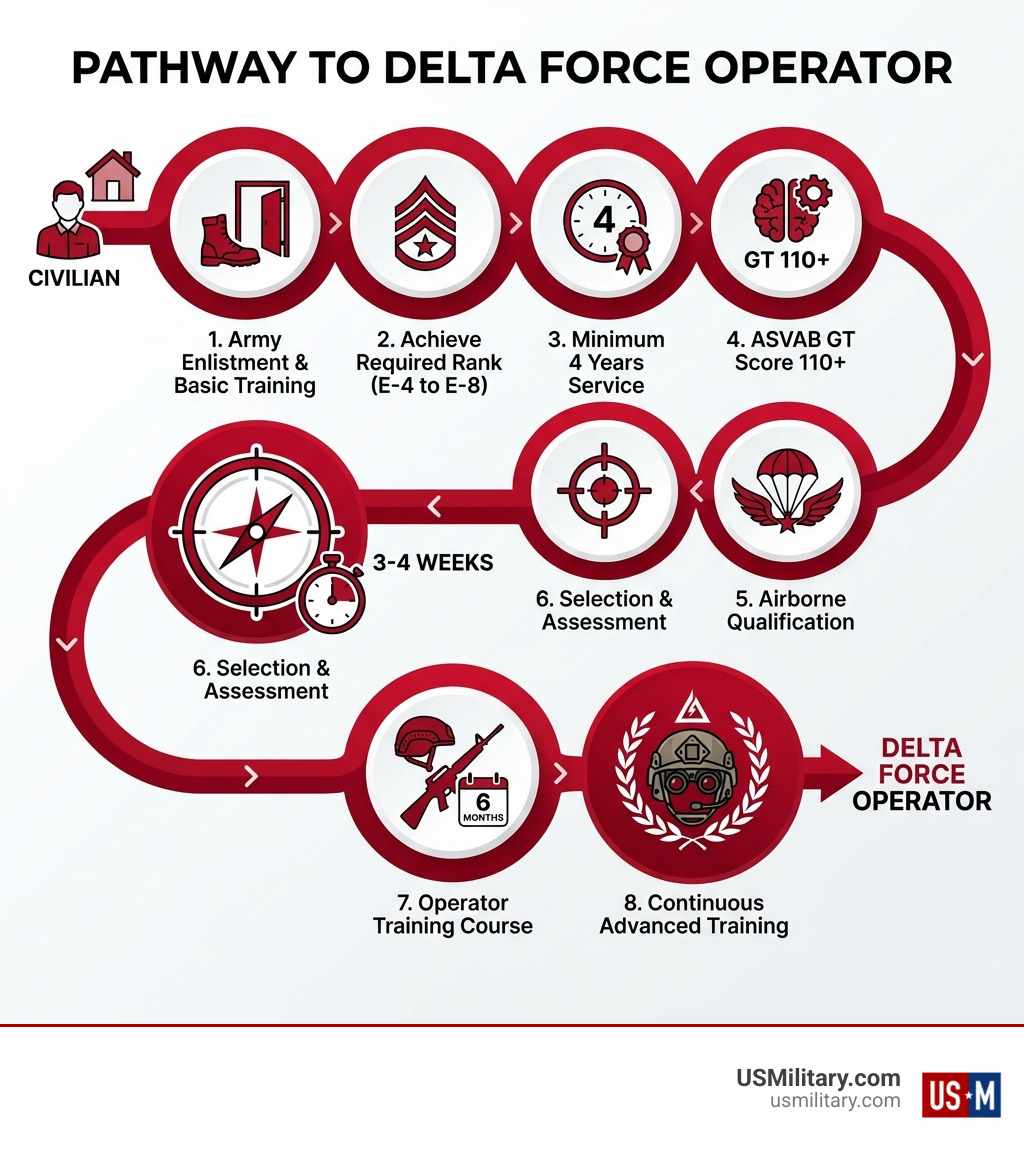
Requirements To Become An Army Delta Force Operator are among the most stringent in the entire U.S. military. Before you can even attempt the grueling selection process, you must meet specific criteria that separate casual interest from serious candidacy.
Essential Requirements at a Glance:
- Citizenship & Age: U.S. citizen, minimum 21-22 years old
- Rank: E-4 to E-8 (enlisted) or O-3 to O-4 (officers)
- Service Time: Minimum 4 years in service, with 2.5 years remaining
- ASVAB Score: General Technical (GT) score of 110 or higher
- Clearance: Eligible for Secret or Top Secret security clearance
- Physical: Airborne qualified (or willing to volunteer)
- Record: Clean disciplinary history, no court-martials
The 1st Special Forces Operational Detachment-Delta (1st SFOD-D), commonly known as Delta Force, operates as the U.S. Army’s premier Tier 1 counterterrorism unit. These elite warriors handle the most sensitive, high-risk missions that often go unacknowledged. The path to joining their ranks is deliberately exclusionary—designed not to make you tough, but to find those who already are.
The reality is stark: Out of a typical class of 120 highly qualified applicants, only 12-14 complete selection, and even fewer finish the subsequent six-month Operator Training Course. This isn’t a journey you stumble into. It requires years of preparation, exceptional performance in your current military role, and an unwavering commitment to pushing beyond every limit.
I’m Larry Fowler, publisher of the USMilitary.com Network, and I’ve been helping service members understand the Requirements To Become An Army Delta Force Operator since 2007, connecting thousands of military personnel with accurate information about elite career paths. My experience working with special operations recruiting has shown me exactly what separates successful candidates from those who never make it past the initial screening.
Requirements To Become An Army Delta Force Operator vocabulary:
The Foundational Prerequisites: Are You Eligible?
Before we dive into the intense world of Delta Force selection, it’s crucial to understand the fundamental requirements. These aren’t just suggestions; they are non-negotiable criteria that every aspiring operator must meet. Think of them as the gatekeepers to an exclusive club—you can’t even knock on the door without these in order.
Basic Eligibility Checklist
First and foremost, to even consider the Requirements To Become An Army Delta Force Operator, you must be a U.S. Citizen. This is a given for any role within the U.S. military, especially for such a highly sensitive unit.
Historically, Delta Force, like many special operations units, has exclusively sought male candidates. While the military has opened many roles to women, the specific requirements and physical demands for direct combat operator roles in Tier 1 units often remain gender-specific.
Age is another critical factor. Candidates must be a minimum of 21 years old, though the typical entry age is often quoted as 22 years old. This isn’t just about physical maturity; it’s about life experience, judgment, and emotional stability—qualities honed over time that are essential for making split-second decisions in high-stress environments.
Given the nature of Delta Force’s missions, a high level of trust is paramount. Therefore, candidates must be eligible for, and able to obtain, a Secret or Top Secret security clearance. This involves a thorough background investigation into your personal history, finances, and associations to ensure you can be trusted with classified information.
Maintaining a Clean Disciplinary Record is absolutely essential. Any history of recurring disciplinary action, such as an Article 15 (non-judicial punishment) or, even worse, No Court-Martials, will likely disqualify you. Delta Force looks for individuals who demonstrate unwavering discipline and adherence to military standards, not those who bend the rules.
Finally, all candidates must be Airborne Qualified or, at a minimum, willing to volunteer for airborne training. Parachute insertions are a common method of deployment for special operations forces, so the ability to jump from aircraft is a baseline skill. If you’re not already airborne, be prepared to earn your wings!
Rank and Service Experience
Delta Force doesn’t recruit fresh out of basic training. They seek seasoned soldiers with a proven track record. This means specific requirements for both enlisted personnel and officers.
For Enlisted Ranks, candidates typically need to be between E-4 (Specialist/Corporal) and E-8 (Master Sergeant). This range ensures that operators have sufficient military experience and leadership potential. For Officer Ranks, candidates are generally sought between O-3 (Captain) and O-4 (Major), often with a background in command.
Beyond rank, a significant amount of prior service is required. You must have a minimum of four years in service to qualify for Delta Force. This experience ensures you’ve seen a variety of situations and understand the complexities of military operations. Furthermore, you need to have at least 2.5 years of active service remaining on your enlistment contract. This ensures the unit can invest in your extensive training without you immediately separating from service.
While not strictly mandatory, having Prior Experience in other elite units significantly boosts your chances. Most Delta Force candidates come from the Special Forces (Green Berets) or the 75th Ranger Regiment. These units provide an excellent proving ground, developing the skills and mental fortitude necessary for Delta selection. If you’re looking to start your Army career with an eye toward special operations, exploring these paths is a smart move. You can find More info about Army careers on our site.
Educational and Aptitude Requirements
Intelligence and adaptability are just as crucial as physical prowess for a Delta Force operator. A High School Diploma is a baseline requirement, demonstrating fundamental academic capability.
However, the real benchmark for aptitude comes from your ASVAB Score. Specifically, a General Technical (GT) score of 110 or higher on the Armed Services Vocational Aptitude Battery is mandatory. This score indicates a strong ability to learn, comprehend complex information, and apply it effectively—skills vital for the advanced training and diverse missions Delta Force undertakes.
To put these requirements into perspective, let’s compare them to those for becoming an Army Green Beret, another highly respected special operations force:
| Requirement | Delta Force | Army Green Beret (Initial Entry) |
|---|---|---|
| Citizenship | U.S. Citizen | U.S. Citizen |
| Gender | Male | Male |
| Minimum Age | 21 (typically 22) | 20 |
| Rank | E-4 to E-8 (enlisted), O-3 to O-4 (officer) | Not specified for initial enlistment (civilians can enlist directly); typically E-3 or higher for current service members |
| Service Time | Minimum 4 years service; 2.5 years remaining | Not specified for initial enlistment; 2 years active service remaining for current service members |
| ASVAB GT Score | 110 or higher | 110 or higher |
| Education | High School Diploma | High School Diploma |
| Airborne Qual. | Yes (or willing to volunteer) | Yes (or willing to volunteer) |
| Security Clearance | Secret/Top Secret | Secret |
| Discipline | Clean Record | Clean Record |
As you can see, while there are similarities, Delta Force generally requires more seasoned individuals with a greater depth of military experience.
The Grueling Gauntlet: Navigating the Selection and Assessment (A&S)
Once you meet the foundational prerequisites, you’re invited to the selection and assessment (A&S) course—a crucible designed to break all but the most determined individuals. This phase is shrouded in secrecy and psychological warfare, pushing candidates to their absolute limits.
The selection and assessment for Delta Force takes place over a 3-4 week period, typically held twice a year at locations like Camp Dawson, West Virginia. This is not a training course; it’s an evaluation. The High Attrition Rate is legendary, with only a small fraction of candidates making it through. The process is specifically designed for what’s called Psychological Dismantling—stripping away preconceived notions and ego to reveal the raw, adaptable individual beneath. It’s about testing your Self-Reliance when all external support and encouragement are removed.
Phase 1: Physical and Mental Screening
The initial phase is a brutal test of physical endurance and navigation skills. While a Standard APFT (Army Physical Fitness Test) is a baseline, you’ll need to be exceeding minimums significantly. We’re talking about push-ups, sit-ups, and a 2-mile run that push you far beyond what’s comfortable. You’ll also face a 100-meter swim performed in uniform, adding to the challenge.
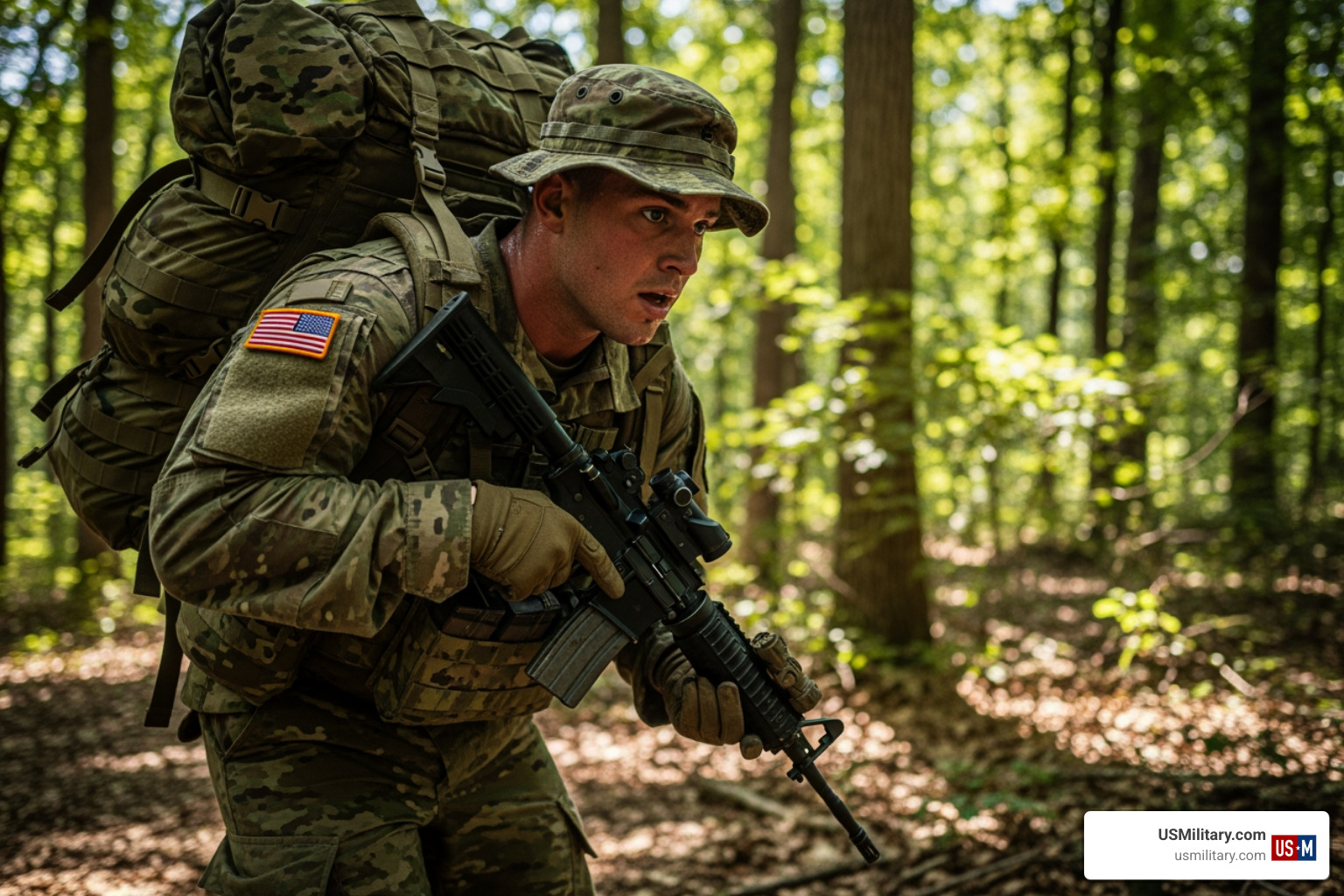
The real physical test comes with the Ruck Marches. Candidates carry heavy loads in rucksacks, with the weight and distance increasing daily. This isn’t just about strength; it’s about endurance and mental toughness. You’ll be navigating through rugged terrain, often in darkness, relying solely on your wits and a compass.
Land Navigation skills are paramount. You’ll be given a map and compass and sent into the wilderness with a heavy pack, expected to find designated points under extreme time pressure. The instructors won’t offer encouragement; they’re looking for individuals who can perform under immense physical and psychological strain without external motivation.
The culmination of this phase is often referred to as The “Long Walk.” This grueling event is a timed 40-mile ruck march with a 45-pound pack over rough, steep terrain. Candidates are typically not told the distance or the time limit, adding another layer of psychological pressure. It’s a test of pure will and resilience, designed to see who truly refuses to quit.
Phase 2: Psychological and Board Review
If you manage to survive the physical onslaught, you’ll face an even more insidious challenge: intense Psychological Evaluations. These are designed to assess your mental fortitude, emotional stability, and problem-solving abilities under extreme stress. You’ll undergo Stress Tests and be presented with complex Problem-Solving Scenarios to gauge your adaptability and decision-making capabilities.
The final hurdle is often a Board Interview. This isn’t your typical job interview; it’s an in-depth evaluation by a panel of seasoned operators who will probe your motivations, your reactions to stress, and your overall character. They are Assessing Mental Fortitude and looking for individuals who embody the “whole man” concept—someone who is intelligent, emotionally stable, mature, and capable of operating independently and as part of a small, elite team.
It’s during this phase that many otherwise physically capable individuals are disqualified. The reasons for disqualification can range from a lack of mental resilience to an inability to maintain composure under pressure. As one source noted, the selection process is designed to find those who already are tough, not to make them tough. We’ve seen that one of the common Reasons for disqualification is often related to mental rather than purely physical shortcomings.
Forging an Operator: The Operator Training Course (OTC) and Beyond
Successfully navigating A&S is a monumental achievement, but it’s just the beginning. The few candidates who make it through are then invited to the Operator Training Course (OTC), where they are forged into fully qualified Delta Force operators.
The Six-Month OTC Curriculum
The Operator Training Course (OTC) is an intensive six-month curriculum that takes the raw potential identified during selection and refines it into a highly specialized skill set. This course is modeled after the British SAS selection process, focusing on developing mature, psychologically stable operators capable of independent action.
Here’s a glimpse into the rigorous training blocks:
- Advanced Marksmanship: This goes far beyond basic rifle qualifications. Operators train to achieve surgical precision with a variety of firearms, often in dynamic, high-stress scenarios.
- Demolitions and Breaching: Learning to create entry points using explosives, mechanical tools, or thermal methods is crucial for direct action and hostage rescue missions.
- Close Quarters Combat (CQC): This is a core competency, focusing on rapid, decisive action in confined spaces, such as buildings or aircraft. Live-fire exercises, sometimes with fellow students acting as hostages, push the realism and stress levels.
- Tradecraft (espionage): Operators learn skills typically associated with intelligence agencies, including surveillance, counter-surveillance, clandestine communications, and operating discreetly in civilian environments.
- Executive Protection: Given their role in high-value target (HVT) operations and hostage rescue, operators are trained in protecting individuals, often high-ranking officials, in hostile territories.
- Culmination Exercise: The OTC concludes with a complex, dynamic mission simulation that integrates all learned skills, testing the operator’s ability to plan, execute, and adapt under realistic operational conditions.
Continuous Training and Specialization
Becoming a Delta Force operator isn’t a one-and-done deal. It’s a commitment to Ongoing Professional Development and continuous learning. The world changes, and so do the threats, meaning operators must constantly be Adapting to New Threats and evolving their skill sets.
This includes specialized training in areas like Cyber Warfare, as the future of special operations increasingly involves digital battlegrounds. The unit even has a Computer Network Operations Squadron, nicknamed “The Digital Devils.” Operators also pursue advanced skill courses, allowing for Specialization in areas such as sniper operations, advanced demolitions, or foreign language proficiency.
Career Advancement within Delta Force can lead to Leadership Roles within the unit, training new recruits, or taking on more complex mission planning and execution. The commitment to excellence is a lifelong endeavor for these elite soldiers. To understand more about Delta Force’s role in modern operations, we can see how they are continuously involved in critical global events.
The Complete Requirements To Become An Army Delta Force Operator
The journey from a regular soldier to a Delta Force operator is one of the most transformative experiences in the military. It shapes individuals into highly adaptable, resilient, and lethal assets capable of operating effectively in the most demanding environments.
Primary Roles and Responsibilities
Delta Force operators are the tip of the spear for the U.S. Army, tasked with missions that are often too sensitive or too dangerous for other units. Their primary roles and responsibilities include:
- Counterterrorism: Neutralizing terrorist threats and preventing attacks both domestically and abroad.
- Hostage Rescue: Liberating captives from high-risk situations, often requiring precision and speed.
- Direct Action: Conducting raids and precision strikes against enemy targets, including High-Value Targets (HVTs).
- Special Reconnaissance: Gathering critical intelligence in denied or hostile areas.
These missions often involve Working with JSOC (Joint Special Operations Command), which is the operational control for all Tier 1 units. Delta Force has been involved in some of the most critical military operations in recent history. Here’s a list of some key missions that highlight their diverse capabilities:
- Operation Urgent Fury (1983): Invasion of Grenada.
- Operation Just Cause (1989): Invasion of Panama to remove Manuel Noriega.
- Operation Gothic Serpent (1993): The Battle of Mogadishu, famously depicted in “Black Hawk Down.”
- Operation Red Dawn (2003): The capture of Saddam Hussein in Iraq.
- Operation Black Swan (2016): The capture of Joaquin ‘El Chapo’ Guzman in Mexico.
- Operation Kayla Mueller (2019): The raid that led to the death of ISIS leader Abu Bakr al-Baghdadi.
These operations underscore the extreme risk and profound impact of their work. They are truly the ones called upon when all other options have failed.
How Training Differs from Other SOF
While all special operations forces (SOF) undergo rigorous training, Delta Force’s approach has distinct characteristics that set it apart:
- Intense Focus on CQC: Delta Force’s training places an exceptionally high emphasis on Close Quarters Combat, reflecting their frequent involvement in hostage rescue and direct action in urban or confined environments.
- Emphasis on Individual Problem-Solving: Unlike some units that prioritize rigid team conformity, Delta Force fosters operators who can think critically and act independently, even when separated from their team or without explicit orders. This is a direct outcome of their selection process, which screens for self-reliance.
- Modeled After British SAS: Delta Force was founded with inspiration from the British Special Air Service (SAS), adopting many of their methodologies for selection and training, particularly the focus on individual initiative and psychological resilience.
- Higher Emphasis on Tradecraft: The OTC’s inclusion of extensive tradecraft training, akin to espionage skills, is more pronounced than in many other SOF units, reflecting Delta Force’s role in clandestine operations and intelligence gathering.
- Smaller Team Operations: Delta Force typically operates in very small, highly autonomous teams, requiring each member to be exceptionally versatile and capable across a wide range of skills.
These differences highlight that while other SOF units are incredibly capable, Delta Force is custom for a specific niche of highly sensitive, often clandestine, and extremely high-stakes operations that demand a unique blend of skills and mindset.
Frequently Asked Questions about Joining Delta Force
We understand you might have more questions about this incredibly challenging, yet rewarding, path. Here are some of the most common inquiries we receive:
Can a civilian join Delta Force directly?
No, you must first join the U.S. Army and meet the service and rank requirements. The journey begins with a standard enlistment, often through combat arms roles like Infantry or by joining units like the 75th Ranger Regiment or Special Forces. There is no direct path for a civilian to apply to Delta Force; you must already be a proven soldier within the Army with a solid record.
What is the success rate for Delta Force selection?
The success rate is extremely low. While exact numbers are classified, anecdotal evidence from former operators suggests that out of a class of over 100 highly qualified candidates, only 10-15% may pass the initial selection course, with even fewer graduating from the Operator Training Course (OTC). For example, in one account, out of 120 applicants, only 16 passed selection, and just 8 finished OTC. This illustrates the incredibly high bar set for aspiring operators.
What is the most common reason for failing selection?
The most common reason for failure is not a lack of physical strength, but the inability to complete the land navigation courses, particularly the final “Long Walk.” This event tests a combination of physical endurance, mental toughness, and individual navigation skills under extreme stress and isolation. Many candidates are physically strong enough, but they break mentally or fail to steer accurately when exhausted and deprived of sleep. The instructors are looking for individuals who can maintain their composure and effectiveness when faced with ambiguity and extreme discomfort.
Conclusion
The path to becoming a Delta Force operator is one of the most challenging in the U.S. military, demanding a unique blend of physical prowess, intellectual capability, and unwavering mental fortitude. It starts with meeting the basic standards of the Army and excelling in every task. For those who believe they have what it takes, the first step is understanding the fundamental prerequisites for military service. USMilitary.com provides resources to help you understand this initial phase of your journey. Learn more about the requirements to join the Army.