

Are Suicides An Important Concern For Army Special Force Operators — and the answer is yes, but not in the way most people expect.
Here is a quick summary of what the research shows:
| Factor | SOF Operators | Regular Army |
|---|---|---|
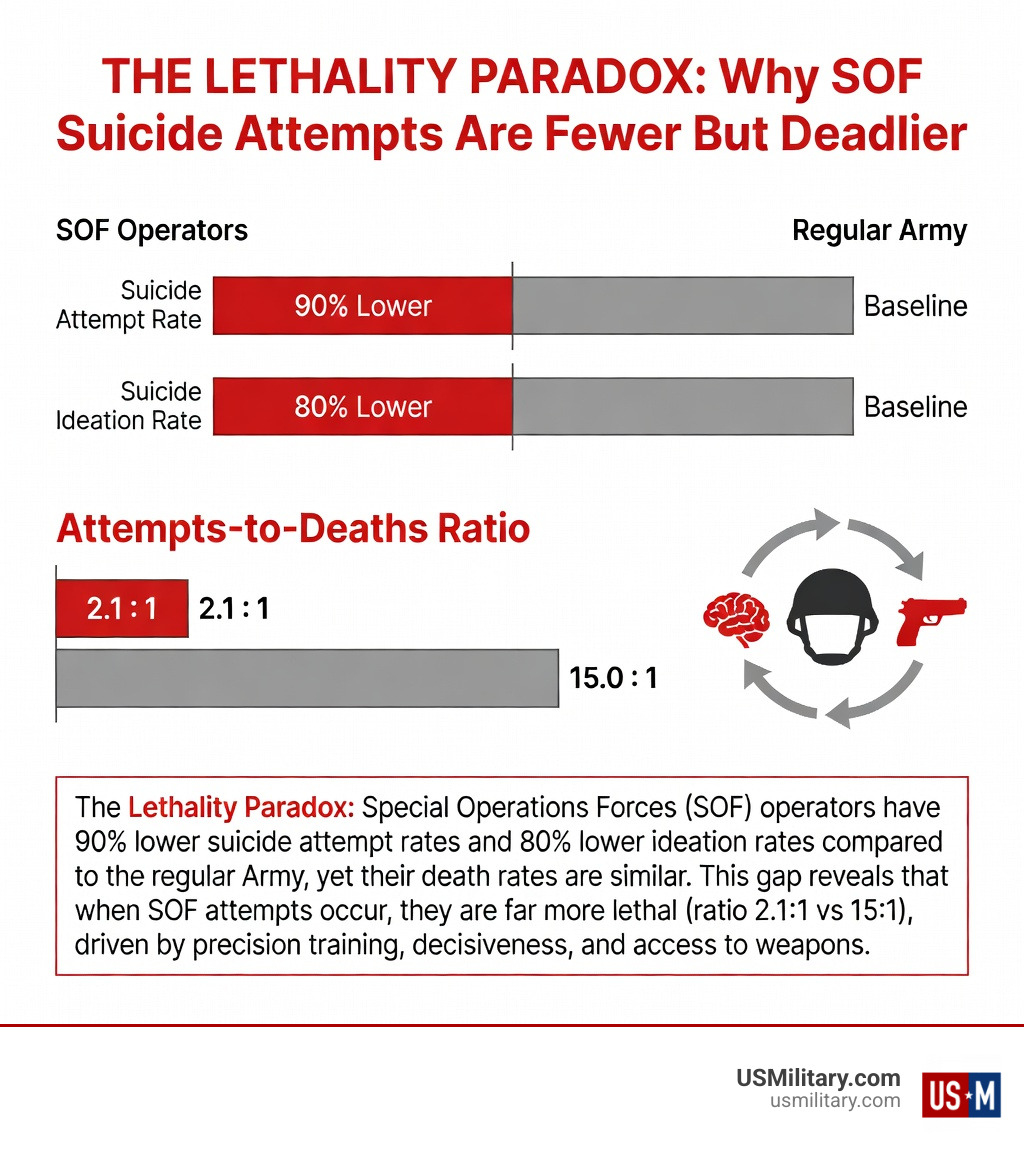
| Suicide attempt rate | 90% lower | Baseline |
| Suicide ideation rate | 80% lower | Baseline |
| Suicide death rate | Similar | Similar |
| Attempts-to-deaths ratio | 2.1 : 1 | 15 : 1 |
Key takeaway: SOF operators attempt suicide far less often — but when they do, it is far more likely to be fatal.
This is what researchers call the lethality paradox. Elite soldiers are trained to act with precision and decisiveness. That same training, combined with access to lethal means, means their suicide attempts are dramatically more deadly than those of regular soldiers or even support personnel.
A large-scale study analyzing over 48 million person-months of Army data (2004–2012) found that SOF operators had 70% lower suicide attempt rates than SOF support personnel and 90% lower than the regular enlisted force. Yet their rate of dying by suicide was nearly identical to both groups.
That gap between attempts and deaths tells a critical story — one that commanders, policymakers, and families of Special Forces soldiers need to understand.
I’m Larry Fowler, publisher of USMilitary.com, and I’ve spent nearly two decades tracking military health trends, veteran benefits, and service-related data — including research directly relevant to whether are suicides an important concern for Army Special Force Operators. In the sections ahead, I’ll break down the data, risk factors, and what can actually be done to protect these elite soldiers.
Basic Are Suicides An Important Concern For Army Special Force Operators vocab:
Analyzing the Data: Are Suicides An Important Concern For Army Special Force Operators?
When we look at the numbers, we see a picture that challenges common assumptions. The Army Study to Assess Risk and Resilience in Servicemembers (Army STARRS) provided the most comprehensive look at this issue to date. By analyzing over 48 million person-months of data, researchers were able to separate “operators” (the elite Green Berets and Rangers) from the “support personnel” who enable their missions.
The Suicidal Behavior in US Army Special Operations Forces study revealed that operators have a significantly lower “volume” of suicidal behavior. Specifically, SOF operators showed 90% lower suicide attempt rates and 80% lower ideation rates than the regular enlisted force. Even compared to their own SOF support personnel, operators had 70% lower rates of both attempts and ideation.
However, the “lethality” of these actions is where the concern deepens. While a regular soldier might have an attempt-to-death ratio of 15 to 1, an SOF operator’s ratio is a staggering 2.1 to 1. This means that for every two operators who attempt suicide, one dies. This high “success” rate in self-harm is why we must conclude that yes, suicides are a massive concern, even if the number of individuals reaching that breaking point is smaller than in the general population.
Military Jobs With the Highest Suicide Rates?
The Lethality Paradox in Elite Units
Why is the ratio so different? It comes down to what makes an operator elite: precision, access, and mindset. SOF operators are trained to be comfortable with high-stakes environments and lethal tools. In the civilian world or the regular Army, a suicide attempt might involve methods with a higher chance of intervention or survival. For an operator, the method is almost always a firearm, and the execution is, by nature of their training, decisive.
Furthermore, the very unit cohesion that keeps them alive in combat can become a double-edged sword during a crisis. If an operator feels they are failing their “brothers,” the perceived burden can lead to a quick, lethal decision to “remove” the problem. For families left behind by such decisive acts, finding resources like books for suicide grief becomes a vital part of the healing process.
Comparing Special Forces to Combat Medics and Infantry
It is often assumed that the more combat you see, the more likely you are to attempt suicide. However, the data tells a more nuanced story. Special Forces soldiers actually have lower odds of suicide attempts (OR 0.3) compared to almost all other military occupations.
As shown in the table above, Combat Medics (CM) actually face the highest risk, with a standardized rate of 504 per 100,000 person-years. Infantry and other combat arms follow at 417. Special Forces sit at the bottom of this risk pool at 102. This suggests that the rigorous selection process for Special Forces acts as a powerful filter, identifying individuals with high baseline resilience. But we cannot let these lower attempt numbers lure us into a false sense of security; the lethality of the attempts that do happen remains the primary threat.
Risk Factors and the Role of Military Training
We have to look at the training itself to understand the mental landscape of an operator. Special Forces training is designed to push the human mind to its breaking point. One specific phenomenon often ignored is dissociation. According to the DSM-5-TR, dissociation involves a disruption in the usually integrated functions of consciousness, memory, or identity.
Research on dissociation in military training has found that up to 96% of personnel experience dissociative symptoms during extreme survival training (like SERE school). While this “mental numbing” helps a soldier survive a prisoner-of-war camp, it can become a dangerous habit in civilian life. If a soldier learns to “check out” to handle pain, they may use that same mental mechanism to distance themselves from the emotional weight of their own suicidal thoughts, making the act of self-harm feel less “real” and more achievable.
Why Suicides Are An Important Concern For Army Special Force Operators During Transition
The most dangerous time for an operator isn’t always in the middle of a fire fight; it’s often when the fighting stops. We call this the “Fractured Brotherhood.” When an operator leaves the military—especially through involuntary separation—they lose their identity, their family, and their purpose all at once.
Using Maslow’s Hierarchy of Needs, we can see that operators have their “belonging” and “esteem” needs met entirely by their unit. When they are suddenly separated, they fall into a void of social isolation and loneliness. This transition creates a “moral injury”—a sense that the system they sacrificed everything for has abandoned them. Without that community to lean on, the “decisive action” mindset of the operator can quickly turn inward.
Career Characteristics and Mental Health Triggers
Beyond the big picture of identity, there are specific “ground-level” triggers that increase risk. Data shows that lower rank, a recent demotion, or a formal mental health diagnosis are major red flags.
- Demotions: An operator who is demoted faces not just a pay cut, but a massive loss of status in a community where status is everything.
- TBI and Neuro-inflammation: We are now learning that repeated exposure to “breaching” charges and heavy weapon fire causes chronic neuro-inflammation. This isn’t just “stress”—it’s a physical brain injury that can manifest as depression, anxiety, and impulsive behavior.
- Alcohol Dependence: Nearly half of SOF suicide cases involve harmful alcohol use, often used as a “self-medication” for the physical and mental pain of service.
Unique Challenges for Female Operators and High-Risk Demographics
While the SOF community is predominantly male, the number of women in these roles is growing, and they face a unique set of stressors. Recent data indicates that female operators may have an odds ratio for suicide attempts as high as 7.4.
This is a significant research gap that we need to address. Female operators often deal with additional layers of stress, including equipment that doesn’t fit properly (which can lead to increased physical injury), potential harassment, and the pressure of being a “trailblazer” in a hyper-masculine environment. The psychological autopsies of SOF suicides suggest that these cumulative stressors can lead to a “downward spiral” that is difficult to arrest without gender-specific support systems.
Evolution of Risk from Iraq to Afghanistan
The nature of suicide risk has evolved alongside the wars we’ve fought. During the early years of the Iraq and Afghanistan conflicts (2004–2009), the focus was on combat trauma. However, by 2012, we saw a spike in suicides that surpassed combat deaths.
The trend persisted with another spike in 2018. What we’ve learned is that it’s rarely just one “bad deployment” that causes a crisis. Instead, it is the cumulative stress of multiple rotations, the strain on marriages, and the physical toll of unconventional warfare over a 20-year career. The “Quiet Professional” often stays quiet until it is too late.
Protective Elements and Prevention Strategies
It’s not all bad news. The same things that make SOF operators high-risk also provide them with unique protections. The selection process itself is a “filter for resilience.” Those who make it through are naturally more optimistic, have better problem-solving skills, and possess a higher-than-average “grit.”
As illustrated above, unit camaraderie is the strongest “armor” an operator has. When operators feel they are part of a tight-knit team where it is safe to speak up, the risk drops significantly.
Screening Recommendations: Are Suicides An Important Concern For Army Special Force Operators Today?
To move the needle on these rates, we need to move beyond “PowerPoint” training. We recommend:
- Biochemical Testing: Assessing for neuro-inflammation and brain chemistry alterations rather than just asking “how do you feel?”
- Lethal Means Restriction: Encouraging “safe storage” of firearms during high-stress periods (like a divorce or transition) without the fear of career repercussions.
- Embedded Providers: Placing mental health professionals directly within the units so they understand the “SOF culture” and are seen as part of the team, not outsiders.
Policy and Support Resources
If you or someone you know is struggling, there are resources designed specifically for the military community. You can access free crisis care for up to 90 days at any VA or non-VA facility through the Veterans Crisis Line (dial 988, then press 1).
We also advocate for the Sanctuary Model, which focuses on trauma-informed care and “restorative interventions.” Instead of punitively discharging a soldier for an alcohol incident, we should be looking at the underlying TBI or moral injury and providing a path to rehabilitation. Post-service networks and transition mentorship are also vital to ensure that when an operator hangs up the uniform, they don’t lose their sense of brotherhood.
Frequently Asked Questions about SOF Suicides
Why do SOF operators have lower attempt rates but similar death rates?
This is the “lethality paradox.” Operators are trained to be decisive and have easy access to firearms. While they reach the point of an attempt less often than regular soldiers, their training ensures that when they do act, they use highly effective means, resulting in a 2.1 to 1 attempt-to-death ratio.
Are Suicides An Important Concern For Army Special Force Operators compared to civilians?
Yes. Some studies suggest SOF suicide rates can be up to 30% higher than the general U.S. population. This is particularly true in the 18–34 age demographic, where firearm involvement is a major factor in the “success” of suicide attempts.
What role does dissociation play in Special Forces suicide risk?
Dissociation is a common side effect of intense survival training (affecting up to 96% of participants). While it helps in combat, it can lead to emotional numbing in civilian life. This “disconnection” can make it easier for an individual to carry out a suicide attempt because they have mentally “distanced” themselves from the reality of the act.
Conclusion
At USMilitary.com, we believe that the “Quiet Professional” shouldn’t have to suffer in silence. Protecting our elite operators requires a cultural transformation—moving away from punitive separations and toward a model of rehabilitation and identity preservation. We must ensure that the brotherhood doesn’t end when the service does.
If you want to learn more about how different elite units compare in terms of culture and requirements, you can compare Army Delta Force vs Navy SEALs on our platform. Our mission is to provide the resources and community belonging that every service member deserves, from their first day of selection to their final day of retirement.