
What Are the Top 10 VA Disabilities Successfully Claimed By Army Veterans?

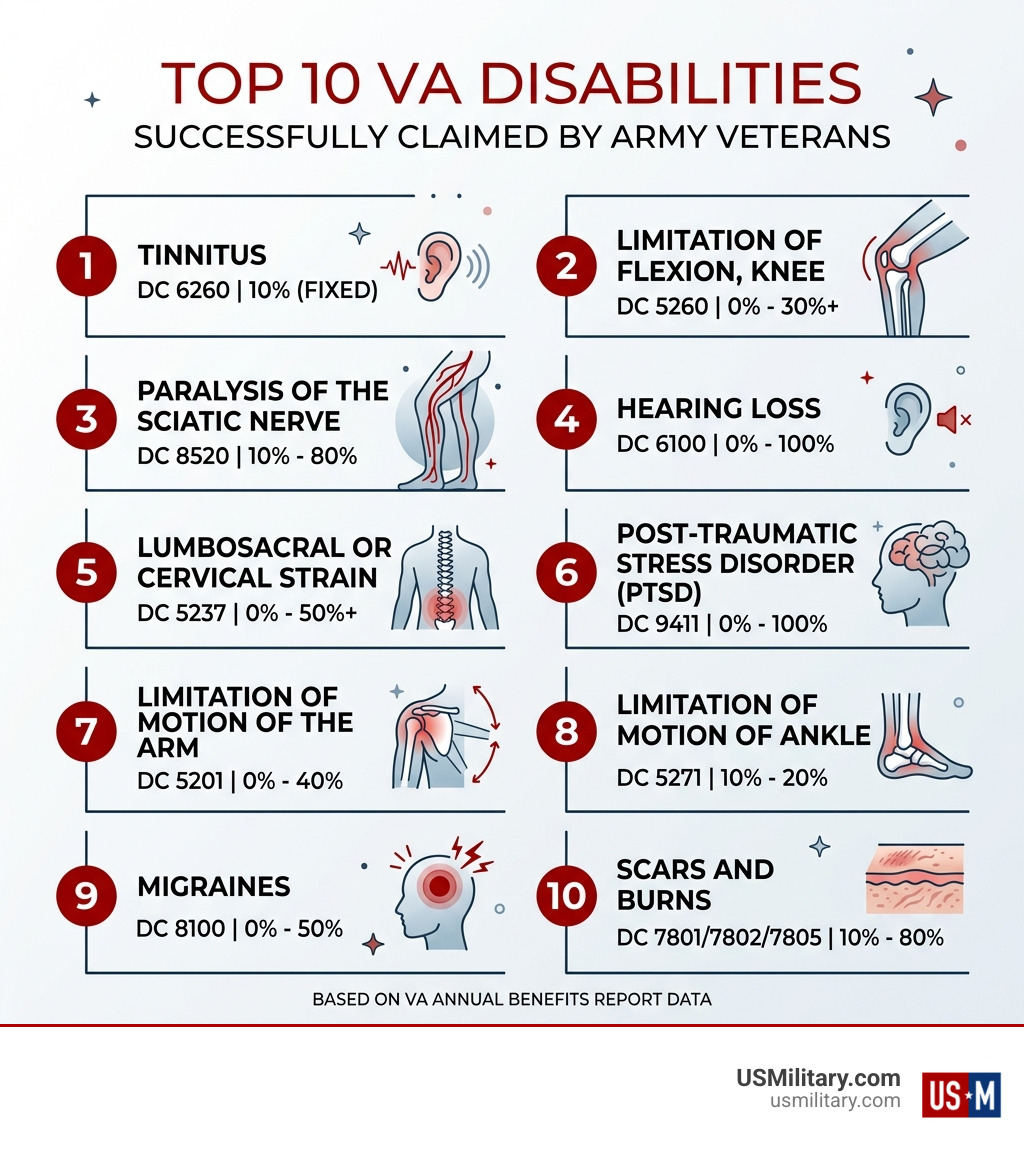
The top 10 VA Disabilites Successfully Claimed By Army Veterans, based on the VA’s most recent Annual Benefits Report data, are:
| Rank | Disability | Diagnostic Code | Typical Rating Range |
|---|---|---|---|
| 1 | Tinnitus | DC 6260 | 10% (fixed) |
| 2 | Limitation of Flexion, Knee | DC 5260 | 0% – 30%+ |
| 3 | Paralysis of the Sciatic Nerve | DC 8520 | 10% – 80% |
| 4 | Hearing Loss | DC 6100 | 0% – 100% |
| 5 | Lumbosacral or Cervical Strain | DC 5237 | 0% – 50%+ |
| 6 | Post-Traumatic Stress Disorder | DC 9411 | 0% – 100% |
| 7 | Limitation of Motion of the Arm | DC 5201 | 0% – 40% |
| 8 | Limitation of Motion of the Ankle | DC 5271 | 10% – 20% |
| 9 | Migraines | DC 8100 | 0% – 50% |
| 10 | Scars and Burns | DC 7801/7802/7805 | 10% – 80% |
These conditions reflect the physical and mental toll that Army service takes — from ruck marching and heavy loads to combat exposure and acoustic trauma.
As of 2026, roughly 5.9 million disabled veterans receive VA compensation for an average of 6.9 disabilities each. Army veterans make up a significant share of that group, especially in the musculoskeletal and auditory categories.
It makes sense when you think about it. Infantry soldiers carry heavy packs for miles. Artillerymen stand next to howitzers. Combat veterans face life-threatening trauma. These aren’t desk jobs — and the body keeps score.
I’m Larry Fowler, author of Dare To Live Greatly and publisher of USMilitary.com/USArmy.com and a veteran benefits advocate with nearly two decades of experience helping veterans understand their earned benefits. Tracking the top 10 VA Disabilites Successfully Claimed By Army Veterans has been a core part of my work since 2007. Read on for a detailed breakdown of each condition, how ratings work, and exactly what evidence you need to file a winning claim.
Top 10 VA Disabilites Successfully Claimed By Army Veterans further reading:
- 10 most common va disabilities in 2025
- what conditions qualify for veteran disability benefits
- VA Disability
The Top 10 VA Disabilites Successfully Claimed By Army Veterans

When we look at the Veterans Benefits Administration (VBA) Annual Benefits Report for 2024 and 2025, a clear pattern emerges for those who wore the Army uniform. The physical demands of the “Big Green Machine”—jumping out of planes, carrying 80-pound rucks, and exposure to high-decibel environments—lead to specific, predictable injuries.
In 2026, the VA continues to process record numbers of claims, with an approval rate hovering around 62%. For Army vets, the “Top 10” are often the most straightforward to service-connect because the link between the job (MOS) and the injury is so evident. Below, we break down the criteria for the Top 10 VA Disabilites Successfully Claimed By Army Veterans.
1. Tinnitus (Diagnostic Code 6260)
Tinnitus is consistently the most common disability across the entire veteran population, with nearly 3 million veterans receiving benefits. For Army veterans, this is almost always linked to acoustic trauma from gunfire, explosives, or loud machinery.
The rating for tinnitus is a flat 10%. It doesn’t matter if the ringing is in one ear or both, or if it sounds like a jet engine or a soft hum—the VA schedule currently caps this at 10%. Because it is a subjective condition (meaning there is no objective test to “prove” you hear ringing), the VA relies heavily on your service history and a current diagnosis. Check out our 12 Easiest VA Disability Claims Guide 2026 to see why this tops the list.
2. Limitation of Flexion of the Knee (DC 5260)
If you spent any time in the infantry or a combat arms MOS, your knees likely paid the price. Ruck marching over uneven terrain with heavy loads puts immense stress on the joint. Limitation of flexion refers to how much you can bend your knee.
The VA rates this based on the range of motion (ROM). However, even if you have a “normal” range of motion, you may still qualify for a 10% rating under the “painful motion” principle. If it hurts to move your knee during a C&P exam, the VA is required to grant a minimum compensable rating. You can find more details on how these joints are measured in our Va Disability Rating Charts Ultimate Guide.
3. Paralysis of the Sciatic Nerve (DC 8520)
Often referred to as sciatica, this condition involves pain, numbness, or tingling that radiates from the lower back down the leg. For Army vets, this is frequently a secondary condition caused by years of lumbosacral strain (back injuries).
Ratings for the sciatic nerve range from 10% for “mild” incomplete paralysis to 80% for “complete” paralysis (where the foot drops and the leg is essentially useless). Most veterans fall into the 10% to 20% range. Because the criteria are somewhat vague, using lay statements to describe how the pain affects your ability to walk or stand is crucial.
4. Hearing Loss (DC 6100)
While tinnitus is the most common claim, hearing loss is a close fourth. The VA uses a very specific grid involving audiometric testing (pure-tone thresholds) and speech discrimination scores (the Maryland CNC test).
It is notoriously difficult to get a rating higher than 0% for hearing loss unless your impairment is severe. However, even a 0% rating is a “win” because it establishes service connection, making you eligible for VA-provided hearing aids and future increases if your hearing worsens. For the latest on how these ratings impact your monthly check, see Va Disability Rates 2026 2.
5. Lumbosacral or Cervical Strain (DC 5237)
Back and neck pain are the bread and butter of Army disability claims. Whether it was a hard parachute landing, a vehicle accident, or just the cumulative effect of wearing body armor for 15 months in Iraq, spinal strains are prevalent.
The VA rates back conditions primarily on the range of motion of the “entire” spine segment. A key tip for Army vets: the VA must consider “flare-ups.” If your back locks up twice a month so badly that you can’t put on your socks, that functional loss must be accounted for in your rating. We explain the filing steps in How To File A Va Disability Claim.
6. Post-Traumatic Stress Disorder (DC 9411)
PTSD is the leading mental health claim for Army veterans. As of 2026, the VA has transitioned to a new “five-domain” system for evaluating mental health. Instead of looking at a single “social and occupational impairment” score, they now assess:
- Cognition
- Interpersonal Relationships
- Task Completion
- Navigating Environments
- Self-Care
This change aims to be more objective and fair. PTSD ratings can be 0%, 10%, 30%, 50%, 70%, or 100%. If you also struggle with related issues, our guide on Anxiety Va Rating can help you understand the overlap.
7. Limitation of Motion of the Arm (DC 5201)
Army mechanics, aviators, and even those in administrative roles often suffer from shoulder and arm limitations. This is usually rated based on “abduction” (lifting the arm away from the side) and “flexion” (lifting the arm in front of you).
The VA also considers whether the injury is to your dominant or non-dominant arm. A 20% rating for a dominant arm might only be 10% for the non-dominant one. Understanding these nuances is part of Va Disability Benefits Eligibility.
8. Limitation of Motion of the Ankle (DC 5271)
Ankle injuries are especially common among paratroopers and those who served in light infantry units. Chronic instability or “marked” limitation of motion typically results in a 20% rating, while “moderate” limitation earns 10%. Like the knee and back, the painful motion principle applies here—if it hurts to rotate your ankle, you should receive at least 10%. See our Va Disability Rating Charts Ultimate Guide for the full breakdown.
9. Migraines (DC 8100)
Migraines are frequently claimed by Army veterans as secondary to Traumatic Brain Injuries (TBI) or even PTSD. The “magic word” for a successful migraine claim is prostrating.
To get a 30% or 50% rating, you must show that your headaches are “prostrating,” meaning they are so severe you must lie down in a dark room and cannot function. Keeping a headache log is the best evidence you can provide. For more on this, visit Va Disability For Migraines.
10. Scars and Burns (DC 7801)
While it might seem minor, scars are a top 10 claim because so many Army veterans have them from combat injuries or surgeries required to fix service-connected orthopedic issues. If a scar is “painful” or “unstable” (meaning it breaks down or bleeds), it can be rated significantly higher than a purely cosmetic scar.
Establishing Service Connection for Army-Specific Conditions
To win any claim for the top 10 VA Disabilites Successfully Claimed By Army Veterans, you must satisfy the “Caluza Triangle.” This requires:
- A Current Diagnosis: You need a doctor to confirm you have the condition now.
- An In-Service Event: Evidence that something happened during your Army service (an injury, exposure, or onset of symptoms).
- A Medical Nexus: A doctor’s statement saying your current condition is “at least as likely as not” caused by your service.
We detail this entire journey in our Process For A Va Disability Claim guide.
Presumptive Conditions and the PACT Act
The PACT Act of 2022 (and its ongoing updates through 2026) has made it much easier for Army veterans to establish service connection for toxic exposures. If you served in qualifying locations (like Iraq, Afghanistan, or Vietnam), the VA “presumes” certain conditions were caused by your service. This includes many respiratory issues and cancers. For example, if you have chronic sinus issues, check the Sinusitis Va Rating to see if you qualify.
Secondary Conditions Linked to Top 10 VA Disabilites Successfully Claimed By Army Veterans
Many veterans stop after claiming their primary injuries, but secondary conditions are where you can often find the most success. For example:
- PTSD can lead to Sleep Apnea or GERD.
- Lumbosacral Strain (back pain) often causes Sciatica.
- Knee Injuries can lead to “favoring” one side, causing hip or ankle problems on the opposite leg.
Don’t leave money on the table. If your service-connected back pain has caused digestive issues, look into the Gerd Va Disability Rating to see how to link them.
How to Maximize Your VA Rating in 2026
Maximizing your rating isn’t about “gaming the system”—it’s about ensuring the VA fully understands the severity of your symptoms. Use Disability Benefits Questionnaires (DBQs) to guide your doctor in providing the specific language the VA raters look for.
Nexus letters from specialists and “buddy statements” from fellow soldiers who witnessed your injury can be the deciding factor in a close case. If you feel your current rating is too low, our Increase Va Disability Rating 3 resource provides a roadmap for appeals.
Navigating Mental Health and Sleep Apnea Updates
In April 2026, the VA continues to refine how it rates sleep apnea. While having a CPAP used to almost guarantee a 50% rating, the new criteria focus more on “functional impairment” and whether the condition is managed by treatment. Similarly, the five-domain mental health system requires veterans to be very specific about how their PTSD affects their daily life, not just their job. You can find the latest updates at Sleep Apnea Va Rating.
Strategies for Top 10 VA Disabilites Successfully Claimed By Army Veterans
If your service-connected disabilities prevent you from maintaining “substantially gainful employment,” you may qualify for Total Disability Based on Individual Unemployability (TDIU). This allows the VA to pay you at the 100% rate even if your combined scheduler rating is only 60% or 70%. For many Army vets with severe back or mental health issues, this is the path to financial stability. Learn more at 100 Va Disability Rating What It Means For Your Wallet In 2026.
Frequently Asked Questions about Army VA Claims
What is the most common 100% VA disability for Army vets?
It is rare for a single condition to reach 100% unless it is a severe mental health diagnosis or a total loss of use of limbs. Most 100% ratings are “combined ratings,” where several of the top 10 VA Disabilites Successfully Claimed By Army Veterans (like 70% PTSD + 50% Sleep Apnea + 20% Back Strain) add up to 100% using “VA Math.”
Can I claim secondary conditions for back pain?
Absolutely. Sciatica is the most common secondary claim for back pain. However, you can also claim hip issues, knee problems (from an altered gait), and even depression or anxiety caused by living with chronic, debilitating pain.
How does my Army MOS affect my hearing loss claim?
The VA uses the “Duty MOS Noise Exposure Listing.” If your MOS is listed as “High Probability” for noise exposure (like 11B Infantry, 13B Artillery, or 15T Blackhawk Mechanic), the VA will often concede that you were exposed to hazardous noise without requiring further proof. This makes winning a hearing loss or tinnitus claim much easier.
Conclusion
Navigating the VA system can feel like a second enlistment, but you don’t have to do it alone. At USMilitary.com, we are dedicated to providing the most current, accurate information to help you secure the benefits you earned through your sacrifice. Whether you are just starting your claim or looking to increase an existing rating, understanding the top 10 VA Disabilites Successfully Claimed By Army Veterans is the first step toward success.
Ready to take the next step?
- Check your Va Disability Benefits Eligibility
- Learn how to Apply for VA Disability Benefits
- Use our resources to gather the evidence you need to win.