
What Are the Top 15 VA Military Disability Claims By Army Veterans?
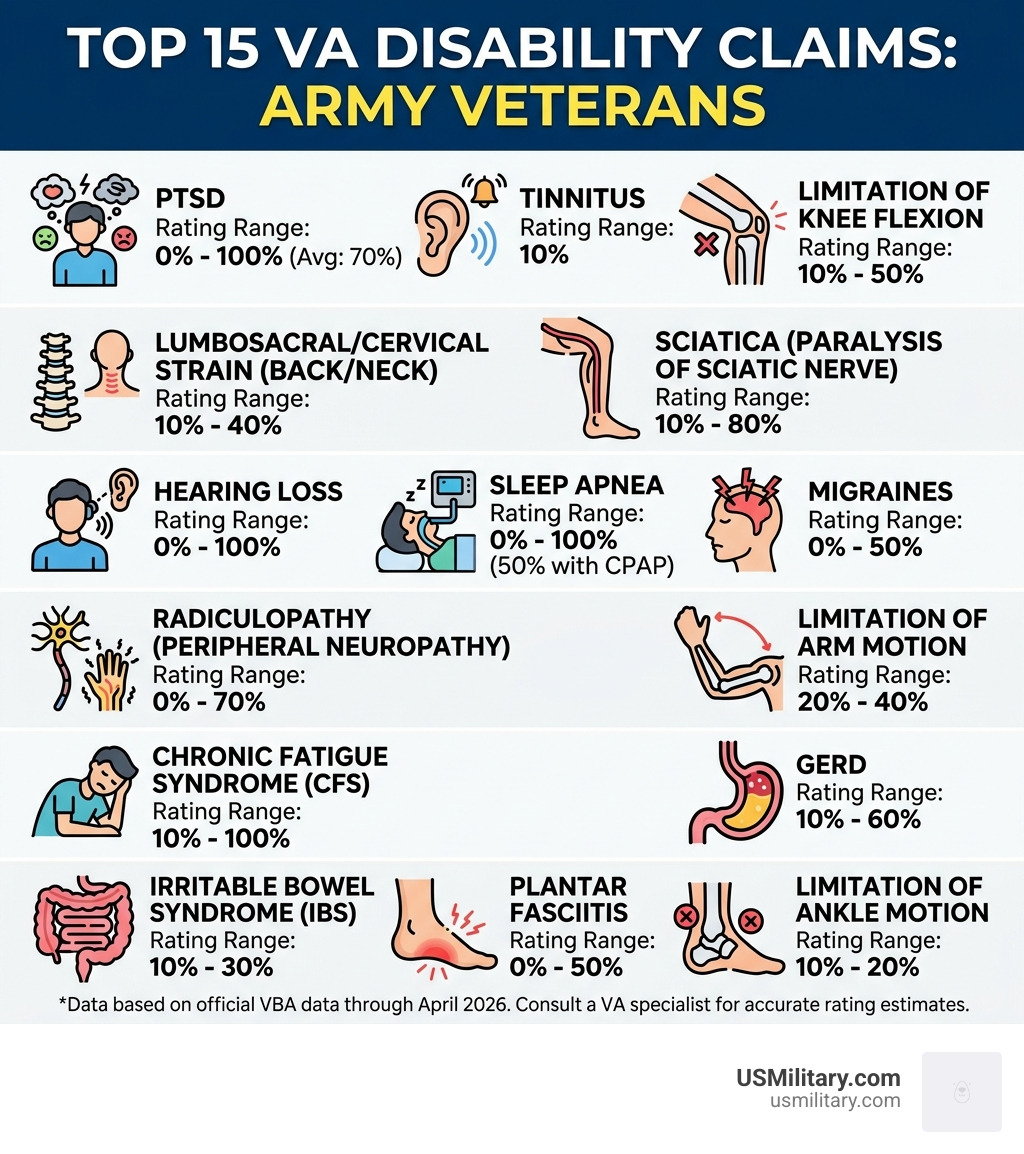
The Top 15 VA Military Disability Claims By Army Veterans are the most commonly filed and approved conditions Army veterans receive monthly VA compensation for, based on official Veterans Benefits Administration (VBA) data through April 2026:
| # | Condition | Typical VA Rating |
|---|---|---|
| 1 | PTSD | 0% – 100% (avg 70%) |
| 2 | Tinnitus | 10% |
| 3 | Limitation of Knee Flexion | 10% – 50% |
| 4 | Lumbosacral/Cervical Strain (Back/Neck) | 10% – 40% |
| 5 | Sciatica (Paralysis of Sciatic Nerve) | 10% – 80% |
| 6 | Hearing Loss | 0% – 100% |
| 7 | Sleep Apnea | 0% – 100% (50% with CPAP) |
| 8 | Migraines | 0% – 50% |
| 9 | Radiculopathy (Peripheral Neuropathy) | 0% – 70% |
| 10 | Limitation of Arm Motion | 20% – 40% |
| 11 | Chronic Fatigue Syndrome (CFS) | 10% – 100% |
| 12 | GERD | 10% – 60% |
| 13 | Irritable Bowel Syndrome (IBS) | 10% – 30% |
| 14 | Plantar Fasciitis | 0% – 50% |
| 15 | Limitation of Ankle Motion | 10% – 20% |
As of 2024, roughly 5.9 million disabled veterans receive VA compensation for approximately 41.6 million total disabilities — that’s nearly 7 separate conditions per veteran. Army veterans make up the largest share of that group, driven by the physical demands of combat, heavy gear, and MOS-specific hazards like noise exposure and blast injuries.
The VA rates each condition on a scale from 0% to 100% in 10% increments. Your monthly payment depends on your combined rating across all service-connected conditions. Filing for multiple conditions — including secondary ones linked to a primary disability — is often the fastest path to a higher rating.
I’m Larry Fowler, publisher of the USMilitary.com Network since 2007, and I’ve spent nearly two decades tracking VA disability trends and helping veterans understand their benefits — including the Top 15 VA Military Disability Claims By Army Veterans covered in depth below. Let’s break down each condition, what the VA pays, and how to build the strongest possible claim.
Understanding the Top 15 VA Military Disability Claims By Army Veterans
When we look at the raw data from the VBA, it becomes clear that Army veterans carry a unique burden of service-connected disabilities. With over 1.5 million Army veterans currently receiving compensation, the sheer volume of claims is staggering. But it isn’t just about the numbers; it’s about the intensity of the work.
Army life often involves “rucking” hundreds of pounds of gear over uneven terrain, jumping out of planes, and enduring the “whole-body vibration” of armored vehicles. These physical stresses lead to a high prevalence of musculoskeletal issues like back strain and knee limitations. Furthermore, the combat intensity experienced by many soldiers leads to a higher percentage of mental health claims compared to some other branches.
According to the Top 20 VA Disability Claims – Veterans Guide, the average veteran today is service-connected for roughly 6.9 disabilities. For those who served in the Gulf War era or later, that number often jumps even higher. This is because the VA has become more adept at recognizing how one primary injury—like a back strain—can lead to secondary issues like sciatica or depression.
Mental Health and Respiratory High-Value Claims
In recent years, we have seen a massive shift in how the VA handles mental health and respiratory issues. A major catalyst for this was the PACT Act of 2022, which expanded benefits for veterans exposed to burn pits and other toxic substances. By April 2026, the VA has processed record-breaking numbers of these claims, with approval rates hovering around 62%.
Why PTSD Leads the Top 15 VA Military Disability Claims By Army Veterans
Post-Traumatic Stress Disorder (PTSD) is consistently one of the most significant claims for Army veterans. Research shows that military veterans are four times (4x) more likely to develop PTSD than civilians. While many associate PTSD with direct combat, the VA also recognizes non-combat stressors, such as Military Sexual Trauma (MST) or severe training accidents.
Under the 2025 mental health rating revisions, the VA has moved toward a system that more accurately reflects occupational and social impairment. Most veterans service-connected for PTSD receive a 70% rating, which indicates “deficiencies in most areas, such as work, school, family relations, judgment, thinking, or mood.” To secure a 100% rating, evidence must show total occupational and social disability.
Sleep Apnea and Chronic Fatigue Syndrome (CFS)
Sleep apnea has become a “high-value” claim because it is frequently rated at 50% if a CPAP machine is required. Army veterans are four times (4x) more likely to suffer from sleep apnea than the general population. While it can be hard to prove a direct service connection if you weren’t diagnosed while on active duty, many veterans successfully claim it as secondary to PTSD or weight gain caused by service-connected knee and back injuries.
Chronic Fatigue Syndrome (CFS) is another critical area, particularly for Gulf War veterans. The VA now recognizes CFS as a presumptive condition for those who served in Southwest Asia. This means if you have a formal diagnosis of ME/CFS and served in those regions, you do not have to provide a “nexus” (link) to a specific in-service event; the VA presumes your service caused the illness.
Musculoskeletal and Neurological Conditions

The “knees and back” are the bread and butter of Army disability claims. If you were a paratrooper or served in the infantry, your body likely took a beating that didn’t show up on an X-ray until years after you hung up the uniform. For a detailed breakdown of how these are evaluated, you can refer to the List of VA Disability Ratings by Medical Condition | Hill & Ponton, P.A..
Back Injuries, Sciatica, and Radiculopathy
Sciatica, which the VA classifies as “paralysis of the sciatic nerve,” is the #7 most common disability across the board. It often stems from lumbosacral strain (lower back pain). When a disk in your spine is damaged from heavy lifting or the jarring impact of a parachute landing, it can pinch the nerve, causing numbness, tingling, and “shooting” pains down the legs.
The VA rates sciatica from 10% to 80%. A key winning strategy here is documenting functional loss and flare-ups. Even if you have a decent range of motion during your C&P exam, the law (specifically the Sharp v. Shulkin case) requires the examiner to consider how your back performs during a flare-up when you can barely move.
Migraines and Tinnitus: Frequent Top 15 VA Military Disability Claims By Army Veterans
Tinnitus—that constant ringing in the ears—is the #1 most claimed disability. While it is currently a flat 10% rating, it is a gateway to many secondary claims. For instance, roughly 27% of tinnitus sufferers also suffer from migraines.
Migraines are rated up to 50% based on “prostrating attacks.” In VA terms, “prostrating” means the headache is so severe you are forced to lie down in a dark room and cannot function or work. If these attacks happen once a month on average, you may qualify for a 30% rating. If they are very frequent and cause “severe economic inadaptability,” you could reach the 50% mark.
Digestive Issues and Secondary Service Connections
Many Army veterans overlook digestive issues, thinking they are just a result of “MRE stomach” or aging. However, conditions like Irritable Bowel Syndrome (IBS) and Gastroesophageal Reflux Disease (GERD) are frequently linked to service-connected mental health conditions or the long-term use of NSAIDs (like Ibuprofen) for joint pain.
IBS and GERD Secondary to PTSD
The VA recognizes a strong link between the gut and the brain. Veterans with PTSD often develop IBS or GERD as a physical manifestation of chronic stress—sometimes called Somatic Symptom Disorder.
- IBS is rated at 10%, 20%, or 30% based on the severity of abdominal pain and bowel disturbances.
- GERD can be rated up to 60% if symptoms include severe pain, vomiting, and “regurgitation with aspiration” (stomach acid entering the lungs).
It is important to note the “pyramiding” rules: the VA generally won’t give you two separate ratings for the same symptoms in the same body system, but IBS and GERD can sometimes be rated separately if the symptoms are distinct.
Plantar Fasciitis and Joint Limitations
Plantar fasciitis is a common struggle for infantry soldiers who spent years marching in boots. The VA rates this from 0% to 50%. If you have “extreme” cases where even surgery didn’t help, you could see a significant rating.
Additionally, the Painful Motion Rule is a veteran’s best friend. It states that if a joint (like a knee or ankle) hurts when you move it, the VA should grant at least a 10% rating for that joint, even if your range of motion is technically within “normal” limits.
Strategies to Win Your Army VA Disability Claim
Winning a claim for the Top 15 VA Military Disability Claims By Army Veterans requires more than just filling out a form. You need a strategy built on three pillars: a current diagnosis, an in-service event, and a medical nexus.
- Nexus Letters: This is a document from a medical professional that states it is “at least as likely as not” that your condition was caused or aggravated by your service. This is often the missing piece for secondary claims like sleep apnea secondary to PTSD.
- DBQs (Disability Benefits Questionnaires): These forms help ensure the C&P examiner captures all the necessary data to rate you accurately.
- Buddy Letters: Statements from fellow soldiers who witnessed your injury or noticed your symptoms can provide vital “lay evidence” when medical records are missing.
- Statement in Support of Claim: Don’t let the VA guess how your life is affected. Write a clear personal statement describing your “worst days,” not your best ones.
Frequently Asked Questions about Army VA Claims
How do Army veterans increase their overall combined VA disability rating?
The most effective way is to file for secondary conditions. For example, if you are rated for a back injury, you should look for related issues like radiculopathy (nerve pain in the legs), depression due to chronic pain, or even erectile dysfunction (ED) caused by pain medication. These “add-ons” use “VA math” to push your combined rating toward 100%.
What are the presumptive conditions for Gulf War Army veterans?
Under the PACT Act and Gulf War presumptive rules, conditions like Chronic Fatigue Syndrome, Fibromyalgia, and various respiratory cancers are presumed to be service-connected. If you served in certain locations (like Iraq or Afghanistan) during specific windows, you only need a diagnosis to qualify.
How can I service connect secondary conditions like erectile dysfunction to PTSD?
This is a very common claim. Many medications used to treat PTSD or depression have side effects that cause sexual dysfunction. By providing a medical nexus linking the medication to the condition, you can receive a rating under SMC-K (Special Monthly Compensation), which provides an extra monthly payment (roughly $136 as of 2025) on top of your standard disability check.
Conclusion
Navigating the VA system can feel like a second tour of duty, but you don’t have to do it alone. By focusing on the Top 15 VA Military Disability Claims By Army Veterans, you can prioritize the claims that are most likely to be approved and carry the highest value. Whether you are dealing with the invisible wounds of PTSD or the physical toll of years in the infantry, the benefits you earned are there to provide security for you and your family.
At USMilitary.com, we are committed to being your central hub for military resources. From understanding your VA disability ratings to finding the best VA home loans, we provide the unbiased guidance you need to make the most of your post-service life.