

Trump has not ruled out a military draft amid Iran war operations — and that single statement from the White House has set off a wave of anxiety across the country, especially among families with young men aged 18 to 25.
Here is what you need to know right now:
- No draft has been reinstated. A draft is not currently in effect.
- The White House has not ruled it out. Press Secretary Karoline Leavitt said President Trump “wisely does not remove options off the table.”
- Current operations are air-based. The U.S. is running an air campaign — no ground troops have been confirmed in Iran.
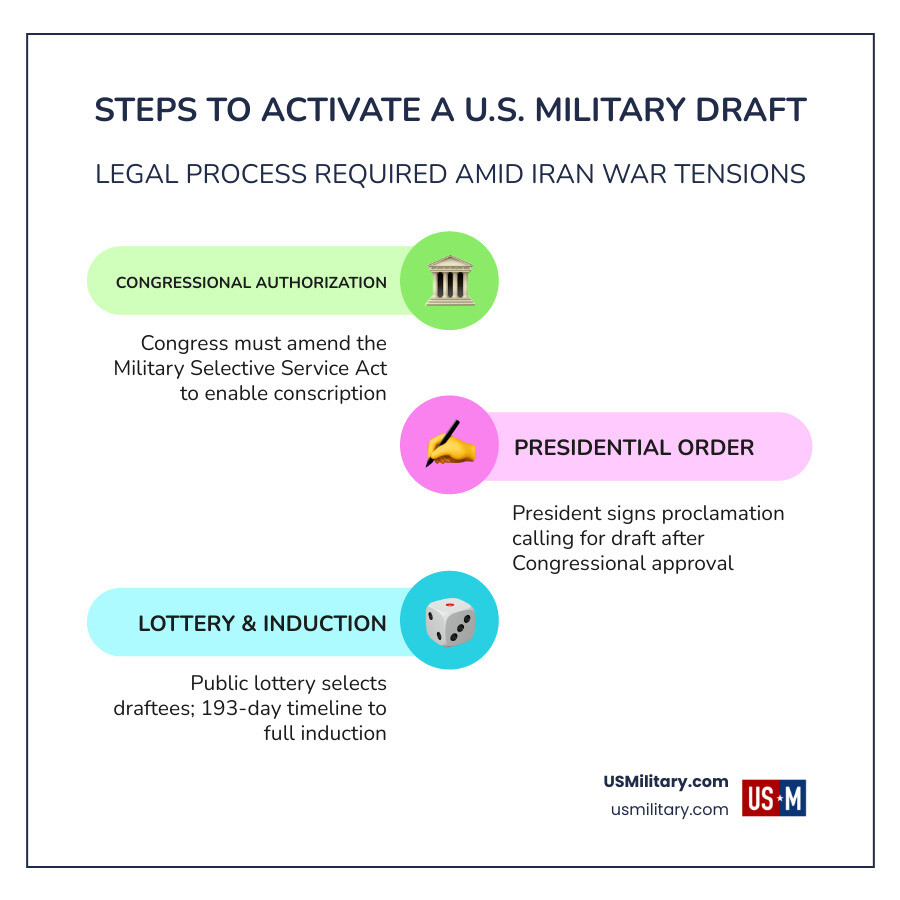
- A draft requires Congress. The President cannot restart the draft alone. Congress must amend the Military Selective Service Act first.
- The war has been costly. Seven Americans have been killed so far, along with at least 1,230 people in Iran, nearly 400 in Lebanon, and at least 11 in Israel.
The fear is real — but so is the gap between a press secretary’s careful non-answer and an actual draft notice.
I’m Larry Fowler, publisher of the USMilitary.com Network since 2007, where I’ve tracked military policy, recruitment trends, and Selective Service developments that directly affect service members and their families — including everything emerging around the fact that Trump has not ruled out a military draft amid Iran war escalation. Below, I’ll walk you through exactly what’s been said, what the law requires, and what it could mean for you or someone you love.
Key terms for Trump Has Not Ruled Out a Military Draft Amid Iran War:
- Could A War With Iran Spark a Military Draft
- Everything You Need to Know About the Military Draft
- Does the US currently have a military draft
Current Status of the War in Iran and U.S. Involvement
The conflict, often referred to as Operation Epic Fury, has escalated rapidly following initial strikes. We have seen after Israel and the U.S. launched strikes on Iran, smoke rising over Tehran as the air campaign targets strategic assets. While the Pentagon has focused on a high-tech air offensive, the human cost is climbing.
As of early March 2026, the Oil prices soar as Pentagon IDs 7th U.S. war death headline reflects a grim reality: seven Americans have lost their lives. On the ground in the region, the devastation is even more widespread, with over 1,200 reported dead in Iran and hundreds more in Lebanon and Israel.
This regional escalation hasn’t just stayed on the battlefield. Back home, Americans are feeling the pinch at the pump as rising fuel prices hammer the stock market and increase the cost of living. The combination of rising casualties and economic strain is exactly why the conversation about a potential draft has moved from the fringes of the internet to the center of national news.
Trump Has Not Ruled Out a Military Draft Amid Iran War
The spark that lit the “draft rumor” fire came during a high-profile interview on Sunday Morning Futures with Maria Bartiromo. When asked about the fears of mothers across America regarding their sons and daughters being sent to war, White House Press Secretary Karoline Leavitt did not give a definitive “no.”
Instead, she noted that the President “wisely does not remove options off the table.” This phrase is standard diplomatic and military “strategic ambiguity,” but in the context of an active war, it carries heavy weight. While we have explored the us-military-draft-in-2026/ scenario previously, this is the first time the administration has explicitly left the door open in a public forum.
The President himself has touched on the possibility of ground troops. During comments on Air Force One on March 7, he suggested that while ground troops aren’t the current plan, they could be deployed for a “very good reason.”
Official Statements on Why Trump Has Not Ruled Out a Military Draft Amid Iran War
The administration’s refusal to rule out a draft is rooted in the concept of commander-in-chief authority. By keeping all options open, the White House believes it maintains a stronger bargaining position and keeps adversaries guessing. Karoline Leavitt emphasized that Donald Trump wants to ensure he has every tool available to protect national security.
Interestingly, this contrasts with some of his campaign rhetoric. In a September 2024 Truth Social post, Trump claimed that a vote for his opponent would lead to a draft, implying he would avoid one. Now that he is in the Oval Office facing a hot war, the language has shifted from campaign promises to the “reality of the table.”
Public Anxiety and the Reality That Trump Has Not Ruled Out a Military Draft Amid Iran War
The shift in tone has caused a spike in gen-z-military-draft/ searches and social media panic. Many young Americans are seeing rumors about “Project 2025” and automated registration, leading to questions like would-americas-youth-today-have-the-courage-confidence-to-defend-america-if-drafted/.
It is important to separate political rhetoric from legal reality. While the administration is keeping its “options open,” the actual path to a draft is blocked by significant legal hurdles that would require more than just a presidential tweet or a press secretary’s comment.
Legal Requirements and the Selective Service System Process
If the government decided to move forward, they couldn’t just start picking names tomorrow. According to the Selective Service System (SSS), a specific sequence of events must occur:
- Congress passes legislation: Both the House and Senate must pass an amendment to the Military Selective Service Act to authorize inductions.
- Presidential Signature: The President must sign the bill into law.
- The Lottery: A public lottery is held. This uses two air-filled drums—one for dates of the year and one for numbers 1 to 365. If “August 4” is drawn with the number “1,” then men born on August 4 are the first to be called.
| Feature | Voluntary Enlistment | Military Draft (Conscription) |
|---|---|---|
| Choice | Individual’s decision | Mandated by law |
| Authority | Department of Defense | Congress & President |
| Process | Recruiter interview/MEPS | Random lottery by birthdate |
| Timeline | Immediate to months | 193 days to first induction |
The 193-day timeline is a key safeguard. From the moment Congress authorizes a draft, the SSS has roughly six months to conduct the lottery, issue orders, and perform physical and mental evaluations before the first draftee is delivered to the military. Furthermore, the War Powers Act limits a President’s ability to keep troops in a conflict for more than 90 days without a formal declaration of war or specific authorization from Congress. We have seen recent legislative moves to automate-military-draft-passed-by-congress/, but this refers to registration, not the actual call to serve.
Draft Eligibility, Exemptions, and Conscientious Objector Status
Currently, the law requires almost all male U.S. citizens and male immigrants (including undocumented, legal permanent residents, and refugees) aged 18-25 to register with the Selective Service. You can find more on the age-to-be-drafted-by-military/ here. While there has been much debate about women-draft-us-defense-gender-equality-future/, current law still only applies to men.
If a draft were activated, your detailed-guide-to-military-draft-status/ would determine if you actually have to go.
Classifications and Deferments
Not everyone whose number is called ends up in boots. There are several ways to postpone or be exempted from service:
- Student Postponements: College students can usually finish their current semester; seniors can often finish their degree.
- Hardship Deferments: If your service would cause extreme hardship to dependents (like children or elderly parents), you may be deferred.
- Medical Disqualifications: Physical or mental health issues that prevent service.
- Age Limits: The cut-off-age-for-military/ is generally 26 for the draft, though we’ve seen the-draft-age-debate-can-you-be-called-to-serve-after-26-or-even-40/ pop up in legal circles.
- Ministerial Exemptions: Full-time ministers and divinity students are often exempt.
Conscientious Objector Status
For those with deeply held beliefs against war, there is the “conscientious objectors,” status. To qualify, you must demonstrate that your opposition to war is based on moral, ethical, or religious beliefs and that you are opposed to all war, not just the specific conflict in Iran.
If classified as a conscientious objector, you might still serve in a non-combatant role within the military (like a medic) or perform “alternative service” in civilian jobs that contribute to the national interest, such as healthcare or environmental work.
Historical Context: Trump’s Vietnam Record and Past Conscriptions
The U.S. has a long and complicated history with the draft. It was used in the Civil War (where about 2% of Union troops were draftees), WWI, WWII, and Korea. However, the most modern reference point is the Vietnam War. It has been over 50 years since the Vietnam War ended, a conflict where 1.8 million men were conscripted.
The draft became so unpopular that the U.S. transitioned to an all-volunteer force in 1973. The President’s authority to induct draftees expired the following year, which is why Congress must act today to bring it back.
Trump’s Personal Draft History
Discussions about a potential draft often bring up the President’s own history. During the Vietnam War, Donald Trump received four education deferments while attending college. After graduating, he received a medical exemption for bone spurs in his heels, which prevented him from serving.
This history has been a point of contention for years. In a 2016 interview, Trump called the Vietnam War a “horrible mistake.” We provide everthing-you-need-to-know-about-the-military-draft/ including how these historical exemptions worked for those curious about the precedents.
Frequently Asked Questions about the Iran War Draft
Has a draft been officially reinstated for the Iran war?
No. There is currently no military draft in the United States. The military remains an all-volunteer force. While the administration has not ruled it out as a future option, no legal steps have been taken to restart conscription.
Can the President start a draft without Congress?
No. Under the Military Selective Service Act, the President does not have the unilateral authority to induct people into the military. Congress must pass a law authorizing the draft, which the President must then sign.
Who is currently required to register for the Selective Service?
Almost all male U.S. citizens and male immigrants living in the U.S. who are between the ages of 18 and 25 are required to register. Registration is a requirement to remain eligible for federal student aid, job training, and government employment.
Conclusion
The news that Trump has not ruled out a military draft amid Iran war tensions is understandably jarring. However, it is vital to remember the difference between military strategy—where leaders rarely “limit their options”—and the actual legislative process required to change American life so drastically.
At USMilitary.com, we are committed to providing you with the most accurate, non-biased information to help you navigate these uncertain times. Whether you are looking for career paths in the current volunteer force or need more More info about what is the US military draft, we are here to serve as your central hub for military resources.
Stay informed, stay calm, and keep checking back with us as this situation develops. We’ve got your back.