
Find a VA Disability Lawyer You Can Trust

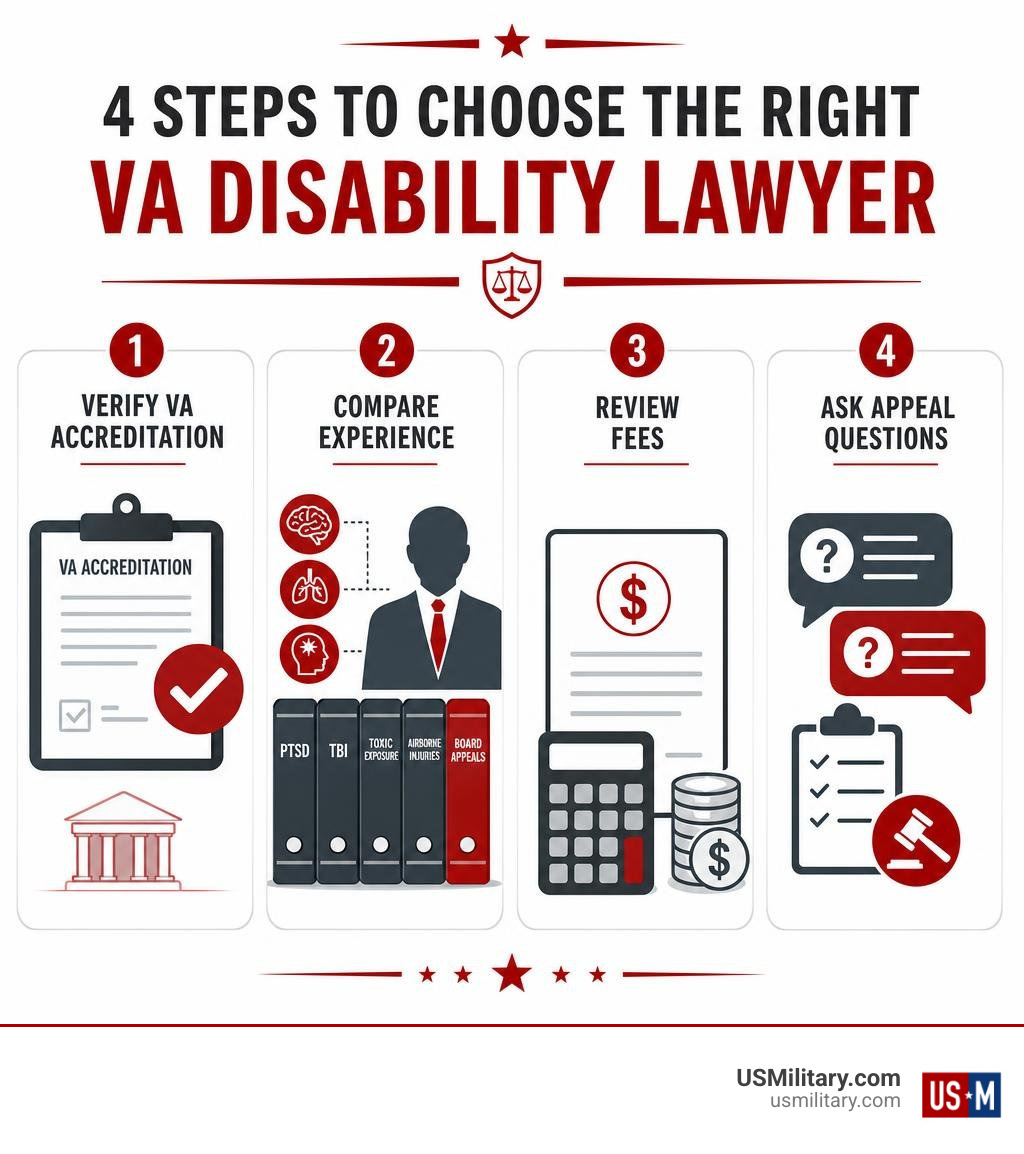
Army veterans can find the right VA disability lawyer by taking four simple steps:
- Verify VA accreditation in the VA Office of General Counsel directory.
- Check the lawyer’s state bar record for an active license and discipline history.
- Ask about experience with your condition and appeal stage, such as PTSD, TBI, toxic exposure, airborne injuries, or a Board appeal.
- Read the fee agreement before signing. A lawyer cannot charge for an initial VA claim, and a direct-pay fee agreement is generally limited to 20% of past-due benefits.
The best fit is not always the biggest firm or the one with the flashiest success-rate claim. It is an accredited lawyer with enough time for your case, clear communication, and proven work on appeals like yours.
A free Veterans Service Organization representative may be all you need for a first claim or simple paperwork issue. But after a denial, low rating, wrong effective date, or complex medical question, a VA disability attorney can help identify evidence gaps, choose the right Appeals Modernization Act lane, and protect potential back pay. Act promptly: veterans generally have one year, or 365 days, from the date on the Rating Decision cover letter to seek review while preserving the effective date.
I am LARRY FOWLER, publisher of the USMilitary.com Network, which has helped military members and veterans understand VA benefit trends since 2007. In this guide to How Army Veterans Can Find The Best VA Disability Lawyers, I will help you sort credible legal help from costly claims pitches and make a more informed choice.
Understanding VA-Accredited Representatives: Attorneys vs. Claims Agents vs. VSOs
Navigating the Department of Veterans Affairs can feel like conducting an unmapped tactical march through administrative red tape. Fortunately, federal law creates a regulated framework of recognized advocates to ensure that former soldiers never have to navigate this bureaucracy alone.
Under federal regulations, anyone assisting a veteran with the preparation, presentation, or prosecution of a VA benefits claim must be formally accredited. The Department of Veterans Affairs recognizes three distinct types of advocates:
- Veterans Service Organization (VSO) Representatives
- Accredited Claims Agents
- Accredited VA Disability Attorneys
Understanding the differences among these advocates helps you choose the right level of support for your current claim stage.
Accreditation Types and Roles Under 38 CFR § 14.629
The VA Office of General Counsel (OGC) governs the accreditation of all legal representatives under 38 CFR § 14.629. This oversight ensures that claimants receive competent, ethically bound representation. If an individual is not accredited by the VA OGC, federal law prohibits them from preparing or prosecuting claims on your behalf.
- Accredited Attorneys: Licensed lawyers who maintain active membership in good standing with at least one state bar. They must complete continuing legal education (CLE) credits specifically in veterans benefits law to maintain their federal accreditation. Attorneys can represent veterans at all administrative levels and escalate denied claims to the U.S. Court of Appeals for Veterans Claims (CAVC) and the Federal Circuit.
- Accredited Claims Agents: Independent, non-attorney professionals who have passed a comprehensive, specialized written examination administered by the VA covering Title 38 statutes, case law, and procedural rules. Claims agents undergo character and fitness background checks and can charge contingency fees for appeals just like attorneys.
- Veterans Service Officers (VSOs): Representatives working for recognized chartered organizations such as the VFW, DAV, The American Legion, or state and county veterans affairs departments. VSOs receive specialized training and are legally mandated to provide all claim services completely free of charge. You can Get Help From A VA Accredited Representative Or VSO directly through official VA channels or local service offices.
Choosing Between Free VSO Assistance and Private Disability Counsel
A common question Army veterans ask is whether they should stick with a free VSO or hire an accredited disability attorney. The right answer depends entirely on your procedural posture, the legal complexity of your case, and whether you are filing an initial claim or appealing a stubborn denial.
VSOs are ideal partners for initial claims, standard service connections, adding dependents, and submitting routine paperwork. However, many VSOs handle massive caseloads and may not have the capacity to write in-depth legal briefs or navigate complex appellate courts.
Private disability attorneys focus primarily on appeals. They invest substantial law firm resources into gathering private medical records, securing independent medical opinions (nexus letters), working with vocational experts for Total Disability Individual Unemployability (TDIU) claims, and drafting appellate briefs. To evaluate reputable legal options, review our Top 10 Veteran Disability Lawyers Guide.
| Feature / Criteria | VSO Representative | Accredited Claims Agent | Accredited VA Attorney |
|---|---|---|---|
| Cost / Fees | 100% Free by Law | Contingency on Back Pay | Contingency on Back Pay |
| Best For | Initial Claims & Basic Increases | Mid-Level Appeals & Increases | Complex Appeals, TDIU, CAVC Court |
| Licensing / Vetting | VSO Training & VA OGC | VA Written Exam & OGC Vetting | Active State Bar License & VA OGC |
| CAVC Federal Court Appeals | No | No | Yes |
| Medical Evidence Funding | Veteran Pays Upfront | Firm/Agent Advance or Veteran | Firm Often Advances Costs |
How Army Veterans Can Find The Best VA Disability Lawyers for Complex Appeals
Soldiers are trained to execute missions based on intelligence, preparation, and proper equipment. Finding a qualified legal advocate requires that exact same disciplined approach. When facing a denied appeal or an inaccurate disability rating, selecting the right advocate requires proper vetting.

Step-by-Step Vetting: How Army Veterans Can Find The Best VA Disability Lawyers Using Official Portals
Never rely solely on sleek marketing campaigns or social media ads when your financial future is at stake. Follow this step-by-step verification process to vet prospective legal counsel:
- Check the VA Office of General Counsel Online Directory: Visit the official VA OGC accreditation search page (
va.gov/ogc/apps/accreditation/index.asp). The VA updates this database three times per week (every Monday, Wednesday, and Friday evening). Confirm that the individual attorney—not just the law firm’s general name—is actively listed as an accredited attorney. - Verify State Bar Standing: Look up the attorney on their respective state bar association website. Ensure their law license is active, in good standing, and completely free of public disciplinary sanctions, suspensions, or ethical reprimands.
- Cross-Reference Professional Associations: Search the National Organization of Veterans’ Advocates (NOVA) directory. NOVA is the premier national professional association for attorneys and agents dedicated to veterans law. Membership demonstrates ongoing professional training and dedication to Title 38 jurisprudence.
- Evaluate Firm Workload and Accessibility: Ask prospective law firms directly about their current active docket. A high-volume firm with excessive caseloads may leave you feeling like a number, while a dedicated boutique or balanced national firm can provide consistent case updates. Making informed choices ensures The Veterans Guide to Not Leaving Money on the Table becomes a reality for your household.
Matching Army-Specific Injuries to Legal Appellate Experience
The military occupational specialties (MOS) across the United States Army expose soldiers to unique physical and psychological stressors. Whether your background is Infantry (11B), Combat Engineer (12B), Cannon Crewmember (13B), or Motor Transport (88M), your legal counsel must understand how Army operations cause specific disabilities.

When interviewing attorneys, verify their experience with Army-specific claim profiles:
- Combat Arms & Physical Trauma: Degenerative disc disease, bilateral knee instability, cervical strain, and hip replacements resulting from road marches, tactical vehicle operations, and airborne jump injuries.
- Auditory Damage: Tinnitus and bilateral sensorineural hearing loss tied to small arms fire, artillery blasts, engine noise, and breaching operations.
- Toxic Exposure & Airborne Hazards: Presumptive respiratory conditions, rhinitis, sinusitis, asthma, and rare cancers linked to burn pit exposure across Iraq, Afghanistan, and CENTCOM deployment areas under the PACT Act.
- Complex Mental Health & TBI: Post-Traumatic Stress Disorder (PTSD) secondary to combat operations or Military Sexual Trauma (MST), alongside Traumatic Brain Injury (TBI) secondary to improvised explosive device (IED) concussions.
An experienced lawyer knows how to analyze your military service personnel records, DD Form 214, Service Treatment Records (STRs), and unit line-of-duty (LOD) determinations to build a clear medical nexus connecting your current diagnosis to active service.
Legal Fee Regulations, Contingency Caps, and Red Flags to Avoid
Federal law strictly regulates how and when legal fees can be assessed for veterans benefits representation. Knowing these rules protects you from predatory actors and unlawful billing schemes. For a deeper breakdown of managing representation costs, read How to Afford a VA Lawyer on a Budget.
Permitted Fee Structures and Direct Pay Safeguards
Under 38 U.S.C. § 5904 and 38 CFR § 14.636, accredited attorneys work on a contingency fee basis. This means:
- Zero Upfront Costs: You do not pay hourly retainers, intake charges, or consultation fees.
- No Fee Unless You Win: If the attorney does not secure a retroactive increase or win your appeal, you owe zero legal fees.
- Paid Only From Past-Due Back Pay: Legal fees can only be calculated from the retroactive back pay awarded between the established effective date and the date of the successful decision. Attorneys are legally barred from taking any percentage of your future ongoing monthly disability compensation checks.
- The 20% Direct-Pay Rule: If a fee agreement specifies a 20 percent contingency fee, the VA can withhold that amount directly from your past-due lump-sum award and disburse it straight to the attorney. Over recent 12-month periods, the VA has disbursed over $394 million in direct attorney and agent fees, averaging roughly $32 million per month. While fee agreements up to 33.3% are legally permissible under certain conditions, agreements exceeding 20% require the attorney to collect the additional amount directly from the veteran rather than via automatic VA withholding.
- EAJA Fees in Federal Court: If your appeal escalates to the Court of Appeals for Veterans Claims (CAVC) and the court remands your case, the attorney’s court fees are often paid directly by the government under the Equal Access to Justice Act (EAJA), saving you out-of-pocket court costs.
Understanding your monthly payout tiers is critical during appeals; review our VA Disability Rating Chart Guide 2026 to calculate anticipated benefit amounts.
Spotting Unaccredited Claims Poachers and Predatory Fee Schemes
Unaccredited “claims consulting companies” and self-proclaimed “veterans coaches” have proliferated online. These entities operate outside the authority of the VA Office of General Counsel and evade federal consumer protection caps.
Watch out for these major red flags:
- Demanding Future Monthly Benefits: Any company requiring contracts that take “5x or 6x the monthly increase” or a continuous slice of your ongoing monthly checks is operating outside accredited VA standards.
- Requiring Your Personal VA.gov / eBenefits Logins: Unaccredited consultants cannot legally represent you, so they frequently demand your private login credentials to file paperwork under your name. Never give your login credentials to third parties.
- Boilerplate Medical Opinion Mills: Predatory operations often direct veterans to unvetted, out-of-state medical providers who charge thousands of dollars upfront for generic, templated DBQs (Disability Benefits Questionnaires) that the VA routinely rejects.
- Guaranteed Disability Ratings or Fast Timelines: No legitimate, ethical attorney can guarantee a 100% rating or specific timeline. Any promise of guaranteed success is a deceptive practice.
Navigating the Appeals Modernization Act (AMA) Lanes with Legal Counsel
The Appeals Modernization Act (AMA) replaced the older Legacy appeal system, creating a structured, three-lane appellate framework. When the VA denies your claim or issues an inadequate rating, our guide on How to Turn Your VA Denial Into a Winning Appeal helps you formulate your strategy.
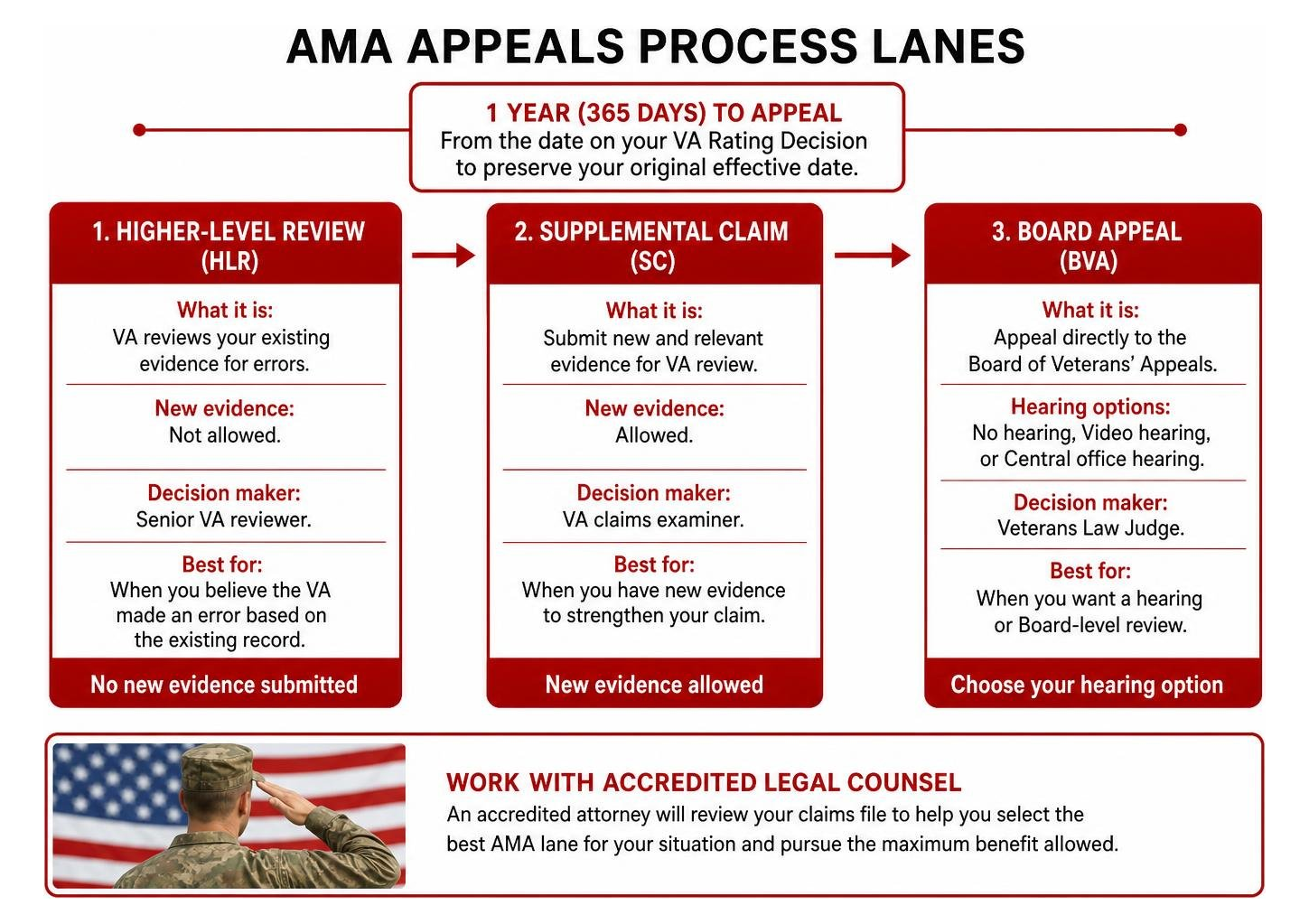
Veterans have exactly one year (365 days) from the date printed on the VA Rating Decision cover letter to file an appeal. Meeting this 365-day deadline preserves the original effective date, protecting every month of accumulated retroactive back pay.
Higher-Level Review, Supplemental Claims, and BVA Representation
An accredited attorney will evaluate your Claims File (C-File) to select the optimal AMA lane:
- Supplemental Claim Lane (VA Form 20-0995): Used when you have “new and relevant” evidence to submit, such as a fresh private medical nexus opinion, civilian surgical treatment notes, or lay witness statements (buddy letters) from fellow soldiers.
- Higher-Level Review (HLR – VA Form 20-0996): Used when the evidence of record already supports your claim, but the regional adjudicator made a clear factual or legal error. In this lane, no new evidence is allowed, but an accredited attorney can request an Informal Conference to present direct statutory and regulatory arguments to a senior Decision Review Officer (DRO).
- Board of Veterans’ Appeals (BVA – VA Form 10182): Direct appeal to a Veterans Law Judge (VLJ) in Washington, D.C. The Board offers three dockets: Direct Review (no new evidence), Evidence Submission (submit evidence within 90 days), or Hearing Docket (testify directly before a judge). Board appeals typically take 12 to 24 months, where skilled legal representation is invaluable.
Practical Criteria: How Army Veterans Can Find The Best VA Disability Lawyers During Consultations
During your initial free consultation, interview the attorney just as thoroughly as they evaluate your claim. You can also explore 10 VA Disability Benefits That Veterans Often Dont Claim but Many Can to identify potential secondary conditions to raise during your meeting.
Ask the following questions:
- Are you personally accredited by the VA Office of General Counsel, and what is your OGC accreditation number?
- How many years have you actively practiced Title 38 veterans benefits law?
- Have you successfully handled appeals specifically involving my conditions (e.g., combat PTSD, TBI, spinal injuries, sleep apnea secondary to toxic exposure)?
- Do you represent claimants across all appellate stages, including the Board of Veterans’ Appeals and the Court of Appeals for Veterans Claims (CAVC)?
- Does your firm advance the initial costs for obtaining private medical records and independent medical nexus opinions?
- How often will I receive updates on my claim’s status, and will I speak directly with my attorney or a designated case manager?
- What exact contingency percentage do you charge, and is your fee agreement filed for direct pay withholding with the VA?
Managing Your Representation: Appointing, Discharging, or Switching Attorneys
Veterans maintain absolute control over their claims representation. You are never permanently locked into an attorney relationship if communication breaks down or if you are dissatisfied with how your appeal is being handled.
Submitting VA Form 21-22a and Revoking Power of Attorney
To officially appoint an accredited attorney or claims agent, complete and submit VA Form 21-22a (Appointment of Individual as Claimant’s Representative). This form must be signed by both you and the appointed attorney.
Replacing a Representative: Under federal rules, appointing a new accredited representative by submitting a new VA Form 21-22a automatically revokes and replaces any previous representative or VSO on file. You can also cancel representation at any time by calling the VA helpline at 800-827-1000 or by sending a formal revocation letter to the Janesville Claims Intake Center.
Resolving Fee Liens and Filing OGC Misconduct Complaints
If you discharge an attorney before a claim is completed, that attorney may file a fee lien against any future retroactive back pay for the work they performed. However, the VA Office of General Counsel reviews disputed fee claims to ensure any fee collected is reasonable and directly reflects the work completed.
If an accredited advocate engages in unethical behavior, charges improper fees, or demonstrates severe lack of skill:
- File a formal complaint directly with the VA Office of General Counsel (022D), 810 Vermont Avenue NW, Washington, DC 20420, accompanied by a signed VA Form 3288.
- Report unethical misconduct to the attorney’s respective State Bar Licensing Board.
- File deceptive business complaints with the Federal Trade Commission (FTC) and your state Attorney General.
Frequently Asked Questions About Finding VA Disability Lawyers
How long do Army veterans have to appeal a VA disability rating decision?
Veterans have exactly one year (365 days) from the date printed on their VA Rating Decision cover letter to file an appeal under the Appeals Modernization Act. Filing within this 365-day window preserves your original effective date, protecting your accrued retroactive back pay. If you miss the one-year deadline, the decision becomes final, and you must file a Supplemental Claim with new and relevant evidence to reopen the matter.
Can a VA disability attorney charge a fee for an initial claim filing?
No. Federal law (38 U.S.C. § 5904) strictly prohibits accredited attorneys and claims agents from charging fees for assistance with filing an initial claim application. Legal fees are only permitted after the VA has issued an initial adverse decision (a denial or low rating) and a compliant fee agreement alongside VA Form 21-22a is submitted.
What is the standard fee percentage for an accredited VA appeals lawyer?
The industry standard contingency fee for accredited VA disability appeals is 20 percent of past-due retroactive benefits, which qualifies for direct payment withholding by the VA. While fee agreements between 20% and 33.3% are legally permissible, any fee exceeding 20% is not automatically withheld by the VA and must be collected directly from the claimant. Fees exceeding 33.3% are presumed unreasonable by the VA Office of General Counsel.
Conclusion
Securing the full disability compensation you earned through military service requires preparation, accurate medical evidence, and dependable advocacy. While free Veterans Service Organizations provide invaluable help for initial filings, navigating complex denials, low ratings, and Board appeals often requires an experienced, accredited VA disability attorney.
By verifying credentials through official VA OGC databases, steering clear of unaccredited claims poachers, and choosing an advocate experienced in your specific Army service conditions, you can confidently take the next step. To calculate your monthly benefits and review updated payment amounts, explore our VA disability pay tables today.