
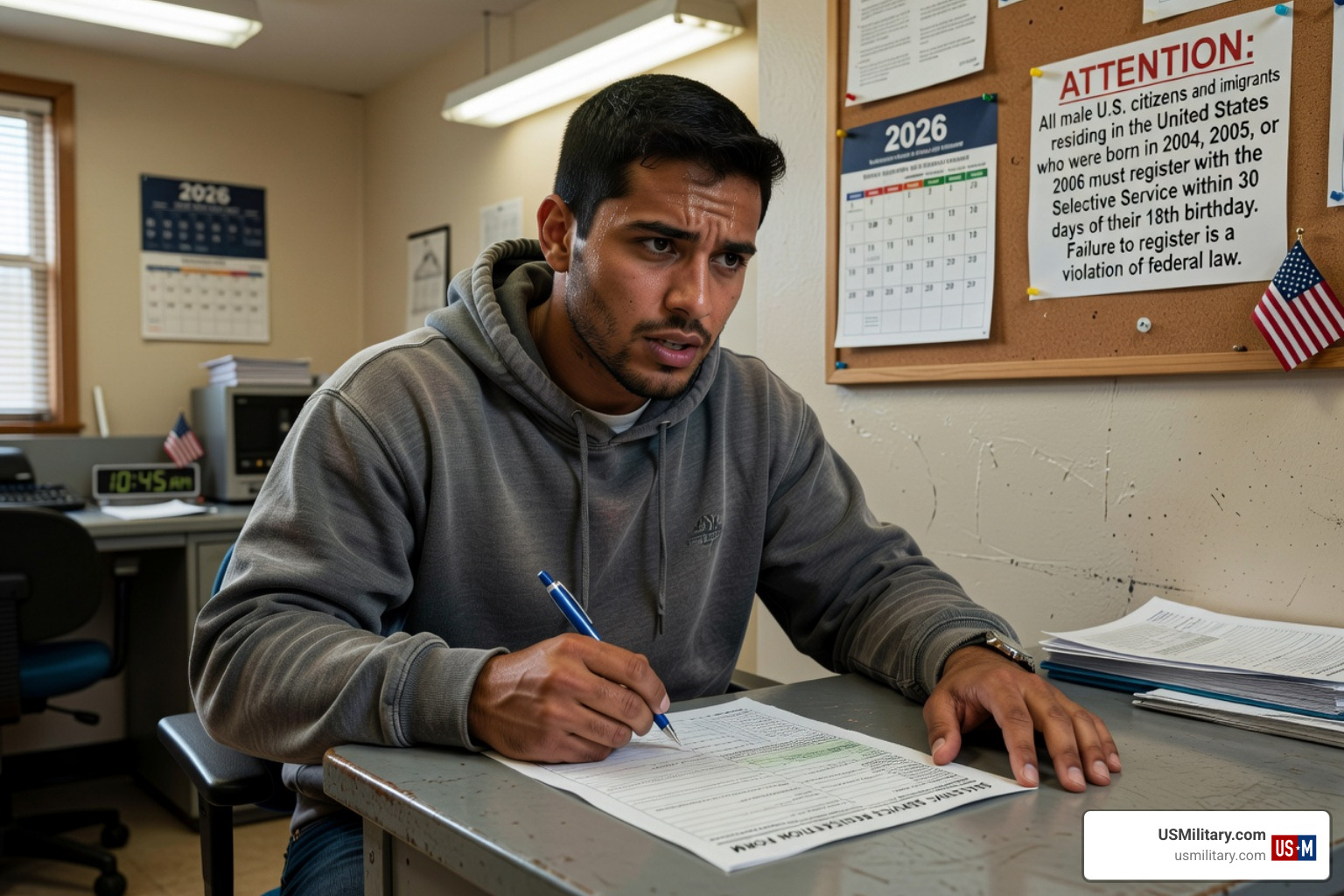
The Military Draft Age Limit Beginning in 2026 is not about reinstating the draft — it’s about who gets automatically registered and what age range is now covered. Here’s the quick answer:
| Key Detail | What You Need to Know |
|---|---|
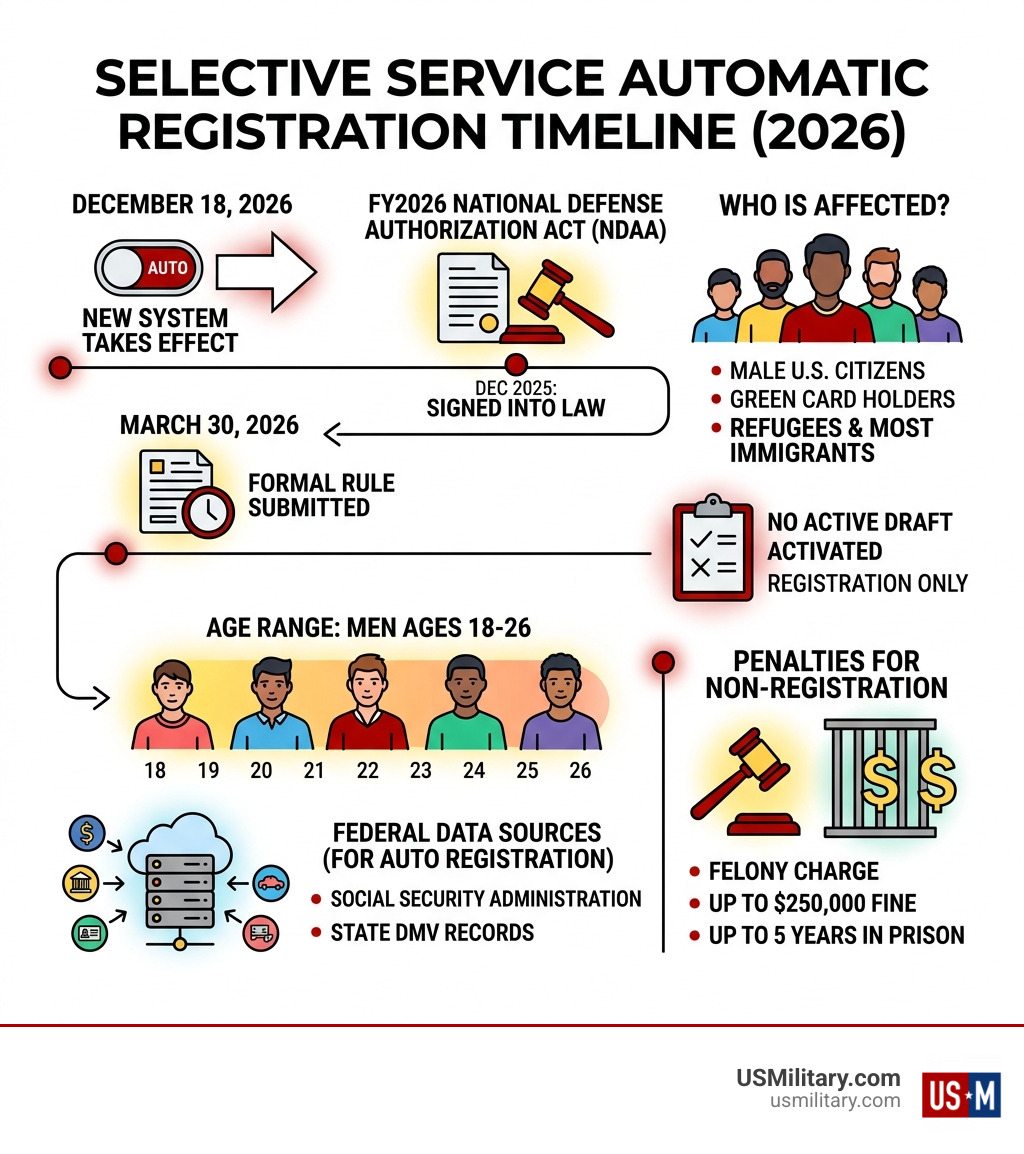
| Draft age range | Men ages 18 to 26 |
| What’s changing | Automatic registration replaces self-registration |
| When it takes effect | December 18, 2026 |
| Is there an active draft? | No — registration only |
| Who is affected | Male U.S. citizens, green card holders, refugees, and most immigrants |
| Penalties for non-registration | Felony — up to $250,000 fine or 5 years in prison |
No draft has been activated. What is happening is a major shift in how young men are enrolled in the Selective Service System — and it affects millions of Americans starting later this year.
This change comes from the FY2026 National Defense Authorization Act (NDAA), signed into law in December 2025. Instead of requiring men to register themselves, the government will now pull data from federal sources like the Social Security Administration and state DMV records to register eligible men automatically.
The timing has drawn attention. A formal rule was submitted on March 30, 2026 — shortly after the start of the U.S.-Iran conflict — and the White House has confirmed it is keeping “all options on the table,” including a potential draft if circumstances demand it.
That context has a lot of people asking questions they haven’t had to ask in decades.
I’m Larry Fowler, publisher of USArmy.com and a longtime resource for active-duty military, veterans, and anyone navigating the complexities of military service and benefits. I’ve been tracking the Military Draft Age Limit Beginning in 2026 closely, and this guide breaks down everything you need to know — clearly and without the noise. Let’s get into it.
Basic Military Draft Age Limit Beginning in 2026 terms:
The core of the new policy is a shift in responsibility. For decades, the law required men to proactively register with the Selective Service System (SSS) within 30 days of their 18th birthday. However, compliance has been slipping. In 2024, only 81% of eligible men registered, a noticeable drop from previous years. To fix this “readiness gap,” Congress included a provision in the FY2026 National Defense Authorization Act to automate the process.
The Military Draft Age Limit Beginning in 2026 applies to men ages 18 through 25. Once you hit your 26th birthday, you are generally no longer eligible for the draft under current law. The “December 2026” deadline mentioned in recent news reports refers to the date by which the Selective Service System must have the automatic registration system fully operational. According to reports from Military draft 2026: What to know as automatic registration starts this year, this change aims to ensure the government has a complete and accurate database of all draft-eligible men without relying on individual initiative.
For a deeper dive into how these specific 2026 changes were codified, you can view our detailed breakdown of the Us Military Draft In 2026.
Comparing Historical Rules to the Military Draft Age Limit Beginning in 2026
The U.S. has a long history with conscription, and the age limits have fluctuated based on the severity of the conflict. During World War II, the draft age was famously expanded to include men from 18 all the way to 45 (and at one point, men up to 64 were required to register for “the old man’s draft,” though they weren’t intended for combat).
In the Vietnam era, the age range was 18 to 26, which is consistent with the Military Draft Age Limit Beginning in 2026. After the draft was suspended in 1975, President Jimmy Carter reinstated the registration requirement in 1980 following the Soviet invasion of Afghanistan. Since then, the age limit has remained relatively steady at 18–25. The most significant modern change isn’t the age itself, but the move toward automation to prevent young men from accidentally becoming felons by forgetting to sign a form. You can read more about these historical transitions in our article on the Military Age Cut Off.
Student Deferments and the Military Draft Age Limit Beginning in 2026
One of the biggest concerns for families involves high school seniors and college students. During the Vietnam War, many students used “2-S” deferments to stay in school and avoid the front lines. However, those broad deferments were largely eliminated by President Nixon in 1971 to make the system fairer.
Under the rules for the Military Draft Age Limit Beginning in 2026, being a student does not make you exempt. If a draft were activated today:
- High school students could have their induction postponed until they graduate or reach age 20, whichever comes first.
- College students could postpone their service until the end of their current semester. If they are in their senior year, they may be allowed to finish the full academic year.
This means that while Gen Z Military Draft conversations often focus on school, the current legal framework treats education as a reason for a temporary delay, not a permanent pass.
How Automatic Selective Service Registration Works in 2026

So, how does the government actually find you? The transition to automatic registration means the Selective Service System will now integrate with several federal and state databases. The goal is to eliminate the need for manual paperwork.
According to the Automatic registration for US military draft coming by end of 2026, the SSS will utilize data from:
- The Social Security Administration (SSA): Providing names, dates of birth, and Social Security numbers.
- Department of Motor Vehicles (DMV): Over 60% of registrations already come from state DMVs when men apply for driver’s licenses.
- Federal Student Aid (FAFSA): While the 2020 FAFSA Simplification Act removed registration as a requirement for aid, the SSS still uses these records for data verification.
- U.S. Citizenship and Immigration Services: Ensuring that green card holders and refugees are included in the pool.
This shift is intended to be a “cost-saving measure,” as it reduces the millions of dollars spent on advertising and manual data entry. For a step-by-step look at the registration flow, check out How Does Military Draft Work.
Penalties for Non-Compliance and Registration Status
Even with automatic registration, it is vital to understand that failing to be registered is still a federal felony. While the government is trying to make it easier, the consequences of slipping through the cracks remain severe.
The penalties under the Military Selective Service Act include:
- Fines: Up to $250,000.
- Imprisonment: Up to 5 years in federal prison.
- Loss of Benefits: Non-registrants are permanently ineligible for federal student loans, federal job training, and most government jobs.
- Citizenship Barriers: For immigrants, failing to register can be viewed as a lack of “good moral character,” potentially blocking their path to U.S. citizenship.
More than 1 million men have already been denied government benefits for failing to register in the past. To ensure you are in the clear, you can verify your status at the official SSS website. For more details on these legal risks, visit our page on the Military Draft.
The Draft Lottery: Order of Induction and Age Priority
If the Military Draft Age Limit Beginning in 2026 were to move from “registration” to “induction,” the process would follow a very specific sequence. A draft cannot be started by the President alone; it requires an Act of Congress. Once authorized, a lottery would be held based on birthdates.
The “Order of Call” is not what most people expect. It does not start with the youngest (18-year-olds). Instead, it prioritizes 20-year-olds. The sequence is as follows:
- 20-year-olds (those turning 20 during the calendar year of the lottery).
- 21-year-olds.
- 22, 23, 24, and 25-year-olds.
- 19-year-olds.
- 18.5-year-olds.
The logic is that 20-year-olds are considered at the peak of physical readiness while having slightly more maturity than those fresh out of high school. This priority system is a key part of The Draft Age Debate Can You Be Called To Serve After 26 Or Even 40.
Geopolitical Context and the US-Iran Conflict
As of April 2026, the global landscape is tense. The ongoing conflict between the U.S. and Iran has reignited fears of a return to conscription. While the administration has emphasized that the U.S. military remains an all-volunteer force, the move to automate registration is seen by some as a “contingency plan” for a national emergency.
White House statements have indicated that while a draft is not currently planned, “all options remain on the table” to ensure national security. This has led to a national conversation about whether today’s youth are prepared for such a call to service. We explore these cultural and readiness questions in our article: Would Americas Youth Today Have The Courage Confidence To Defend America If Drafted.
Exemptions, Deferments, and Disqualifications
Not everyone who is registered will actually serve. Even in a draft scenario, the Selective Service System uses a classification system to determine who is “1-A” (available immediately) and who is exempt.
| Classification | Meaning |
|---|---|
| 1-A | Available for unrestricted military service. |
| 1-O | Conscientious Objector (opposed to all war; available for civilian service). |
| 4-F | Disqualified for medical, physical, or mental reasons. |
| 3-A | Hardship deferment (service would cause extreme hardship to dependents). |
| 4-D | Ministerial exemption (for full-time ministers). |
Medical disqualifiers are a major factor. Interestingly, current data suggests that only about 23% of Americans ages 17–24 meet the basic physical, mental, and moral standards for service without a waiver. Common disqualifiers include obesity, criminal records, and certain chronic health conditions. For a comprehensive list, see 5 Common Ways To Know If Youre Disqualified From A Military Draft.
Legal Protections and Conscientious Objection
For those whose deeply held religious or moral beliefs prohibit them from participating in war, the law provides for Conscientious Objector (CO) status. This is not a way to “dodge” the draft, but a legal classification that requires the individual to serve in a non-combatant role (such as a medic) or perform alternative civilian service that contributes to the national interest.
To qualify, an individual must demonstrate that their opposition to war is sincere, deeply held, and applies to all war, not just a specific conflict. We provide a guide on how to navigate these legalities in How To Legally Avoid The Draft Without Leaving The Country.
Gender and the Selective Service Requirement
One of the most frequent questions we receive at USMilitary.com is: “Will women be drafted in 2026?”
As of now, the answer is no. Despite women serving in all combat roles since 2016, the Military Selective Service Act specifically uses the term “male persons” regarding registration. The Supreme Court upheld this male-only requirement in the 1981 case Rostker v. Goldberg. While there have been several legislative proposals to expand registration to include women for the sake of equity, none have yet been signed into law.
However, there is one exception: the Health Care Personnel Delivery System (HCPDS). This is a standby plan to draft medical professionals (doctors, nurses, etc.) aged 20 to 45 in a crisis. Under this specific medical draft, women could be included if Congress authorized it. You can read more about these age extensions in Can You Be Drafted At Age 40.
Frequently Asked Questions about the 2026 Draft Rules
Is a military draft being reinstated in 2026?
No. There is no active draft. The 2026 changes only affect registration. The U.S. has relied on an all-volunteer force since 1973. Reinstating an actual draft would require Congress to pass a law and the President to sign it.
Will women be required to register for the draft in 2026?
Currently, only men are required to register. While there is ongoing debate in Congress about making registration gender-neutral, no such change is part of the December 2026 automatic registration rollout.
What is the maximum age to be drafted?
For the general population, the cutoff is your 26th birthday. Once you turn 26, you are no longer liable for induction under current law. However, if you are interested in voluntary enlistment, the ages are much higher—the Army recently raised its maximum enlistment age to 42. Check out the Age Limit To Join Military for more on voluntary service.
Conclusion
The Military Draft Age Limit Beginning in 2026 represents a modernization of a century-old system. By moving to automatic registration, the government aims to ensure that every eligible man is accounted for in the event of a national emergency, while also protecting young men from the legal penalties of failing to register manually.
At USMilitary.com, we are dedicated to providing the most accurate and up-to-date information for our military community. Whether you are a young man looking at your registration status, a parent concerned about current events, or a veteran looking for VA benefits information like Aid & Attendance, we are here to serve as your central hub.
Stay informed, stay prepared, and remember that understanding your rights and responsibilities is the first step in defending them. For a complete overview of the system, visit our pillar resource: What is the U.S. Military Draft?