
What You Need to Know About US Army Discharge Types

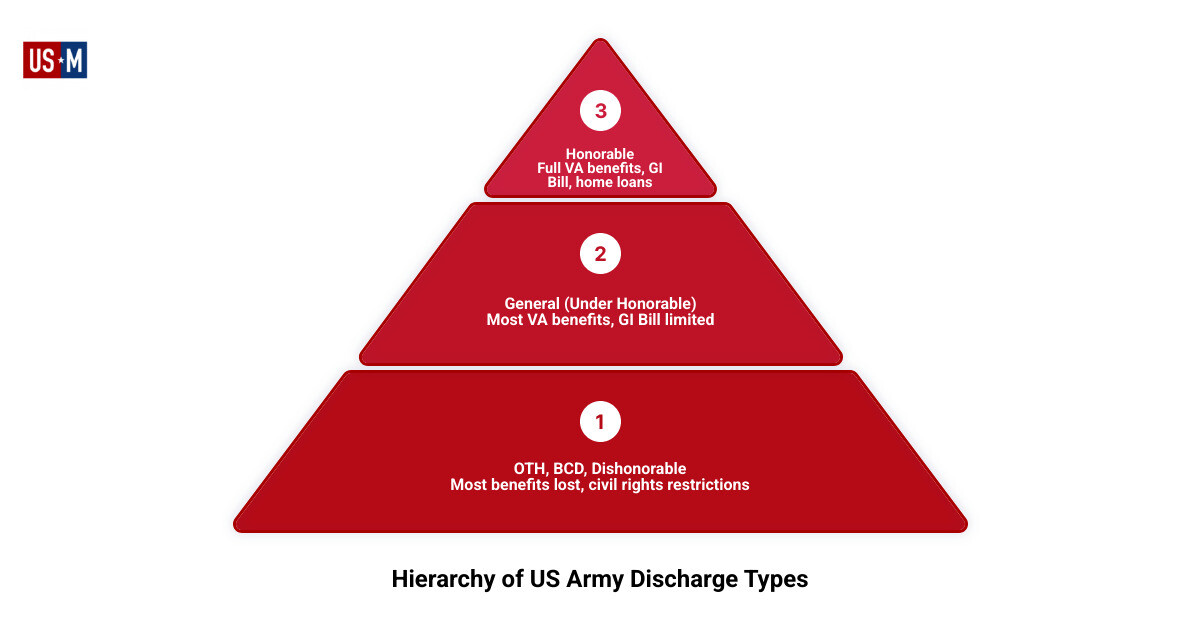
US Army discharge types fall into six main categories, each carrying different consequences for your benefits, career, and civilian life:
| Discharge Type | Category | Benefits Impact |
|---|---|---|
| Honorable | Administrative | Full VA benefits, GI Bill, home loans |
| General (Under Honorable Conditions) | Administrative | Most VA benefits; GI Bill may be limited |
| Other Than Honorable (OTH) | Administrative | Most benefits lost; VA review required |
| Bad Conduct Discharge (BCD) | Punitive | Most or all benefits forfeited |
| Dishonorable | Punitive | All benefits forfeited; civil rights lost |
| Entry-Level Separation (Uncharacterized) | Administrative | No characterization; limited benefits |
Every year, more than 200,000 U.S. service members leave military life. The type of discharge they receive follows them for decades — shaping access to VA healthcare, education benefits, home loans, and even civilian employment.
Think of your discharge characterization like a final GPA. It’s a quick summary of your entire military performance, and it can open doors or close them for the rest of your life.
In 2014 alone, out of 207,000 service members discharged, more than 18,000 — roughly 9% — received less-than-honorable paperwork. Between 2000 and 2014, that number reached 352,000 people across all branches. These aren’t small numbers, and the stakes are high.
I’m Larry Fowler, publisher of the USMilitary.com Network since 2007, and I’ve spent nearly two decades helping veterans navigate complex topics like US Army discharge types, VA benefits, and disability claims. Let’s break down exactly what each discharge type means and what it could mean for your future.
Understanding the Primary US Army Discharge Types
When we talk about leaving the Army, we often use the words “separation” and “discharge” interchangeably, but there is a technical difference. According to the U.S. Department of Labor, “separation” is a broad umbrella term. It includes being released from active duty, transferring to the Individual Ready Reserve (IRR), or retiring after 20 years. A “discharge,” however, is the formal release from your legal obligation to serve.
The Military discharge process is governed by the Uniform Code of Military Justice (UCMJ) and specific Army Regulations, most notably AR 635-200. These rules ensure that every Soldier is treated according to a standard legal framework.
Administrative vs. Punitive Separations
In our experience, the most important distinction to understand is between administrative and punitive separations.
- Administrative Separations: These are handled by your command. They don’t require a court-martial. Most Soldiers leave via this route, whether they are finishing their contract (ETS), leaving for medical reasons, or being separated for minor misconduct. Administrative types include Honorable, General, and Other Than Honorable (OTH).
- Punitive Discharges: These are much more serious. They can only be handed down as a sentence from a court-martial. These are reserved for criminal acts or severe violations of military law. This category includes Bad Conduct Discharges (BCD) and Dishonorable Discharges.
The Role of the DD-214 Form
The DD Form 214, or the “Certificate of Release or Discharge from Active Duty,” is the most important piece of paper you will ever receive from the Department of Defense. It is the “capstone” of your service.
When you apply for a job, a VA loan, or even a specialized veteran license plate, people are going to look at specific parts of this form. As noted in the guide Service Discharges; DD Form 214 Explained | Article | The United States Army, you should pay close attention to:
- Block 24 (Character of Service): This is where your discharge type is listed (e.g., Honorable).
- Block 26 (Separation Code): A three-letter code used by the DoD to identify the reason for your exit.
- Block 27 (Reentry Code): This tells the military whether you are allowed to enlist again.
- Block 28 (Narrative Reason): This explains in plain English why you were separated (e.g., “Completion of Required Active Service” or “Misconduct”).
Administrative Separations: Honorable, General, and OTH
Most of us strive for that “Honorable” stamp. It’s the key that unlocks almost every benefit we’ve earned through our sweat and sacrifice. However, life happens, and sometimes service doesn’t go exactly as planned.
The Gold Standard: Honorable US Army Discharge Types
An Honorable discharge means you met or exceeded the standards of acceptable performance and conduct. You did your job, followed orders, and stayed out of trouble.
Benefits of an Honorable Discharge:
- Full VA Benefits: Access to the GI Bill (both Montgomery and Post-9/11), VA home loans, and disability compensation.
- Civilian Employment: Many federal and state jobs give “veteran preference” to those with honorable discharges.
- Healthcare: Full access to VA medical facilities.
- Social Standing: It is a badge of honor that signifies you served your country faithfully.
General and Other Than Honorable (OTH) Characterizations
If your service was generally honest and faithful but you had some bumps in the road, you might receive a General (Under Honorable Conditions) discharge. This often happens if a Soldier struggles with physical fitness standards, weight control, or minor disciplinary infractions (like a few Article 15s).
While a General discharge allows you to keep most VA benefits, there is one major catch: you usually lose eligibility for the GI Bill. This can be a devastating blow for those planning to use their service to pay for college.
An Other Than Honorable (OTH) discharge is the most severe administrative separation. It is often called a “bad paper” discharge. It is typically issued for things like drug use, assault, or a pattern of serious misconduct that doesn’t quite rise to the level of a court-martial.
With an OTH, you are generally barred from almost all VA benefits. Furthermore, under federal law (38 U.S. Code § 101(2)), individuals with an OTH or worse may not be legally considered “veterans” for certain benefit purposes. However, don’t lose hope—the VA can perform its own “Character of Discharge” review to see if you qualify for healthcare for service-connected conditions.
Punitive Discharges and Entry-Level Separations
Punitive discharges are meant to punish. They carry a heavy social stigma and can make civilian life very difficult.
Bad Conduct and Dishonorable US Army Discharge Types
A Bad Conduct Discharge (BCD), colloquially known as a “Big Chicken Dinner,” is issued by a Special or General Court-Martial. It is usually the result of repeated offenses or crimes like DUI, disorderly conduct, or adultery. Forfeiture of all veteran benefits is common with a BCD.
The Dishonorable Discharge (DD) is the worst possible exit. It is reserved for the most heinous crimes: murder, treason, desertion, or espionage. In many states, a Dishonorable discharge is treated as the equivalent of a felony conviction.
- Loss of Civil Rights: You may lose the right to vote or hold public office.
- Firearm Prohibition: Federal law prohibits anyone with a Dishonorable discharge from owning a firearm or ammunition.
- No Benefits: You lose 100% of your VA benefits.
For officers, the equivalent of a Dishonorable discharge is a Dismissal, which carries the same weight and consequences.
Uncharacterized and Entry-Level Separations (ELS)
If you leave the Army within your first 180 days of service, you will likely receive an Entry-Level Separation (ELS). This is considered “uncharacterized.” It’s essentially the Army saying, “It just didn’t work out.”
Common reasons for an ELS include:
- Failure to adapt to the military environment.
- Medical issues that existed prior to service.
- Minor pre-existing mental health conditions.
In 2019 alone, over 19,000 uncharacterized discharges were issued. While you won’t get the GI Bill, an ELS is neutral. It doesn’t carry the stigma of a “bad” discharge, and in many cases, you can even try to re-enlist later with a waiver.
Impact on VA Benefits and Reenlistment Eligibility
Your discharge type dictates your relationship with the Department of Veterans Affairs (VA) for the rest of your life.
Reenlistment Eligibility (RE) Codes
If you ever want to put the uniform back on, you need to look at your RE Code on your DD-214:
- RE-1: You are eligible to reenlist. No issues here.
- RE-2: You are usually eligible, but there might be some administrative hurdles.
- RE-3: You are ineligible unless you get a waiver. This is common for medical separations or those who left for “hardship.”
- RE-4: You are fully ineligible to serve in any branch of the U.S. military again. This is standard for punitive discharges.
How the VA Determines Benefit Eligibility
It is a common misconception that the VA only helps those with an Honorable discharge. While that is the easiest path, the VA has the authority to make its own “Administrative Decisions.”
For example, if you have an OTH discharge, you can request a Character of Discharge (COD) review. The VA will look at your entire record. If they find your service was “Honorable for VA purposes,” they can grant you access to disability compensation and healthcare, even if your DD-214 still says “Other Than Honorable.”
Also, keep in mind the “Reenlistment Loophole.” If you served one full term honorably, reenlisted, and then got a “bad paper” discharge during your second term, you are still eligible for benefits based on that first honorable period of service.
How to Appeal or Upgrade Your Army Discharge
If you feel your discharge characterization was unfair or based on an error, you don’t have to just live with it. There are legal avenues to fight for an upgrade.
The Discharge Review Board (DRB) and BCMR
Each branch has its own review board. For the Army, you have two main options:
- Army Discharge Review Board (ADRB): You must apply within 15 years of your discharge using DD Form 293. They can upgrade any discharge that wasn’t issued by a General Court-Martial.
- Board for Correction of Military Records (BCMR): If it has been more than 15 years, or if the ADRB denies your request, you use DD Form 149. This board has the power to correct any error or injustice in your file.
Upgrades for PTSD, MST, and Mental Health
In recent years, the Department of Defense has issued new guidance (often called the “Hagel Memo” and “Kurta Memo”) to be more lenient toward veterans seeking upgrades for conditions like:
- Post-Traumatic Stress Disorder (PTSD)
- Traumatic Brain Injury (TBI)
- Military Sexual Trauma (MST)
If your misconduct was linked to an undiagnosed mental health condition caused by your service, your chances of a successful upgrade are much higher today than they were a decade ago.
Additionally, we’ve seen progress in other areas. For example, Air Force Elevates Discharge Authority For Transgender Related Airmen Separations/ highlights how the military is modernizing its approach to sensitive separations. As of May 2025, new policies ensure that administrative separations related to gender dysphoria are characterized as Honorable.
Frequently Asked Questions about Army Discharges
Can I upgrade an Other Than Honorable (OTH) discharge?
Yes. You can apply to the Army Discharge Review Board. Success often depends on showing “equity” (that the discharge was inconsistent with how others were treated) or “propriety” (that an error was made in the legal process). Providing evidence of good post-service conduct—like steady employment or community service—can also help your case.
Does a General discharge qualify for the GI Bill?
Generally, no. To use the Post-9/11 GI Bill, you almost always need a fully Honorable discharge. However, you still qualify for VA disability compensation, VA home loans, and most VA medical care with a General (Under Honorable Conditions) characterization.
What is the difference between a discharge and a separation?
Separation is the act of leaving active duty (which could lead to retirement or transfer to the reserves). A discharge is the complete severance of your military obligation. Most people are “separated” at the end of their contract, but they only receive their final “discharge” once their total eight-year Military Service Obligation (MSO) is complete.
Conclusion
Navigating US Army discharge types can feel like wading through a sea of red tape. Whether you are currently serving and facing a board, or you’re a veteran looking to fix “bad paper” from years ago, knowledge is your best weapon.
Remember the GPA analogy: your discharge summarizes your service, but a low grade doesn’t have to define your future forever. With the right evidence and persistence, many veterans have successfully upgraded their status and reclaimed the benefits they earned.
At USMilitary.com, we are committed to being your central hub for transition assistance and veteran resources. If you believe your record contains an error, don’t wait. Veterans can request a correction to military records through a review board to ensure their service is accurately reflected.
Your service mattered. Make sure your paperwork reflects the truth of that sacrifice. For more updates on VA benefits, disability ratings, and military news, keep following us as we continue to serve those who served.