
What Is the US Army? A Complete Overview
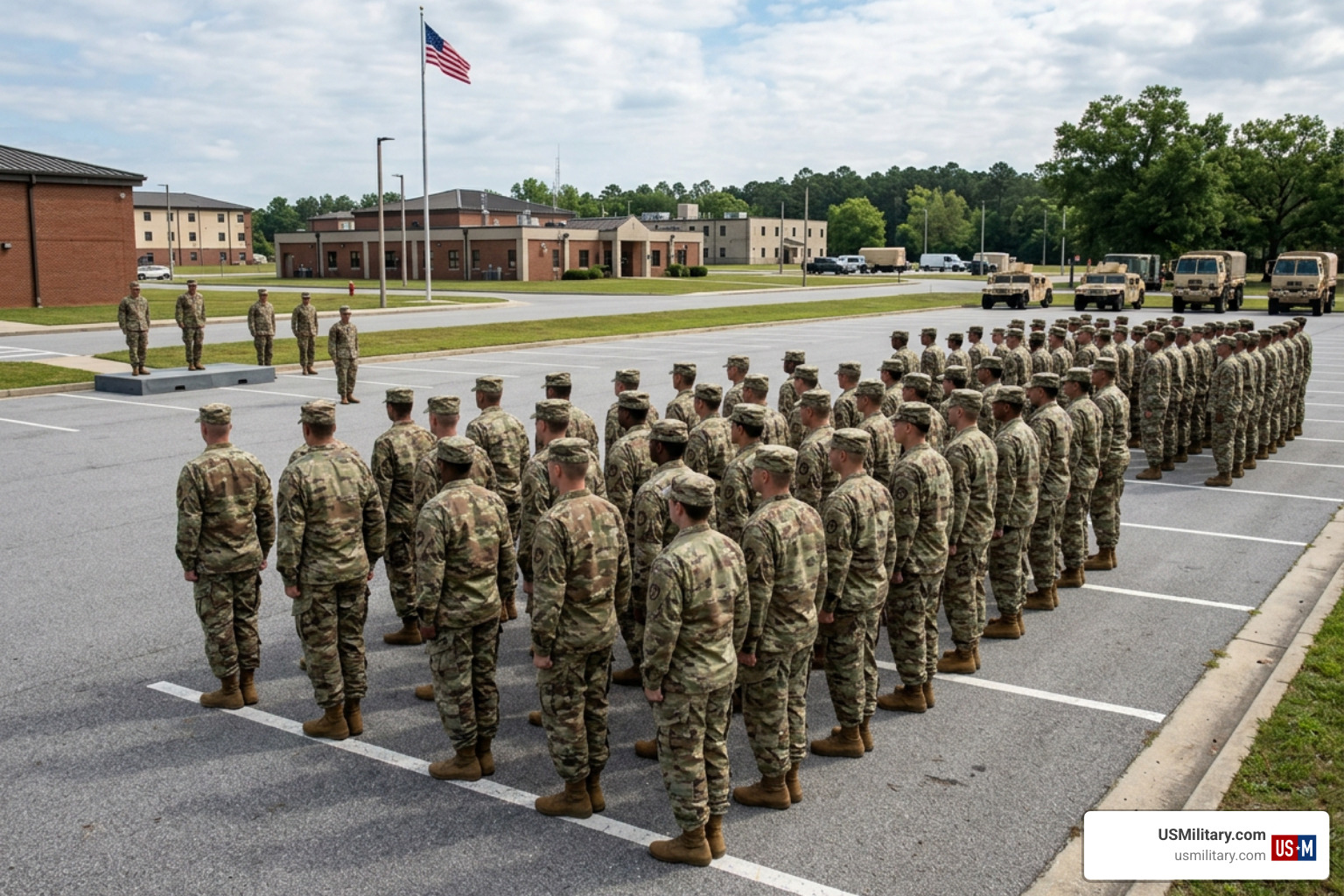
The US Army is the land service branch of the United States Armed Forces — the oldest, largest, and most deployed military branch in the country. If you want the short version, here it is:
| Key Facts | Details |
|---|---|
| Founded | June 14, 1775 |
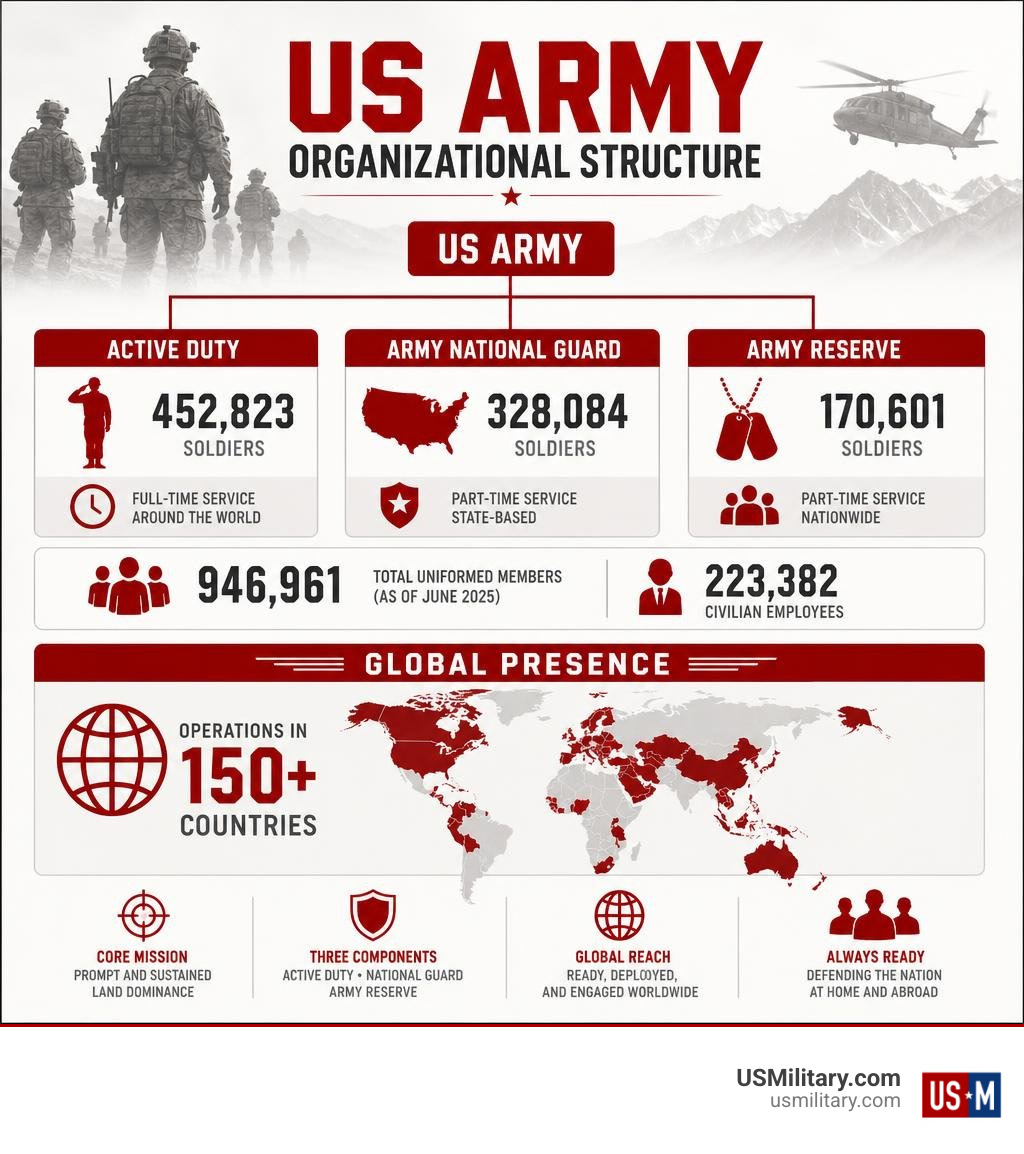
| Total Personnel (as of June 2025) | 946,961 uniformed members |
| Active Duty | 452,823 |
| Army National Guard | 328,084 |
| Army Reserve | 170,601 |
| Civilian Employees | 223,382 |
| Global Presence | Operations in 150+ countries |
| Core Mission | Prompt and sustained land dominance |
| Service Options | Active Duty, Army Reserve, Army National Guard |
The Army’s mission, as defined by law, is to fight and win the nation’s wars by providing prompt, sustained land dominance. It does this through three components — full-time active duty soldiers, part-time Army Reserve members, and state-based Army National Guard units.
Whether you’re exploring enlistment, researching career paths, or trying to understand veteran benefits, the US Army touches nearly every aspect of American defense and public life. From securing major international events to developing cutting-edge cyber warfare capabilities, the Army’s reach goes far beyond the battlefield.
I’m Larry Fowler, publisher of the USMilitary.com Network since 2007 and a long-time resource for those navigating US Army enlistment, career options, and VA benefits. Over the years, this network has helped hundreds of thousands of active service members and veterans find reliable, plain-language answers to their most pressing military questions.
US Army terms simplified:
- Army vs Marines: Whose Boot Camp Is Tougher
- Is The Quality Of Army Soldiers The Same As 50 Years Ago?
- army basic training length
History and Evolution of the US Army
To understand the modern US Army, we have to travel back to where it all began: June 14, 1775. Facing the formidable power of the British Empire, the Second Continental Congress established the Continental Army. They appointed George Washington as commander-in-chief, tasked with turning a ragtag collection of local militias into a unified, professional fighting force.
During those early, grueling years, European military experts like Friedrich Wilhelm von Steuben arrived to instill discipline, teaching Prussian tactics and standardized drill maneuvers. These foundational lessons in leadership and organization proved vital, culminating in historic victories like the storming of Redoubt No. 10 at Yorktown.
As the nation grew, so did its land force. The 19th century brought massive shifts, including the War of 1812—where General Andrew Jackson famously defended New Orleans—and the Mexican-American War. However, nothing reshaped the military, or the country, quite like the American Civil War. This devastating conflict resulted in the deaths of over 620,000 men on both sides, representing roughly 8% of all white males aged 13 to 43 at the time. Under the leadership of General Ulysses S. Grant, the Union Army mastered large-scale logistics, seizing key choke points like the Mississippi River and securing victory at turning points like the Battle of Gettysburg.
By the 20th century, the US Army evolved from a regional defense force into a premier global power. In World War I, American troops tipped the balance on the Western Front. In World War II, the Army coordinated massive amphibious assaults and fought across multiple global theaters to defeat fascism. The Cold War era brought a new kind of readiness, marked by proxy conflicts in Korea and Vietnam, alongside a constant vigil in divided Europe.
The 21st century ushered in asymmetric warfare, with decades of counterinsurgency operations in Iraq and Afghanistan. Today, in July 2026, the Army continues to adapt. It is transitioning away from localized counterterrorism to prepare for great-power competition and multi-domain operations. To learn more about the campaigns, transformations, and battles that defined this service branch, explore the comprehensive United States Army history.
Mission, Core Competencies, and Global Footprint
What is the day-to-day purpose of the US Army? Under Title 10 of the U.S. Code, the Army is legally mandated to preserve peace and security, support national policies, implement strategic objectives, and overcome any nation responsible for aggressive acts that imperil the United States.
To achieve this, the Army relies on five core competencies that define its unique military value:
- Prompt and sustained land combat: The ability to deploy quickly and hold ground indefinitely.
- Combined arms operations: Integrating armored, mechanized, airborne, and air assault operations into a unified force.
- Special operations forces: Deploying elite, highly specialized units for unconventional warfare.
- Setting and sustaining the theater: Establishing the logistics, supply chains, and bases required for all joint military branches to operate.
- Integrating national, multinational, and joint power on land: Working seamlessly with other military branches and international allies.
The Army’s footprint is truly global. While the United States remains its primary home, the Army operates in 150 countries. It maintains a massive presence in Germany, South Korea, Italy, Japan, and Puerto Rico.
This massive global operation relies on three distinct components: the Regular Army (Active Duty), the Army National Guard, and the Army Reserve. To help you understand how these components differ, we have broken down their roles below:
| Component | Service Type | Primary Mission | Command Structure |
|---|---|---|---|
| Active Duty | Full-Time | Global operations, immediate deployment, and theater command. | Federal (President / Department of Defense) |
| Army National Guard | Part-Time | State-level emergency response and domestic defense, but can be federalized for global combat. | Dual control (State Governor / President) |
| Army Reserve | Part-Time | Specialized support (medical, engineering, logistics, legal) to reinforce the active component. | Federal (President / Department of Defense) |
While Active Duty soldiers live and work on military bases full-time, part-time service members balance civilian careers with military service. The Guard serves a unique dual mission, often called upon by state governors to combat natural disasters or secure domestic events. Meanwhile, the Reserve provides the specialized operational depth needed to sustain long-term operations. You can explore unit locations, family programs, and active reserve missions directly on the U.S. Army Reserve home page.
How the US Army is Organized for Combat
To manage nearly one million soldiers, the US Army uses a highly structured, hierarchical command system. This organization ensures that orders flow clearly from the civilian Secretary of the Army and the military Chief of Staff down to the individual soldier in the field.
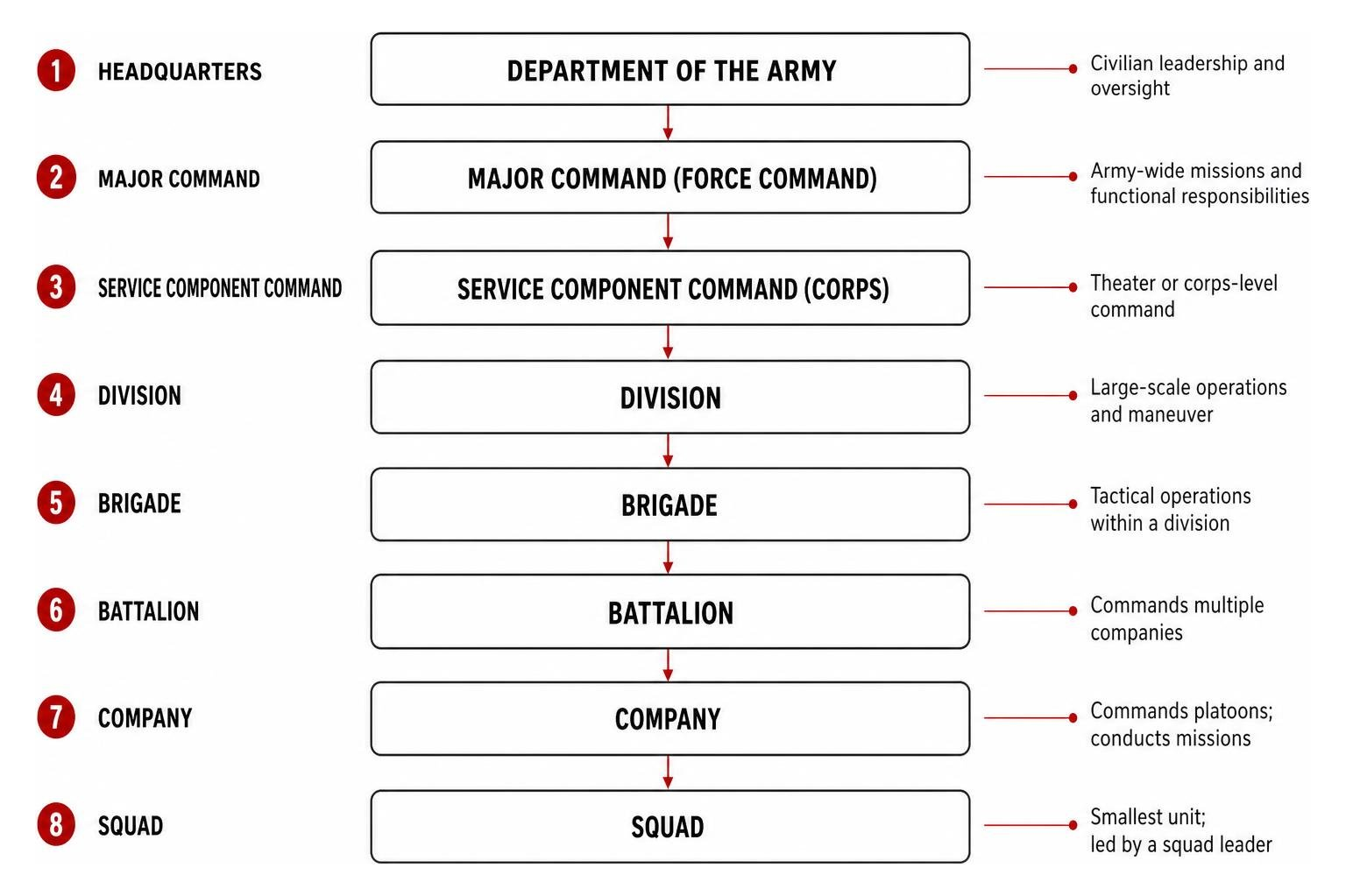
At the highest level, the Army is organized into Major Commands, which handle everything from training recruits to designing future weapons systems. When it comes to actual combat, the Army integrates with joint and allied forces to conduct multinational operations. This seamless integration ensures that land forces work hand-in-hand with the Navy, Air Force, Marines, and Space Force. You can keep up with the latest operational deployments and global exercises on The Official Home Page of the United States Army.
Major Commands and Divisions of the US Army
The US Army is structured into several major commands that divide operational responsibilities:
- Forces Command (FORSCOM): Trains, mobilizes, and equips combat-ready soldiers for deployment.
- Training and Doctrine Command (TRADOC): Recruits, trains, and designs the educational standards for the force.
- Materiel Command (AMC): Manages global logistics, supply chains, and base support.
- Army Futures Command (AFC): Leads modernization efforts, ensuring soldiers have the best technology for future conflicts.
Below these commands sit the combat formations. The Army is organized into Numbered Armies (which oversee entire geographical regions), Corps (which plan large-scale operations), and Divisions (the primary tactical units, such as the historic 10th Mountain Division or the 82nd Airborne Division).
Each division is made up of Brigade Combat Teams (BCTs), which are self-contained tactical units capable of independent operations. Within these brigades are Special Operations Forces, including the Army Rangers and Special Forces (Green Berets), who conduct high-risk, unconventional warfare missions worldwide.
Tactical Formations and Joint Integration
Modern warfare is no longer fought on a single, isolated battlefield. Today, the Army operates under the concept of Multi-Domain Operations (MDO). This means soldiers must be prepared to fight across land, air, sea, space, and cyberspace simultaneously.
By combining infantry, armor, air assault, and airborne operations, the Army creates a highly flexible force. During joint exercises, Army units coordinate with Air Force transport wings for rapid deployment, Navy fleets for amphibious support, and Space Force assets for satellite communications. This collaborative approach is essential for deterring adversaries in an era of great-power competition.
Modernization, Cyber Warfare, and Future Readiness
As we look ahead in 2026, the US Army is undergoing one of its most ambitious technological overhauls in decades. Led by Army Futures Command, the service is shifting its focus from regional counterinsurgency to conventional warfare readiness.
This shift is backed by serious financial investment. The Army allocated $30 billion for its top six modernization priorities over a five-year period, achieved through $8 billion in cost avoidance and $22 billion in program terminations. These funds are being funneled directly into upgrading staple equipment, including the M1 Abrams tank, the Bradley Fighting Vehicle, and the UH-60 Black Hawk helicopter.
However, modernization is about more than just heavier armor and faster helicopters. The Army is actively integrating artificial intelligence (AI) for real-time command and control, deploying rapid-prototyping initiatives, and even constructing 3D-printed housing for soldiers on remote bases.
Cyberspace Operations and the US Army
The battlefield of the future is digital, and the Army is fully prepared to defend it.

Operating as the dedicated shield and sword in the digital realm, U.S. Army Cyber Command integrates cyberspace operations, electromagnetic warfare, and information operations. Their goal is simple: ensure decision dominance and freedom of action for friendly forces while denying the same to adversaries.
To protect critical infrastructure, the Army has implemented a strict Zero Trust security architecture. This framework assumes that threats exist both inside and outside the network, requiring continuous verification at every level. From preventing email extortion to disrupting state-sponsored hacking groups, Army cyber warriors are on the front lines of defense every single day.
Future Force Structure and Multi-Domain Dominance
To maintain its edge, the Army is continuously adjusting its force structure. A key milestone in this effort is the establishment of the Space Operations Branch, designed to protect satellite communication networks and disable adversary tracking capabilities.
The Army is also embracing rapid prototyping to field new gear faster. Through partnerships with private tech companies, the Army is launching advanced drone programs, upgrading tactical communication networks, and rolling out its Force Design 2030 initiative. These efforts ensure that tactical units remain connected, informed, and lethal, even in the most contested environments.
Joining the Army: Requirements, Training, and Benefits
For many, the US Army is more than a defensive force—it is a pathway to a rewarding career, higher education, and personal growth. Whether you choose to serve full-time or part-time, the Army offers over 200 different jobs (Military Occupational Specialties, or MOS) spanning medical, engineering, aviation, and cyber security fields.

If you are ready to take the first step toward your future, you can explore career options, take a career match quiz, and connect with a local recruiter at Be All You Can Be | U.S. Army.
Enlistment Pathways and Requirements
Before you can wear the uniform, you must meet several foundational eligibility criteria. To help you prepare, we have outlined the basic pathways below:
- Enlisted Soldiers (82% of the Army): You must be between 17 and 35 years old, hold a high school diploma or GED, and be a U.S. citizen or permanent resident.
- Army Officers (18% of the Army): Officers act as the managers and leaders of the military. You can earn a commission through the Reserve Officers’ Training Corps (ROTC) at college, by attending the U.S. Military Academy at West Point, or by completing Officer Candidate School (OCS) after earning a bachelor’s degree.
Every applicant must take the Armed Services Vocational Aptitude Battery (ASVAB). Your score on this test, specifically the Armed Forces Qualification Test (AFQT) portion, determines which jobs you qualify for. The minimum AFQT score required to enlist in the Army is 31. For a detailed breakdown of medical, physical, and background standards, check out our guides on the Requirements to Join the Army and How to Join the Army.
Basic Training and the Army Combat Fitness Test (ACFT)
Once you enlist, your journey officially begins at Army Boot Camp. This intense, 10-week training program is designed to transform civilians into disciplined soldiers. Throughout basic training, recruits are drilled on the 7 Army Values: Loyalty, Duty, Respect, Selfless Service, Honor, Integrity, and Personal Courage.
Physical fitness is a core component of soldier readiness. In recent years, the Army transitioned to the Army Combat Fitness Test (ACFT), which assesses general physical readiness through six events:
- 3-Repetition Maximum Deadlift: Tests lower body strength.
- Standing Power Throw: Measures explosive power.
- Hand-Release Push-Up: Tests upper body endurance.
- Sprint-Drag-Carry: Simulates moving a wounded comrade or ammunition under fire.
- Plank: Measures core stability (which replaced the traditional leg tuck).
- Two-Mile Run: Tests aerobic endurance.
Soldier Benefits and Career Opportunities
Serving in the military comes with an outstanding suite of benefits for soldiers and their families. At USMilitary.com, we specialize in helping service members maximize these resources.
Key benefits of serving include:
- Education Assistance: The Post-9/11 GI Bill covers college tuition, housing allowances, and books. Active duty soldiers can also utilize Tuition Assistance to take classes while serving.
- VA Home Loans: Get competitive interest rates and purchase a home with $0 down payment.
- Comprehensive Healthcare: TRICARE provides excellent health, dental, and vision coverage for soldiers and their dependents.
- Enlistment Bonuses: Depending on your chosen job and enlistment timing, you may qualify for substantial cash bonuses.
- Retirement Plans: The Blended Retirement System (BRS) combines a traditional pension with a 401(k)-style investment account, complete with government matching.
To learn more about how these programs can secure your financial future, read our complete guide on the Benefits of Joining the US Army.
Frequently Asked Questions about the US Army
What is the current size of the US Army?
As of June 30, 2025, the US Army has a total uniformed strength of 946,961 personnel. This includes 452,823 active duty soldiers, 328,084 Army National Guard members, and 170,601 Army Reserve personnel. Additionally, the Army employs 223,382 civilian staff members.
What are the primary requirements to join the US Army?
To enlist, you must be a U.S. citizen or permanent resident, be between 17 and 35 years old, possess a high school diploma or GED, pass a physical medical exam, and score at least a 31 on the AFQT portion of the ASVAB.
What is the difference between the Army Reserve and the Army National Guard?
While both are part-time components, the Army Reserve is a federal force that provides specialized support units (like medical and logistics) directly to the active Army. The Army National Guard is organized by state and answers to state governors for domestic emergencies, though they can be called into federal service by the President during times of war.
Conclusion
The US Army remains the cornerstone of American land defense, combining a rich historical legacy with cutting-edge modernization. Whether protecting the nation in cyberspace, deploying to support international allies, or responding to domestic natural disasters, soldiers continue to embody the spirit of service.
At USMilitary.com, we are dedicated to supporting our service members, veterans, and their families. We offer unbiased guidance across all military branches, helping you compare career paths, calculate VA disability ratings, explore military loans, and plan your retirement.
If you are ready to take the next step on your military journey, dive into our detailed Explore Army Basic Training Guide or visit USMilitary.com to explore our comprehensive resource hub today.