
The VA Home Loan: A Powerful Benefit Every Veteran Should Know About

A VA home loan is one of the most valuable financial benefits available to U.S. military members, Veterans, and eligible surviving spouses — and most people who qualify don’t fully understand what they have access to.
Here’s what you need to know at a glance:
| Feature | VA Home Loan |
|---|---|
| Down payment required | None (in most cases) |
| Private mortgage insurance | Not required |
| Who backs the loan | U.S. Department of Veterans Affairs |
| Who provides the loan | Private lenders (banks, mortgage companies) |
| Who qualifies | Active duty, Veterans, National Guard, Reserves, eligible surviving spouses |
| Can it be reused? | Yes — it’s a lifetime benefit |
| Interest rates | Typically lower than conventional loans |
Nearly 90% of VA-backed loans are made with no down payment. That’s not a typo. This benefit was created by the original G.I. Bill in 1944, and it has helped generations of military families achieve homeownership on terms that most civilians simply can’t access.
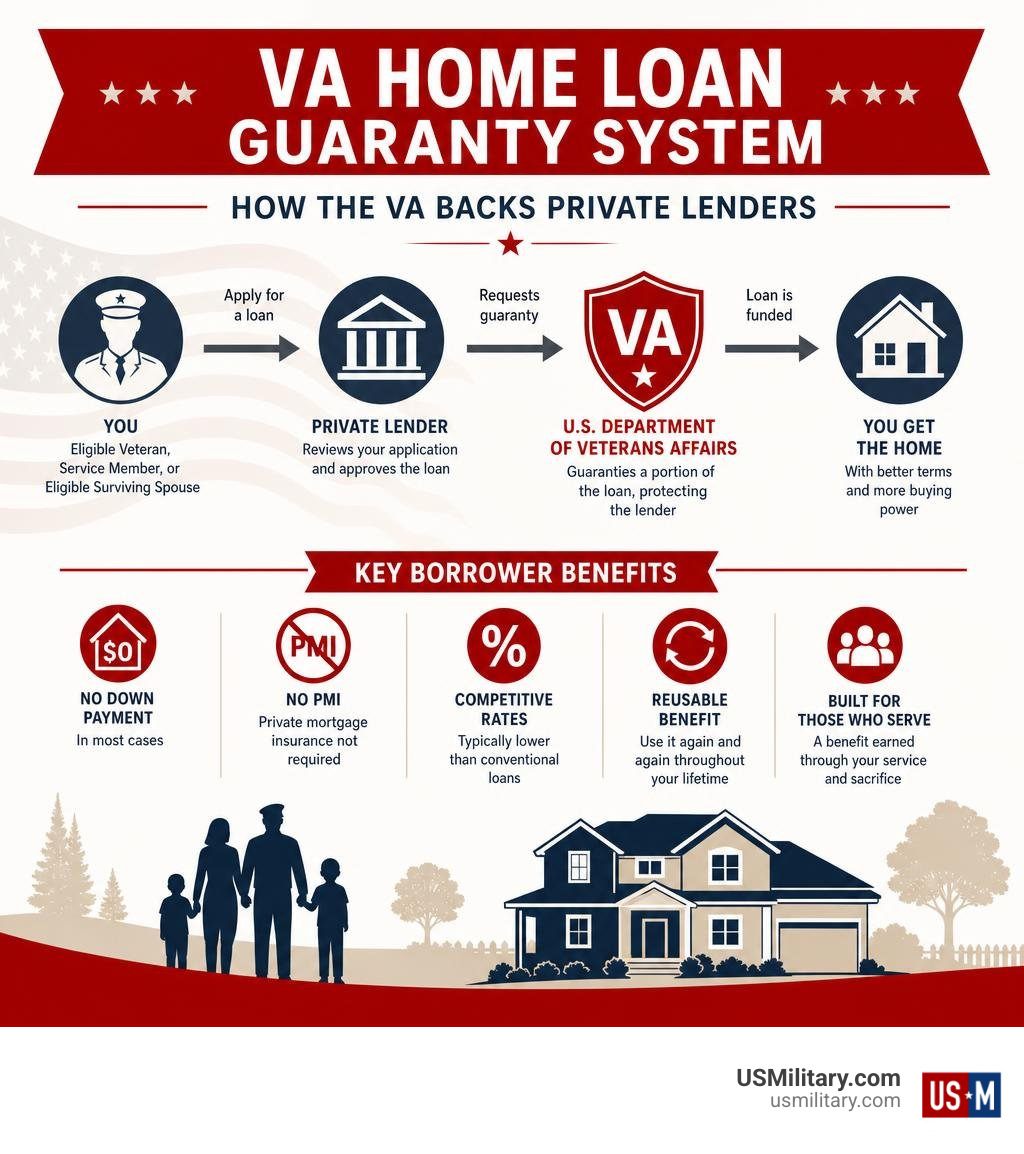
The program works because the VA guarantees a portion of each loan. That guarantee protects the lender — so lenders can offer better terms to you, the borrower. No PMI. No down payment requirement. Competitive rates.
I’m Larry Fowler, publisher of the USMilitary.com Network, and I’ve spent nearly two decades tracking VA benefits and connecting veterans with the resources they’ve earned — including everything related to the VA home loan benefit. In this guide, I’ll walk you through exactly how it works, who qualifies, and how to use it.
What is a VA Home Loan and How Does the Guaranty Work?
To understand why a VA home loan is such a fantastic deal, we have to look at how the program is structured. A common misconception is that the government directly hands you a pile of cash to buy a house. With a few rare exceptions (such as direct loans for Native American Veterans), that is not how it works.
Instead, the program operates as a partnership. Private lenders—such as mortgage companies, banks, and credit unions—provide the actual funding for your mortgage. The VA Home Loans program, run by the Department of Veterans Affairs, acts as the co-signer.
By guaranteeing a portion of the loan (typically 25% of the total loan amount), the federal government promises the private lender that if you happen to default on your mortgage, the VA will step in and cover a significant portion of the loss.
This government-backed safety net drastically reduces the risk for private lenders. Because their risk is minimized, they can confidently offer you:
- Zero Down Payment: You do not have to save up tens of thousands of dollars just to get through the front door.
- No Private Mortgage Insurance (PMI): On conventional loans, if you do not put down at least 20%, you are forced to pay monthly PMI. With a VA mortgage, PMI is entirely eliminated, saving you hundreds of dollars every single month.
- Lower Average Interest Rates: VA mortgages consistently offer some of the lowest average interest rates in the entire housing market, beating out FHA, USDA, and conventional options.
Understanding VA Home Loan Eligibility and Requirements
While the benefits are generous, the program is reserved exclusively for those who have served our nation. Eligibility is extended to active-duty service members, Veterans, National Guard members, Reserve members, and eligible surviving spouses.
To prove you qualify, you must meet the minimum service requirements established by the VA. These requirements vary depending on the era in which you served:
- Active Duty: At least 90 continuous days of active service.
- Wartime Veterans: At least 90 days of active service during designated wartime periods (such as the Gulf War era).
- Peacetime Veterans: At least 181 continuous days of active service during peacetime eras.
- National Guard and Reserves: Typically require 6 creditable years of service. However, modern updates have expanded this: National Guard members who have at least 90 days of active service—including at least 30 consecutive days under Title 32 orders—are also eligible.
Your discharge status is also a critical piece of the puzzle. To qualify automatically, you must have been separated under conditions other than dishonorable. If you received an other-than-honorable, bad conduct, or dishonorable discharge, you may not be immediately eligible. However, you can apply for a discharge upgrade or request a VA Character of Discharge review to establish eligibility.
There are also qualifying exceptions. For example, if you were discharged early due to a service-connected disability, you may still qualify even if you did not meet the standard minimum service lengths. We dive deeper into these service windows and exceptions in our guide on 2026 VA Home Loan Requirements.
How to Obtain Your VA Home Loan Certificate of Eligibility (COE)
Before any lender can officially approve your mortgage, you must prove your military service qualifies you for the benefit. This is done by obtaining a Certificate of Eligibility (COE).
The COE is the official document issued by the VA that tells lenders you meet the service requirements and details how much “entitlement” you have available. Fortunately, getting your COE is a straightforward process:
- Through Your Lender: This is the easiest route. Most VA-approved lenders have access to an online portal called WebLGY. They can pull up and establish your COE in a matter of minutes using your basic military details.
- Online via VA.gov: You can request your COE directly through the official Eligibility For VA Home Loan Programs | Veterans Affairs portal. You will need to log in and upload your separation paperwork.
- By Mail: You can print out VA Form 26-1880 (Request for a Certificate of Eligibility), fill it out by hand, and mail it to the VA. While this works, it is by far the slowest method.
To prepare for your COE request, make sure you have your discharge papers ready. For Veterans, this is your DD214 (Member 4 copy). Active-duty members will need a current statement of service signed by their commander or adjutant.
Key Benefits of a VA Home Loan vs. Other Mortgages
When we compare a VA home loan to conventional, FHA, or USDA mortgages, the advantages are clear. The combination of zero down payment and no monthly mortgage insurance makes it a highly competitive financial tool.
Let’s look at how these options stack up side by side:
| Feature | VA Loan | FHA Loan | Conventional Loan |
|---|---|---|---|
| Minimum Down Payment | 0% | 3.5% | 3% to 5% |
| Monthly Mortgage Insurance | None | Yes (MIP for life of loan) | Yes (PMI if under 20% down) |
| Average Interest Rates | Lowest | Moderate | Higher |
| Credit Score Flexibility | High (No official VA minimum) | Moderate | Strict |
| Seller Concessions Limit | Up to 4% of home value | Up to 6% of home value | Up to 3% to 9% (varies) |
As you can see, the financial savings of a VA mortgage are substantial. On a $300,000 home purchase, a conventional buyer putting 3% down has to bring $9,000 to the closing table just for the down payment—plus thousands more in closing costs—and then pay an extra $100 to $200 per month in PMI. A qualifying military buyer can walk into that same home with $0 down and zero monthly PMI.
Additionally, the VA allows sellers to contribute up to 4% of the purchase price toward your closing costs or to pay off your debts at closing. This can significantly reduce the out-of-pocket cash you need to finalize the deal. To learn more about how these options compare, check out our breakdown of VA Loan vs FHA vs Conventional.
Step-by-Step Guide to the VA Home Loan Process
Buying a home is a major financial milestone, but breaking the process down into clear steps makes it far less intimidating.
Step 1: Establish Your Budget and Finances
Before you start looking at listings, look at your monthly income, debts, and savings. Even though you do not need a down payment, you will still need some cash on hand for earnest money, home inspections, and moving expenses.
Step 2: Choose a VA-Approved Lender and Get Preapproved
Shop around and compare rates from multiple lenders. Getting a preapproval letter shows sellers that you are a serious buyer with the financial backing to complete the purchase.
Step 3: Partner with a Military-Friendly Real Estate Agent
Find an agent who understands the nuances of the VA home buying process, minimum property requirements, and how to write a competitive offer.
Step 4: Find Your Home and Sign a Purchase Agreement
When you find the right house, work with your agent to submit an offer. Crucially, your purchase agreement must include the VA Escape Clause. This clause protects you by stating that you are not legally obligated to complete the purchase or forfeit your earnest money deposit if the home’s appraised value comes in lower than the agreed-upon sales price.
Step 5: The Lender Processes the Loan and Orders the VA Appraisal
Once your offer is accepted, your lender will officially begin the underwriting process. They will submit a request for a VA-approved appraiser to evaluate the property. You can read the official step-by-step instructions on Buying A Home With A VA-Backed Loan | Veterans Affairs to understand how this timeline unfolds.
Step 6: Review Your Closing Disclosure
At least 3 business days before you sign the final paperwork, your lender must provide you with a Closing Disclosure. Review this document carefully to confirm that your interest rate, loan terms, and final closing fees match your expectations.
Step 7: Close and Move In
Sign the paperwork, pay any remaining closing costs, collect your keys, and move into your new home!
VA Appraisals and Minimum Property Requirements (MPRs)
During the home-buying process, the VA appraisal often causes the most anxiety for buyers and sellers. It is important to know that the VA appraisal is actually a dual-purpose process:
- Valuation: The appraiser determines the fair market value of the home to ensure the lender isn’t lending more than the home is worth.
- Safety Check: The appraiser ensures the home meets the VA’s Minimum Property Requirements (MPRs).
MPRs are designed to protect you, the buyer, from purchasing a home that is unsafe, structurally unsound, or unsanitary. The appraiser will look for major issues such as:
- Working heating, electrical, and plumbing systems.
- A solid roof with no active leaks.
- No dry rot or active wood-destroying insect infestations (termites).
- Safe lead-free paint (no peeling or cracking paint on homes built before 1978).
- Safe access from a public or private street.
Important Note: A VA appraisal is not the same thing as a comprehensive home inspection. An appraisal is a high-level check for safety and value, while a private home inspection is a highly detailed, top-to-bottom examination of the home’s overall health. We always recommend that buyers pay for an independent home inspection in addition to the mandatory VA appraisal.
If the appraisal comes back lower than the purchase price, you have options. You can ask the seller to drop the price, pay the difference out of pocket, request a Reconsideration of Value (ROV) through your lender, or use the VA escape clause to walk away from the contract with your earnest money intact.
VA Loan Fees, Funding Fees, and Exemptions
While VA loans do not require a down payment or monthly mortgage insurance, they do carry a one-time administrative fee known as the VA Funding Fee. This fee is paid directly to the VA to help keep the home loan program running for future generations of military homebuyers.
The funding fee is calculated as a percentage of your total loan amount and varies depending on your down payment size and whether you have used your VA loan benefit before. For example, a first-time buyer putting 0% down will pay a slightly lower fee percentage than a subsequent user putting 0% down. You can choose to pay this fee upfront at closing or roll it directly into your total loan balance.
Fortunately, many military members are exempt from paying this fee entirely. You are exempt if you:
- Receive VA compensation for a service-connected disability.
- Are eligible to receive VA disability compensation but receive active-duty retirement pay instead.
- Are an active-duty service member who has received the Purple Heart.
- Are a surviving spouse receiving Dependency and Indemnity Compensation (DIC).
If you have a disability rating of 10% or higher, or fit into any of these categories, you can save thousands of dollars on your purchase. For a deeper look at disability-related housing benefits, read our guide on the Disabled Veteran Home Loan.
Refinancing, Reusing, and Managing Your VA Loan
The benefits of your VA loan do not stop once you close on your home. The VA offers excellent refinance programs to help you manage your mortgage over time.
If you already have a VA loan and want to lower your monthly payments, the Interest Rate Reduction Refinance Loan (IRRRL)—often called a VA Streamline Refinance—is a fantastic option. It requires minimal paperwork, typically does not require a new appraisal, and has a very low funding fee.
If you want to take cash out of your home’s equity to pay off high-interest debt, fund home improvements, or cover emergency expenses, you can utilize a VA Cash-Out Refinance. This allows you to replace your current loan (whether it is a VA, conventional, or FHA loan) with a new VA loan for up to 100% of your home’s appraised value. You can explore these financial moves in detail in our guide on Unlock Your Home’s Potential: VA Loan Refinance Strategies.
If you ever experience financial hardship and struggle to make your payments, do not face it alone. Contact your loan servicer immediately. You can also reach out to a VA loan technician at 877-827-3702 for free foreclosure avoidance assistance. The VA offers active support to help you negotiate repayment plans, loan modifications, or forbearance options.
Restoring and Reusing Your VA Home Loan Entitlement
A common myth is that the VA home loan is a one-time deal. In reality, it is a lifetime benefit that you can use over and over again.
Your ability to reuse the benefit is tied to your VA entitlement. When you buy a home with a VA loan, a portion of your entitlement is “charged” or tied up in that property. To free up that entitlement for another purchase, you must complete an entitlement restoration.
This typically happens in one of three ways:
- Sell and Pay in Full: You sell your current home, the existing VA loan is paid off in full, and you request a restoration of your entitlement to buy your next home.
- One-Time Restoration (No Sale): If you have paid off your VA loan in full but want to keep the property (perhaps as a rental), you can request a one-time restoration of entitlement to buy a new primary residence.
- Loan Assumption: A qualified Veteran buyer can assume your existing VA loan and substitute their entitlement for yours, freeing your entitlement up completely.
If you have “full entitlement” (meaning you do not currently have an active VA loan), there are no official loan limits. You can borrow as much as your lender is willing to approve, provided you have the income and credit to support the payments.
Frequently Asked Questions About VA Loans
Are there loan limits for VA-backed mortgages?
If you have full entitlement available on your COE, there are no limits on the size of the loan the VA will guarantee. However, if you have remaining entitlement (because you currently have an active VA loan and are buying a second home), your loan limits will be determined by the Federal Housing Finance Agency (FHFA) conforming loan limits for your county.
What documents are required by lenders when applying for a VA loan?
To keep your loan process moving quickly, gather these documents early:
- Your Certificate of Eligibility (COE).
- Your DD214 (for Veterans) or a signed Statement of Service (for active-duty members).
- Recent pay stubs covering the last 30 days.
- W-2 forms and federal tax returns for the last two years.
- Bank statements for the last 60 days to verify assets.
What should I do if I am struggling to make my mortgage payments?
Do not wait for a missed payment to turn into a foreclosure. Contact your mortgage loan servicer right away to explain your situation. You can also call the VA directly at 877-827-3702 to speak with a loan technician who can guide you through foreclosure avoidance programs and help you find a workable solution.
Conclusion
The VA home loan benefit is a life-changing financial resource designed to thank you for your service and help you build long-term wealth. From zero down payments and no monthly PMI to competitive interest rates, it is an unmatched tool for achieving the American Dream of homeownership.
At USMilitary.com, we are proud to serve as your central hub for military information, financial guidance, and benefit resources. Whether you are ready to buy your first home, refinance an existing mortgage, or explore your service benefits, we are here to support you every step of the way.
Ready to take the next step? Explore our comprehensive USMilitary.com VA Home Loans Hub to connect with approved lenders and start your home-buying journey today!