

What Are the 10 Most Common Veteran Benefits Claimed By Army Special Forces?
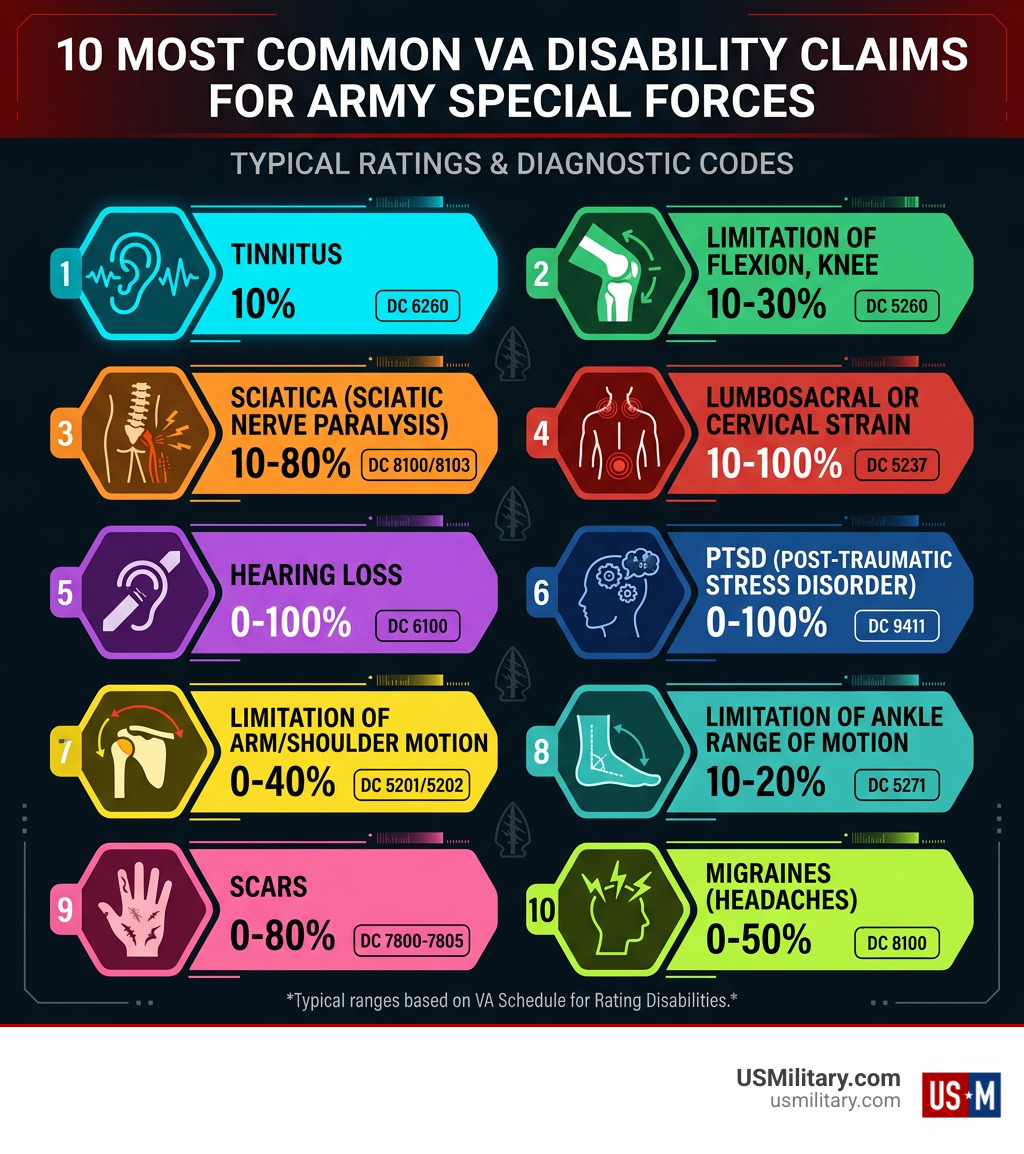
The 10 Most Common Veteran Benefits Claimed By Army Special Forces are listed below, based on VA claims data for combat MOS veterans in the 18-series:
| Rank | Condition | Typical VA Rating |
|---|---|---|
| 1 | Tinnitus | 10% |
| 2 | Limitation of Flexion, Knee | 10-30% |
| 3 | Paralysis of the Sciatic Nerve (Sciatica) | 10-80% |
| 4 | Lumbosacral or Cervical Strain | 10-100% |
| 5 | Hearing Loss | 0-100% |
| 6 | Post-Traumatic Stress Disorder (PTSD) | 0-100% |
| 7 | Limitation of Motion of the Arm/Shoulder | 0-40% |
| 8 | Limitation of Range of Motion of the Ankle | 10-20% |
| 9 | Scars | 0-80% |
| 10 | Migraines | 0-50% |
Army Special Forces operators — known as Green Berets — serve under some of the most physically and mentally demanding conditions in the U.S. military. Years of heavy ruck marches, HALO jumps, close-quarters combat, and blast exposure take a serious toll on the body and mind.
According to the VA’s FY2024 Annual Benefits Report, approximately 5.99 million veterans currently receive disability compensation for over 37 million service-connected conditions. That averages nearly 7 disabilities per veteran — and for combat veterans like those in the 18-series MOS, that number is often higher.
Many Special Forces veterans leave service without knowing which conditions qualify or how to build a strong claim. The result? Delayed benefits, low ratings, or outright denials — for injuries that were clearly earned in service.
I’m Larry Fowler, publisher of USMilitary.com and a longtime resource for veterans navigating VA benefits, including the 10 Most Common Veteran Benefits Claimed By Army Special Forces. Since 2007, I’ve helped active-duty service members and veterans cut through the complexity of VA claims and find the benefits they’ve earned.
Handy 10 Most Common Veteran Benefits Claimed By Army Special Forces terms:
The 10 Most Common Veteran Benefits Claimed By Army Special Forces
When we look at the data for elite units, the Official VBA 2024 Annual Benefits Report highlights that musculoskeletal and sensory issues dominate the landscape. For a Green Beret, “the quiet professional” lifestyle often means pushing through pain until it becomes a chronic disability. Understanding how to request VA disability compensation starts with recognizing these top ten conditions.
The list is topped by Tinnitus, a flat 10% rating that nearly every operator qualifies for due to constant exposure to gunfire and explosives. Following closely are joint issues—specifically the knee, ankle, and shoulder—which are the literal hinges of a Special Forces career. Sciatica and back strain are almost universal among those who spent decades carrying 100-pound rucks. Mental health conditions like PTSD and neurological issues like Migraines round out the list, often serving as high-value claims that reflect the intense psychological and physical pressure of the 18-series MOS.
Auditory Conditions: Tinnitus and Hearing Loss in Special Forces
If you’ve spent any time on a range or in a shoot-house, you know the “ringing” that never quite goes away. Tinnitus is the single most common claim for Special Forces. According to the Mayo Clinic Tinnitus symptoms and causes, this subjective ringing or buzzing is often the result of damage to the inner ear hair cells.
For Green Berets, the VA makes the process slightly easier through the Duty MOS Noise Exposure Listing (Fast Letter 10-35). This document concedes that 18-series MOS holders were “highly probable” to have been exposed to hazardous noise. Whether it’s small arms fire, breaching charges, or the roar of a Chinook, the VA acknowledges the exposure.
Under 38 CFR § 4.87 Tinnitus rating criteria, Tinnitus is rated at a maximum of 10%, regardless of whether it’s in one ear or both. Hearing loss, however, is rated on a scale from 0% to 100% based on speech discrimination and pure-tone thresholds. While many veterans receive a 0% rating for hearing loss (meaning it is service-connected but not yet compensable), it is a vital foundation for future increases. If you are ready to start, you can file a VA disability claim online to establish these connections early.
Musculoskeletal Injuries and 10 Most Common Veteran Benefits Claimed By Army Special Forces
The “Green Beret back” isn’t just a myth; it’s a documented medical reality. The physical demands of Special Forces training—heavy rucks, HALO (High Altitude Low Opening) jumps, and airborne operations—place an incredible amount of “G-load” and compressive force on the spine and joints.
Knee Flexion Limitation is the second most common claim. Every time an operator hits the silk or rucks 12 miles through the Uwharrie Mountains, the cartilage in the knees takes a beating. The VA rates this under 38 CFR § 4.71a Knee rating schedule, primarily focusing on the range of motion. If you can’t bend your knee past a certain point without pain, you qualify for a rating.
Furthermore, “Jumper’s Knee” and “Jumper’s Back” are common terms for the degenerative arthritis that sets in after years of hard landings. We often see these musculoskeletal issues rated between 10% and 30% per joint. To see how these percentages affect your monthly check, refer to the VA disability rating chart 2025.
Mental Health and Combat Exposure: PTSD and TBI
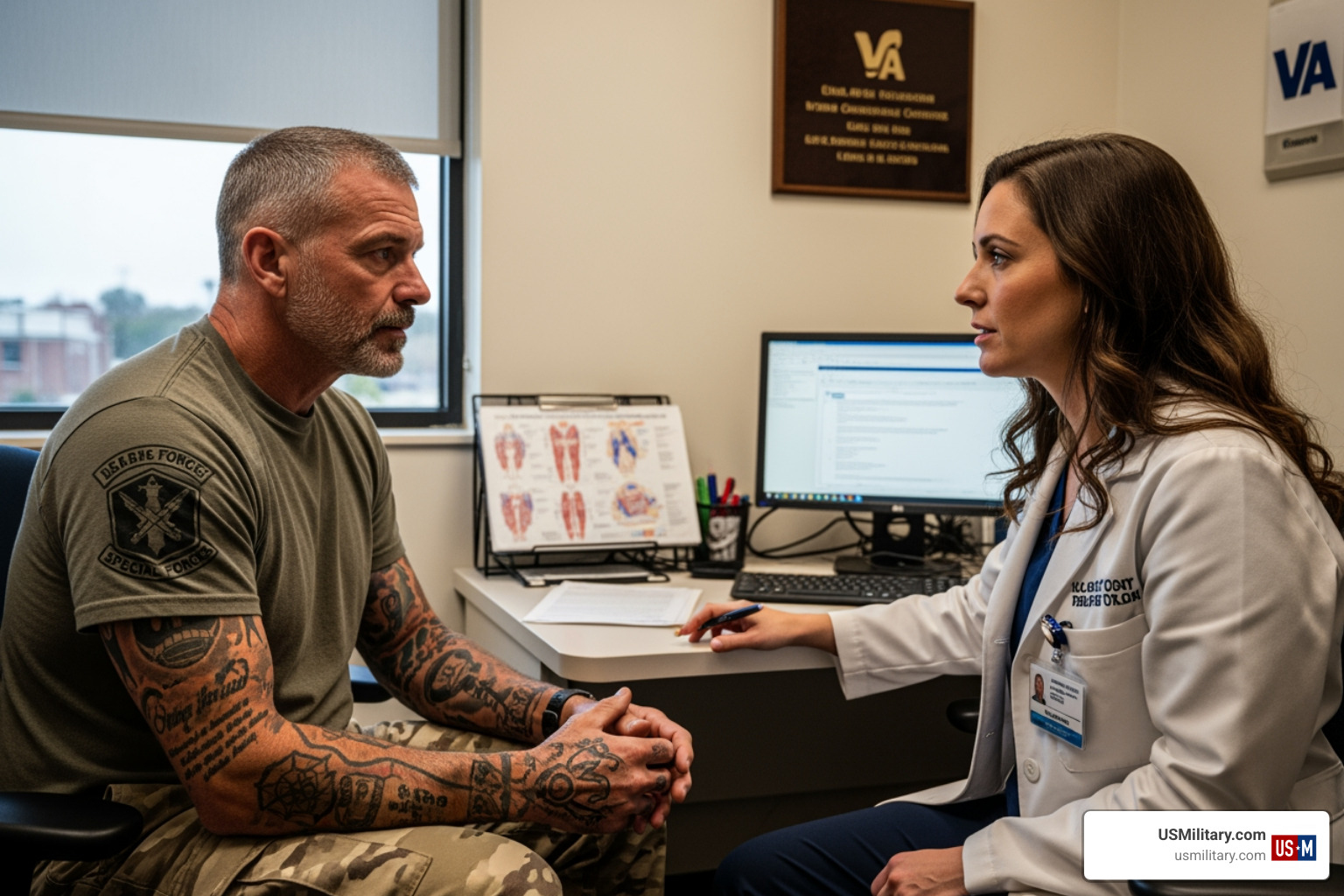
Special Forces missions often involve high-stakes environments, unconventional warfare, and prolonged exposure to combat stressors. This makes Post-Traumatic Stress Disorder (PTSD) one of the most significant claims for the 18-series community.
The VA evaluates PTSD based on “occupational and social impairment.” Ratings can be 0, 30, 50, 70, or 100%. A 70% rating, for example, often applies to veterans who struggle with suicidal ideation, near-continuous panic, or an inability to maintain effective relationships. You can find a deeper breakdown in our VA disability rating for PTSD guide.
Another critical area is Traumatic Brain Injury (TBI). In the Special Forces world, TBIs aren’t always caused by a single massive explosion. “Blast overpressure”—the cumulative effect of being near breaches, heavy weapon systems, and shoulder-fired rockets—can cause “invisible” brain injuries. These often manifest as memory loss, irritability, and severe anxiety. If you struggle with these symptoms, our Anxiety VA rating guide explains how the VA looks at mental health overlaps.
Under 38 CFR § 4.130 Schedule for Mental Disorders, the VA is required to look at the “totality of symptoms.” For many operators, PTSD and TBI symptoms overlap, leading to a single combined mental health rating.
Secondary Conditions and High-Value Claims for 18-Series Veterans
One of the best ways to increase VA disability rating 2025 is to look at secondary conditions. A secondary condition is an illness or injury that was caused or aggravated by an existing service-connected disability.
For Special Forces veterans, the most common secondary links include:
- Sciatica secondary to Lumbosacral Strain: Years of carrying heavy gear leads to back strain, which eventually compresses the sciatic nerve. This causes numbness, tingling, or “shooting” pain down the legs. The VA rates this under 38 CFR § 4.124a Sciatica and neurological ratings, with ratings as high as 80% for severe paralysis.
- Migraines secondary to TBI or PTSD: The light sensitivity and prostrating headaches that follow combat-related stress or head trauma are high-value claims, often rated at 30% or 50%.
- Sleep Apnea secondary to PTSD: Veterans with PTSD are four times more likely to develop sleep apnea. If you require a CPAP machine, this can be a 50% rating if linked correctly to your service-connected mental health.
We must be careful of “pyramiding”—the VA’s rule against rating the same symptom under two different codes. However, by clearly identifying how a back injury caused nerve damage (radiculopathy), we can maximize the combined rating without breaking VA rules.
Presumptive Exposures and Strengthening the Special Forces Claim
The PACT Act has changed the game for Special Forces veterans who served in the Middle East, Africa, or Southeast Asia. If you were exposed to burn pits, chemicals, or other toxins, certain conditions are now “presumptive.” This means the VA assumes your service caused the illness, removing the need for a difficult “nexus” (link).
Common presumptive conditions include:
- Asthma and Chronic Bronchitis
- Sinusitis and Rhinitis (Check our Sinusitis VA disability rating guide)
- Various types of rare cancers
Beyond toxins, we look at Scars and Disfigurement. Between training accidents, shrapnel, and surgeries, most Green Berets have significant scarring. Under 38 CFR § 4.118 Scar rating criteria, scars are rated based on their size, location (head, face, neck), and whether they are painful or unstable.
To strengthen any claim, we recommend three things:
- Nexus Letters: A medical professional’s opinion stating your condition is “at least as likely as not” caused by service.
- Buddy Statements: Letters from teammates who witnessed the jump, the blast, or the injury.
- Personal Statements: Your own account of how the injury limits your daily life.
Frequently Asked Questions about 10 Most Common Veteran Benefits Claimed By Army Special Forces
How does the Duty MOS Noise Exposure Listing support Green Beret claims?
The VA maintains a list of jobs that are almost guaranteed to cause hearing damage. Since “Special Forces” (18-series) is on the “Highly Probable” list, the VA concedes that you were exposed to hazardous noise. This means you don’t have to prove the noise happened; you only need a current diagnosis of Tinnitus or Hearing Loss from an audiologist.
What role do secondary conditions play in maximizing a Special Forces disability rating?
Secondary conditions are the “secret weapon” for reaching a 100% rating. Because the VA uses “VA Math” (where 50% + 50% equals 75%, not 100%), adding secondary claims like sciatica (secondary to back) or depression (secondary to chronic pain) helps fill the gaps in your total rating.
Can Special Forces veterans claim benefits for injuries from classified missions?
Yes. You do not need to reveal classified details to file a successful claim. The VA focuses on the medical evidence and the general stressor. For example, you can state you were involved in “combat operations in an undisclosed location” or provide a redacted copy of your ERB/ORB. Buddy statements from teammates can also verify the event occurred without compromising mission specifics.
Conclusion
At USMilitary.com, we know that the transition from a Special Forces ODA to civilian life is a mission in itself. Securing the 10 Most Common Veteran Benefits Claimed By Army Special Forces is about more than just a monthly check; it’s about accessing the healthcare and support you earned through years of elite service.
Whether you are dealing with the constant ringing of tinnitus, the grinding pain of a “jumper’s knee,” or the heavy weight of PTSD, we are here to help you navigate the system. A combined disability rating can open doors to vocational rehabilitation, property tax waivers, and lifetime medical care.
If you’re ready to learn more about the full spectrum of support available to you, explore our comprehensive guide All about U.S. Veteran Benefits. You stood for us; now let us stand for you.