

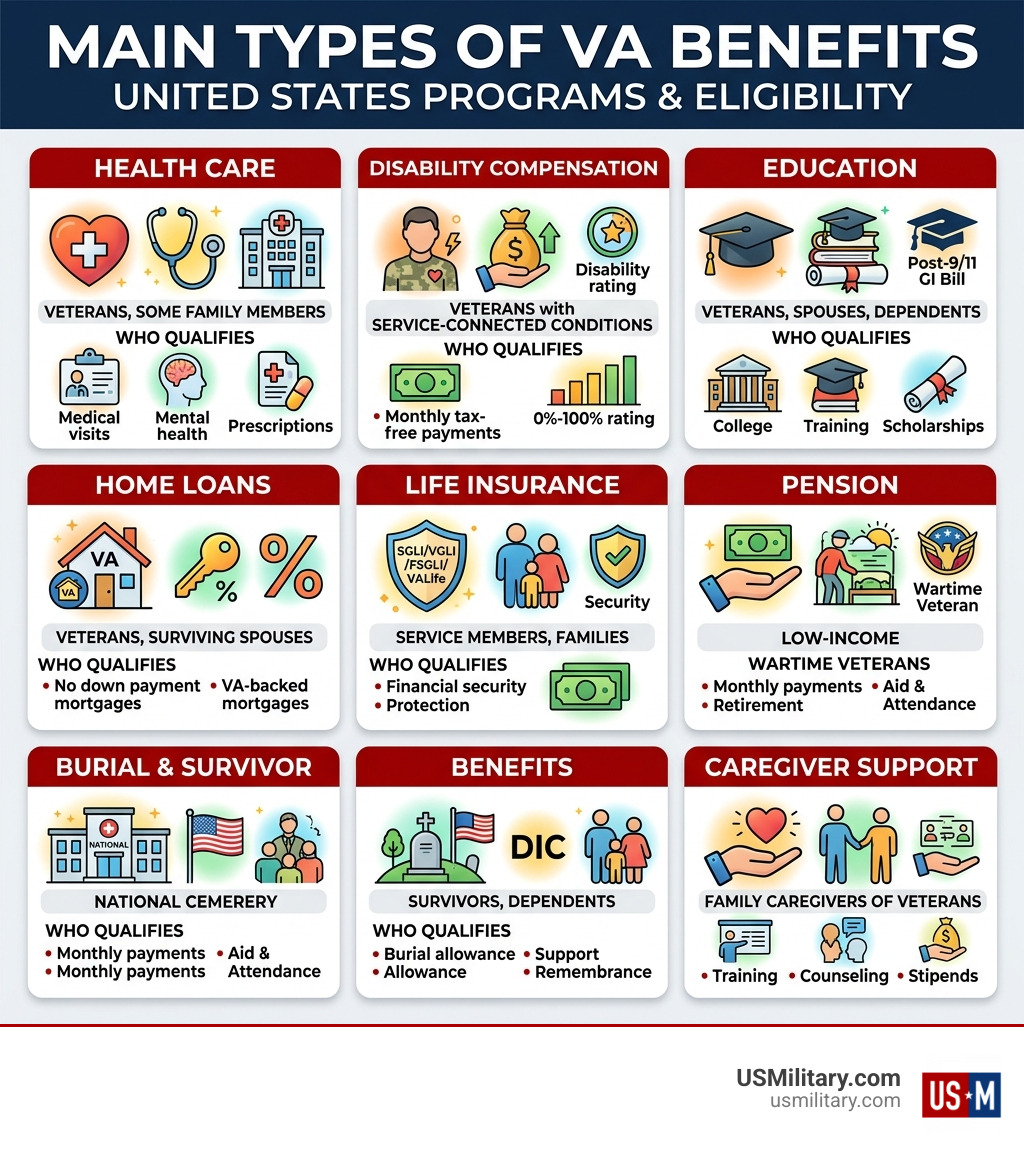
VA benefits United States programs provide financial, medical, and educational support to eligible Veterans, service members, and their families. Here’s a quick overview of the main benefit categories:
| Benefit Type | Who It’s For | Key Examples |
|---|---|---|
| Health Care | Veterans, some family members | Medical visits, mental health, prescriptions |
| Disability Compensation | Veterans with service-connected conditions | Monthly tax-free payments, 0%-100% rating |
| Education | Veterans, spouses, dependents | Post-9/11 GI Bill, Fry Scholarship, Chapter 35 |
| Home Loans | Veterans, surviving spouses | No down payment, VA-backed mortgages |
| Life Insurance | Service members, families | SGLI, VGLI, FSGLI, VALife |
| Pension | Low-income wartime Veterans | Monthly payments, Aid & Attendance |
| Burial & Survivor Benefits | Survivors, dependents | DIC, national cemetery, burial allowance |
| Caregiver Support | Family caregivers of Veterans | Training, counseling, stipends |
The VA serves nearly 9 million Veterans each year across more than 1,200 care locations. More Veterans are receiving these benefits today than at any point in history.
Whether you just enlisted, are approaching separation, or served decades ago — there’s likely a benefit you qualify for that you haven’t tapped yet.
I’m Larry Fowler, publisher of the USMilitary.com Network, and since 2007 I’ve tracked trends in VA benefits United States programs — from disability ratings to Aid and Attendance — helping hundreds of thousands of Veterans and families navigate what they’ve earned. In this guide, we’ll break down every major VA benefit so you can find exactly what applies to your situation.
Understanding Eligibility for VA Benefits in the United States
Before we dive into the “what,” we have to tackle the “who.” Eligibility is the foundation of every claim. At USMilitary.com, we often see Veterans who assume they aren’t eligible because they didn’t serve in combat or didn’t retire. In reality, the umbrella of VA benefits United States is much wider than most realize.
Who Qualifies for Veterans Benefits?
Generally, if you served on active duty, active duty for training, or inactive duty training and were discharged under conditions other than dishonorable, you are likely eligible for some form of support.
- Active Duty: Full-time members of the Army, Navy, Air Force, Marine Corps, and Coast Guard.
- National Guard and Reserve: You may qualify if you were called to active duty by a federal order. Traditional Guard and Reserve members who haven’t been federalized still qualify for specific programs, like the VA home loan, after meeting certain length-of-service requirements.
- Discharge Status: This is critical. An Honorable or General Under Honorable Conditions discharge typically opens all doors. If you have an “Other Than Honorable” (OTH) discharge, don’t lose hope—you may still be eligible for mental health services or a discharge upgrade.
To get a clear picture of your specific standing, we recommend consulting VA accredited representatives or reading our detailed From Health to Home: A Veteran’s Guide to VA Benefits.
Benefits for Spouses, Dependents, and Survivors
The VA doesn’t just care for the person in boots; it extends a safety net to the family. Spouses and children of Veterans may qualify for:
- CHAMPVA: A comprehensive health insurance program where the VA shares the cost of covered health care services and supplies with eligible beneficiaries.
- Survivors’ and Dependents’ Education Assistance (Chapter 35): Provides monthly payments to help cover the cost of school or job training.
- Fry Scholarship: Specifically for the children and spouses of service members who died in the line of duty after September 10, 2001.
For those who have lost a loved one, the Surviving Spouses & Dependents portal provides a roadmap for accessing these vital resources.
Comprehensive Health Care and Mental Health Services
The VA health care system is the largest integrated health care network in the United States. With nearly 9 million Veterans enrolled, the system is designed to handle the unique injuries and exposures that come with military service.
Priority Groups and Enrollment
When you Apply for Health Care, the VA assigns you to one of eight priority groups. These groups ensure that those with service-connected disabilities or lower incomes get access to care first.
- Service-Connected Status: If you have a disability rating of 50% or higher, you are placed in Priority Group 1.
- Combat Veterans: If you recently separated from active duty and served in a theater of combat operations, you have 10 years of enhanced eligibility for VA health care. This means you can enroll even if your income is higher than the usual thresholds.
- Financial Assessments: For some Veterans, the VA uses a financial assessment (means test) to determine if they qualify for free care or if they will have small copays.
Once enrolled, you can use My HealtheVet to message your doctors, refill prescriptions, and view your medical records online.
Mental Health Support and Crisis Resources
At USMilitary.com, we believe mental health is just as important as physical health. The VA provides specialized care for PTSD, depression, anxiety, and substance use.
Immediate Help: If you or a Veteran you know is in crisis, you don’t need to be enrolled in VA health care to get help.
- Call 988 and Press 1 to reach the Veterans Crisis Line.
- Text 838255.
- Start a confidential chat online.
Transitioning can be tough on the mind. We encourage you to Visit our mental health site for transitioning service members to find tools specifically tailored for the move from military to civilian life.
Financial Support: Disability Compensation and Pensions
Financial stability is a major pillar of VA benefits United States. These payments are designed to compensate for the “average loss in earning capacity” caused by service-related injuries.
Applying for VA Disability and Special Monthly Compensation
VA disability compensation is a tax-free monthly payment. To qualify, you must show that your condition was caused or worsened by your military service.
- The Rating Scale: Ratings range from 0% to 100% in 10% increments. A 0% rating means the VA acknowledges the injury is service-connected but it doesn’t currently cause a significant impairment. Even a 0% rating is valuable because it grants you access to VA health care for that condition.
- Fully Developed Claims (FDC): This is the fastest way to get a decision. You submit all your medical evidence and service records upfront and certify that you have no more evidence to provide.
- Special Monthly Compensation (SMC): This is an additional tax-free benefit for Veterans with even more severe disabilities, such as the loss of use of a limb or the need for a caregiver.
If you’re wondering about the financial impact, check the 2024 VA Disability Pay Chart or learn How to File a VA Disability Claim to get started. In some cases, Veterans have received substantial retroactive payments—see our article on What is the Largest VA Back Pay Ever? for more on how that works.
Veterans Pension and Aid & Attendance
Unlike disability compensation, a Veterans Pension is a needs-based benefit for wartime Veterans with limited income who are either age 65 or older or have a permanent and total non-service-connected disability.
- Aid & Attendance: This is a “booster” to the pension. If you require the help of another person to perform daily activities (like bathing or dressing), are bedridden, or are in a nursing home, you may qualify for a much higher monthly payment.
- Housebound Benefits: This applies if you are permanently confined to your immediate premises because of a disability.
Navigating the forms can be tricky, so we’ve put together a VA Aid and Attendance Form: Complete Guide and an article Understanding Aid and Attendance Tax-Free Income to simplify the process.
Education, Housing, and Life Insurance Programs
The GI Bill is perhaps the most famous of all VA benefits United States programs. It has transformed the lives of millions by providing a path to higher education without the crushing weight of student debt.
VA Home Loan Benefits and Eligibility
The VA home loan is often the best mortgage product on the market. Why?
- No Down Payment: Most conventional loans require 3% to 20% down. The VA loan requires $0.
- No Private Mortgage Insurance (PMI): This saves you hundreds of dollars every month.
- Competitive Rates: Because the government backs the loan, lenders can offer lower interest rates.
To get started, you’ll need a Certificate of Eligibility (COE). You can learn more through our VA Loan Eligibility FAQs and discover the full Benefits of VA Loans.
Life Insurance Options for Families
The VA offers several life insurance programs to give you peace of mind that your family will be taken care of.
- SGLI (Servicemembers’ Group Life Insurance): Automatic coverage for active-duty members.
- VGLI (Veterans’ Group Life Insurance): Allows you to convert your SGLI to a permanent program after you leave the service. You must do this within 1 year and 120 days of discharge.
- VALife: A newer program that offers guaranteed acceptance whole life insurance for Veterans with service-connected disabilities.
- FSGLI (Family SGLI): Coverage for the spouses and children of service members covered by SGLI.
You can manage your policies and find Life Insurance Online Applications directly through the VA’s portal.
Support for Caregivers, Survivors, and Veterans in Transition
The transition from military to civilian life isn’t a single event—it’s a process. The VA provides several layers of support during this time, especially for those who need extra help at home.
Time-Sensitive Benefits Before Separation
If you are currently serving, the 180-day window before your discharge is the most critical time for your future benefits.
- Benefits Delivery at Discharge (BDD): This program allows you to file your disability claim while you are still on active duty (between 180 and 90 days before separation). The goal is to have your benefits start the day after you leave the service.
- Pre-separation Counseling: You should attend a TAP (Transition Assistance Program) briefing to understand your options.
- SGLI Conversion: You only have 120 days to convert your SGLI to VGLI without a medical exam.
For more transition resources, we recommend the Department of Defense (DoD) Military OneSource website.
Burial Benefits and Survivor Compensation
The VA honors the service of Veterans by providing a final resting place and support for their families.
- National Cemeteries: Burial in a VA national cemetery is available to eligible Veterans, spouses, and dependents at no cost to the family. This includes the gravesite, opening and closing of the grave, a headstone or marker, and perpetual care.
- Dependency and Indemnity Compensation (DIC): This is a tax-free monthly benefit paid to eligible survivors of service members who died in the line of duty or Veterans whose death resulted from a service-related injury or disease.
- Burial Allowance: A flat-rate monetary benefit to help cover burial and funeral costs.
You can research eligibility through the National Cemetery Administration and learn about survivor pay at VA Dependency and Indemnity Compensation (VA DIC).
Frequently Asked Questions about VA benefits United States
How do I manage my VA benefits online?
The best way to manage your benefits is by creating an account on VA.gov. This central hub allows you to track the status of your claims, download your benefit letters, and update your personal information. You can also use the eBenefits portal online to manage your home loan COE and insurance policies. Additionally, the VA Health and Benefits App is a great tool for refilling prescriptions and checking your disability rating on your smartphone.
What resources are available for homeless Veterans?
No Veteran should be without a home. The VA offers several programs to help:
- National Call Center for Homeless Veterans: Call 877-424-3838 for 24/7 access to trained counselors.
- HUD-VASH: This program combines HUD housing vouchers with VA supportive services to help Veterans find and keep permanent housing.
- Health Care for Homeless Veterans (HCHV): Provides outreach and exams to Veterans living on the streets or in shelters.
For more information, visit the Homeless Veterans resource page.
Can I get help with a denied VA benefits United States claim?
Yes. If your claim is denied, it is not the end of the road. You have the right to appeal. You can choose a Higher-Level Review, file a Supplemental Claim with new evidence, or appeal directly to the Board of Veterans’ Appeals. We highly recommend working with a Veterans Service Officer (VSO) or an accredited attorney to navigate this. Learn more about your options if your VA Disability Claim Denied.
Conclusion
Navigating VA benefits United States can feel like a full-time job, but it is one that pays off. These programs were created because you earned them through your service and sacrifice. Whether it’s securing a home for your family, getting the medical care you need, or furthering your education, the VA is there to support you.
At USMilitary.com, we are committed to providing you with the most up-to-date and nonbiased information. Remember to stay vigilant—as benefits increase, so do scammers. Always use official channels and read up on safeguarding your benefits to protect your hard-earned compensation.
If you’re ready to take the next step, Explore all VA benefits on our site to find the programs that will help you and your family thrive. Thank you for your service.