

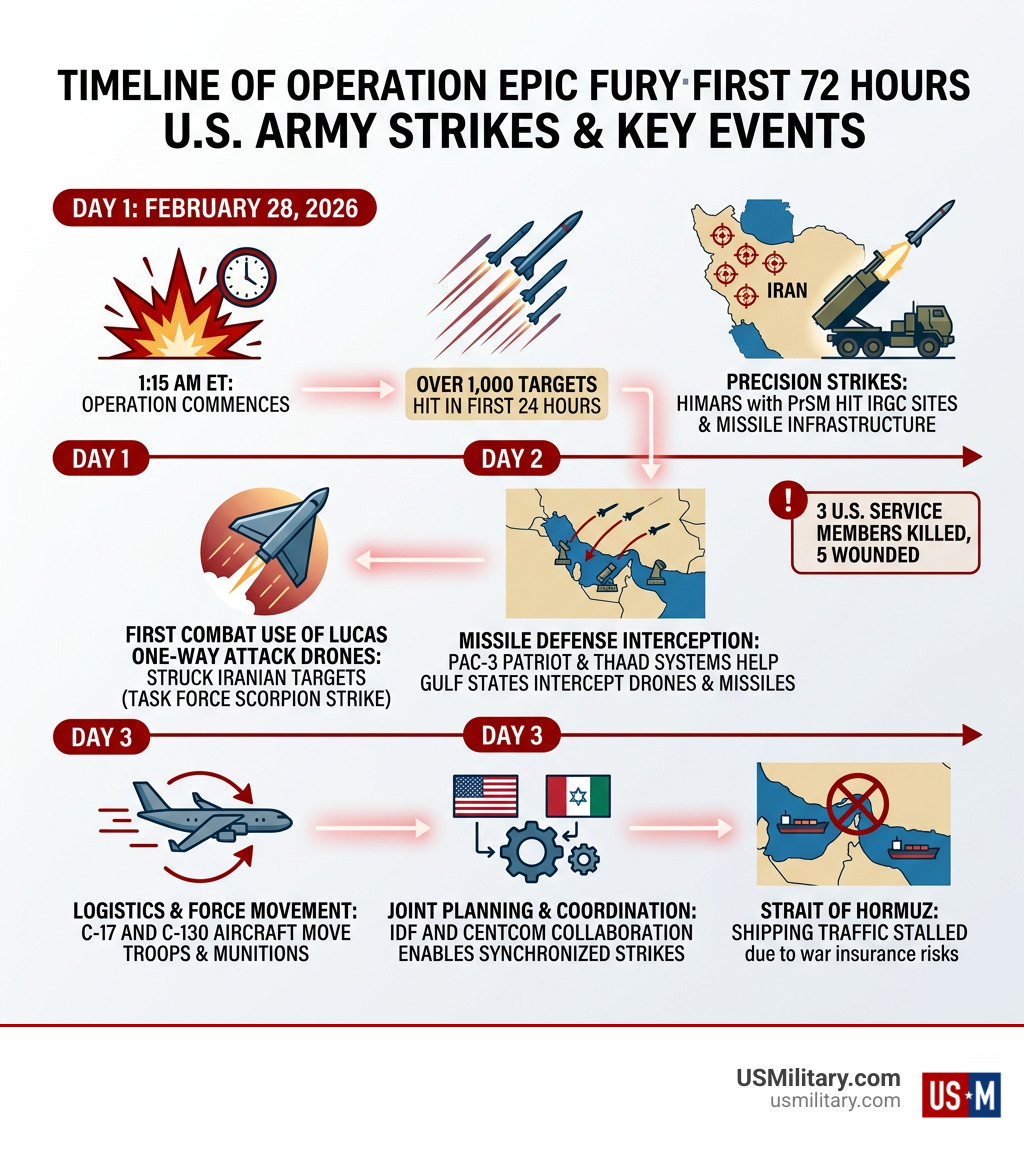
The Day Three Update on Operation Epic Fury: How The Army Is Involved shows a multi-front Army contribution — from precision rocket strikes deep inside Iran to missile defense across the Gulf region.
Here is a quick breakdown of the Army’s key roles so far:
| Army Role | Asset Used | What It Did |
|---|---|---|
| Precision strikes on Iranian targets | M-142 HIMARS with PrSM | Hit IRGC sites and missile infrastructure in western Iran |
| First combat use of one-way attack drones | LUCAS drones (Task Force Scorpion Strike) | Struck Iranian targets, modeled after Iran’s own Shahed-136 |
| Missile and drone interception | PAC-3 Patriot and THAAD systems | Helped Gulf states intercept 282 missiles and 833 drones |
| Logistics and force movement | C-17 and C-130 aircraft | Moved troops and munitions across the region |
| Joint planning and coordination | IDF and CENTCOM collaboration | Months of pre-strike planning enabled synchronized strikes |
Over 1,000 targets were hit in the first 24 hours alone. Three U.S. service members have been killed and five seriously wounded. The Strait of Hormuz remains technically open, but shipping traffic has stalled due to war insurance risks.
The operation began at 1:15 a.m. ET on February 28, 2026, under direct Presidential order. By Day Three, the Army’s role has expanded well beyond support — it is an active, lethal part of a joint campaign.
I’m Larry Fowler, publisher of the USMilitary.com Network since 2007, and I’ve spent nearly two decades tracking how U.S. Army assets are deployed in major operations like the Day Three Update on Operation Epic Fury: How The Army Is Involved. Read on for a full breakdown of every Army role in this fast-moving conflict.
Day Three Update on Operation Epic Fury: How The Army Is Involved terms explained:
- Boldest Epic Attack On Iran Regime For Lasting World Peace
- Iran Supreme Leader Khamenei Reported Dead
- Who gets pulled into the military draft first
Day Three Update on Operation Epic Fury: How The Army Is Involved
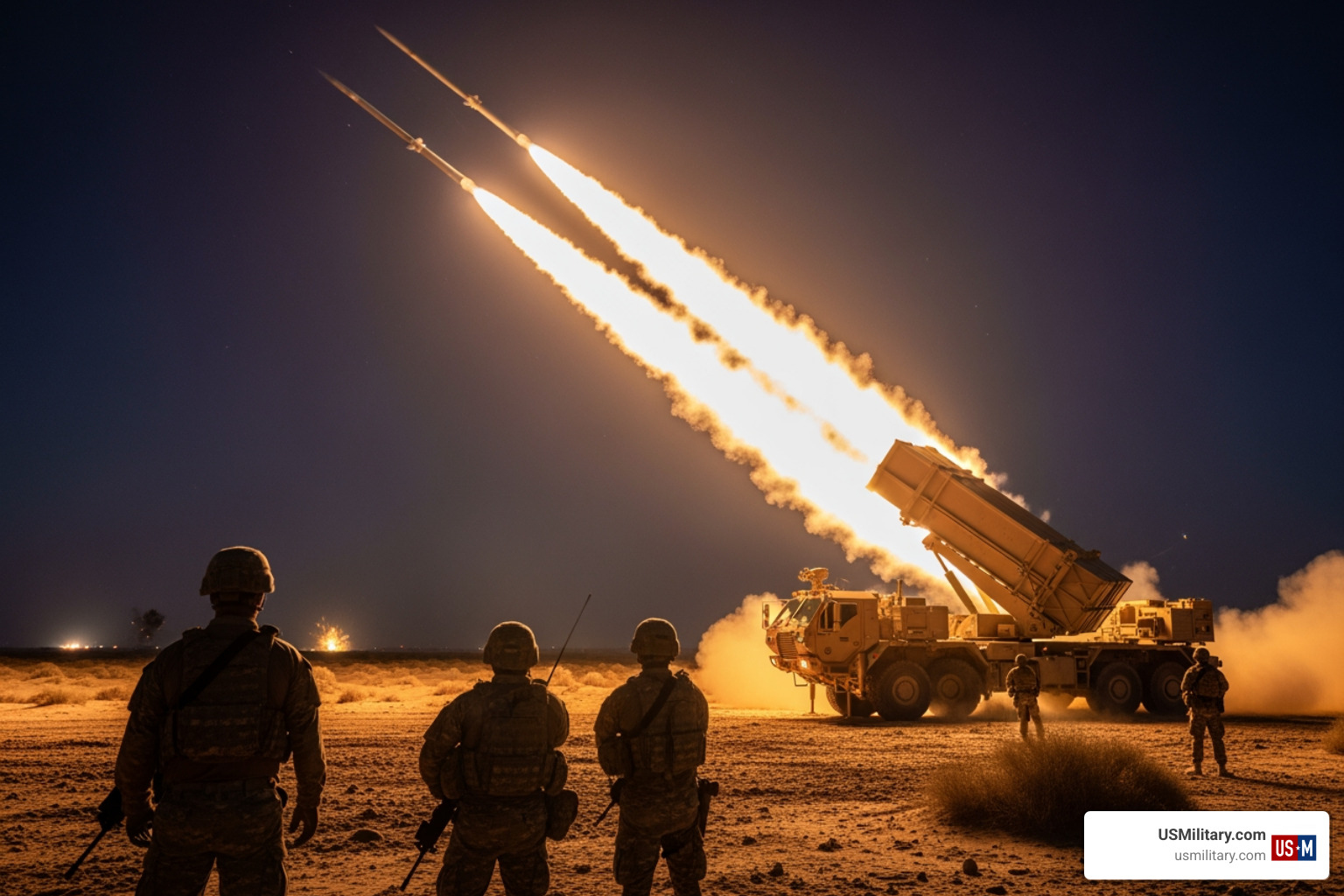
As we enter the third day of this massive campaign, the U.S. Army’s footprint is visible across the entire theater of operations. While the initial headlines focused on Air Force B-2 bombers and Navy Tomahawk missiles, the Army has been the “ground-based hammer” in this fight.
The primary objective of the Day Three Update on Operation Epic Fury: How The Army Is Involved is the systematic dismantling of the Iranian security apparatus. This includes hitting Islamic Revolutionary Guard Corps (IRGC) headquarters, air defense nodes, and mobile missile launchers that threaten regional stability.
One of the most significant developments has been the Official CENTCOM launch video, which confirmed that Army assets were engaged from the very first hour. Task Force Scorpion Strike, a specialized unit, has also made waves by deploying the LUCAS drone—a low-cost, one-way attack munition that provides the Army with a “suicide drone” capability similar to the systems Iran has used against U.S. interests for years.
Precision Strikes and the Combat Debut of PrSM in the Day Three Update on Operation Epic Fury: How The Army Is Involved
The M-142 HIMARS (High Mobility Artillery Rocket System) has long been a favorite of Army commanders for its “shoot and scoot” capability. In Operation Epic Fury, these mobile launchers have been utilized to strike high-value targets in Western Iran.
However, the real news is the Combat debut of PrSM. The Precision Strike Missile (PrSM) is the Army’s next-generation replacement for the ATACMS. It offers a longer range (exceeding 300 miles) and higher precision. Analysts noted that HIMARS units fired these missiles to take out hardened Iranian command centers and mobile ballistic missile batteries. Because these launchers are mobile, they can fire and relocate before Iranian counter-battery radar can lock onto their position, making them nearly impossible for the enemy to pin down.
Task Force Scorpion Strike: Army Drone Involvement in the Day Three Update on Operation Epic Fury: How The Army Is Involved
In a move that many are calling “American-made retribution,” the Army’s Task Force Scorpion Strike has unleashed the LUCAS drone. These are low-cost, one-way attack drones modeled after the Iranian Shahed-136.
By using these drones, the Army can achieve several goals:
- Attrition: They are cheap enough to be used in “swarms” to overwhelm Iranian air defenses.
- Precision: They can loiter over a target area before diving into a specific IRGC vehicle or radar dish.
- Combat Testing: This is the first time these systems have been used in a high-intensity conflict, and the results on Day Three suggest they are highly effective at degrading the Iranian military’s ability to respond.
Shielding the Region: PAC-3 and THAAD Air Defense Operations
While the HIMARS and LUCAS drones are on the offensive, the Army’s air defense units are playing a critical “shield” role. Iran responded to the initial U.S. strikes by launching a massive wave of retaliation. According to CENTCOM data, at least 282 Iranian missiles and 833 drones were intercepted by a coalition of forces.
The U.S. Army’s PAC-3 Patriot and THAAD (Terminal High Altitude Area Defense) systems have been the backbone of this defense. These systems are strategically placed across Gulf states to protect both U.S. bases and host-nation infrastructure. THAAD, in particular, is designed to intercept short-, medium-, and intermediate-range ballistic missiles in their terminal phase, providing a layered protection that has saved countless lives over the last 72 hours.
Counter-Drone Efforts and Integrated Defense
The sheer volume of drones launched by Iran—over 800 in three days—required a highly coordinated response. The Army has utilized electronic warfare (EW) suites alongside traditional kinetic interceptors to “blind” and down these swarms.
This effort is not a solo mission. The Army is working in lockstep with the IDF (Israel Defense Forces) and regional partners to create a “fused” air defense picture. This means that if a radar in Saudi Arabia picks up a drone, the data is instantly shared with an Army Patriot battery in Kuwait, ensuring the highest possible interception rates.
Casualties and the Human Cost of Operation Epic Fury
War always comes with a heavy price, and Operation Epic Fury is no exception. Despite the technological superiority of U.S. forces, Iranian counterattacks have hit home.
The March 1 CENTCOM casualty update confirmed the tragic news: three U.S. service members have been killed in action and five are seriously wounded. Several others have sustained minor shrapnel injuries and concussions. These casualties occurred primarily during Iranian missile and drone strikes aimed at U.S. military bases in the region.
Army Response to Personnel Losses on Day Three
The Army’s response to these losses has been two-fold: immediate medical care and increased base security. All wounded personnel were quickly evacuated for medical treatment and are currently reported to be in stable condition.
Politically and strategically, the response has been firm. President Trump warned Iran that any further retaliation would be met with “a force never seen before.” On the ground, Army commanders have implemented “Critical” risk level protocols, ensuring that all personnel are in hardened shelters during high-threat windows and that counter-battery assets are on 24/7 hair-trigger alert.
Logistics and Multi-Service Coordination
An operation of this scale requires a massive logistical “backbone.” The Army doesn’t just fight; it moves and feeds the force. Currently, there are approximately 35,000 U.S. personnel stationed across the Middle East, with 10,000 at Al Udeid in Qatar and 3,200 at the Bahrain Fifth Fleet HQ.
To keep these troops supplied, the Army relies on a heavy rotation of transport aircraft.
| Aircraft | Primary Army Use |
|---|---|
| C-17 Globemaster III | Transporting heavy equipment, HIMARS launchers, and large munitions |
| C-130 Hercules | Tactical airlift, moving troops between regional bases, and “last-mile” delivery |
Strategic Objectives of the Army’s Role in Operation Epic Fury
The Army’s involvement is part of a broader joint campaign involving the Air Force and Navy. While the Navy’s carriers (like the USS Abraham Lincoln) and the Air Force’s stealth bombers handle the “deep” strikes, the Army focuses on regional stability and precision ground-based fires.
A major success of this joint planning was the elimination of 40 senior Iranian commanders, including Chief of Staff Abdolrahim Mousavi. Army intelligence assets and coordination with the IDF were pivotal in identifying the locations of these high-ranking officials. Furthermore, the Army’s presence in Iraq and Syria (totaling about 3,500 troops) serves as a deterrent to Iranian-backed proxies who might attempt to open a second front.
Regarding the Strait of Hormuz, while the Army doesn’t sail ships, its land-based anti-ship capabilities and radar sites provide critical “overwatch” for the Navy. Currently, the Strait remains open, but the risk to commercial shipping is at an all-time high, stalling much of the world’s oil traffic.
Frequently Asked Questions about the Army’s Role in Operation Epic Fury
What specific Army assets are deployed in the Day Three Update on Operation Epic Fury: How The Army Is Involved?
The Army has deployed M-142 HIMARS rocket systems, the new Precision Strike Missile (PrSM), PAC-3 Patriot batteries, and THAAD systems. Additionally, Task Force Scorpion Strike is utilizing LUCAS one-way attack drones.
Has the Army been involved in ground combat during the Day Three Update on Operation Epic Fury: How The Army Is Involved?
As of Day Three, there have been no reports of large-scale Army ground invasions into Iranian territory. The Army’s role has focused on long-range precision strikes, air defense, logistics, and counter-drone operations.
How is the Army coordinating with the IDF and other U.S. branches?
The coordination is seamless and has been in the works for months. The Army shares real-time radar data with the IDF for missile defense and works with the Air Force for “tanker” support to keep drones and aircraft airborne. Logistics are handled through joint hubs like Al Udeid Air Base.
Conclusion
The Day Three Update on Operation Epic Fury: How The Army Is Involved paints a picture of a modernized, lethal force that is essential to the success of this campaign. From the combat debut of the PrSM missile to the heroic efforts of Patriot battery crews, the U.S. Army is proving its worth in a complex, multi-domain conflict.
At USMilitary.com, we are committed to providing you with the most accurate and up-to-date information on our service members’ actions abroad. Whether you are looking for news on current operations or exploring career paths within the service, we are your central hub for military-related guidance.
If you are interested in how other branches are contributing to this mission, you can Explore Navy Jobs to see how the sea-based side