
What Is Army Basic Training? A Quick Overview
Army Basic Training — also called Basic Combat Training (BCT) or “boot camp” — is the mandatory 10-week program that transforms civilians into U.S. Army Soldiers.
Here’s what you need to know at a glance:
| Topic | Key Facts |
|---|---|
| Duration | ~10 weeks (plus Reception/Week Zero beforehand) |
| Phases | Yellow (Wks 1-2), Red (Wks 3-4), White (Wks 5-7), Blue (Wks 8-10) |
| Locations | Fort Moore (GA), Fort Jackson (SC), Fort Leonard Wood (MO), Fort Sill (OK) |
| Fitness Test | Army Combat Fitness Test (ACFT) — minimum 360 points to graduate |
| Completion Rate | ~90% of recruits graduate |
| Pay | Yes — on the 1st and 15th of every month |
| What Comes Next | Advanced Individual Training (AIT) or One Station Unit Training (OSUT) |
BCT is required for every new enlisted Soldier — whether you’re joining the active Army, the Army Reserve, or the National Guard. It’s designed to be physically and mentally demanding, but it’s also structured to build you up, not break you down.
As one drill sergeant put it: “Don’t take it personal. Take it as a learning experience and constantly tell yourself that you can do it, and you will do it.”
I’m Larry Fowler, publisher of USMilitary.com — and since 2007 I’ve helped hundreds of thousands of recruits and veterans navigate every stage of military life, including Army Basic Training. In this A-Z guide, I’ll walk you through everything you need to know before you ship out.
The Four Phases of Army Basic Training

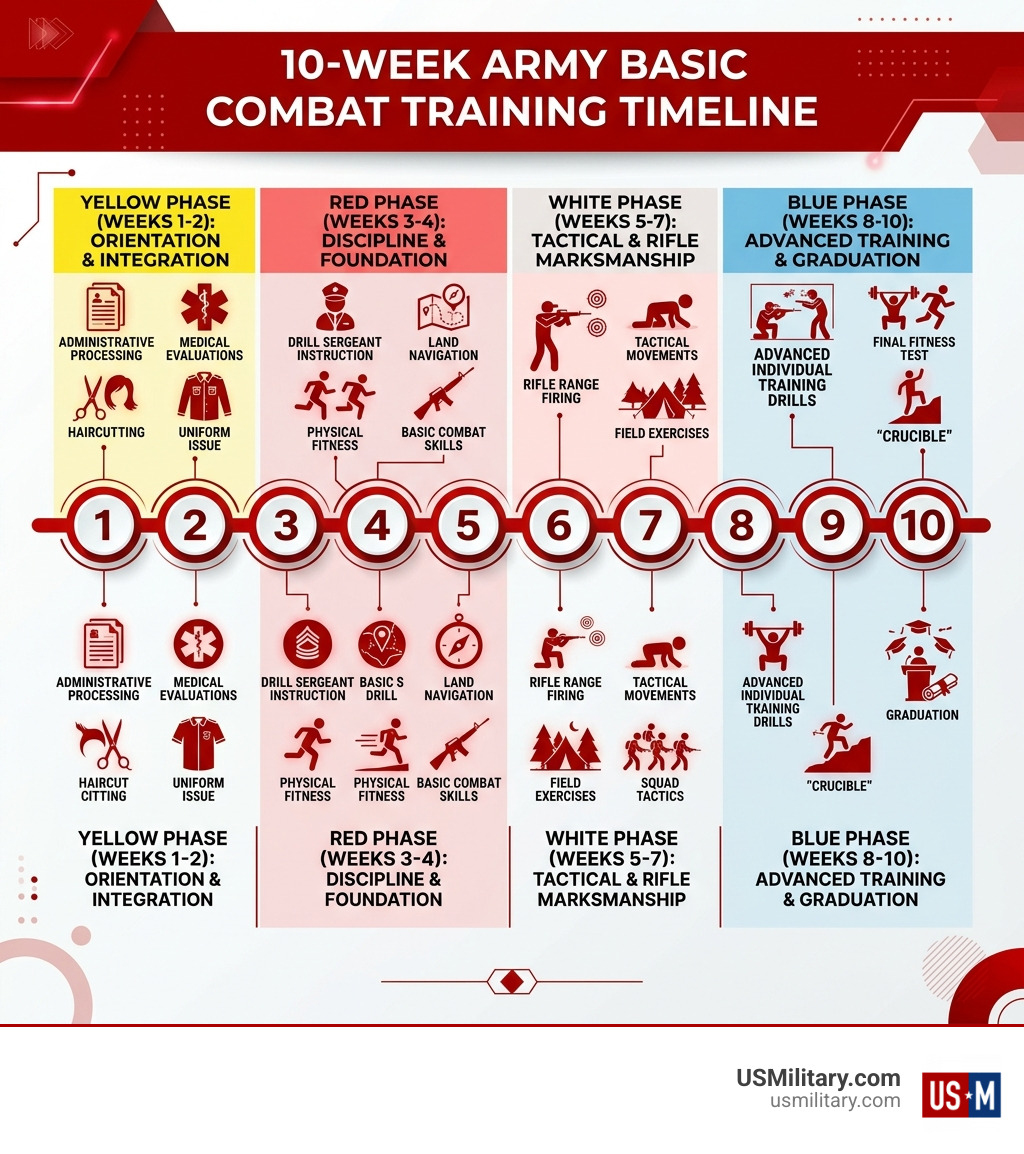
As of April 2026, the Army utilizes a four-phase color-coded system to track your progress from a nervous civilian to a disciplined Soldier. While many people think of “boot camp” as one long blur of yelling and push-ups, it is actually a highly structured curriculum designed by the Training and Doctrine Command (TRADOC).
The journey officially begins with Basic Combat Training | U.S. Army, which is divided into the Yellow, Red, White, and Blue phases. Each phase has a specific “flavor” and set of graduation requirements. You won’t just be running; you’ll be learning Army history, first aid, land navigation, and legal codes.
The transition is psychological as much as it is physical. We see recruits go from “I” and “me” to “we” and “us” in a matter of weeks. The goal is to instill the Warrior Ethos and the Soldier’s Creed into your DNA. By the time you reach the final week, the person who stepped off the bus at the start of the cycle will be long gone.
Yellow and Red Phases: The Foundation of Army Basic Training
The first stop for every recruit isn’t actually “Basic.” It’s the Reception Battalion, often called “Week Zero” or the Yellow Phase (Weeks 1-2). This is where the paperwork happens. You’ll get your first military haircut (sorry, guys, it’s a buzz cut), your initial issue of uniforms, and a battery of immunizations.
One of the most famous moments is the “shakedown.” You’ll be ordered to empty your bags completely. If any contraband—like snacks, tobacco, or non-prescription meds—falls out, you’ll get your first taste of a Drill Sergeant’s “enthusiastic” feedback. We recommend reading up on Youll Be Shock To What To Expect At Army Boot Camp/ to avoid these early rookie mistakes.
Once you move into the Red Phase (Weeks 3-4), the real intensity begins. This is the “Shaping” phase. You will learn the Army Core Values, remembered by the acronym LDRSHIP:
- Loyalty
- Duty
- Respect
- Selfless Service
- Honor
- Integrity
- Personal Courage
You’ll also face the infamous Nuclear-Biological-Chemical (NBC) chamber. Yes, the gas chamber. You’ll head inside, remove your mask, and recite your name and Social Security number while exposed to CS gas. It’s a rite of passage that proves your equipment works and builds your confidence. The Army has also been looking to bring back Drill Sergeants for more disciplined new Soldiers/ to ensure that these foundational weeks focus heavily on discipline and the “First 100 Yards” of your career.
White and Blue Phases: Advanced Skills in Army Basic Training
The White Phase (Weeks 5-7) is also known as the “Rifleman” or “Gunfighter” phase. The focus shifts from general discipline to combat lethality. You’ll spend a massive amount of time on the range with your M4 carbine. You’ll learn “zeroing” (aligning your sights) and progress to qualifying on targets up to 300 meters away. You’ll also tackle the Confidence Course and the Rappel Tower (Victory Tower).
The Blue Phase (Weeks 8-10) is the “Warrior” phase. This is where everything you’ve learned is put to the test. You’ll move into advanced squad tactics, Military Operations in Urban Terrain (MOUT), and convoy operations. You are also required to throw two live hand grenades to graduate.
The culminating event of Army Basic Training is The Forge. This is a grueling 96-hour field training exercise (FTX) that includes night infiltration courses and tactical marches of up to 15 kilometers. It is designed to push you to your physical and mental limits. If you survive The Forge, you earn your tan beret (or black beret, depending on your unit) and the right to be called a U.S. Army Soldier. To make sure you’re ready for this jump in intensity, check out our guide on Enlisted Basic Combat Training Prep/.
Locations and Requirements for Enlistment
The Army doesn’t just train everyone in one place. Where you go for Army Basic Training depends largely on your Military Occupational Specialty (MOS) and gender.
| Location | Notable Training Units | Primary Focus |
|---|---|---|
| Fort Moore, GA | 197th & 198th Infantry Brigades | Infantry, Armor, Cavalry OSUT |
| Fort Jackson, SC | 165th & 193rd Infantry Brigades | Largest BCT site; 60% of all women train here |
| Fort Leonard Wood, MO | 1st Engineer Brigade | Engineers, Military Police, Chemical Corps |
| Fort Sill, OK | 434th Field Artillery Brigade | Field Artillery, Air Defense Artillery |
To even get to these locations, you must meet the enlistment requirements. As of 2026, you generally need to be between 17 and 35 years old (though some waivers exist for older recruits). You must be a U.S. citizen or a legal permanent resident with a Green Card. Educationally, a high school diploma is preferred, though a GED is often acceptable with higher ASVAB scores. For a deep dive into the specifics, read our full breakdown of Army Boot Camp Requirements And Locations/.
Physical Fitness and the ACFT
Gone are the days of just doing push-ups and sit-ups. The current standard is the Army Combat Fitness Test (ACFT). To graduate Army Basic Training, you must score a minimum of 60 points in each of the six events, for a total of at least 360 points.
The six events are:
- Three-Rep Max Deadlift: Tests lower body strength.
- Standing Power Throw: Tests explosive power by throwing a 10lb med ball backward.
- Hand-Release Push-Ups: Tests upper body endurance.
- Sprint-Drag-Carry: A high-intensity shuttle run involving 40lb kettlebells and a 90lb sled.
- Plank: Tests core strength and stability.
- Two-Mile Run: The classic test of aerobic endurance.
If you arrive and find yourself struggling, the Army has the Fitness Training Company (FTC). This isn’t a punishment; it’s a resource. Recruits in FTC get extra coaching and two chances per week to pass the physical assessment. However, if you fail to meet standards after four weeks (eight attempts), you may face an administrative discharge. We always tell our readers: Ready For Your Military Boot Camp Think Again/ if you haven’t started running yet!
Daily Life and Communication During Boot Camp
Life in BCT is governed by the clock. A typical day looks like this:
- 0430: Wake up (and yes, it feels as early as it sounds).
- 0500-0630: Physical Training (PT).
- 0700-0800: Breakfast at the Dining Facility (DFAC).
- 0830-1200: Training (Classroom or Field).
- 1200-1300: Lunch (DFAC or MREs in the field).
- 1300-1700: Training (Rifle range, marches, etc.).
- 1800-1900: Dinner.
- 1900-2100: Mail call, personal time, and preparing gear.
- 2100: Lights out.
You will live by the Battle Buddy system. You are never allowed to go anywhere alone—not to the latrine, not to the laundry room, nowhere. This builds accountability and ensures safety. You will also take turns on Fire Guard or CQ (Charge of Quarters) duty, which involves staying awake for an hour or two at night to watch over the barracks.
When it comes to the outside world, communication is limited but available. Most recruits are allowed to make a short “I arrived safely” phone call during Reception. After that, phone privileges are earned and usually restricted to Sundays. Letter writing remains the most reliable way to stay in touch. We recommend families use the official Military Basic Training Resources to find the correct mailing addresses for their recruits. For the recruits themselves, check out our Basic Training Preparation Tips/ to learn how to manage your limited time effectively.
What Happens After Graduation: AIT and OSUT
Graduation day is a massive milestone. It usually involves a Family Day where your loved ones can visit the post, followed by a formal graduation ceremony where you finally don your beret. But graduation from BCT is just the beginning of your Initial Entry Training (IET).
Most Soldiers will move on to Advanced Individual Training (AIT). This is where you learn your specific job, such as being a medic (at Fort Sam Houston) or a human intelligence collector (at Fort Huachuca). AIT can last anywhere from six weeks to over a year, depending on the complexity of your MOS.
However, if you are in a combat role like Infantry, Armor, or Cavalry, you will likely go through One Station Unit Training (OSUT). OSUT combines BCT and AIT into one continuous program at the same location with the same Drill Sergeants. For example, Infantry OSUT at Fort Moore is a 22-week marathon.
Understanding the path ahead is vital for your long-term career. You can learn more about the transition in our articles What Comes After Military Boot Camp/ and Military Training Much More Than Boot Camp/.
Frequently Asked Questions about Army BCT
Do recruits get paid during Basic Training?
Yes! You are an active-duty Soldier from the moment you swear in at MEPS. You will be paid based on your rank (usually E-1 to E-3 for most recruits). Payments occur on the 1st and 15th of every month via direct deposit. The Army will help you set up a bank account during the Reception phase if you don’t already have one. You’ll also receive a small “smart card” with an advance on your pay to buy essential toiletries and gear at the Post Exchange (PX).
What items are prohibited at Basic Training?
The Army provides almost everything you need. Bringing “contraband” will only result in extra push-ups. Prohibited items include:
- Weapons of any kind (including pocket knives).
- Tobacco products, vapes, and lighters.
- Alcohol or any alcohol-based health products.
- Expensive electronics (gaming systems, laptops).
- Non-prescription drugs or supplements (unless specifically cleared).
- Obscene or pornographic materials.
- Outside food (candy, gum, chips).
For a complete list of what is allowed, consult the United States Army Basic Training guidelines or your recruiter’s packing list.
What is the success rate for Army recruits?
Statistically, about 90% of recruits complete Army Basic Training. Most of the 10% who do not finish are discharged due to pre-existing medical issues that flared up during training, or a “failure to adapt” to the military lifestyle. The Army wants you to succeed. They have invested a lot of money in your training, and the Drill Sergeants are there to mold you into a Soldier, not to kick you out. Mental toughness is usually the deciding factor; if you don’t quit on yourself, the Army won’t quit on you.
Conclusion
Army Basic Training is the most significant transformation you will ever undergo. It’s 10 weeks of sweat, discipline, and growth that paves the way for a rewarding career and a lifetime of veteran benefits. Whether you’re looking for college money, technical skills, or the chance to serve your country, BCT is the gateway.
At USMilitary.com, we are committed to being your central hub for military guidance. From understanding VA disability to choosing the right career path, we’re here for you long after the Drill Sergeants stop yelling.
Ready to take the first step? Start your journey with Army Basic Training today and see what you are truly capable of.