
What to Do After a VA Disability Claim Denial

A VA Disability Claim Denial doesn’t have to be the end of the road. Here’s what you need to know right away:
Quick answers:
- The VA denies roughly 30% of all claims it receives each year
- You have 1 year from your decision date to file an appeal without losing your original effective date
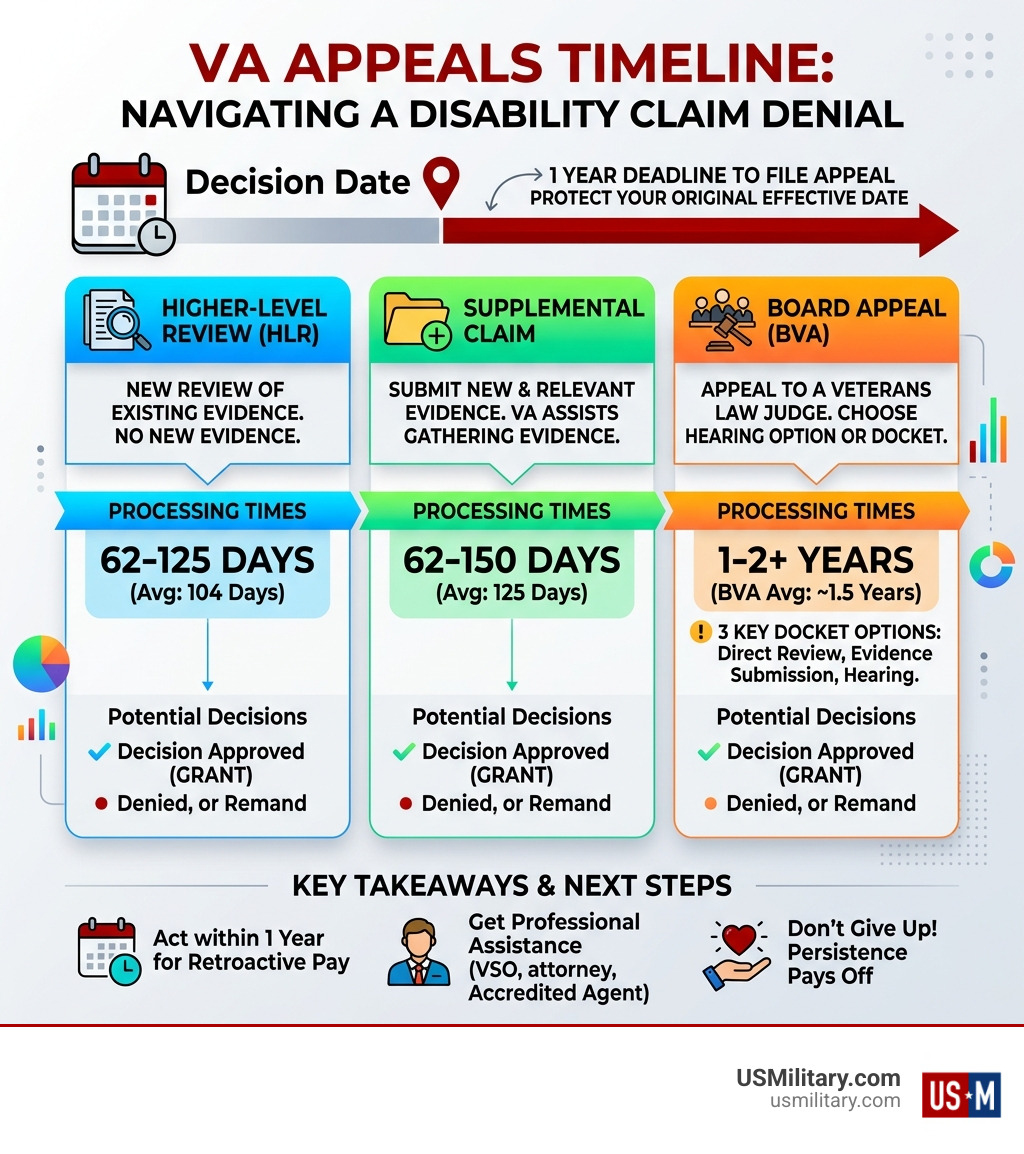
- There are 3 main appeal options: Higher-Level Review, Supplemental Claim, and Board Appeal
- Most denials come down to missing evidence, no service connection, or paperwork errors — all fixable
- Average appeal processing times range from 62 days (Supplemental Claim) to 1-2 years (Board Appeal)
Getting a denial letter after months of waiting is a gut punch. You served your country. You know what that service cost you. And now a government decision is standing between you and the benefits you earned.
The good news? Most denials can be challenged. Over 5.6 million veterans currently receive VA disability compensation — many of them only got there after an initial rejection.
This guide is built for veterans who’ve been denied once, twice, or more. We’ll walk through exactly why denials happen, how to decode your decision letter, and which appeal path gives you the best shot at winning.
I’m Larry Fowler, publisher of USMilitary.com and a long-time advocate for veterans navigating VA benefits — including the frustrating reality of a VA Disability Claim Denial. Since 2007, I’ve tracked VA disability trends and helped connect veterans with the resources they need to fight back. Let’s get into it.
Common Reasons for a VA Disability Claim Denial

When we see a VA Disability Claim Denial, it usually isn’t because the veteran isn’t hurting; it’s because the paperwork didn’t tell the right story. The VA operates on a strict three-pillar system. If one pillar is missing, the whole claim collapses.
No Formal Diagnosis
You might know your back is “messed up,” but the VA needs a specific medical diagnosis from a healthcare professional. Without a current, chronic diagnosis, the VA has nothing to rate. This is one of the Common Reasons Why VA Disability Claims Get Denied because symptoms alone aren’t enough—you need the name of the condition on a medical report.
Lack of Service Connection
The VA must see a clear link between your current condition and an event, injury, or illness that happened while you were in uniform. If the VA can’t find a “nexus” (the bridge between your service and your health), they will deny the claim. Many veterans struggle here, especially if they didn’t go to medical while they were active duty. Understanding Why VA Disability Claims Get Denied often starts with looking at your service treatment records (STRs).
Missing C&P Exams
The Compensation & Pension (C&P) exam is arguably the most important day in your claim process. If you miss this appointment, it’s almost always an automatic denial. Even if you attend, an inadequate exam where the doctor doesn’t fully document your limitations can lead to a rejection.
Paperwork Errors and Insufficient Evidence
Sometimes the “enemy” is just a missed checkbox. Incomplete forms or failing to sign a document can trigger a denial. Furthermore, the VA often denies claims for “insufficient evidence” if they don’t have enough records to determine the severity of your condition. This is also common in specialized claims; for example, you can learn What Are Common Reasons For Aid And Attendance Denial to see how specific benefit types have their own evidentiary hurdles.
Fraud Suspicion
While rare, if the VA notices major inconsistencies—like claiming you can’t walk while social media shows you running a marathon—they may deny the claim based on a suspicion of fraud. Always be honest and describe your “worst days,” but never exaggerate.
Decoding Your Decision Letter and the One-Year Deadline

Your decision letter is more than just a “no”—it is your roadmap to a “yes.” When you receive a VA Disability Claim Denial, you need to look past the first page.
Understanding Rejection Codes and Evidence Gaps
The VA uses specific language and sometimes numeric codes to explain their decision. Look for the “Reasons for Decision” section. It will tell you exactly what was missing. Did they acknowledge the diagnosis but say there was no service connection? Did they say the condition isn’t severe enough to be compensable? Identifying these gaps is the first step in Filing Veterans Disability Claim appeals that actually win.
The One-Year Appeal Window
As of May 2026, the rules remain strict: you have exactly one year from the date on your decision letter to file an appeal. If you miss this deadline, your claim becomes “final.” While you can sometimes reopen it later, you will likely lose your “effective date.”
Protecting Your Retroactive Pay
The effective date is the date the VA starts “counting” your back pay. If you appeal within the one-year window and eventually win, the VA owes you all the monthly payments you missed while waiting. If you’ve been asking My VA Claim Was Denied: What Do I Do Now?, the answer is always: Watch the calendar. Protecting that back pay can result in thousands of dollars in a single lump-sum payment once the appeal is granted.
Navigating the Three AMA Appeal Options
Under the Appeals Modernization Act (AMA), veterans have more control over how their appeal is handled. You aren’t stuck in a single “legacy” line anymore. You can choose the “lane” that fits your specific situation.
| Appeal Lane | Best Used When… | New Evidence Allowed? | Avg. Time (May 2026) |
|---|---|---|---|
| Higher-Level Review | You think the rater made a legal or factual error. | No | 125 Days |
| Supplemental Claim | You have new medical records or buddy statements. | Yes | 62.2 Days |
| Board Appeal | You want a Judge to review the case or need a hearing. | Yes (in specific dockets) | 1-2 Years |
Choosing the right lane is essential for How To Turn Your Va Denial Into A Winning Appeal. Let’s look at each one.
Higher-Level Review for a VA Disability Claim Denial
A Higher-Level Review (HLR) is a “closed-record” review. This means a senior VA adjudicator looks at the exact same evidence the first rater had. You cannot submit anything new. Choose this if you believe the evidence was already there, but the rater simply missed it or applied the law incorrectly.
You can request an Informal Conference, which is a short phone call with the senior reviewer. This is your chance to point out the specific errors. It’s also where many “Duty to Assist” errors are caught—if the senior reviewer sees that the VA failed to gather a record they were supposed to, they will send the claim back to be fixed. For more official details, visit VA Decision Reviews And Appeals.
Supplemental Claims: Adding New and Relevant Evidence
This is the most common path for a VA Disability Claim Denial. If the VA said “no” because you lacked a nexus or a diagnosis, you use a Supplemental Claim to give them that missing piece. You must submit “new and relevant” evidence.
As of March 2026, these are moving faster than ever, with an average turnaround of about 62 days. This is also the lane you use for PACT Act claims if you were previously denied for a condition that is now considered “presumptive” due to toxic exposure. You can Give Your Claim New Life With Form 20 0995 by submitting the proper documentation.
Board Appeals: Taking Your VA Disability Claim Denial to a Judge
If the first two lanes don’t work, you head to the Board of Veterans’ Appeals (BVA) in Washington, D.C. Here, a Veterans Law Judge reviews your case. You have three choices at the Board:
- Direct Review: The Judge looks at the evidence already in your file.
- Evidence Submission: You have 90 days to mail in new evidence.
- Hearing: You speak directly to the Judge (usually via video).
While this is the most thorough review, it is also the slowest, often taking a year or more to reach a decision.
Strengthening Your Case with Nexus Letters and Evidence
To beat a VA Disability Claim Denial, your evidence needs to be “bulletproof.” The VA doesn’t just want to see that you’re in pain; they want to see the clinical “why” and “how.”
The Power of the Medical Nexus Letter
A nexus letter is a document from a medical professional that explicitly links your disability to your service. To be effective, the doctor should use the phrase “at least as likely as not” (meaning there is at least a 50% chance) that the condition was caused or aggravated by your military service. If you are trying to figure out How To Increase Va Disability Rating 2, a strong nexus letter is often the missing link.
Buddy Statements and Personal Statements
Don’t underestimate the power of “lay evidence.” A Buddy Statement (VA Form 21-10210) from someone you served with can confirm an event happened if it isn’t in your official records. Similarly, a personal statement allows you to explain your symptoms in plain English. For those trying to figure out How To Increase Va Disability From 80 To 100, documenting functional limitations—like how many minutes you can stand before needing to sit—is vital.
Functional Limitations and DBQs
The VA rates you based on how much your disability interferes with your ability to work and live. Using a Disability Benefits Questionnaire (DBQ) can help your private doctor record your symptoms in the exact format the VA raters use.
Professional Assistance: VSOs vs. Accredited Attorneys
You don’t have to fight a VA Disability Claim Denial alone. There are two main types of help available.
Veterans Service Organizations (VSOs)
VSOs like the American Legion, VFW, or DAV provide free assistance. They are great for straightforward claims and initial filings. However, because they are often overwhelmed with high caseloads, they may not have the time to dive deep into complex legal appeals.
Accredited Attorneys and Claims Agents
If your case is complex or has been denied multiple times, you might consider a Va Disability Attorney. These professionals are accredited by the VA and usually work on a contingency fee basis. This means they only get paid if you win, typically taking a percentage (often 20%) of your retroactive back pay.
When looking for the Best Disability Va Claims Lawyers, ensure they have experience specifically with the BVA. You can also check out 10 Hot Tips Finding Expert Help Increasing Va Disabilty Rating or search for Veteran Disability Lawyers Near Me to find local representation.
Frequently Asked Questions about VA Denials
Can I refile a denied claim more than once?
Yes. Under the AMA, you can keep a claim alive indefinitely through “continuous pursuit.” As long as you file a new appeal (like a Supplemental Claim with new evidence) within one year of each denial, you keep your original effective date. There is no limit to how many times you can appeal, provided you have new and relevant information to share.
How do I check the status of my appeal?
The easiest way is to use the Check Your VA Claim Status tool on the official VA website. You’ll need to log in with your ID.me or DS Logon. The portal will show you which “lane” your claim is in and whether the VA is currently gathering evidence or making a final decision.
What happens if I miss the one-year appeal deadline?
If you miss the deadline, you generally lose the ability to get back pay to your original filing date. You will have to file a new Supplemental Claim with “new and relevant” evidence to reopen the issue. Your new effective date will likely be the date you filed the new claim, not the original one.
Conclusion
A VA Disability Claim Denial is a setback, but it is not a defeat. The system is designed to be rigorous, and unfortunately, that means many valid claims are initially rejected. Whether it’s a missing nexus letter, a botched C&P exam, or a simple paperwork error, these obstacles can be overcome with persistence and the right strategy.
At USMilitary.com, we believe every veteran deserves the benefits they were promised when they took the oath. Don’t let a “no” from a rater be the final word on your health and your future. Use the tools available, gather your evidence, and keep fighting. For more help identifying common pitfalls, read our guide on Common Reasons for Veterans Disability Claim Denials and take the next step toward the rating you’ve earned.