
Why the Military Branch You Choose Directly Shapes Your Financial Future

Which military branch offers the best training for long-term financial rewards is one of the most important questions you can ask before signing an enlistment contract — and the answer is more nuanced than most recruiters will tell you.
Here’s the short answer:
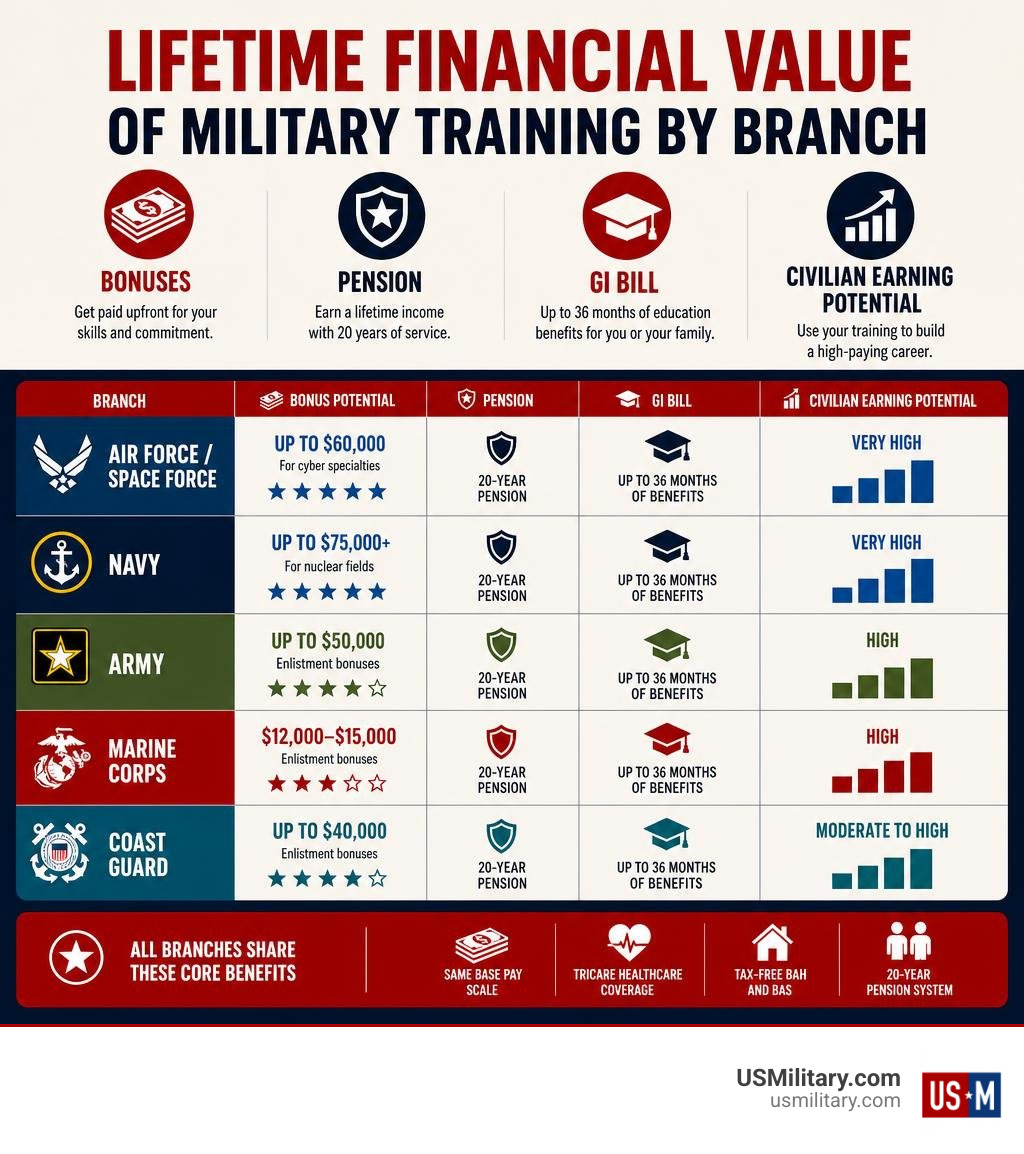
| Branch | Best For | Top Financial Advantage |
|---|---|---|
| Air Force / Space Force | Tech, cyber, aviation | Highest total compensation for skilled roles; up to $60,000 reenlistment bonus for cyber |
| Navy | Nuclear, engineering | Up to $75,000+ nuclear field bonuses; strong civilian earning potential |
| Army | Leadership, fast promotion | Largest enlistment bonuses up to $50,000; fastest promotion timelines |
| Marine Corps | Leadership, discipline | Smaller bonuses (~$12,000–$15,000) but strong civilian leadership value |
| Coast Guard | Maritime, law enforcement | Up to $40,000 enlistment bonus; niche but highly transferable skills |
No single branch wins across every category. The right answer depends on your goals — whether you want the biggest signing bonus, the fastest promotion, the most transferable skills, or the strongest post-service career.
What is clear from the research: your job specialty matters more than your branch. A Navy nuclear technician, an Air Force cyber warfare operator, and an Army Special Forces soldier will all out-earn peers in standard roles — regardless of branch.
A few things all branches share equally:
- The same base pay scale, set by Congress
- Access to the Post-9/11 GI Bill (up to 36 months of education benefits)
- TRICARE healthcare and the 20-year pension system
- Tax-free BAH and BAS allowances
The real differences show up in bonuses, specialized training quality, promotion speed, and how well your military skills translate to a civilian paycheck after service.
I’m Larry Fowler, publisher of USMilitary.com — I’ve spent nearly two decades helping active-duty members and veterans navigate exactly this kind of question, including which military branch offers the best training for long-term financial rewards across every career stage. In the sections below, I’ll break down every major financial factor — bonuses, education benefits, retirement, and post-service earnings — branch by branch, so you can make the most informed decision possible.
Which Military Branch Offers The Best Training For Long Term Financial Rewards terms to learn:
- Top 10 Military Jobs That Pay Six Figures In Civilian Life
- New Military Pay Chart For Enlisted and Officers 2026
- active duty military benefits
Which Military Branch Offers The Best Training For Long Term Financial Rewards?
To accurately assess which military branch offers the best training for long-term financial rewards, we must look beyond basic enlistment bonuses. We have to examine how each branch’s specialized technical training translates into a civilian career. While basic pay is standardized across all branches based on rank and years of service, the ultimate return on investment (ROI) is determined by the civilian market value of the skills you acquire.
When evaluating your options, it is helpful to contrast the immediate benefits of enlisting with alternative routes. For instance, comparing a Degree vs Military: Which Path Offers Better ROI? (Guide 2026) highlights how the military’s zero-debt path provides a robust “wealth-building floor” by your mid-20s.
To help you decide, we can review the comprehensive breakdown in Which Military Branch Has the Best Benefits? [2026 Updated Version] alongside our own analysis of Which Military Branch Has the Best Benefits. Deciding if Is Joining the Military Worth It Financially? (2026 Complete Analysis) | Wealthvieu comes down to how effectively you align your branch selection with a high-demand career track.
Let’s explore the specific branches to see how they stack up.
Air Force and Space Force: High-Tech Training and Cyber Dominance
If your goal is to transition directly from military service into a high-paying civilian tech or aerospace career, the Air Force and Space Force are the clear front-runners. These branches prioritize intellectual and technical capabilities, offering world-class training in cyber warfare, artificial intelligence, systems engineering, and aerospace operations.
The Air Force and Space Force are built around specialized, high-tech roles. For example, Air Force Cyber Warfare Operations (1B4X1) personnel receive training that mirrors elite corporate cybersecurity programs. This background makes them prime targets for defense contractors and tech giants. In fact, many of these roles easily cross over into the fields highlighted in our guide to the Top 10 Military Jobs That Pay Six Figures.
Beyond standard training, these tech-centric branches offer unique developmental pipelines. The Air Force Technical Degree Sponsorship Program is a prime example: it pays participants active-duty E-3 wages while they study engineering or computer science at an accredited university, guaranteeing them an officer commission upon graduation.
With the Space Force managing advanced satellite communications and orbital defense networks, its members gain highly specialized credentials that are virtually impossible to obtain in the civilian sector without a security clearance.
Navy and Coast Guard: Nuclear Power and Maritime Engineering
For those drawn to engineering, mechanics, or advanced maritime technology, the Navy and Coast Guard offer unparalleled technical training. The Navy, in particular, operates some of the most complex nuclear propulsion systems in the world, which translates directly to massive civilian earnings.
The Navy Nuclear Power Program is widely regarded as one of the most academically rigorous training pipelines in the entire U.S. military. Nuclear-trained sailors learn reactor operations, thermodynamics, and electrical engineering. This specialized education makes them highly sought after by commercial nuclear power plants, municipal utility companies, and advanced manufacturing firms. This career trajectory is frequently featured in our resource on the Best Military Careers That Pay Big in Civilian Life.
To recruit and retain this elite talent, the Navy offers programs like the Nuclear Propulsion Officer Candidate (NUPOC) pathway. This program provides substantial monthly salaries and signing bonuses to college students pursuing engineering degrees, requiring zero military drills until graduation.
Meanwhile, the Coast Guard operates under the Department of Homeland Security rather than the Department of Defense. It offers specialized training in marine engineering, environmental protection, and maritime law enforcement. Because Coast Guard operations are highly active on a daily basis, members gain practical, hands-on experience in vessel mechanics and search-and-rescue operations that translate smoothly into commercial maritime careers.
Army and Marine Corps: Leadership, Logistics, and Rapid Promotion Timelines
While the Air Force and Navy are celebrated for technical and nuclear training, the Army and Marine Corps excel at producing elite leaders, logistics experts, and project managers. Furthermore, because of their massive organizational footprints, these branches offer some of the fastest promotion timelines in the military.
The Army is the largest military branch, which means it has a constant need for leadership at every level. A young soldier can quickly rise to the rank of Sergeant (E-5) or Staff Sergeant (E-6), taking charge of multi-million dollar equipment inventories and leading teams of soldiers. This real-world management experience is highly valued in corporate America.
For those looking to transition, our guide on 10 High-Paying Civilian Jobs with Military Training outlines how combat leadership, tactical communications, and supply chain logistics translate directly to lucrative roles in operations management, corporate security, and emergency services.
In addition, the Army is a powerhouse for logistics training. Managing the movement of thousands of troops, vehicles, and supplies across the globe is a highly complex logistical puzzle. Army automated logistical specialists and transportation officers routinely transition into executive logistics roles at major global shipping and supply chain corporations.
The Marine Corps, while offering fewer enlistment bonuses, builds a world-renowned brand of discipline, grit, and executive leadership that commands immense respect from corporate recruiters.
Comparing Enlistment Bonuses, Retention Incentives, and Special Pays

When calculating the immediate financial return of military service, you must look at how enlistment bonuses, retention incentives, and special pays stack up across the branches. Signing bonuses are essentially the military’s way of filling critical, hard-to-staff roles, and they can vary significantly by branch.
To understand how these programs operate, it is helpful to consult Which Military Branch Has the Best Benefits? and review the options. The table below outlines the maximum enlistment bonuses and key special pays available as of July 2026:
| Branch | Max Enlistment Bonus | High-Demand Special Pays | Key Retention Incentives |
|---|---|---|---|
| U.S. Army | Up to $50,000 | Jump Pay, Demolition Pay, Language Proficiency | Up to $80,000+ Selective Reenlistment Bonuses (SRB) |
| U.S. Navy | Up to $140,000 (combined programs) | Nuclear Duty Pay, Sea Duty Pay, Flight Deck Pay | Up to $38,000/year Nuclear Retention Bonuses |
| U.S. Air Force | Up to $40,000 | Flight Pay, Hazard Pay, Special Warfare Pay | Up to $35,000/year Aviation Retention Bonuses |
| U.S. Space Force | Up to $20,000 | Cyber Special Duty Pay, Space Operations Pay | Target-specific critical skill retention bonuses |
| U.S. Coast Guard | Up to $75,000 | Sea Pay, Diving Pay, Flight Pay | Performance-based maritime specialty incentives |
| U.S. Marine Corps | Up to $15,000 | Combat Incentives, Reconnaissance Pay | Selective skill reenlistment bonuses up to $40,000 |
High-Value MOS and Rating Bonuses
The largest financial payouts are reserved for individuals who enter highly technical or physically demanding career fields. The Navy Nuclear Field currently leads the pack, offering up to $75,000 specifically for nuclear ratings like Electrician’s Mate Nuclear or Machinist’s Mate Nuclear. When combined with shipping and educational incentives, a Navy recruit can see a total starting bonus package value of up to $140,000.
The Army also runs an aggressive bonus program to secure top-tier talent. Recruits enlisting in high-demand fields like Cyber Operations Specialist (17C) or Special Forces Candidate (18X) can qualify for the maximum $50,000 enlistment bonus. Additionally, the Army offers “Quick-Ship” bonuses of $10,000 to $15,000 for recruits who agree to report to basic training within 30 days to fill sudden training vacancies.
For those who stay in the service long-term, retention bonuses (often called Selective Reenlistment Bonuses, or SRBs) provide even larger financial rewards. In the Air Force, cyber warfare specialists and pilots can secure annual retention bonuses reaching $35,000 to $60,000 per year, depending on their career track and contract length.
These special pays stack directly on top of your base salary, allowing technical specialists to build substantial savings during their active-duty careers.
Maximizing Long-Term Financial Rewards Through Education Benefits
One of the most effective ways to leverage military service for long-term financial rewards is through education benefits. By obtaining a debt-free degree, you dramatically increase your post-service earning potential.
As detailed in the Benefits of Joining the Military, these programs allow you to bypass student loan debt entirely, giving you a massive head start over civilian peers.
Unique Branch Education Programs and Degree Sponsorships
While the Post-9/11 GI Bill is standardized across all branches, several services offer unique, branch-specific programs that provide incredible financial value:
- The Army Funded Legal Education Program (FLEP): Each year, the Army selects up to 25 active-duty officers to attend law school at the Army’s expense. While in law school, participants continue to receive their full active-duty pay and allowances. Upon graduation, they are guaranteed a position in the JAG Corps, transitioning into a prestigious legal career with zero law school debt.
- The Navy College Program for Afloat College Education (NCPACE): This program allows sailors deployed aboard ships to take college courses with up to 100% tuition coverage (capped at $4,500 per year). This enables sailors to earn their degrees while actively serving at sea.
- The Coast Guard College Student Pre-Commissioning Initiative (CSPI): This program is designed for college sophomores or juniors attending minority-serving institutions. If accepted, the Coast Guard pays for your tuition, fees, and books, while also paying you an active-duty salary (E-3 pay grade) to complete your degree before attending Officer Candidate School.
- The Community College of the Air Force (CCAF): The Air Force is the only branch that operates its own fully accredited community college. Enlisted airmen automatically earn college credits for their basic training and technical school instruction, allowing many to complete an Associate in Applied Science degree before their first enlistment contract is even up.
The 20-Year Pension and Blended Retirement System (BRS)

For those who choose to make the military a long-term career, the retirement benefits are among the most lucrative in the world. If you serve 20 years of active duty, you can retire as early as age 38 (if you joined at 18) and collect an immediate, lifetime pension.
However, before committing to a two-decade journey, it is critical to understand the trade-offs. As analyzed in Join the Military at 18. Retire at 38. Collect a Pension for Life. Sounds Perfect: Here’s What Nobody Tells You – 19FortyFive , a 20-year career requires significant lifestyle sacrifices, including frequent deployments, relocation every few years, and demanding physical stress.
For those who enter the service today, retirement is structured under the Blended Retirement System (BRS):
- The Pension: After 20 years of service, you receive a lifetime monthly pension calculated as 2.0% of your highest 36 months of basic pay, multiplied by your years of service. For example, retiring as an E-7 after 20 years yields a pension worth approximately $2,200 to $2,600 per month, while an O-4 retirement yields $3,200 to $4,000 per month immediately upon separation.
- The Thrift Savings Plan (TSP) Match: Under the BRS, the government automatically contributes 1% of your basic pay to your TSP (the military’s equivalent of a 401k) and will match your personal contributions up to an additional 4%. This ensures that even if you choose to separate after a single 4-year tour, you leave with a portable, government-funded retirement nest egg.
- TRICARE for Life: Retired service members and their families gain access to lifetime, low-cost health insurance. In a civilian market where healthcare costs can easily exceed $500 per month, this benefit alone represents hundreds of thousands of dollars in lifetime savings.
Frequently Asked Questions About Military Training and Financial Rewards
Choosing a branch and a career specialty is a highly personal decision. To help you navigate the process, we have compiled answers to some of the most common questions regarding military training and financial returns.
Which Military Branch Offers The Best Training For Long Term Financial Rewards in cybersecurity?
The Air Force and Space Force offer the absolute best training and certification pipelines for cybersecurity. Air Force Cyber Warfare Operations (1B4X1) and Space Force Cyber Operations Specialists receive intensive, highly technical instruction that qualifies them for top-tier civilian certifications (such as CISSP, Security+, and Certified Ethical Hacker).
Additionally, these branches sponsor top-secret security clearances. When you combine elite cyber training, industry-recognized certifications, and a security clearance, you are highly positioned for six-figure civilian roles at defense contractors, financial institutions, and major tech firms immediately upon separation.
Which Military Branch Offers The Best Training For Long Term Financial Rewards for pilots?
The Air Force is the premier branch for aviation training, offering the most direct path to a commercial airline career. Air Force pilots gain thousands of flight hours on advanced multi-engine aircraft, cargo planes, and tankers.
To combat pilot shortages, the Air Force offers massive aviation retention bonuses of up to $35,000 per year for pilots who extend their service contracts. Once you transition to the civilian sector, major commercial airlines actively recruit former military pilots, with starting first officer salaries routinely exceeding $115,000 to $150,000 per year.
How do tax-free allowances like BAH and BAS affect lifetime earnings?
Tax-free allowances like the Basic Allowance for Housing (BAH) and Basic Allowance for Subsistence (BAS) dramatically boost your real-world take-home pay. Because these allowances are not subject to federal or state income taxes, they effectively stretch your dollar much further than an equivalent civilian salary.
For example, an E-5 with six years of service might have a modest basic pay of around $37,000 per year. However, when you add tax-free BAH (which scales based on your zip code’s cost of living) and BAS, your total compensation package is often equivalent to a civilian salary of $80,000 to $98,000. This tax advantage allows service members to save and invest a much higher percentage of their earnings.
Conclusion
Determining which military branch offers the best training for long-term financial rewards ultimately depends on your personal career interests and long-term financial goals. If you want high-tech cyber or aerospace training, the Air Force and Space Force are your best options. If you want nuclear engineering and maritime technical skills, the Navy is the clear winner. For leadership, logistics, and rapid promotion timelines, the Army and Marine Corps offer incredible value.
At USMilitary.com, we are dedicated to helping you make the most informed decision possible. Before you sign any contract, we highly recommend that you research your options, speak with recruiters from multiple branches, and compare specific job specialties.
To take the next step in planning your financial and professional future, we invite you to Explore Military Benefits and Career Paths or visit our homepage at USMilitary.com to connect with a military advisor today. If you are looking for further inspiration on leadership, discipline, and personal growth, consider reading Dare to Live Greatly to help guide your journey.