
How Countries Around the World Stack Up by Military Size
When comparing military size by country, a few numbers stand out immediately. China fields the largest active-duty force on Earth, while North Korea tops the charts when you count every soldier, reservist, and paramilitary member combined.
Here’s a quick snapshot of the top 10 countries by active military personnel in 2026:
| Rank | Country | Active Personnel |
|---|---|---|
| 1 | China | 2,035,000 |
| 2 | India | 1,475,750 |
| 3 | United States | 1,326,050 |
| 4 | North Korea | 1,280,000 |
| 5 | Russia | 1,264,000 |
| 6 | Ukraine | 900,000 |
| 7 | Pakistan | 660,000 |
| 8 | Iran | 610,000 |
| 9 | Ethiopia | 503,000 |
| 10 | South Korea | 450,000 |
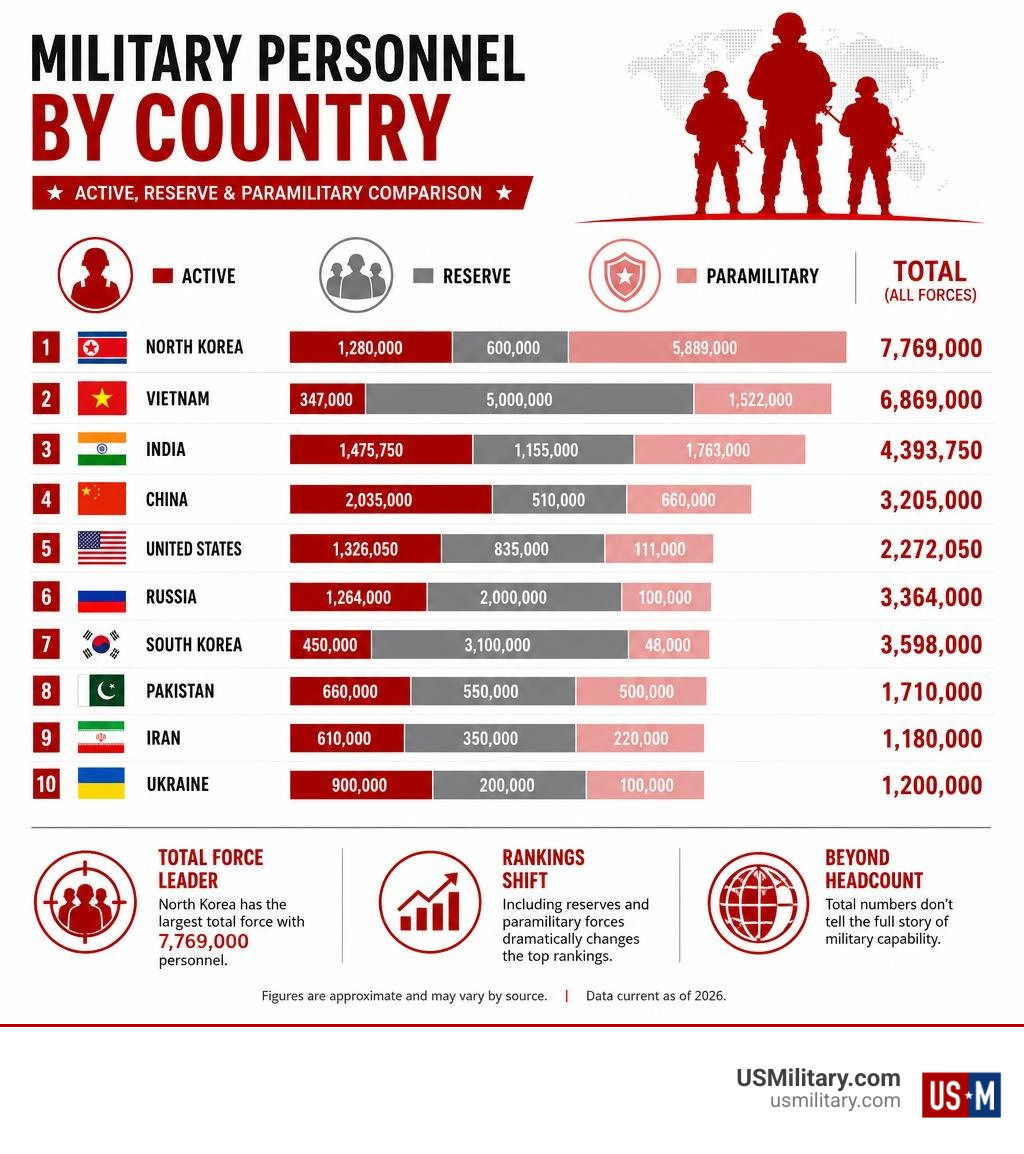
But active-duty numbers only tell part of the story. When reserves and paramilitary forces are added, rankings shift dramatically. North Korea jumps to 7,769,000 total personnel — the largest combined force in the world. Vietnam, India, and South Korea also climb sharply in total force size.
These numbers matter whether you’re thinking about enlistment, understanding global threats, or just trying to make sense of how the U.S. military fits into the bigger picture.
I’m Larry Fowler, publisher of USArmy.com & USMilitary.com since 2007, and a long-time researcher of how global force structures affect American service members and veterans. Tracking military size by country has been central to helping our readers understand where U.S. forces stand and what that means for career and service decisions. In the sections below, we’ll break down the full rankings, explain what the numbers actually mean, and look at which factors — beyond headcount — truly determine military power.
Global Military Size by Country: Active vs. Total Forces
When we look at the raw headcount of global armed forces, it is easy to get overwhelmed by the millions of uniforms. However, comparing the military size of one nation to another requires us to look past a single, flat number. If we only count “active-duty” troops, the global leaderboard looks very different than if we include those who can be called up in a crisis.
This difference between immediate readiness and potential mobilization is why we categorize military personnel into distinct buckets. To truly understand how global forces are distributed, we must analyze the specific roles these personnel play. You can explore the complete, ready-to-fight standings in the Active Military Personnel by Country 2026 database to see how these active forces stack up.
Defining Active, Reserve, and Paramilitary Personnel
To make sense of global rankings, we first need to define the three main categories of personnel that make up a nation’s total military footprint:
- Active-Duty Personnel: These are your full-time, professional service members. They are the standing force on permanent duty, ready to deploy at a moment’s notice without requiring extra mobilization. They live and breathe military life daily.
- Reserve Forces: These are part-time military personnel. They maintain civilian jobs but train regularly to keep their skills sharp. In times of conflict or national emergency, they are “activated” to reinforce the active standing army. In the United States, this includes our National Guard and Reserve branches.
- Paramilitary Forces: These are armed government organizations that are not part of the formal military but have training, equipment, or structures similar to them. They can include border guards, national police forces, or internal security units that can be integrated into military operations during war.
Understanding these distinctions is crucial because some nations rely heavily on part-time citizens or internal security forces to artificially inflate their total numbers. For a complete breakdown of how these forces are categorized internationally, the List of countries by number of military and paramilitary personnel provides an excellent, sortable reference.
The Top Standing Armies in 2026
When we look at the actual data for June 2026, the contrast between active-duty standing forces and total mobilized forces is stark. Some countries maintain massive standing armies, while others build giant reserve pools that can be activated in hours.
The table below highlights this contrast across the world’s most prominent military powers, illustrating how rankings shift depending on what you measure:
| Country | Active-Duty Personnel | Reserve Personnel | Paramilitary Personnel | Total Military Force |
|---|---|---|---|---|
| North Korea | 1,280,000 | 600,000 | 5,889,000 | 7,769,000 |
| Vietnam | 450,000 | 5,040,000 | — | 5,490,000 |
| India | 1,475,750 | 1,155,000 | 2,557,050 | 5,187,800 |
| South Korea | 450,000 | 3,100,000 | 13,500 | 3,563,500 |
| Russia | 1,264,000 | 1,500,000 | 559,000 | 3,323,000 |
| China | 2,035,000 | 510,000 | 500,000 | 3,045,000 |
| United States | 1,326,050 | 797,200 | — | 2,123,250 |
As you can see, China maintains the world’s largest standing active military with over 2 million professional soldiers. However, when you factor in reserves and massive paramilitary forces, North Korea and India leap forward.
If you are wondering how our own domestic force numbers compare historically and where we stand today, check out our detailed look at How Big Is The US Military Today And 2024 to see how the Pentagon balances active and reserve components. You can also read our deep-dive analysis on How Big Is The US Military 2 to understand the structural layout of our branches.
Beyond the Numbers: Personnel Count vs. Actual Military Power
There is an old saying in military strategy: “Quantity has a quality all its own.” While that might have been true during the industrial-scale trench warfare of the 20th century, modern battles are decided by technology, logistics, training, and command structure. Raw headcount is no longer the ultimate metric of a nation’s defense capability.
If troop size were the only thing that mattered, North Korea would rule the global stage, and the United States would be a distant runner-up. Yet, when experts rank global power, the U.S. consistently sits at the top. To understand why, we have to look at the massive gap between size and actual combat effectiveness. For a broader perspective on how global power is assessed, read our guide on Who Has The Best Military In The World.
Why Military Size by Country Does Not Equal Combat Power
A country can put five million soldiers in uniform, but if those soldiers are armed with outdated weapons, lack fuel for their trucks, and have no air support, they are highly vulnerable to a smaller, more advanced force.
True military power is built on several pillars:
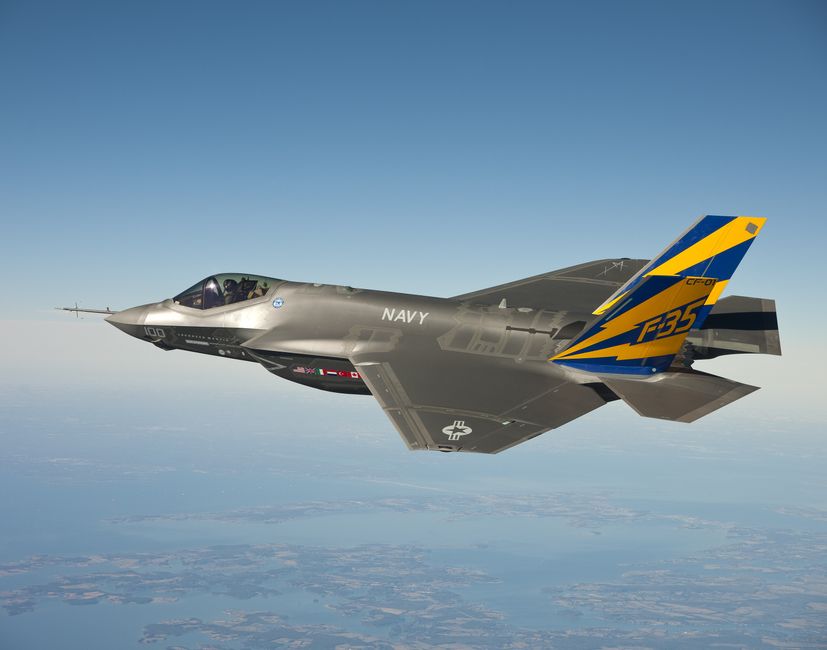
- Air and Naval Superiority: The ability to control the skies and the seas allows a military to strike anywhere on earth. The United States operates 14,486 military aircraft, compared to Russia’s 4,211 and China’s 3,304. Furthermore, the U.S. Navy operates 11 full-sized nuclear aircraft carriers and 8 helicopter carriers, giving us unmatched global force projection.
- Defense Spending and Budget: Technology is expensive. The U.S. defense budget exceeds $750 billion annually—more than the next several nations combined. This funding goes directly into cutting-edge research, stealth technology, precision-guided munitions, and superior protective gear for our troops.
- Training and Professionalism: Well-trained, volunteer soldiers who are empowered to make decisions on the battlefield consistently outperform poorly trained conscripts who rely on rigid, top-down command structures.
To understand how the U.S. translates this massive financial and technological investment into actual battlefield dominance, take a look at our analysis of How Strong Is The US Military 2. It is a reminder of why the US Military Must Be Strong to maintain global stability, even when critics occasionally argue that the US Military Rated Weak in specific regional readiness metrics.
The Tooth-to-Tail Ratio in Modern Warfare
To truly understand why a massive army might actually be weak, you need to understand a concept called the Tooth-to-Tail Ratio (T3R).
- The “Tooth” represents the actual combat forces—the infantry, fighter pilots, and tank crews who engage the enemy directly.
- The “Tail” represents the support personnel—logistics officers, mechanics, medical staff, IT specialists, cooks, and supply chain managers who keep the combat forces running.
For a typical country, the proportion of actual combat forces is about 26% of total military personnel. However, the United States Armed Forces has a tooth-to-tail ratio of just 17%. This means that for every single combat unit on the front lines, there are approximately five support units backing them up.
While a 17% “tooth” might sound low, it is actually the secret to American military success. Our massive “tail” ensures that our frontline soldiers never run out of ammunition, always have satellite communication, receive world-class medical evacuation within minutes, and operate highly maintained equipment. Contrast this with armies that have a high “tooth” but no “tail”—they look terrifying on paper, but they quickly stall out on the battlefield due to fuel shortages and broken equipment. You can read more about how our support structures are organized on the United States Armed Forces – Wikipedia page.
Geopolitical Drivers and Conscription Models
Why does one country maintain millions of soldiers while another survives with a tiny volunteer force? The answer lies in geography, history, and regional security threats.
A country’s military size is rarely an accident; it is a direct response to its geopolitical neighborhood. Nations surrounded by friendly neighbors and protected by vast oceans (like the United States) can afford to maintain a highly professional, all-volunteer force. Nations sharing borders with hostile neighbors often have no choice but to force their entire population into uniform. To explore how these regional dynamics impact global rankings, check out the Military Size by Country 2026 report.
How Conscription and Reserves Shape Military Size by Country
Conscription—or mandatory military service—is the fastest way for a country to build a massive military footprint. It completely changes the math of military size by country.
Several notable models exist around the world today:
- South Korea & Israel: Both nations face existential threats from immediate neighbors. South Korea maintains a massive reserve pool of over 3.1 million people because Seoul sits within range of North Korean artillery. Israel’s universal conscription model allows it to expand its active force of 169,500 to a fully mobilized combat force of 642,500 within just 48 hours.
- Eritrea: This East African nation uses an indefinite conscription model, meaning citizens can be forced to serve in the military or state-run projects for decades, resulting in a very high active-duty ratio per capita.
- Finland & Switzerland: These European nations use short-service conscription models to train their entire civilian population, creating massive citizen-soldier reserve forces that can defend their homeland at a moment’s notice.
By contrast, the United States relies entirely on volunteers, balancing this with a highly trained, voluntary Reserve and National Guard system. To see how our volunteer system compares to global mandatory models, read our analysis on How Large US Military forces are, and discover how we maintain our global presence in How Massive Is The US Military Size Revealed.
Nations Without a Standing Military
On the opposite end of the spectrum, there are several sovereign nations that maintain absolutely no standing military forces.
The most famous example is Costa Rica, which constitutionally abolished its military in 1948. Instead of funding tanks and fighter jets, the government redirected those resources toward healthcare, education, and environmental protection.
Other nations with no standing armies include:
- Iceland: While a founding member of NATO, Iceland has no standing army, relying instead on its militarized Coast Guard, national police, and defense treaties with NATO allies for security.
- Panama & Mauritius: These nations do not have formal armies but maintain heavily armed paramilitary police units capable of handling internal security and border defense.
These countries prove that under the right geopolitical conditions—usually backed by strong international defense treaties and protective alliances—it is possible to maintain national sovereignty without spending a single dime on a standing army.
Frequently Asked Questions About Global Military Sizes
Which country has the largest total military force in the world?
North Korea has the largest total military force in the world with approximately 7,769,000 total personnel (combining active-duty, reserves, and paramilitary forces). This massive number is driven by their Songun (“military-first”) doctrine and mandatory conscription. North Korea also holds the world record for military density, with 294.2 military personnel per 1,000 citizens—meaning nearly one in four North Koreans is counted in their total military structure.
How big is the United States military compared to other nations?
The United States maintains the third-largest active-duty military in the world with 1,326,050 active personnel, trailing only China and India. However, when it comes to global reach, technology, and combat power, the U.S. is the undisputed leader. Our military operates globally with hundreds of bases worldwide and a naval fleet that is unmatched in size and capability. You can read a complete breakdown of our domestic numbers in How Massive Is The US Military Size Revealed.
What is the global distribution of military personnel?
There are approximately 20,522,090 active-duty military personnel across 178 countries globally. This distribution is highly concentrated: the top five countries (China, India, the United States, North Korea, and Russia) account for nearly half of the world’s total active military forces. You can view the historical and regional tracking of these global personnel trends through the World Development Indicators database provided by the World Bank.
Conclusion
Sizing up the world’s armies shows us that military size by country is about much more than just counting helmets. While nations like China and North Korea field staggering numbers of personnel, the United States balances its headcount with unmatched technological innovation, unparalleled logistics, and a highly professional volunteer force.
At USMilitary.com, we are dedicated to supporting our active-duty service members, National Guard, Reserves, and veterans. Whether you are looking for guidance on VA home loans, exploring retirement benefits, or trying to understand your career options across different service branches, we serve as your central hub for reliable military information.
Ready to explore your options or learn more about how our military branches are structured? Check out our Complete Guide to Branches of the Military to find the path that is right for you, or visit our homepage at USMilitary.com for the latest news and veteran resources. If you are looking for personal inspiration on your military journey, consider reading Dare to Live Greatly, a powerful resource for building strength and resilience in service and life.