

Who Would Win In A Fist Fight: Army Green Beret, Ranger, or Delta Force Operator is one of the most debated questions in military circles — and for good reason. All three are among the most physically and mentally elite warriors on the planet.
Quick Answer:
| Rank | Unit | Edge In A Fist Fight |
|---|---|---|
| 1 | Delta Force Operator | Most selective screening, highest experience level, drawn from the best Rangers and Green Berets |
| 2 | Army Ranger | Explosive aggression, peak physical conditioning, relentless direct-action tempo |
| 3 | Army Green Beret | Versatile, mentally tough, but mission focus leans more toward strategy than brute force |
In a pure one-on-one fist fight, the edge goes to the Delta Force operator — but only by a razor-thin margin. These are all world-class fighters, and individual factors like size, age, and training background matter enormously.
Delta Force draws roughly 70% of its operators from the Ranger Regiment and Special Forces. It then puts them through a selection process where only 8 out of 120 candidates finish. That is a level of filtering that is simply unmatched.
But this is far from a simple answer. The details matter a lot.
I’m Larry Fowler, publisher of USMilitary.com and a longtime military media professional with deep knowledge of how elite Army units train and operate — including what it takes to answer who would win in a fist fight: Army Green Beret, Ranger, or Delta Force Operator. Let’s break it all down so you can understand exactly where each unit stands.
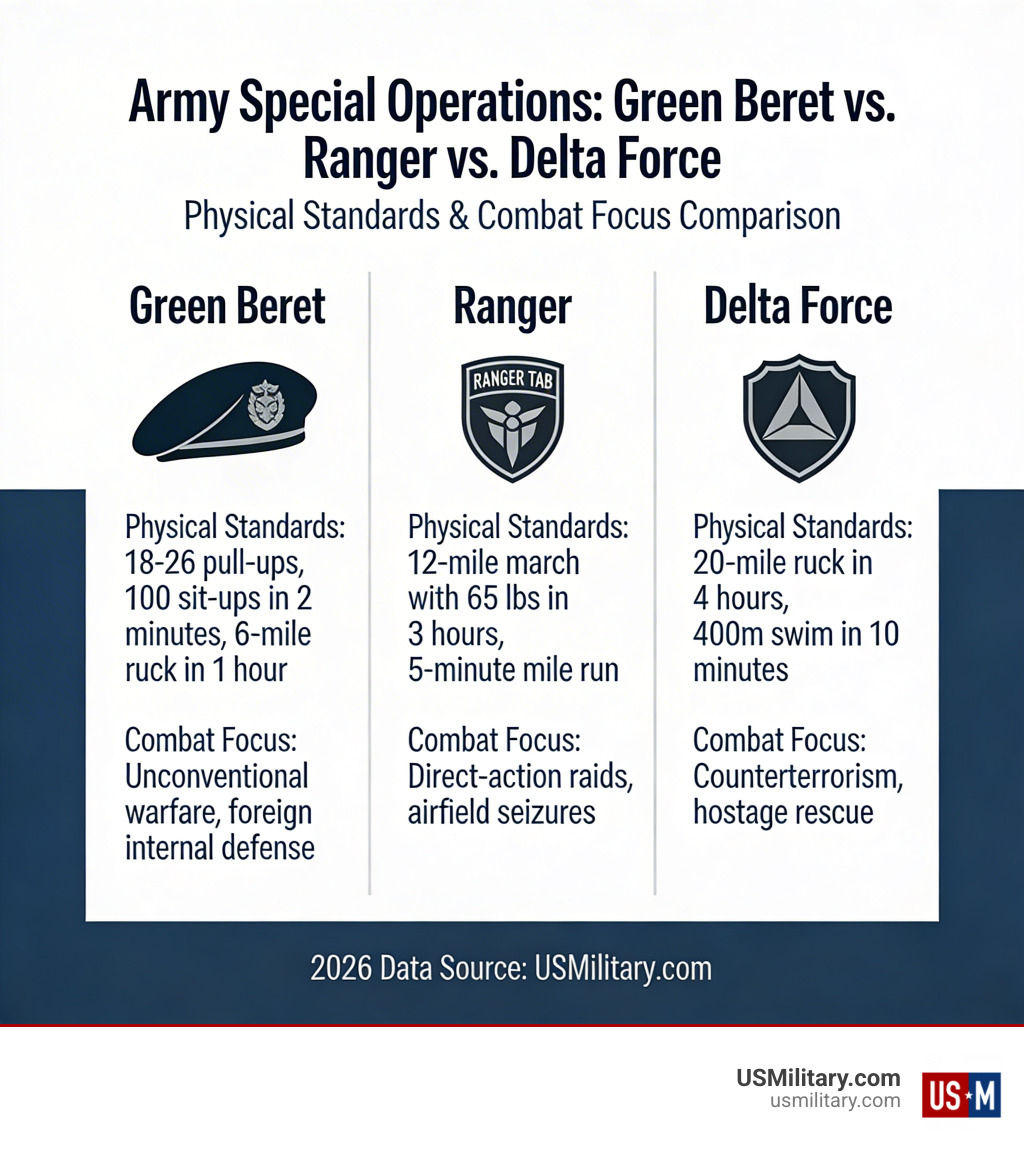
Who Would Win In A Fist Fight: Army Green Beret, Ranger, or Delta Force Operator vocab to learn:
Defining the Contenders: Roles and Missions
To understand who would win in a fist fight: Army Green Beret, Ranger, or Delta Force Operator, we first have to look at what these men are trained to do every day. Their missions shape their bodies and their fighting styles.
The Army Ranger: The Sledgehammer
The 75th Ranger Regiment is the Army’s premier light infantry raid force. We often call them the “Sledgehammer” because they excel at direct action. Their mission is to strike hard and fast. Whether it’s an airfield seizure or a high-intensity raid, Rangers are trained for maximum aggression. This “tip of the spear” mentality means a Ranger is always leaning forward, ready for a physical confrontation. You can learn more about their specific path in our breakdown of the army-ranger-green-beret relationship.
The Green Beret: The Scalpel
Army Special Forces, or Green Berets, are the “Scalpels.” Their primary mission is unconventional warfare and Foreign Internal Defense (FID). They are trained to go behind enemy lines, live with indigenous forces, and train them to fight. While a Ranger might kick the door down, a Green Beret has already spent six months befriending the guy who lives next door to the target. They are incredibly versatile and mentally tough, but their training emphasizes “force multiplication” over pure individual brute force.
Delta Force: The Ghosts
The 1st Special Forces Operational Detachment-Delta (1st SFOD-D), commonly known as Delta Force or “The Unit,” is a Tier 1 Special Missions Unit. As detailed in Sean Naylor’s Relentless Strike, Delta handles the most sensitive counter-terrorism and hostage rescue missions. They are the best of the best, often recruited from the Ranger Regiment and the Green Berets. When we talk about delta-force-seal-team-6, we are talking about the absolute pinnacle of the U.S. military hierarchy.
Training Rigor and Selection Attrition
The “washout rate” tells you a lot about the caliber of the fighter who makes it through. If you want to know who would win in a fist fight: Army Green Beret, Ranger, or Delta Force Operator, you have to look at the crucible that forged them.
Ranger Assessment and Selection Program (RASP)
Becoming a Ranger isn’t just about passing Ranger School (which is a leadership course); it’s about passing RASP. RASP is eight weeks of pure physical and mental smoke. It filters out anyone who isn’t 100% committed to the high-intensity lifestyle of the Regiment. We have a full guide on how-to-become-an-army-ranger if you think you have the grit.
The Special Forces “Q-Course”
Green Berets go through Special Forces Assessment and Selection (SFAS), followed by the Qualification Course (Q-Course). This pipeline can last up to two years. It includes language training and the famous “Robin Sage” exercise, where candidates must navigate a complex, simulated guerrilla war. It’s a marathon, not a sprint, which builds incredible endurance and mental resolve.
Delta Force: The “Long Walk”
Delta Force selection is legendary for its secrecy and brutality. It involves a month-long assessment in the mountains, culminating in a 40-mile solo land navigation march known as the “Long Walk,” carrying a 45-pound rucksack over rough terrain with no trail and a strictly enforced (but unknown) time limit.
The stats are staggering: Out of a class of 120 elite applicants (who are already mostly Rangers or Green Berets), only about 12 to 14 will complete selection. From there, only about 8 will finish the 6-month Operator Training Course (OTC). This extreme filtering means the average Delta operator is a statistical anomaly of physical and mental prowess. This level of selection is often compared to the Navy’s toughest programs, which we discuss in our green-beret-vs-navy-seals comparison.
Who Would Win In A Fist Fight: Army Green Beret, Ranger, or Delta Force Operator?
Now we get to the heart of the matter. If you put all three in a ring—no weapons, no gear, just hands—who walks out?
All three units train in the Modern Army Combatives Program (MACP), which blends Brazilian Jiu-Jitsu, Muay Thai, and wrestling. However, the intensity and focus of that training vary significantly.
Analyzing the Delta Force Operator: Who Would Win In A Fist Fight: Army Green Beret, Ranger, or Delta Force Operator?
The Delta Force operator enters the fight with a massive advantage: experience. Because Delta recruits from the senior ranks of the Rangers and Green Berets, the average operator is in his late 20s or early 30s. He has “old man strength” combined with a decade of elite-level conditioning.
During the 6-month Operator Training Course (OTC), hand-to-hand combat is taken to an entirely different level. They don’t just learn the basics; they master the art of neutralizing a threat as quickly as possible. When comparing a navy-seal-vs-army-green-beret, we often talk about mission sets, but Delta’s focus on hostage rescue means they spend more time in “bad breath distance” of the enemy than almost anyone else.
The Delta Edge:
- Maturity: They are calmer under pressure.
- Selection: They are the top 1% of the top 1%.
- Training: They have the most advanced unarmed combat training in the Army.
The Ranger and Green Beret Factor: Who Would Win In A Fist Fight: Army Green Beret, Ranger, or Delta Force Operator?
Don’t count the others out. An Army Ranger is likely the youngest and most “explosive” of the three. Rangers live in a culture of constant competition and high-pressure standards. In a fist fight, a Ranger’s sheer aggression and “Viking culture” can be overwhelming. We’ve compared this raw intensity before in our army-rangers-navy-seals breakdown.
Green Berets, on the other hand, are the masters of versatility. While they might not spend as many hours in the “shoot house” as a Delta operator, they are incredibly durable. A Green Beret is used to operating in small 12-man ODAs where every man has to be a jack-of-all-trades. Their mental toughness is their greatest weapon. They are used to suffering for long periods, which makes them very hard to finish in a fight. You can see how they stack up against other units in our marsoc-raiders-vs-army-green-berets-elite-forces-face-off article.
| Feature | Army Ranger | Green Beret | Delta Operator |
|---|---|---|---|
| Primary Style | Aggressive / Explosive | Methodical / Durable | Precise / Masterful |
| Average Age | 19–24 | 24–32 | 28–35+ |
| Combatives Level | High (Daily Intensity) | High (Versatile) | Expert (Specialized) |
| Physical Focus | Speed & Power | Endurance & Grit | All-Around Elite |
Key Physical and Mental Attributes for Unarmed Combat
In a pure fist fight, several factors beyond the unit patch come into play.
1. Age and Explosiveness
Rangers are generally younger. In a street fight or a short brawl, that youth and “fast-twitch” muscle fiber can be a deciding factor. However, the Delta operator’s maturity often means better “stress inoculation.” They’ve been in so many high-stress situations that a fist fight feels like a slow-motion exercise to them.
2. Weight Classes and Size
We have to be realistic: a 220-pound Green Beret is likely going to beat a 160-pound Delta operator just based on physics. However, across these units, the average build is remarkably similar—lean, muscular, and built for “functional fitness” rather than bodybuilding.
3. Mental Toughness
This is where the Green Berets shine. Their selection process is designed to find the man who won’t quit when he’s cold, hungry, and alone. In a fight that goes into deep “rounds,” the Green Beret’s ability to endure pain and keep moving is a massive asset.
4. Operational Tempo
The more you do it, the better you are. Delta operators have the highest operational tempo in terms of close-quarters engagement. They spend thousands of hours in shoot houses and training scenarios where they have to transition from a weapon malfunction to a physical takedown in a split second. This muscle memory is hard to beat.
Frequently Asked Questions about Army Special Operations
Is Delta Force more elite than the Green Berets?
“Elite” is a tricky word. Delta Force is a Tier 1 unit, meaning they receive more funding and have a more specialized mission set (counter-terrorism). Green Berets are Tier 2 (or “White SOF”), focusing on unconventional warfare. Most people consider Delta “more elite” because they recruit from the Green Berets, but both are world-class at what they do.
Can an Army Ranger become a Delta Force operator?
Absolutely. In fact, about 70% of Delta Force operators come from the 75th Ranger Regiment and Army Special Forces. A Ranger who has spent a few years in a battalion is a prime candidate for Delta selection.
Which unit has the highest dropout rate in training?
Delta Force has the highest attrition rate among these three, with over 90% of candidates failing to make the cut. However, Navy SEAL training (BUD/S) is often cited as having the highest dropout rate for “entry-level” special operations.
Conclusion
So, who would win in a fist fight: Army Green Beret, Ranger, or Delta Force Operator?
If we are betting on the “average” representative of each unit, our money is on the Delta Force operator. He is the finished product—a man who has likely already been a Ranger or a Green Beret, survived the most brutal selection process in the world, and spent years refining his skills at the highest possible level.
However, never underestimate a Ranger’s aggression or a Green Beret’s refusal to die. On any given day, in any given bar or ring, the individual’s personal background in wrestling, boxing, or BJJ will be the true “X-factor.”
At USMilitary.com, we are proud to support all the men and women who serve in these legendary units. Whether you are a “Quiet Professional” Green Beret, a “Lead the Way” Ranger, or a member of “The Unit,” you represent the very best of the United States.
If you want to see how the Army’s best compare to the Navy’s top tier, be sure to Compare Army Delta Force vs Navy SEALs on our platform.