

Will Army Delta Force Operators Play Another Vital Roll In Possible Iran Attack is one of the most pressing questions as U.S. military presence in the Middle East reaches levels not seen since the lead-up to the 2003 Iraq invasion.
Here is a quick answer:
| Question | Short Answer |
|---|---|
| Could Delta Force be used against Iran? | Yes – for HVT raids, nuclear site assaults, or hostage rescue |
| Have they operated against Iran before? | Yes – starting with Operation Eagle Claw in 1979 |
| What missions would they likely run? | Leadership capture, decapitation strikes, direct action raids |
| What are the biggest risks? | Air defenses, aircraft losses, captures, and proxy retaliation |
| Is a Delta Force deployment certain? | No – diplomacy and military buildup may be enough to coerce a deal |
The U.S. military is actively preparing for potentially weeks-long operations against Iran if ordered by President Trump. Experts like retired Gen. David Petraeus have warned that even recent successes – like the Venezuela raid where a Delta Force pilot was shot three times yet kept his MH-47 Chinook aloft to complete the mission – involved more luck than the public realizes.
As retired General Ben Hodges put it bluntly: “This is not a video game.”
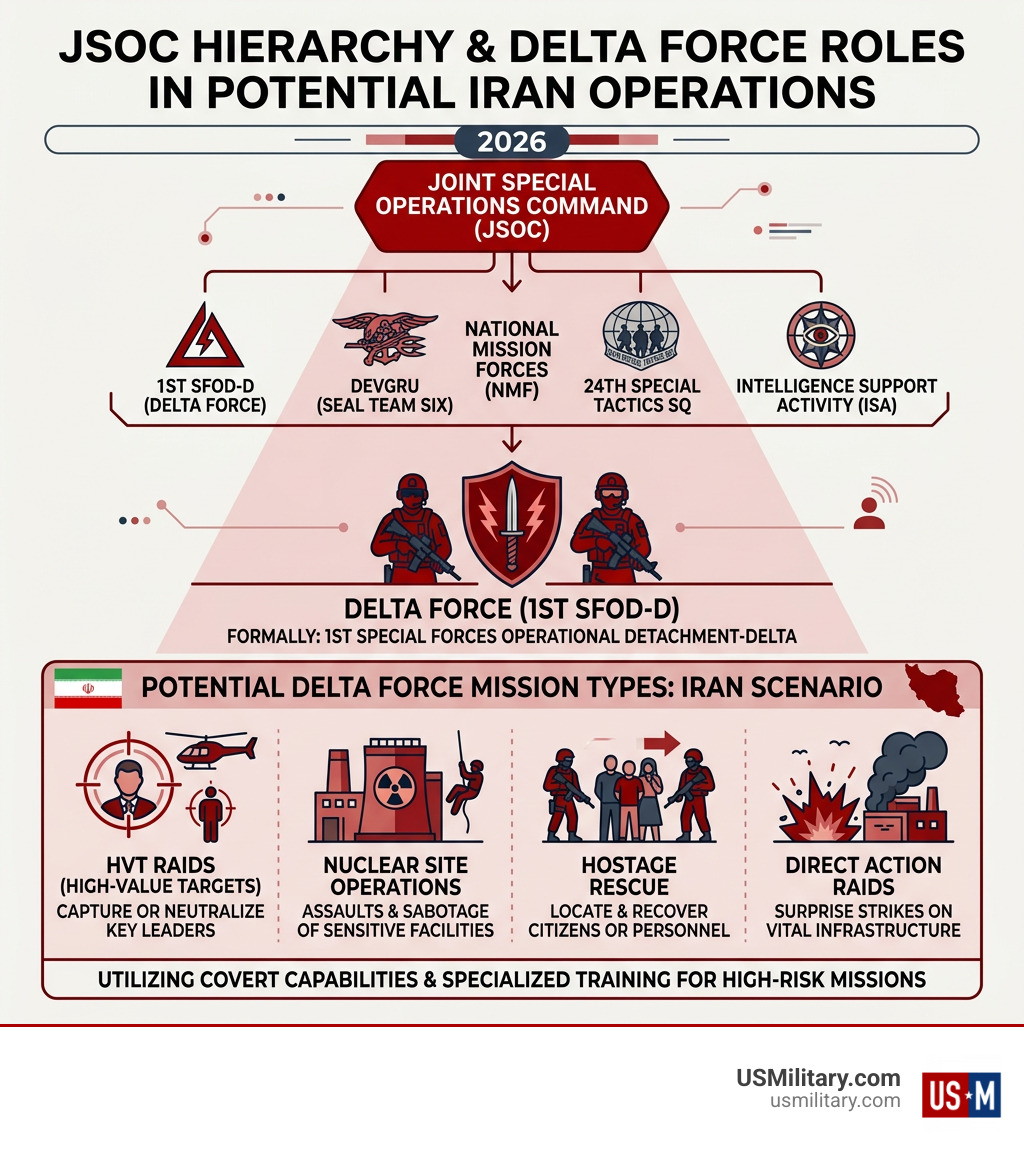
Delta Force, formally known as the 1st Special Forces Operational Detachment-Delta (1st SFOD-D), sits at the top of America’s special operations hierarchy. With roughly 250-300 core operators out of around 1,000 assigned soldiers, they are trained to do what conventional forces simply cannot.
I’m Larry Fowler, publisher of USMilitary.com since 2007 and a longtime voice on U.S. military operations and special forces capabilities – and tracking whether Will Army Delta Force Operators Play Another Vital Roll In Possible Iran Attack is a question with a real answer takes more than headlines. Below, I’ll break down exactly what the evidence tells us.
Will Army Delta Force Operators Play Another Vital Roll In Possible Iran Attack helpful reading:
Historical Context: Will Army Delta Force Operators Play Another Vital Roll In Possible Iran Attack?
To understand the future, we have to look at the scars of the past. The very existence of Delta Force is inextricably linked to Iran. In 1977, Colonel Charlie Beckwith founded the unit, drawing heavy inspiration from the British SAS. However, their first major test was the 1979 Iran Hostage Crisis.

Operation Eagle Claw was an ambitious, multi-stage rescue attempt that ended in tragedy at a remote site known as Desert One. Due to mechanical failures and a blinding sandstorm (haboob), a helicopter collided with a C-130 transport plane, resulting in the deaths of eight U.S. service members. This failure led to a complete overhaul of U.S. special operations, eventually creating the Joint Special Operations Command (JSOC) we know today.
Since then, the “Unit” has frequently crossed paths with Iranian interests. During the Iraq War, Delta operators were involved in raids against the Iranian Liaison Office in Irbil, capturing members of the Quds Force who were coordinating attacks against U.S. troops. These historical U.S.-Iran maritime incidents and land-based skirmishes have turned Delta into the most feared operators in the military.

Past Missions and Regional Expertise
Delta’s resume in the Middle East is extensive. During the 1991 Gulf War, Delta sniper teams performed legendary feats, puncturing the fuel tanks of 26 SCUD missiles from distances of up to 3,000 yards to prevent launches against Israel. In Afghanistan, they led the hunt for high-value targets during Operation Anaconda and the Battle of Tora Bora.
More recently, Delta has been active in countering Iranian influence through Houthi arms interdictions. By seizing Iranian-made weapons bound for Yemen, they have gained invaluable intelligence on Iranian hardware. This regional expertise is bolstered by their frequent collaboration with the 5th Special Forces Group history, which specializes in the Middle Eastern theater.
Core Capabilities and the Selection of the Elite
What makes a Delta operator different from a standard soldier? It starts with the most grueling selection process in the world. Headquartered at Fort Liberty, North Carolina, the unit seeks out soldiers who possess a rare blend of physical dominance and “high IQ” tactical thinking.
The path to becoming an operator involves a six-month Operators Training Course (OTC). This isn’t just about shooting; it covers demolition, advanced tradecraft, executive protection, and even high-level language skills. While many think of them as just “shooters,” their ability to blend into a foreign environment is just as vital as their essential Delta Force equipment. Candidates must meet strict ASVAB score requirements—typically a score of 110 or higher—to even be considered for the brief.
How Selection Determines if Army Delta Force Operators Play Another Vital Roll In Possible Iran Attack
The selection process at Camp Dawson, West Virginia, is designed to break a person. It includes an 18-mile all-night land navigation course with a 40-pound ruck, where the weight increases and the time limits decrease as the days go by. This “crucible” ensures that if Will Army Delta Force Operators Play Another Vital Roll In Possible Iran Attack becomes a reality, the men on the ground have the psychological resilience to handle the isolation of a mission deep inside hostile territory. This level of Army special forces education is what separates the elite from the merely excellent.
Operational Structure and Specialized Squadrons
Delta is organized into several specialized squadrons:
- Assault Squadrons (A, B, C, D): The primary direct-action force.
- Clandestine Squadron (G): Focused on long-term undercover reconnaissance and “low-visibility” operations.
- Aviation Support (E): Highly specialized pilots who work alongside the 160th SOAR.
- CNOS: A dedicated Computer Network Operations Squadron for cyber warfare.
This structure allows for a multi-dimensional attack. In a potential Iran scenario, Squadron G might already be on the ground months in advance, while the Assault squadrons prepare for the final hit. For those wondering how this compares to other units, the debate of Delta Force vs Navy SEALs often comes down to Delta’s specific focus on counter-terrorism and HVT (High-Value Target) missions in land-locked or urban environments.
Recent Successes and the “Luck” Factor in Modern Raids
Recent operations under the Trump administration have shown the “Unit” is as lethal as ever. The capture of Venezuelan leader Nicolás Maduro and the elimination of ISIS leader Abu Bakr al-Baghdadi are prime examples of Delta’s reach. During the al-Baghdadi raid, Delta operators used a combination of canine support (the famous dog “Conan”) and precision breaching to corner the terrorist leader.
However, we shouldn’t mistake success for ease. In the Maduro operation, a Delta Force Chinook reportedly came under heavy fire. The pilot was shot three times in the leg but managed to keep the bird in the air. This “luck” factor is something military leaders are deeply concerned about regarding Iran.
The risks of major Iran operations are significantly higher than a raid in Venezuela or a strike on a terrorist compound. Iran possesses a sophisticated military, integrated air defenses, and a massive proxy network.
| Feature | Maduro Capture (Venezuela) | Hypothetical Iran HVT Raid |
|---|---|---|
| Air Defenses | Minimal/Degraded | Integrated S-300 & Indigenous systems |
| Enemy Force | ~30 Cuban Special Ops killed | Hundreds of thousands (IRGC/Basij) |
| Geographic Depth | Coastal/Proximate | Deep inland/Mountainous |
| Retaliation Risk | Low | High (Missiles/Proxies/Oil disruption) |
Strategic Risks: Could Army Delta Force Operators Play Another Vital Roll In Possible Iran Attack?
General Dan Caine, Chairman of the Joint Chiefs, and other top leaders have reportedly warned that a major operation against Iran would carry significant risks. While President Trump has posted that a military decision would be “easily won,” seasoned veterans like David Petraeus urge caution.
By 2009, Delta operators in Iraq had suffered a 20% casualty rate, with 50% of those deployed receiving Purple Hearts. In a conflict with Iran, these numbers could be even higher. The Israel vs Iran dynamics also play a role; if the U.S. uses Delta for a “decapitation strike” on Iranian leadership, Iran might retaliate not just against U.S. bases, but against allies across the region.
Tactical Challenges and Regional Contingencies
If the order is given, what would a Delta-led mission look like? It wouldn’t be a massive invasion. Instead, it would likely be a “surgical” strike.
Potential targets include:
- Nuclear Facility Assaults: While “Midnight Hammer” used stealth bombers, Delta might be needed to secure intelligence or disable underground centrifuges that bombs can’t reach.
- Decapitation Strikes: Capturing or eliminating top IRGC leadership to disrupt command and control.
- HVT Raids: Seizing key scientists or military officials for intelligence.
The U.S. has already positioned a “massive armada” in the region, including two aircraft carriers and thousands of additional troops. This buildup provides the necessary “missile math” to suppress air defenses, allowing special ops helicopters to slip through. We’ve also seen the deployment of MOP bombs and nuclear facilities as a clear signal of intent. Current U.S. military buildup statistics suggest that the pieces are in place for a sustained campaign.
Potential Outcomes and Setbacks
We have to talk about what happens if things go wrong. In the 1993 Battle of Mogadishu, 5 Delta operators were killed in an 18-hour firefight after two Black Hawks were shot down. In Iran, the terrain is even more unforgiving.
If a helicopter goes down over Tehran, the rescue mission (CSAR) would be a monumental task. Furthermore, the U.S. must consider special forces language skills; while many operators speak Farsi, navigating a country of 85 million people while being hunted by the IRGC is a nightmare scenario. This is why the unit trains alongside Army Rangers vs Navy SEALs to ensure they have a “Quick Reaction Force” (QRF) capable of bailing them out of a hot zone.
Frequently Asked Questions about Delta Force and Iran
What is the historical role of Delta Force in Iran?
Delta Force was essentially “born” out of the need to rescue hostages in Iran in 1979. While Operation Eagle Claw failed, it led to the creation of the modern special operations structure that Delta uses today. They have since conducted numerous “shadow war” missions to counter Iranian proxies in Iraq and Syria.
How does Delta Force training prepare them for Iran?
Their training focuses on “asymmetric warfare.” This means they don’t fight fair. They use speed, surprise, and superior technology to hit targets before the enemy knows they are there. Their 6-month OTC includes specific blocks on “tradecraft,” which allows them to operate undercover in hostile urban environments like Tehran.
What are the risks of using Delta Force against Iranian nuclear sites?
The primary risk is the “deep penetration” required. Many Iranian nuclear sites, like Fordow, are buried deep inside mountains and protected by sophisticated air defense umbrellas. A ground raid would require specialized insertion techniques and carries a high risk of capture or “Black Hawk Down” style setbacks.
Conclusion
At USMilitary.com, we believe in providing the facts so our veterans and service members can understand the landscape of modern conflict. The question of whether Will Army Delta Force Operators Play Another Vital Roll In Possible Iran Attack isn’t just a matter of “if,” but “how.”
Delta Force remains the ultimate “break glass in case of emergency” tool for the President. Whether they are used to capture a leader, secure a nuclear site, or simply act as a silent deterrent, their presence in the Middle East changes the strategic calculus. As the U.S. continues to balance diplomacy with the threat of force, Delta will be the ones standing in the shadows, ready for whatever comes next.
If you’re interested in how these elite soldiers stack up against other units, be sure to Compare Army Delta Force vs Navy SEALs on our platform to see which force is best suited for the challenges of the 21st century.