
Will the Army Be the First Branch to Start a Military Draft? Here’s the Quick Answer
Will the army be the first branch to start a military draft is one of the most searched questions right now — and the short answer is: no, not automatically.
Here’s what you need to know right away:
- No draft is currently active. The U.S. has relied on an all-volunteer military since 1973.
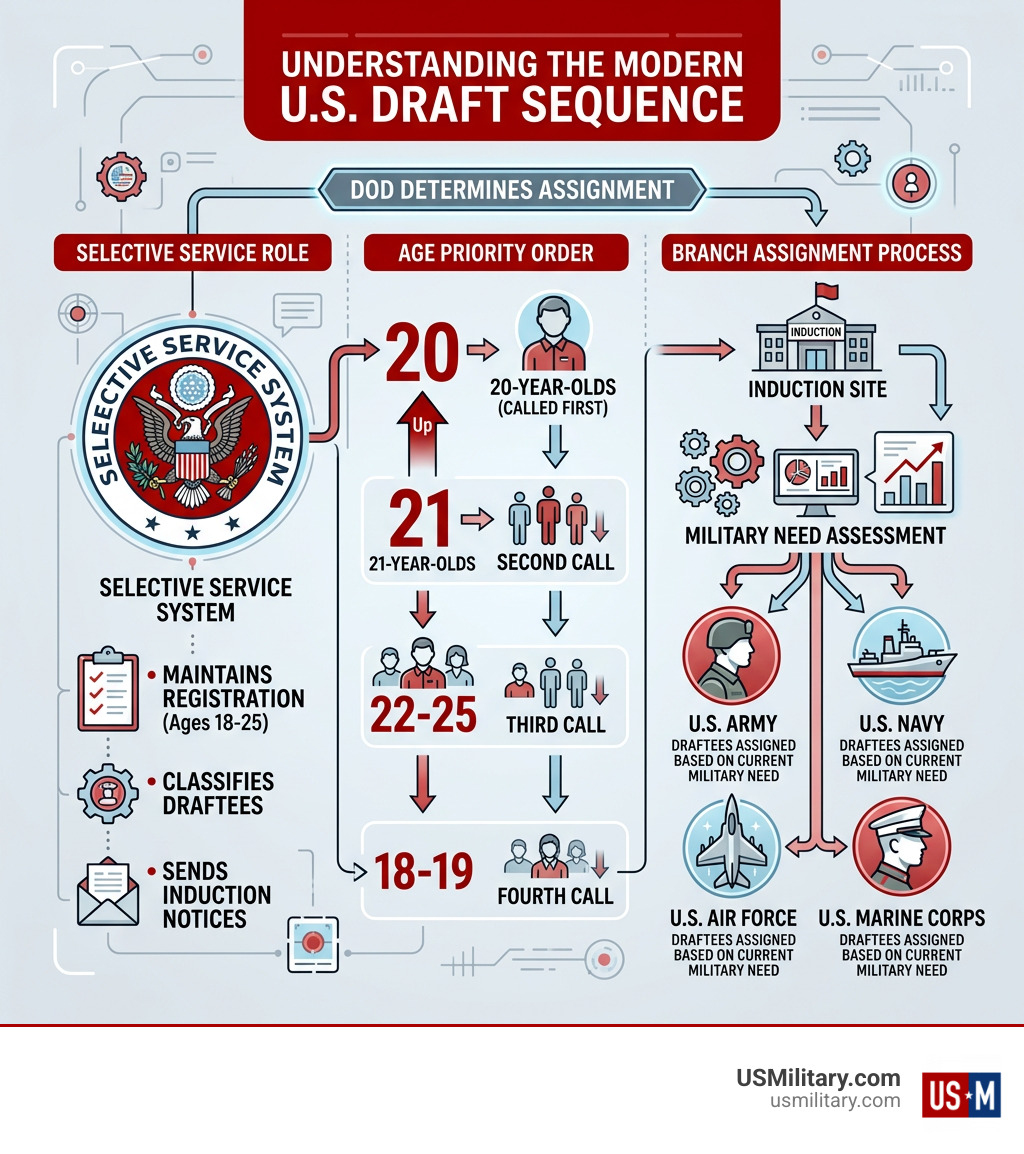
- The Army does NOT automatically go first. If a draft were reinstated, the Department of Defense — not any single branch — would determine where draftees are assigned based on military need at the time.
- The Selective Service System handles induction. It classifies and assigns draftees across all branches, not just the Army.
- Age, not branch, determines draft order. 20-year-olds are called first, then 21-year-olds, then 22–25-year-olds, and finally 18–19-year-olds — regardless of which branch needs them.
- Congress and the President must act first. No branch can start a draft on its own. It requires an act of Congress and presidential authorization.
The Army is often associated with the draft because it historically absorbs the largest share of ground troops. But that doesn’t mean it goes first in any legal or procedural sense.
I’m Larry Fowler, publisher of the USMilitary.com Network since 2007 and a longtime resource for active military, veterans, and anyone trying to understand topics like will the army be the first branch to start a military draft. My network has supported hundreds of thousands of service members navigating enlistment decisions, VA benefits, and military policy changes. Read on for a full breakdown of exactly how the draft process works and what it would mean for you.
Will the army be the first branch to start a mlitary draft terminology:
- Who gets pulled first in a draft?
- Everything You Need to Know About the Military Draft
- Does the US currently have a military draft
Understanding the Selective Service and the Modern Draft Process
To understand whether the Army would be the “first” branch, we have to look at the machinery that actually runs a draft. That machine is the Selective Service System. Contrary to what some viral social media posts might suggest, the Selective Service is an independent agency, not a part of the Department of Defense. Its job is to maintain a list of names—essentially a “insurance policy” for the nation’s security.
Currently, the law requires nearly all male U.S. citizens and male immigrants living in the U.S. who are ages 18 through 25 to register with the Selective Service. This includes dual citizens, refugees, and even those with disabilities. If you’re wondering who will be drafted if WW3 starts, the list starts with these registered individuals.
There has been significant news lately regarding an automate military draft bill. The House of Representatives recently passed a version of the National Defense Authorization Act (NDAA) that would allow the government to automatically register eligible men using existing databases like the DMV or Social Security records. This isn’t “starting the draft”—it’s simply making the registration process more efficient because compliance rates have dropped to about 84% recently.
Failing to register is no small matter. It is technically a federal felony punishable by a fine of up to $250,000 and up to five years in prison. More commonly, it results in the loss of eligibility for federal student loans, government jobs, and even U.S. citizenship for immigrants.
The system is supported by over 2,000 local draft boards across the country. These boards are staffed by over 11,000 civilian volunteers. If a draft were ever activated, these regular citizens—not military generals—would be the ones deciding on deferments and exemptions in your local community.
Will the Army Be the First Branch to Start a Military Draft?
When people ask will the army be the first branch to start a military draft, they are often thinking about the sheer size of the Army. It is the largest branch, and in major conflicts like World War II or Vietnam, it naturally required the most “boots on the ground.” However, the legal authority to draft personnel belongs to the President and Congress, not the Army.
Currently, the U.S. military has a massive “Total Force” of over 1.3 million serving personnel across active duty, the Reserves, and the National Guard. This provides a massive buffer. Before the government would even consider a draft, they would first mobilize the Reserves and the National Guard.
Whether a draft happens depends on “induction authority.” While registration is ongoing, the power to actually induct (force someone into service) expired in 1973. To bring it back, Congress would have to pass a new law and the President would have to sign it. You can read more about the likelihood of this in our analysis on could there be a military draft in the US.
If that authority were granted, the Department of Defense would look at the needs of the entire military. While the Army might need 50,000 new infantrymen, the Navy might need 10,000 sailors, and the Air Force might need 5,000 technicians. All branches could receive draftees simultaneously.
Why the Army is often linked to the first branch to start a military draft
The association between the Army and the draft is rooted in history. During the 1917 Selective Service Act, the U.S. needed to grow an army from 200,000 to 4 million almost overnight. The Army is the primary branch for large-scale land combat and “holding ground,” which is personnel-intensive.
In World War II, the Army inducted millions of men to fill combat arms roles. Because the Army has the highest “manpower” requirements for its mission, it has historically been the destination for the vast majority of draftees. This is likely why rumors about US military draft 2025 updates often focus on the Army first. If a conflict requires a massive increase in ground troops, the Army is the branch that would see the most expansion.
How the lottery determines if the Army will be the first branch to start a military draft
If a draft were activated, it wouldn’t be a matter of the Army “starting” it. Instead, the Selective Service would conduct a nationally televised birthday lottery.
This is a random selection process where 366 balls (representing every possible birth date, including February 29) are drawn to determine the order of induction. The draft age debate is settled by a very specific priority sequence:
- 20-year-olds: Those turning 20 during the calendar year of the draft are the first priority.
- 21-year-olds: The next group called.
- 22 to 25-year-olds: These groups follow in ascending order.
- 18 and 19-year-olds: These are actually the last to be called.
Once your number is called, you report for an evaluation. Based on the results of your physical and mental testing, as well as the needs of the military, you would be assigned to a branch. While the Army might have the most openings, you could just as easily be assigned to the Marines or the Navy if that’s where the “critical need” lies.
Legal Requirements and the Current Political Climate
For a draft to become a reality, the political hurdles are incredibly high. We live in an era of the “all-volunteer force,” which military leaders widely prefer because it results in a more professionalized and highly skilled military.
However, recent US military draft in 2026 speculation has increased due to global tensions, particularly involving Iran. During what some news outlets have called “Operation Epic Fury,” White House officials were asked if a draft was on the table. Press Secretary Karoline Leavitt noted that while there is “no current plan” for a draft, the President “wisely keeps his options on the table.”
This kind of “strategic ambiguity” often fuels rumors. But legally, the President cannot simply tweet a draft into existence. It requires:
- Congressional Action: Both the House and Senate must pass a bill to amend the Military Selective Service Act to authorize inductions.
- Presidential Signature: The President must sign that bill into law.
- Selective Service Activation: The agency then has a specific timeline to start the lottery and induction process.
In the current political climate, reinstating the draft would be seen as a “last resort” or a response to an “existential threat” to the United States.
Eligibility Challenges and the All-Volunteer Force
Even if the government wanted to start a draft tomorrow, they would hit a major roadblock: the “eligibility crisis.”
According to Department of Defense data, only about 23% of Americans ages 17 to 24 actually meet the basic standards for military service without needing a waiver. This is a startling statistic that affects every branch, not just the Army. The primary reasons for disqualification include:
- Obesity: Physical fitness standards are strict.
- Criminal Records: Certain felonies or drug-related offenses are automatic bars.
- Education: A high school diploma or equivalent is required.
- Drug Use: While some standards have relaxed, many types of drug use still disqualify candidates.
You can find the full military draft disqualification list on our site to see the specifics.
Furthermore, a modern draft would likely look very different from the 1960s. Today’s military relies heavily on technical skills. We need cyber warfare specialists, drone operators, and high-tech engineers. Drafting someone who doesn’t have the aptitude for these roles doesn’t help a modern military as much as it did when the primary goal was simply having someone who could carry a rifle. This makes the disqualifications for the draft even more relevant in today’s world.
Frequently Asked Questions about the Military Draft
Are women required to register for the Selective Service?
Currently, no. Federal law only requires “male persons” to register. This policy was upheld by the Supreme Court in the 1981 case Rostker v. Goldberg, primarily because women were excluded from combat roles at the time.
However, since all combat roles were opened to women in 2015, there has been an intense debate on women and the draft. Some lawmakers have proposed making registration gender-neutral, arguing it’s a matter of equality and necessity. Other countries, like Norway and Sweden, already have gender-neutral conscription models. For now, in the U.S., it remains a male-only requirement, though this could change if Congress updates the law.
What role do the National Guard and Reserves play before a draft?
The National Guard and Reserves are our “Strategic Reserve.” In any modern conflict, they are the first to be “called up” to support the active-duty force. We have hundreds of thousands of trained soldiers in these components who are ready to deploy.
The U.S. follows a “Total Force Policy,” meaning the active duty and reserve components are integrated. A draft would only be considered if the active duty, National Guard, and Reserves combined were still insufficient to meet the national security threat. This is why a draft is truly a “break glass in case of emergency” scenario.
What are the penalties for failing to register?
As mentioned, it is a felony. Beyond the $250,000 fine and potential prison time, the most immediate “penalty” for many young men is the loss of benefits. You cannot get federal student aid (FAFSA), you cannot work for the federal government (including the Postal Service), and in many states, you cannot even get a driver’s license without being registered.
For veterans, if you served but failed to register before age 26, your DD Form 214 usually serves as proof that your failure to register wasn’t “willful,” allowing you to still access federal benefits. You can find more details on Selective Service registration for veterans if you find yourself in that situation.
Conclusion
So, will the army be the first branch to start a military draft? The answer is a firm “no.” The Army doesn’t start drafts; the U.S. government does. And if it happens, it will likely involve all branches of the military based on the specific needs of the conflict.
The draft remains a contingency plan—a “standby” system designed to ensure that the United States is never caught off guard in a massive global crisis. While tensions in places like Iran or Eastern Europe keep the conversation alive, the all-volunteer force remains the gold standard for our national defense.
At USMilitary.com, we are dedicated to providing you with the most accurate, nonbiased information regarding your service and your rights. Whether you are looking for information on VA loans, disability benefits, or simply trying to understand the news, we are here to help.
If you want to dive deeper into the legalities and history of conscription, check out our guide on what is the US military draft. Knowledge is the best defense against the rumors and misinformation you might see online. Stay informed, and stay ready.