
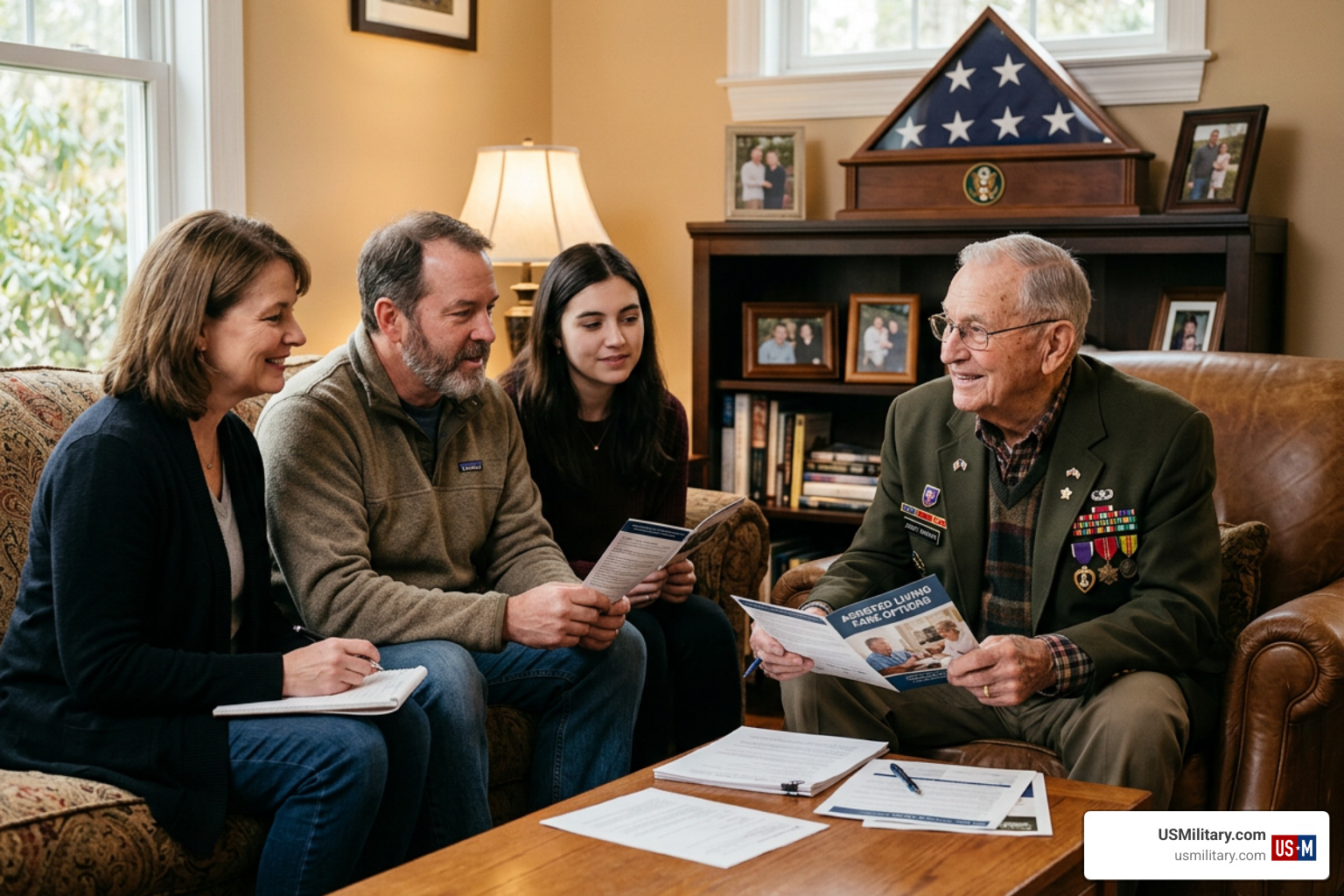
Will the VA or the Army pay for my assisted living costs is one of the most important questions a veteran or military family member can ask — and the short answer is: partially, yes, but not in the way most people expect.
Here’s a quick breakdown:
| What You’re Asking | The Answer |
|---|---|
| Does the VA pay for assisted living room and board? | No |
| Does the VA cover medical services inside assisted living? | Yes, if enrolled in VA health care |
| Does the Army directly pay for assisted living? | No, but some Army-connected benefits may help |
| Can VA pension benefits help offset assisted living costs? | Yes, through programs like Aid and Attendance |
| Can surviving spouses get help too? | Yes |
The VA does not write a check directly to your assisted living facility. But through programs like the VA Aid and Attendance benefit, eligible veterans can receive up to $2,358 per month (2025 rates) to help cover care costs. Despite this, it’s estimated that only about 25% of eligible veterans actually apply — leaving billions in earned benefits unclaimed.
The costs are real. The national median for assisted living runs around $5,190 per month in 2025. Understanding which VA or military benefits apply — and how to access them — can be the difference between affordable care and rapidly depleting your life savings.
I’m Larry Fowler, publisher of USMilitary.com and a longtime resource for veterans navigating VA benefits, including will the VA or the Army pay for my assisted living costs. Since 2007, I’ve helped connect veterans with the benefits information they’ve earned through their service. Below, I’ll walk you through everything you need to know to access the funding available to you.
Handy will the va or the Army pay for my assisted living costs terms:
Understanding if the VA or the Army Pay for My Assisted Living Costs
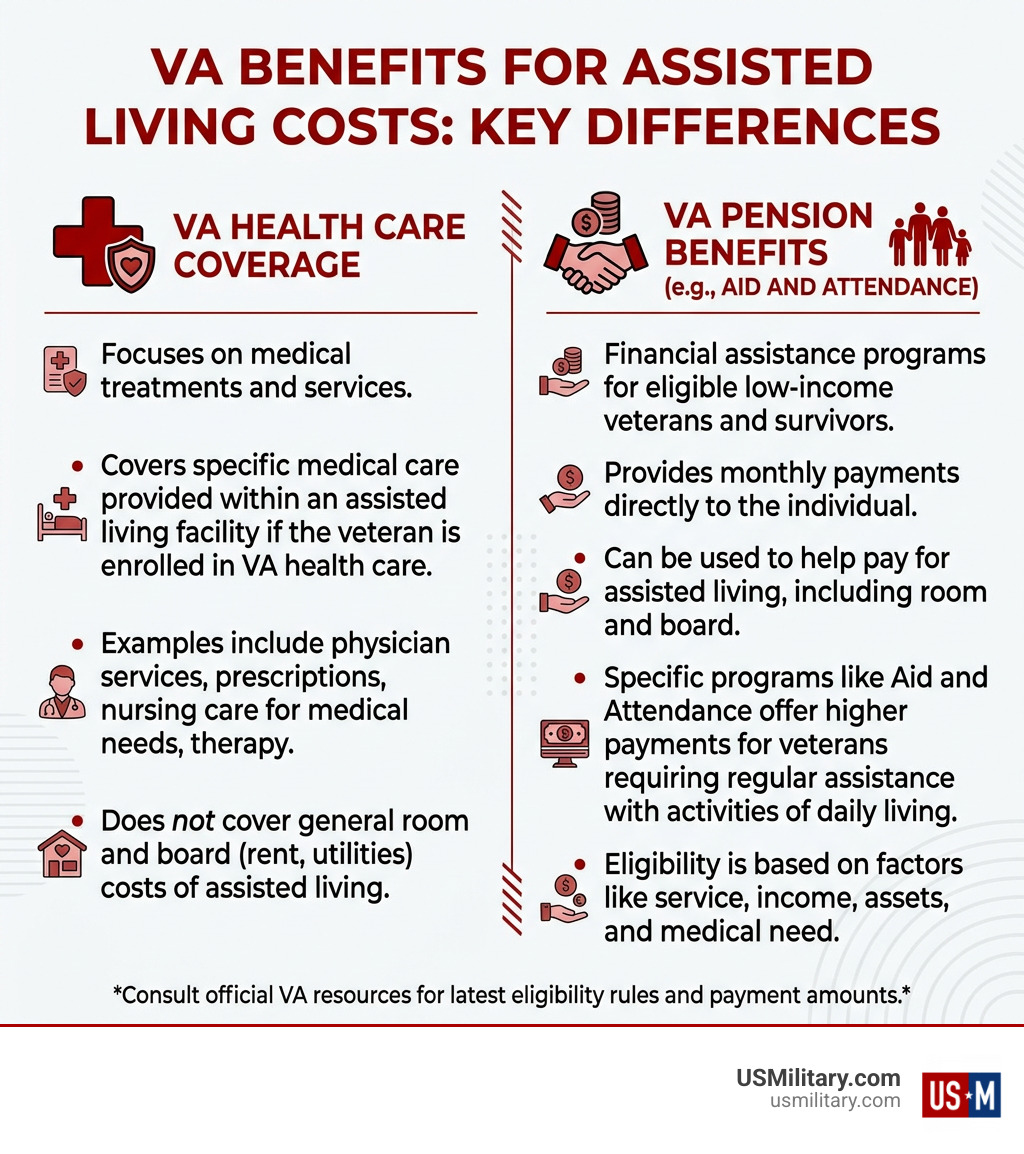
When we look at the financial landscape of senior care, the most critical distinction to make is between “room and board” and “clinical services.” Most people assume that if they are eligible for VA benefits, the government will cover the entire monthly bill at an assisted living facility. Unfortunately, that isn’t how the system is structured.
The VA generally does not pay for the “rent” portion of assisted living. Room and board—the cost of your apartment, your meals, and your utilities—is considered a personal expense. However, if you are enrolled in VA health care, the VA may provide and pay for professional clinical services delivered within that facility. This can include skilled nursing, physical therapy, or occupational therapy.
For many veterans, the question of does the VA pay for assisted living is answered through the VA’s Standard Medical Benefits package. If a veteran has a clinical need for long-term care services, the VA may cover those specific medical costs, though copayments may apply depending on your disability rating and income level. To dive deeper into these official distinctions, we recommend reviewing the VA’s Geriatrics and Extended Care resources.
The Role of the U.S. Army vs. the VA
It is a common misconception that the U.S. Army itself manages long-term care for its retirees. In reality, once a soldier transitions to veteran status, their primary source of health and pension benefits is the Department of Veterans Affairs (VA), not the Department of the Army.
While the Army provides retiree pay (which can certainly be used to pay for care), it does not have a specific “assisted living fund.” There are, however, two notable exceptions:
- Armed Forces Retirement Home (AFRH): With locations in Washington, D.C., and Gulfport, MS, the AFRH offers a unique model where residents can enter while independent and transition to assisted living or skilled nursing as their needs change.
- TRICARE for Life: While TRICARE generally does not cover long-term “custodial” care (help with dressing or bathing), it remains a vital secondary payer for medical treatments, prescriptions, and doctor visits while you reside in an assisted living community.
If you are wondering will the VA really pay for my assisted living, the answer lies in the transition from Army retiree status to utilizing VA supplemental income programs.
What Services are Covered in Assisted Living?
While the VA won’t pay your landlord, it will often pay for the “care” part of “care facility.” This is usually determined by your need for help with Activities of Daily Living (ADLs).
| Service Type | Covered by VA Health Care? | Covered by VA Pension (A&A)? |
|---|---|---|
| Room and Board | No | Yes (Indirectly via cash payment) |
| Skilled Nursing | Yes (If clinically necessary) | Yes |
| Physical Therapy | Yes | Yes |
| Help with Bathing/Dressing | Partial (via HHA programs) | Yes |
| Pain Management | Yes | Yes |
To access these medical services, you must be enrolled in the VA health care system. Once enrolled, a VA social worker or patient care coordinator can help determine which clinical services can be brought to you in your assisted living community.
VA Aid and Attendance: The Primary Funding Source
If you need a direct way to pay for the rent and “custodial” care in assisted living, the VA Aid and Attendance (A&A) benefit is your best friend. This is a supplemental “add-on” to the basic VA Pension. It is designed specifically for veterans and surviving spouses who require the “aid and attendance” of another person to perform daily tasks.
Because A&A is a cash benefit paid directly to the veteran, it is incredibly flexible. You can use this money to pay for the room and board at an assisted living facility, hire an in-home caregiver, or even pay a family member (in some cases) to provide care. For those looking at the future, keep an eye on the Aid and Attendance payouts for 2026 to plan your long-term budget.
Will the VA or the Army pay for my assisted living costs through the Aid and Attendance benefit?
To qualify for this financial boost, you don’t necessarily need a service-connected disability. Instead, the VA looks at three main pillars:
- Service: You must have served at least 90 days of active duty, with at least one day during a recognized wartime period.
- Medical Need: You must require help with ADLs (like bathing, dressing, or feeding), be bedridden, or have severe visual impairment.
- Financial Need: Your “countable” income and net worth must be below certain limits set by Congress.
In 2025, the maximum annual benefit for a single veteran with no dependents is $28,300. This is a significant sum that can bridge the gap between your Social Security income and the cost of a high-quality facility. Learning how to get Aid and Attendance approval is the first step toward securing this funding.
2025 Benefit Amounts and Statistics
The VA updates these rates annually to keep up with the cost of living. As of late 2024 and heading into 2025, the monthly maximums for those who qualify for Aid and Attendance are:
- Single Veteran: $2,358 per month ($28,300 annually)
- Veteran with one dependent (spouse): $2,795 per month ($33,548 annually)
- Two Married Veterans (both qualifying): $3,740 per month ($44,886 annually)
- Surviving Spouse (no dependents): $1,515 per month ($18,187 annually)
It is also important to note the Net Worth Limit. For 2025, the limit is $159,240. This includes your income and assets but excludes your primary home and your vehicle. The VA uses a “look-back” period for asset transfers, so review the Veterans Aid and Attendance requirements before moving your money around.
Eligibility and Clinical Requirements for Long-Term Care
Getting approved isn’t just about showing your discharge papers. The VA requires medical evidence that your health has reached a point where assisted living is a necessity, not just a preference.
The basic eligibility starts with an Honorable or General Under Honorable Conditions discharge. If you were a member of the National Guard or Reserves, you must have been called to active duty by federal order and completed the full period for which you were called. For those who enlisted after 1980, the requirement is generally 24 months of continuous active duty. You can check your specific status on our Aid and Attendance landing page.
Medical Necessity and ADL Requirements
The “clinical” side of the application focuses on your ability to function independently. The VA typically uses the “Two-ADL Rule.” This means a doctor must certify that you need help with at least two of the following:
- Bathing: Getting in and out of the tub or washing safely.
- Dressing: Putting on clothes, fastening buttons, or managing prosthetics.
- Feeding: The physical act of eating (not just cooking).
- Toileting: Help with hygiene or incontinence.
- Transferring: Moving from a bed to a chair or standing up.
Other qualifying factors include being a patient in a nursing home due to mental or physical incapacity, being bedridden (where your disability requires you to remain in bed), or having eyesight limited to a corrected visual acuity of 5/200 or less. Understanding these triggers can help you avoid the common reasons Aid and Attendance is denied.
Financial Eligibility and the Look-Back Period
The VA Pension is a “needs-based” benefit. This means the VA looks at your IVAP (Income for VA Purposes). The good news? You can subtract your unreimbursed medical expenses—including the cost of assisted living—from your total income.
For example, if your income is $30,000 but your assisted living costs $35,000, your “countable income” is technically zero, which often qualifies you for the maximum benefit amount.
However, be careful with the Three-Year Look-Back Period. If you give away assets or sell them for less than fair market value in the three years before you apply, the VA may hit you with a penalty period of up to five years during which you cannot receive benefits. We cover this in detail in our guide: Does VA Aid and Attendance have a look-back period?
How to Apply: A Step-by-Step Checklist
Applying for these benefits can feel like trying to solve a Rubik’s cube in the dark. But if you follow a checklist, it becomes much more manageable.
- File an “Intent to File” (VA Form 21-0966): This preserves your effective date. If it takes six months to get approved, the VA will pay you retroactively back to this date.
- Complete VA Form 21-2680: This is the “Examination for Housebound Status or Permanent Need for Regular Aid and Attendance.” Your doctor must fill this out.
- Complete VA Form 21-527EZ: This is the actual application for the Veterans Pension.
- Submit to the Pension Intake Center: Mail your packet to the Janesville, WI office or deliver it to your VA Regional Office.
Gathering Required Documentation
Don’t hit “send” until you have these documents in order:
- DD-214: Proof of your military service and discharge status.
- Medical Evidence: A letter from your facility or doctor stating you require a “protected environment.”
- Financial Records: Bank statements, Social Security award letters, and pension statements.
- Proof of Expenses: An invoice from your assisted living facility showing what you pay for care.
One of the most common questions we get is, “how long does the VA take to decide?” Generally, you should expect a 3-to-6-month wait, though “Fully Developed Claims” move faster.
Utilizing Accredited Representatives
You don’t have to do this alone. In fact, you shouldn’t. Veterans Service Organizations (VSOs) like the American Legion, VFW, or DAV have accredited representatives who will help you file your claim for free.
If your case is legally complex—perhaps involving trusts or the look-back period—you might consider an accredited attorney. Just be sure they are VA-accredited. You can find out more about when to hire a pro in our article: Need an Aid and Attendance attorney?
Benefits for Surviving Spouses and Alternative Options
We often focus on the veteran, but the “widow’s pension” is a lifesaver for surviving spouses. If you were married to a wartime veteran at the time of their death and have not remarried, you may be eligible for financial help with assisted living.
There are two primary tracks:
- Survivors Pension with Aid and Attendance: For spouses of veterans who died of non-service-connected causes.
- Dependency and Indemnity Compensation (DIC): For spouses of veterans who died from a service-connected disability or on active duty.
Spouses can find specific guidance on assisted living financial assistance for veteran spouses through our dedicated resource pages.
Will the VA or the Army pay for my assisted living costs if I am a surviving spouse?
Yes, the financial support is substantial. A surviving spouse with no dependents can receive a base pension of about $1,054 per month, but with the Aid and Attendance addition, that jumps to $1,515 per month (2025 rates).
To qualify, the marriage must have lasted at least one year (or there must be a child from the marriage). For more details on the “how-to,” check our article on will the VA pay for assisted living for veteran spouses.
State Veterans Homes and Medicaid
If VA benefits aren’t enough, don’t lose heart. There are other “safety nets” available:
- State Veterans Homes: These are managed by individual states but partially funded by the VA. They often offer assisted living at much lower rates than private facilities.
- Medicaid Waivers: While the VA and Medicaid are separate, many veterans use Aid and Attendance and Medicaid “Waiver” programs simultaneously to cover the full cost of care.
- Long-Term Care Insurance: If you have a private policy, it can usually be used alongside your VA benefits.
We provide a full breakdown of these multi-layer funding strategies in our guide on VA benefits for assisted living for spouses.
Frequently Asked Questions about Assisted Living Costs
Does the VA pay for room and board?
Directly? No. The VA health care system covers medical needs, but not rent. However, the cash you receive from a VA Pension or Aid and Attendance can be used to pay for room and board. It is essentially a reimbursement for the high cost of your care.
How long does it take to get approved for Aid and Attendance?
The average processing time is between 3 and 6 months. To speed things up, use the “Fully Developed Claim” (FDC) process, which means you submit all your medical and financial evidence at the same time as your application, rather than waiting for the VA to ask for it.
Can I receive both VA disability and a pension?
No, the VA generally does not allow “double-dipping.” If you are eligible for both Disability Compensation and a Pension, the VA will pay you whichever amount is higher. However, you can receive Aid and Attendance as an “add-on” to either benefit if you meet the medical requirements.
Conclusion
Navigating the question of will the VA or the Army pay for my assisted living costs requires patience and the right information. While the Army provides the foundation of your retirement, the VA provides the specialized financial tools—like Aid and Attendance—that make long-term care sustainable.
At USMilitary.com, we are dedicated to ensuring no veteran or spouse leaves their earned benefits on the table. Whether you are just starting your search for a facility or you are ready to file your claim, help is available. Take the time to learn more about all U.S. Veteran Benefits to ensure your family is protected for the road ahead.