

Would Army Delta Force Maintain High Standards During A Military Draft is one of the most pressing questions for anyone trying to understand how America’s most elite unit would function under conscription. The short answer:
Yes — Delta Force would almost certainly maintain its high standards, even during a draft. Here’s why:
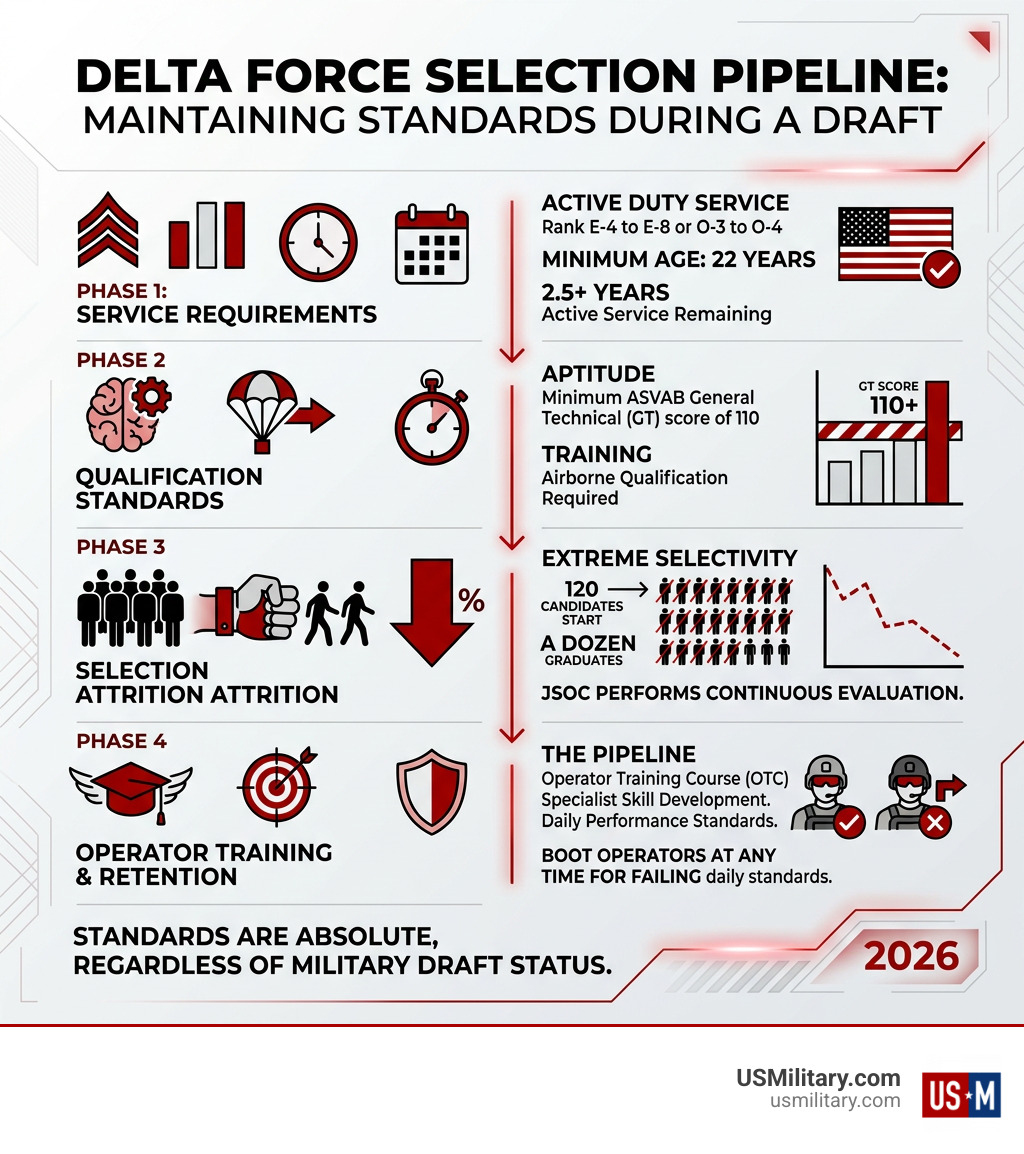
- Delta Force only accepts experienced soldiers, not raw recruits — candidates must already hold rank E-4 to E-8 or O-3 to O-4
- A minimum ASVAB General Technical (GT) score of 110 is required, a bar that roughly half of high school ROTC students currently fail
- Candidates must be at least 22 years old with 2.5 years of active service remaining and airborne qualification
- The selection attrition rate is extreme — a class of 120 candidates may produce only a dozen graduates
- JSOC units boot operators at any time for failing daily performance standards, regardless of time served
- A draft would expand the raw pool, but the multi-year service requirement before Delta eligibility acts as a natural filter
In short, a military draft would change who enters the Army — but Delta Force’s own eligibility rules mean draftees would need years of service before they could even apply.
That said, a draft would still create real pressure on the pipeline. The broader Army is already struggling: only 23% of Americans aged 17–24 meet all eligibility requirements to serve, and ASVAB scores have dropped nearly 10% since the COVID-19 pandemic. If the quality of the general force declines, the pool Delta Force draws from shrinks too.
This guide breaks down exactly what those risks look like — and what history tells us about elite units surviving conscription eras.
I’m Larry Fowler, publisher of the USMilitary.com Network since 2007 and a longtime resource for active-duty service members and veterans navigating military career decisions. Tracking questions like would Army Delta Force maintain high standards during a military draft sits squarely in the kind of military readiness and service-path research I’ve dedicated nearly two decades to. Read on for the full breakdown.
Would Army Delta Force Maintain High Standards During A Military Draft glossary:
- Everything You Need to Know About the Military Draft
- Who gets pulled first in a draft?
- What Disqualifies You From A Military Draft?
The Current Gold Standard: How Delta Force Selects the Best
To understand how a draft might affect the unit, we first have to look at how they operate today. Delta Force, officially known as the 1st Special Forces Operational Detachment-Delta (1st SFOD-D), is a Tier 1 Special Mission Unit under the Joint Special Operations Command (JSOC). They are the “quiet professionals,” often working in civilian clothes and operating from “black funds” that the government rarely acknowledges.
The current selection process is designed to find the “one percent of the one percent.” Unlike the regular Army, where you might sign a contract at a recruiting office and head to basic training, you cannot simply “join” Delta. You must be invited to attend selection after already proving yourself in other units, typically the 75th Ranger Regiment or the Army Special Forces (Green Berets).
The baseline requirements are a massive hurdle. A candidate must have a General Technical (GT) score of 110 or higher on the ASVAB. To put that in perspective, nearly half of high school ROTC students currently fail to meet even basic enlistment scores, let alone the high-tier requirements for Army Delta Force.
The Rigorous Selection and Training Pipeline
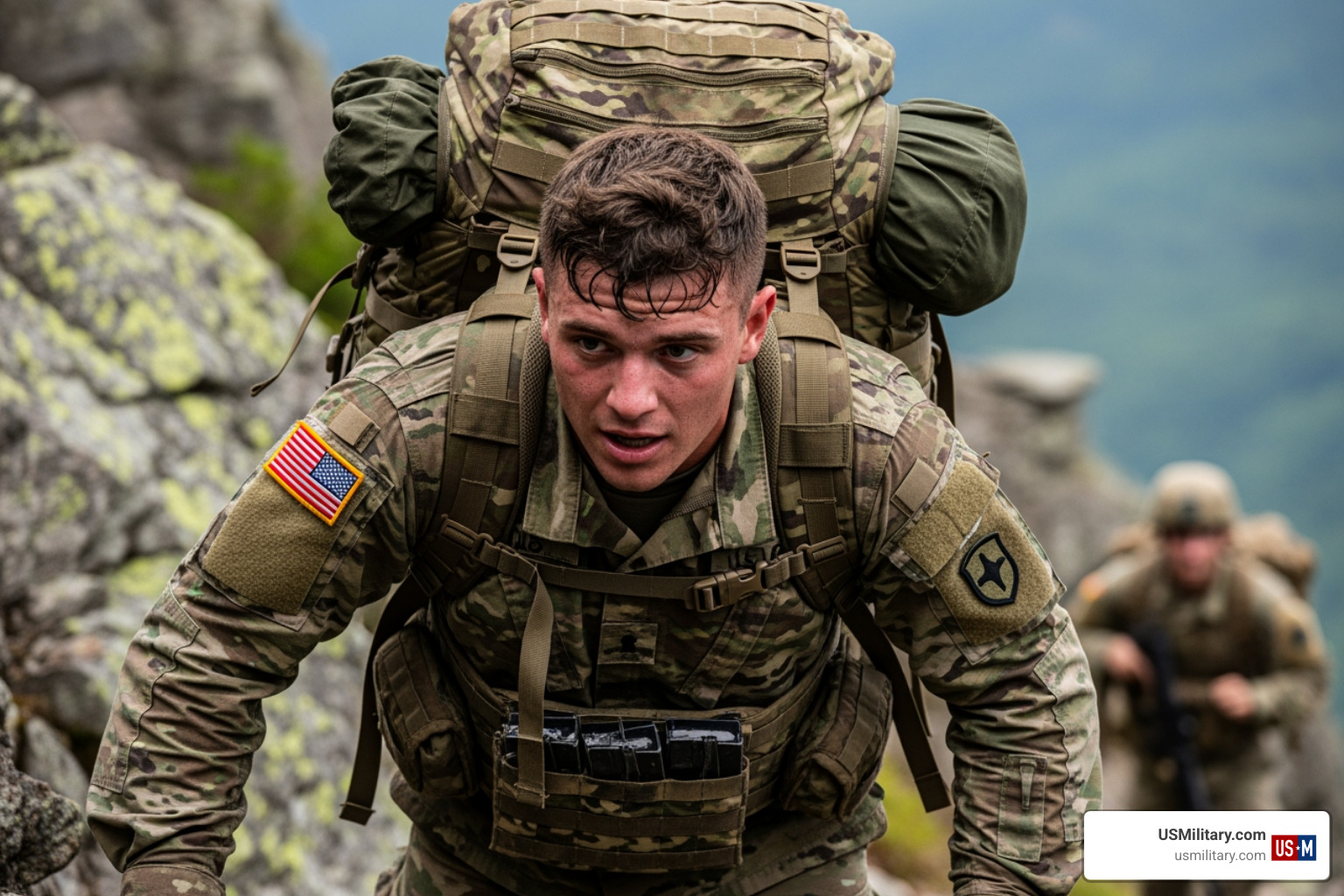
Selection is held twice a year, usually at Camp Dawson, West Virginia. It begins with standard physical tests—push-ups, sit-ups, and a swim—but quickly evolves into a psychological nightmare. The hallmark of the process is the “Long Walk,” a 40-mile solo endurance hike through mountainous terrain. Candidates carry a 45-pound ruck, and here is the kicker: they aren’t told the time limit or the exact distance. They are simply told to keep moving.
If a soldier manages to survive selection, they enter the six-month Operator Training Course (OTC). This is where they master:
- Marksmanship: Operators must achieve 100% accuracy at 600 yards and 90% at 1,000 yards.
- Demolitions: Learning to breach doors and walls with surgical precision.
- Tradecraft: Skills often associated with the CIA, such as dead drops, surveillance, and blending into foreign populations.
- Executive Protection: Guarding high-ranking officials in active war zones.
The attrition rate is staggering. Out of a starting class of 120 battle-hardened Rangers and Green Berets, it is common for fewer than 12 to graduate. You can find more detailed accounts of this grueling process in Eric Haney’s Inside Delta Force training and selection.
Who Would Be The First To Be Drafted?
Why Delta Force Recruitment Relies on Experienced Soldiers
Delta Force does not want “raw” talent; they want proven commodities. This is why the unit only recruits from the ranks of E-4 through E-8 (enlisted) or O-3 through O-4 (officers). They require candidates to be at least 22 years old and have a minimum of 2.5 years of service remaining.
By recruiting experienced soldiers, Delta ensures that every candidate already understands military discipline, basic small-unit tactics, and the rigors of deployment. They also require candidates to be airborne qualified—or willing to go through the training. This reliance on experience is a key differentiator when comparing Navy SEALs vs Delta Force, as Delta focuses heavily on the “mature” soldier who has already spent years in the “Big Army” or other special ops units.
Would Army Delta Force Maintain High Standards During A Military Draft
When we ask, Would Army Delta Force Maintain High Standards During A Military Draft, we have to look at the philosophy of “Quality over Quantity.” Former Army Chief of Staff Gen. James McConville has been vocal about this, stating that lowering requirements to boost recruiting numbers is a “dangerous” path that leads to unimaginable risks during conflict.
In a draft scenario, the Army might be flooded with thousands of new recruits, but Delta Force operates on a different plane. Because they are a Tier 1 unit, they answer primarily to JSOC and the President. They are not beholden to the same “end-strength” quotas that might force the regular Army to lower its standards.
Impact of a Military Draft on the Tier 1 Recruitment Pool
A draft would present a paradox for Delta Force. On one hand, it would significantly expand the “raw pool” of Americans in uniform. On the other hand, the quality of that pool might be lower than the current all-volunteer force.
Currently, only 23% of young Americans are eligible to serve due to obesity, criminal records, or academic failures. During a draft, the Army would likely have to use “Future Soldier Prep Courses” to help draftees meet basic body fat and ASVAB standards. However, Delta’s GT 110 requirement is unlikely to budge. If the general population’s academic preparedness continues to decline, the number of draftees who could even qualify to apply for Delta would remain tiny. You can read more about the reality of a US military draft to see how these numbers play out.
Challenges to Maintaining Delta Force Draft Standards
The biggest challenge wouldn’t be the physical tests—it would be the motivation and “human capital” crisis. Internal Army data shows that nearly one-quarter of soldiers recruited since 2022 have failed to complete their initial contracts. This 25% failure rate is often due to a lack of motivation or an inability to adapt to military life.
In a draft, you are dealing with “involuntary” service. Delta Force relies on a specific “Special Operations Mindset”—a self-starting, highly motivated drive to achieve perfection. You cannot “force” a draftee to have the mental resilience required for a 40-mile solo ruck march in the middle of the night.
Historically, elite units have struggled when forced to take in less-than-ideal candidates. Reports from past conflicts, such as the historical elite unit precedents and reports following Operation Urgent Fury, highlight how even small compromises in training or coordination can lead to mission failure.
Lessons from History and Global Elite Forces
We aren’t the first to grapple with this. The British SAS, which served as the model for Delta Force, existed during eras of British conscription. They maintained their “Who Dares Wins” standard by ensuring that being a draftee was only the entry point to the military—not an entry point to the SAS. To join the elite, a conscript still had to prove themselves in a standard unit first and then volunteer for the most punishing selection process on earth.
Similarly, during WWII, the U.S. Army Rangers were formed using volunteers from the draft-heavy general force. The key was that they were volunteers. Even in a draft, the special operations community remains a volunteer-only endeavor. This “filter” ensures that only those with the highest motivation even attempt the path to becoming one of the most elite units in the US military.
Adapting Selection Processes for High-Caliber Draftees
If a draft were enacted, JSOC leadership would likely adapt rather than compromise. We might see:
- Extended Prep Courses: Similar to the current Future Soldier Prep Course, but focused on the elite level—building up a draftee’s rucking endurance and land navigation skills over months before they ever hit “Selection.”
- Increased Talent Scouting: Identifying draftees with high IQs, athletic backgrounds, or specialized civilian skills (like coding or foreign languages) and fast-tracking them into the prerequisite units like the Rangers.
- Psychological Inoculation: Using “Special Operations Mindset” courses to build resilience in draftees who have the physical tools but lack the “warrior culture” background.
The goal would be to preserve the standard by simply making the “on-ramp” longer.
Risks of Compromising Standards in Special Mission Units
What happens if standards are compromised? The risks are not just “failed missions”—they are national security catastrophes. Delta Force handles hostage rescues and counter-terrorism missions where a single missed shot or a second of hesitation can result in the death of a hostage or the start of a diplomatic crisis.
Compromising standards also leads to:
- Ethical Decay: Lowering the “moral” bar for entry can lead to the kind of scandals seen in other units, ranging from detainee abuse to “mercenary” behavior.
- Morale Issues: Elite operators stay in the unit because they know they are working with the best. If “average” draftees are allowed in, the veteran operators will leave, creating a “brain drain” that destroys the unit’s effectiveness.
- Operational Failure: As seen in the shadow warriors and clandestine ops history, Delta’s success relies on “perfect” execution. There is no room for “good enough” when you are hunting high-value targets in denied territory.
Frequently Asked Questions about Delta Force and the Draft
Can a draftee join Delta Force immediately?
No. Under current and foreseeable regulations, a draftee would first have to complete Basic Combat Training (BCT) and Advanced Individual Training (AIT). They would then need to serve until they reach at least the rank of E-4. They must also be airborne qualified and have at least 2.5 years of service remaining on their contract. Essentially, a draftee would likely need to be in their second enlistment (or have extended their initial draft term) before they could even apply. You can learn more about the timeline in how the military draft works.
How does the ASVAB score affect Delta Force eligibility during a draft?
The ASVAB is a hard gate. Even if the Army lowers the “passing” score to 31 to fill basic infantry slots during a draft, Delta Force’s requirement for a GT score of 110 is tied to the complexity of their missions. Operators must learn advanced electronics, foreign languages, and complex ballistics. If a draftee cannot hit that 110 mark, they are academically disqualified. This is a major hurdle given the current draft age and eligibility debate.
Will the Army lower Delta Force standards to fill quotas?
Highly unlikely. Delta Force is a Tier 1 Special Mission Unit. Unlike regular units that have “manning cycles,” Delta is “standard-based,” not “quota-based.” If only five people pass selection, then only five people join the unit. Furthermore, JSOC units are famous for “booting” people. Even after you become an operator, you are under daily assessment. If your performance slips, you are “returned to unit” (RTU) immediately. This ensures they remain the special forces with the most kills and the highest mission success rates.
Conclusion
So, Would Army Delta Force Maintain High Standards During A Military Draft? All evidence suggests the answer is a resounding yes. The unit’s structure as a “volunteer-only” Tier 1 force within an “involuntary” draft system creates a natural barrier that protects its elite status. While the regular Army might struggle with attrition and declining scores, Delta Force will continue to demand the “Long Walk,” the 100% marksmanship, and the unshakable psychological resilience that has defined them since 1977.
At USMilitary.com, we are committed to providing the most accurate, up-to-date information for those looking to serve or those already in uniform. Whether you are curious about what is the US military draft? or you are aiming for the highest levels of special operations, we are here to guide you through every step of your military journey. Stay lean, stay sharp, and always aim for “Sine Pari”—Without Equal.