
Is Army Doctor Pay Worth It? Here’s What You Need to Know First

Army doctor pay ranges from approximately $41,724 to $158,196 per year in base salary alone — but that number tells only part of the story.
Most physicians considering military service focus on that base figure and stop there. That’s a mistake. The full compensation picture includes tax-free housing allowances, specialty incentive pay, retention bonuses, loan repayment programs, and a pension — all of which can dramatically change the math.
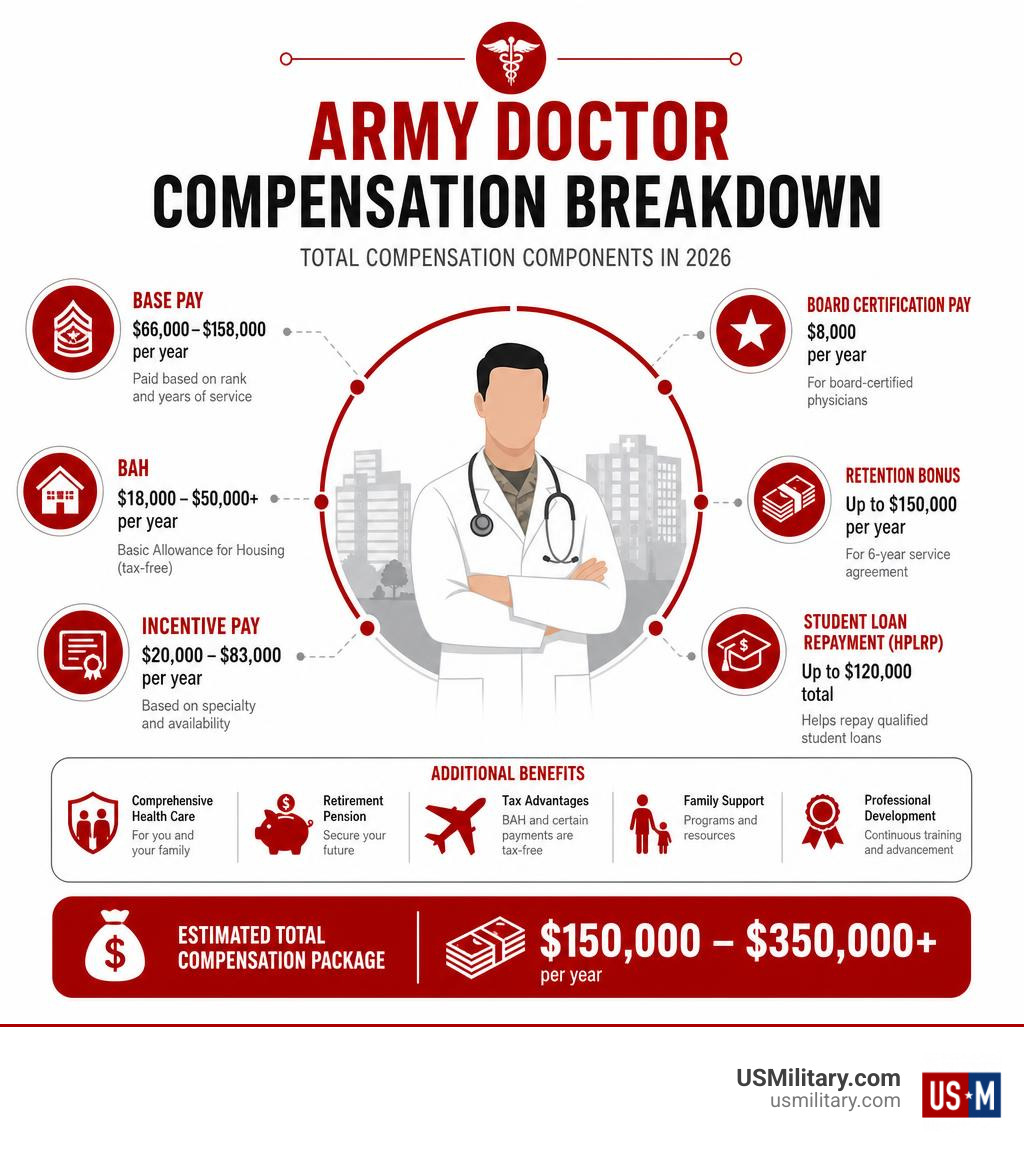
Here’s a quick snapshot of what Army physicians actually earn in 2026:
| Compensation Component | Typical Amount |
|---|---|
| Base pay (O-3 to O-6) | $66,000 – $158,000/year |
| Basic Allowance for Housing (BAH) | $18,000 – $50,000+/year (tax-free) |
| Board Certification Pay | $8,000/year |
| Incentive Pay (by specialty) | $20,000 – $83,000/year |
| Retention Bonus (6-year agreement) | Up to $150,000/year |
| Student Loan Repayment (HPLRP) | Up to $120,000 total |
| Estimated Total Package | $150,000 – $350,000+/year |
The trade-off? Civilian physicians in high-paying specialties like neurosurgery or orthopedics can earn significantly more. Research shows that military attending physicians earn 32% to 58% less than their civilian counterparts after taxes, depending on specialty. At the same time, Army doctors carry no malpractice insurance costs, receive free healthcare for their families, and can enter service with little to no medical school debt.
So is it worth it? The honest answer depends on your specialty, your debt load, your family situation, and what you value in a career.
This guide breaks it all down — rank by rank, dollar by dollar.
I’m Larry Fowler, publisher of USMilitary.com since 2007 and a long-time resource for service members navigating military pay, VA benefits, and career decisions — including the often-overlooked details of Army doctor pay. This guide pulls from official pay tables, peer-reviewed research, and Defense Department sources so you can make a fully informed decision.
Army Doctor Pay in 2026: Base Salary by Rank and Years of Service
Army physicians are commissioned officers in the Medical Corps. Their base pay is not set by specialty, patient volume, RVUs, hospital profit, or how many people ask them, “Can you look at this rash real quick?”
It is based on two things:
- Pay grade, such as O-3 Captain or O-5 Lieutenant Colonel
- Years of creditable military service
For 2026, military base pay reflects a 3.8% increase. You can compare broader officer pay using our 2026 military pay chart and review official health profession pay references through the Official military pay tables.
Here is a simplified 2026 base pay estimate for common Army physician ranks:
| Rank | Typical Physician Career Stage | Approx. Monthly Base Pay | Approx. Annual Base Pay |
|---|---|---|---|
| O-3 Captain | New physician, resident, early attending | $5,534 – $9,004 | $66,410 – $108,050 |
| O-4 Major | Experienced physician, many attendings | $7,386 – $10,000+ | $88,600 – $120,000+ |
| O-5 Lieutenant Colonel | Senior attending, department leadership | $8,500 – $11,800+ | $102,000 – $142,000+ |
| O-6 Colonel | Senior leader, consultant, command roles | $10,000 – $13,183+ | $120,000 – $158,196+ |
These are base-pay-only figures. They do not include BAH, BAS, board certification pay, incentive pay, retention bonuses, deployment-related pay, loan repayment, retirement value, or healthcare benefits.
How army doctor pay changes from O-3 Captain to O-6 Colonel
Most physicians enter the Army Medical Corps at O-3 Captain after medical school, although some may enter at O-4 Major depending on specialty training, prior service, experience, and constructive service credit.
Constructive service credit is the Army’s way of acknowledging that becoming a physician took a few more years than learning how to make coffee in college. Medical school, residency, fellowship, board certification, and prior commissioned service may all affect starting grade and date of rank.
A typical active-duty physician career path may look like this:
| Rank | Title | Common Timeline |
|---|---|---|
| O-3 | Captain | Entry-level physician, resident, or early attending |
| O-4 | Major | Often reached after several years of service |
| O-5 | Lieutenant Colonel | Mid-career to senior physician |
| O-6 | Colonel | Senior physician leader or command-level role |

Promotions are not automatic, but physicians often see advancement roughly every five to six years if they remain competitive, meet professional requirements, and stay in long enough.
Prior enlisted or prior officer service can also change the math. A physician with prior military service may receive higher longevity credit, which can push base pay above a brand-new officer at the same rank.
What the “average” Army physician base salary really means
When people ask for the average Army physician salary, they usually want one clean number. Unfortunately, military pay is not that tidy.
A realistic base-pay-only average for many active-duty Army physicians in 2026 is roughly $115,000 to $135,000 per year, especially for physicians serving as O-4 Majors or O-5 Lieutenant Colonels with several years in uniform.
But that “average” can be misleading because:
- A new O-3 physician may earn closer to the mid-$60,000s in base pay.
- A senior O-6 physician may reach about $158,000 in base pay.
- Specialty does not change base pay.
- Location does not change base pay.
- Bonuses and allowances are separate.
- Housing allowance can change total compensation dramatically.
That is why published Army doctor salary ranges often show something like $41,724 to $158,196 per year. The low end may reflect earlier officer pay, trainee status, or older reported figures. The high end is closer to senior officer base pay.
The key point: base salary is only the floor, not the full paycheck.
Why years of service matter as much as rank
In the military, time matters. Officer pay increases with longevity, usually at set year-of-service points such as over 2, over 4, over 6, over 8, over 10, over 14, and over 20 years.
That means two Army doctors can both be Majors, but one may earn noticeably more if they have more creditable service.
Years of service may include:
- Active-duty time
- Certain prior service
- Time in military residency
- Time after commissioning
- Constructive credit in some accession cases
For a physician, this matters because residency and fellowship can overlap with military service depending on the training pathway. A doctor who trained through an Army program may build years of service earlier than someone who joins later as a fully trained civilian physician.
For a broader look at military pay basics, see our guide on how much you will earn on active duty in 2026.
Beyond Base Pay: Allowances, Special Pays, and Bonuses for Army Doctors
If we stopped at base pay, we would badly understate army doctor pay.
Army physicians may receive several additional forms of compensation:
- Basic Allowance for Housing, or BAH
- Basic Allowance for Subsistence, or BAS
- Board Certification Pay
- Incentive Pay
- Retention Bonus
- Deployment-related pays
- Family separation allowance in qualifying situations
- Loan repayment or scholarship value
The official Medical Corps special pay tables are published through DFAS. You can review the Official Medical Corps special pay tables for current board certification, incentive pay, and retention bonus figures.
Basic Allowance for Housing and Subsistence
BAH is one of the most important parts of Army physician compensation because it is generally tax-free.
BAH depends on:
- Duty station ZIP code
- Rank
- Whether the officer has dependents
- Local housing costs
In lower-cost areas, BAH might be around $18,000 to $25,000 per year. In high-cost areas, it can exceed $30,000 to $50,000 per year. Because BAH is not taxed, its real value can be higher than an equivalent taxable civilian salary increase.
For example, $40,000 in tax-free BAH may feel more like a much larger taxable raise depending on your federal and state tax situation.
BAS is smaller but still helpful. Officer BAS is paid monthly to help offset food costs. For 2026, officer BAS is often cited around the low-$300-per-month range, or roughly $4,000 annually. It is not steakhouse money, but it is real money.
PCS moves can change BAH quickly. A physician stationed in a high-cost market may see a much larger housing allowance than one stationed in a lower-cost area. That variability is one reason total Army doctor compensation can look very different from one installation to another.
Board Certification Pay, Incentive Pay, and Retention Bonus
Board Certification Pay is one of the simplest physician-specific pays. For Medical Corps officers, board certification pay is listed at $8,000 per year, paid monthly on a prorated basis.
Incentive Pay and Retention Bonuses are where compensation can jump.
Common examples include:
| Specialty or Category | Example Pay Feature |
|---|---|
| General Medical Officer | Incentive Pay around $20,000 |
| Family Medicine | Retention Bonus can reach around $60,000 with longer agreements |
| Anesthesiology | High Incentive Pay and Retention Bonus potential |
| Orthopedics | Retention Bonus can reach around $125,000 |
| Neurosurgery | Highest listed levels, up to around $150,000 in some 6-year structures |
In general:
- Incentive Pay is usually tied to specialty and qualification.
- Retention Bonus is tied to signing a service agreement.
- Longer agreements can produce higher annual bonus rates.
- High-demand specialties usually receive larger incentives.
These figures can change by fiscal year, specialty, service policy, and eligibility. Always verify the current table and talk with an Army Medical Department recruiter or personnel office before making a career decision.
Specialty examples: primary care vs surgical subspecialties
The Army does not pay all physicians the same once special pays are included.
A Family Medicine physician and a neurosurgeon at the same rank may have the same base pay, but their total compensation can differ substantially because of incentive and retention pay.
Primary care specialties may include:
- Family Medicine
- Internal Medicine
- Pediatrics
- Psychiatry
Higher-bonus specialties may include:
- Anesthesiology
- General Surgery
- Orthopedics
- Neurosurgery
- Cardiology
- Radiology
- Emergency Medicine
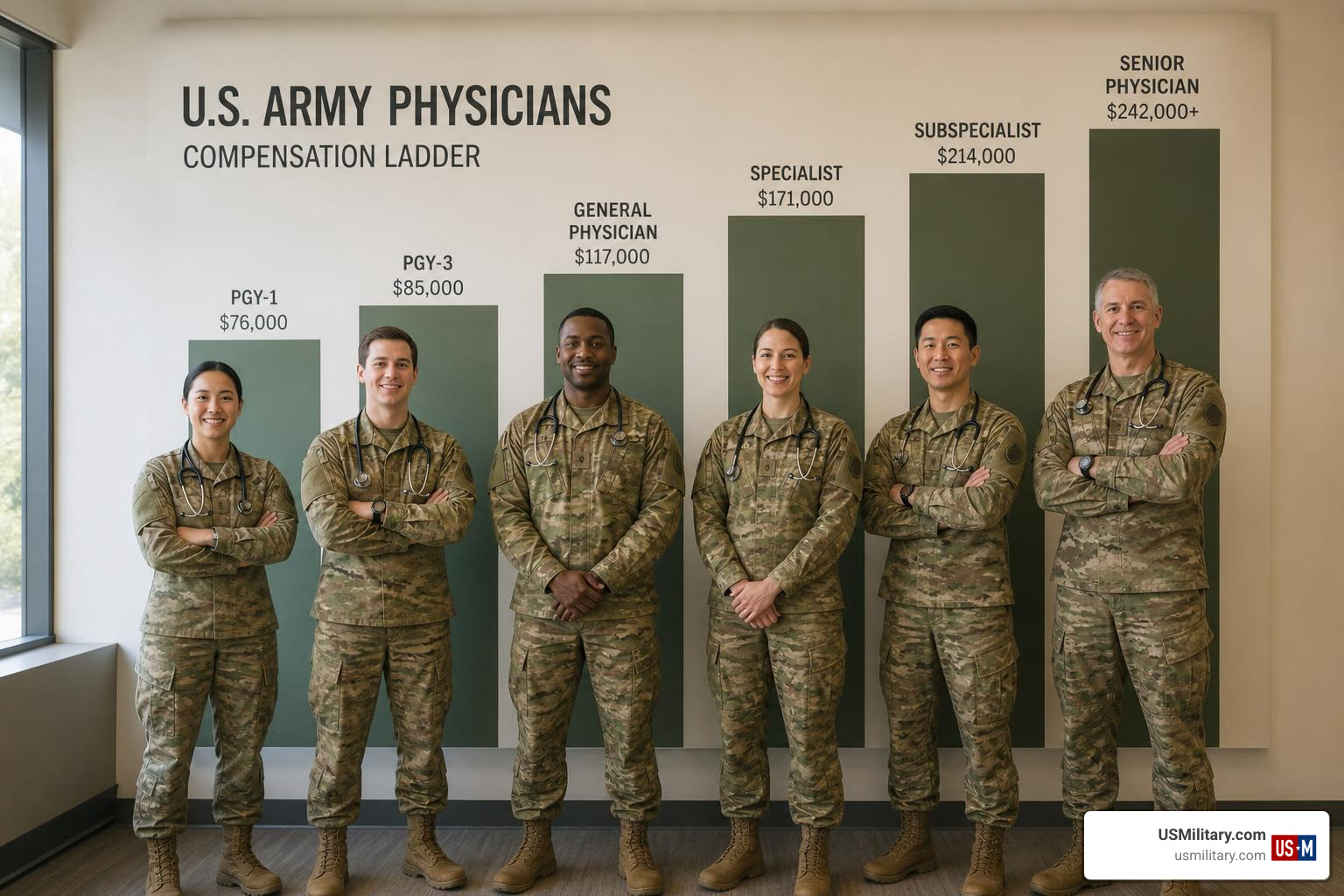
The spread matters. A primary care Army doctor may see total compensation that is competitive with some civilian options, especially after tax-free allowances, healthcare, pension value, and debt reduction. A high-earning surgical specialist, however, may face a much larger civilian-military pay gap.
Army Physician Pay vs Civilian Physician Salary
This is where the conversation gets more complicated.
Army physicians often do better than civilian physicians during training, especially if they receive military pay, allowances, and debt-free medical education. But as fully trained attendings, many civilian physicians, especially specialists, earn more.
Research comparing military and civilian physician compensation found:
- Military residents earned about 53% more than civilian residents after taxes.
- Military attending physicians earned about 32% to 58% less than civilian attendings after taxes, depending on specialty.
- Even tax-free allowances did not fully close the gap for many specialties.
- At senior ranks, many military specialties still remained below the 20th percentile of civilian compensation.
That does not mean Army medicine is a bad financial choice. It means the answer depends heavily on specialty, debt, family needs, retirement planning, and career priorities.
Primary care comparison: Family Medicine, Internal Medicine, Pediatrics, Psychiatry
Primary care is where Army physician compensation can look strongest.
Civilian primary care physicians often earn less than procedural and surgical specialists. That narrows the pay gap between military and civilian practice.
For a Family Medicine physician, total Army compensation may include:
- Base pay
- BAH
- BAS
- $8,000 board certification pay
- Incentive pay
- Retention bonus
- Healthcare for the family
- Pension eligibility
- TSP matching under the Blended Retirement System
- Loan repayment or HPSP value
A civilian primary care physician may still earn more in salary, but must also consider:
- Student loan payments
- Malpractice coverage, depending on employer
- Health insurance premiums
- Retirement plan differences
- Business risk if in private practice
- State and federal tax effects
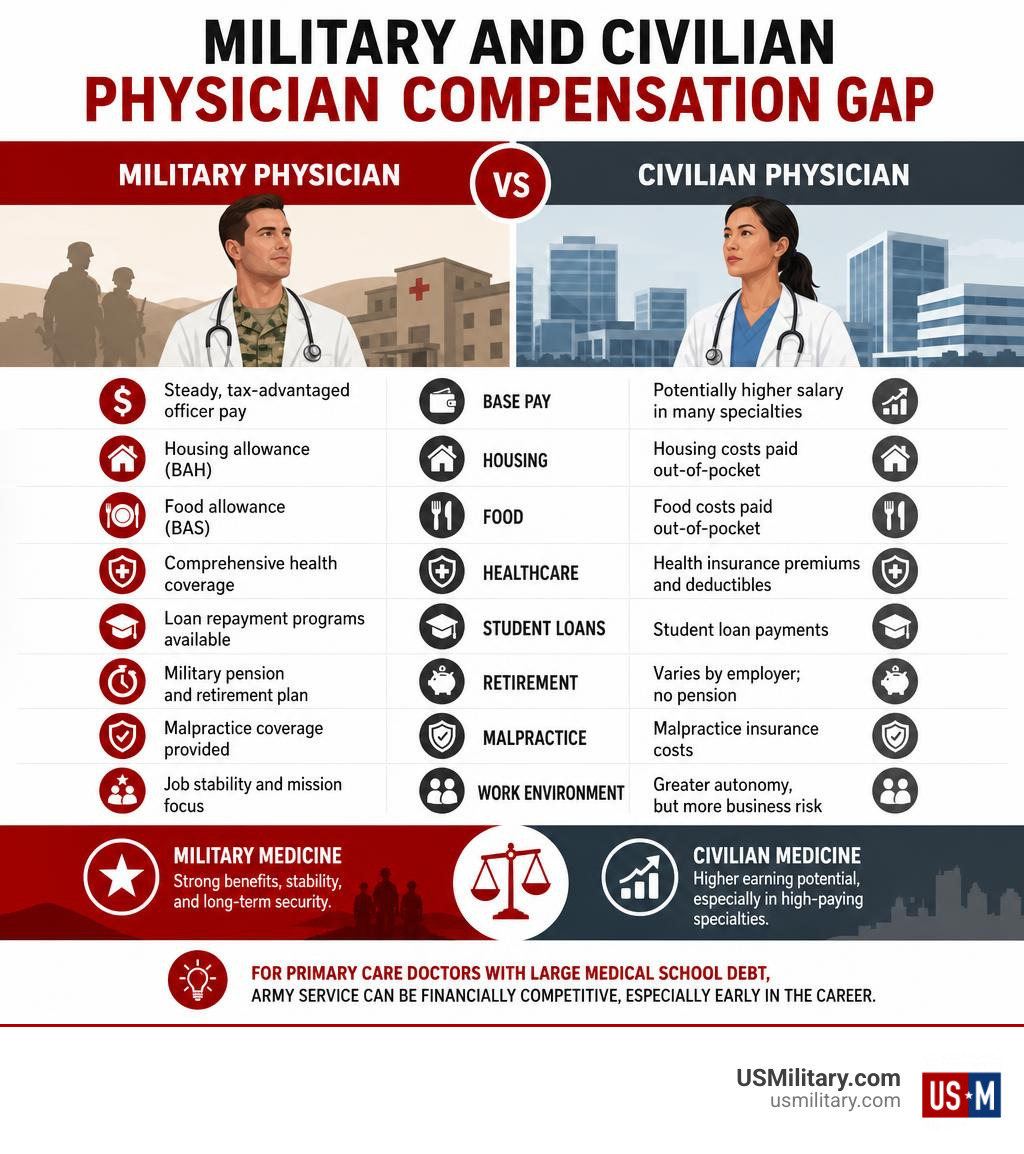
For primary care doctors with large medical school debt, Army service can be financially competitive, especially early in the career.
High-paying specialty comparison: Anesthesiology, Surgery, Orthopedics, Neurosurgery
For high-paying specialties, the civilian market often wins on gross income.
This is especially true for:
- Neurosurgery
- Orthopedic Surgery
- Anesthesiology
- General Surgery
- Some cardiology and radiology roles
Studies and specialty comparisons have shown that even an O-6 military physician can fall below the 20th percentile of civilian pay in many specialties. One widely cited example found an O-6 military neurosurgeon could earn roughly $300,000 less than the 20th percentile and about $500,000 less than the civilian median.
Orthopedics also shows a large gap, with senior military orthopedic surgeons often earning far less than their civilian peers.
This is the opportunity cost of military medicine. The Army can offer mission, stability, benefits, pension, and debt-free education, but it usually cannot match private-sector compensation for the highest-paid specialties.
Why army doctor pay can look better during residency but worse as an attending
Military medicine often flips the normal physician financial timeline.
During residency, military physicians may receive officer pay, BAH, BAS, and benefits. Civilian residents, by comparison, often earn modest salaries while carrying large student loan balances.
That creates an early advantage for military doctors.
But after training, civilian attending salaries rise sharply. Military attending pay rises too, but more slowly because it is tied to rank, years of service, and special pay tables.
So the financial pattern often looks like this:
| Career Stage | Military Advantage? | Why |
|---|---|---|
| Medical school | Often yes | HPSP or USUHS may reduce or eliminate tuition debt |
| Residency | Often yes | Officer pay and allowances can exceed civilian resident pay |
| Early attending | Depends | Loan repayment and BAH may help |
| Mid-career specialist | Often no | Civilian specialty income may be much higher |
| 20-year career | Depends | Pension and healthcare value can offset some gap |
For some physicians, especially those in primary care or those with high debt, the Army can build net worth faster early on. For high-income specialists, the civilian pay gap may eventually dominate.
Education Incentives, Benefits, and Lifestyle Trade-Offs
The Army doctor pay question is not just, “How much is the paycheck?”
It is also:
- Who paid for medical school?
- How much debt did you avoid?
- Do you want a military pension?
- Can your family handle moves?
- Are you willing to deploy?
- Do you want to serve soldiers and military families?
Those are not small questions. They are the difference between “best decision ever” and “why are my household goods in three different states?”
Scholarships and student loan programs that change the math
The Health Professions Scholarship Program, commonly known as HPSP, can cover medical school tuition, required fees, books, and provide a stipend. In exchange, physicians incur an active-duty service obligation.
The Uniformed Services University of the Health Sciences is another military medical school pathway. Students are active-duty officers while training and incur a longer service obligation.
For physicians who already have loans, the Health Professionals Loan Repayment Program may offer up to $120,000 toward qualifying student loans, often described as up to $40,000 per year depending on program rules and eligibility.
These programs can dramatically affect net compensation. Avoiding $200,000 or more in medical school debt can be equivalent to earning a much larger civilian salary, especially once interest is considered.
For a deeper look, see our detailed guide to military medical school costs.
Benefits that add real value beyond salary
Army physicians receive many of the same benefits as other active-duty officers, plus physician-specific compensation.
Important benefits include:
- TRICARE medical coverage for the physician and eligible family members
- Dental coverage options
- 30 days of paid leave per year
- Ability to carry over up to 60 days of leave in many situations
- Malpractice coverage for official military duties
- Thrift Savings Plan access
- Blended Retirement System with government matching
- Pension eligibility after a qualifying career
- VA home loan eligibility
- Servicemembers’ Group Life Insurance, commonly up to $400,000 for a low monthly premium
Active-duty physicians earn 2.5 days of leave per month, totaling 30 days per year. That is a meaningful benefit, especially compared with some civilian medical jobs where vacation depends heavily on employer culture and call coverage.
Malpractice coverage is another major value. Army physicians do not personally pay civilian-style malpractice premiums for official duties. However, moonlighting is different. If a military physician works outside approved military duties, separate malpractice coverage may be required.
For more on military benefits, review our ultimate guide to military benefits.
Service commitments and lifestyle costs to weigh
Now for the part recruiters may not put in the first brochure: military medicine comes with real trade-offs.
Army physicians may face:
- Active-duty service obligations
- Deployment risk
- Frequent PCS moves
- Limited control over location
- Military bureaucracy
- Command requirements
- Operational medicine responsibilities
- Administrative duties unrelated to clinical care
- Moonlighting restrictions
- Family disruption
HPSP, USUHS, residency training, bonuses, and loan repayment can each create service obligations. These obligations may run concurrently or consecutively depending on program rules, so physicians should get the details in writing before signing.
Deployment is also part of the deal. Army doctors may serve in hospitals, clinics, field environments, combat support hospitals, operational units, or overseas assignments. Some physicians find this mission deeply meaningful. Others find the unpredictability difficult.
Neither view is wrong. The Army is not just an employer. It is a military commitment.
Active-duty vs Reserve and Guard Army doctor pay
Active-duty Army physicians serve full time. Reserve and Army National Guard physicians generally serve part time while often maintaining civilian medical careers.
Reserve Component pay may include:
- Drill pay
- Annual training pay
- Active-duty pay when mobilized
- Specialty bonuses
- Accession bonuses
- Retention bonuses
- TRICARE Reserve Select eligibility, if qualified
- Retirement credit toward a Reserve retirement
Reserve Component medical bonuses vary by specialty. FY2026 tables show maximum annual accession or retention bonus amounts ranging roughly from $25,000 to $75,000, with some surgical and high-demand specialties at the higher end.
Examples include:
| Specialty | Possible Reserve Component Bonus Level |
|---|---|
| Family Medicine | Around $25,000 |
| Psychiatry | Around $35,000 |
| Emergency Medicine | Around $50,000 |
| Anesthesiology | Around $50,000 |
| General Surgery | Up to around $75,000 |
| Orthopedic Surgery | Up to around $75,000 |
| Neurosurgery | Up to around $75,000 |
For drill pay basics, see our National Guard pay chart. You can also review the official Reserve Component medical bonus table.
The Reserve or Guard route can be attractive for physicians who want to keep civilian earning power while serving part time. But mobilizations, training, credentialing, and administrative requirements still affect civilian practice and family life.
Frequently Asked Questions About Army Doctor Pay
Is army doctor pay higher than civilian doctor pay?
Sometimes, but usually not for high-paying specialties.
Army doctor compensation may be competitive with civilian pay for some primary care physicians, especially when you include:
- Tax-free BAH
- BAS
- Board certification pay
- Incentive pay
- Retention bonuses
- Free or low-cost healthcare
- Loan repayment
- Pension value
- No malpractice premiums for official duties
However, civilian physicians in specialties like neurosurgery, orthopedics, anesthesiology, cardiology, and some surgical fields often earn much more.
The clean answer:
- During residency: Army physicians often do better financially.
- In primary care: Army total compensation can be competitive.
- In high-paying specialties: civilian pay is usually higher.
- Over a full career: the answer depends on debt, pension, specialty, taxes, and lifestyle.
What starting rank does a licensed Army doctor receive?
Many licensed physicians enter as an O-3 Captain. Some may enter as an O-4 Major depending on their training, specialty, prior service, and constructive service credit.
Factors that may influence starting rank include:
- Medical degree
- Internship completion
- Residency completion
- Fellowship training
- Board certification
- Prior commissioned service
- Prior enlisted service
- Specialty demand
- Army Medical Corps accession policy at the time
A fully trained specialist is more likely to receive additional constructive credit than someone entering right after medical school. Final rank and date of rank are determined through Army review, not a handshake estimate.
How can an Army physician maximize total compensation?
Army physicians can improve total compensation by planning carefully.
Smart moves may include:
- Maintain board certification to qualify for Board Certification Pay.
- Understand Incentive Pay and Retention Bonus timing before signing.
- Consider longer retention agreements if they fit your career plan.
- Choose high-demand specialties if aligned with your medical interests.
- Track promotion requirements and professional military education.
- Use tax-free BAH strategically.
- Contribute to the TSP, especially enough to capture matching.
- Evaluate loan repayment before refinancing student loans.
- Compare active-duty, Reserve, and Guard options.
- Keep excellent records of service obligations.
- Get tax guidance for multi-state military family issues.
For related career research, see our guide to top six-figure military jobs.
Conclusion
So, is Army doctor pay worth it?
For some physicians, yes. Absolutely.
Army medicine can be a strong financial choice if you value debt-free medical education, stable officer pay, tax-free allowances, family healthcare, retirement benefits, and the mission of caring for soldiers and their families.
It can be especially attractive for:
- Future physicians who want HPSP or USUHS
- Doctors with large student loan balances
- Primary care physicians
- Physicians who want military service and leadership
- Families who value healthcare and retirement stability
- Doctors who want a mission beyond private practice revenue
But it may be less attractive for:
- High-earning surgical subspecialists focused on maximum income
- Physicians who need geographic control
- Families unable to tolerate frequent moves
- Doctors who want full autonomy over practice style
- Anyone unwilling to accept deployment risk
The best way to compare military and civilian medicine is not just salary versus salary. Compare net worth, taxes, debt, benefits, pension, malpractice costs, family needs, and quality of life.
At USMilitary.com, we believe the right decision starts with clear information. Army doctor pay is not simple, but once you break it into base pay, allowances, bonuses, benefits, and obligations, the picture becomes much clearer.
If you are exploring military medical careers or other high-paying roles in uniform, start here: Explore high-paying military careers.