
The Most Common Army VA Disability Claims in 2026

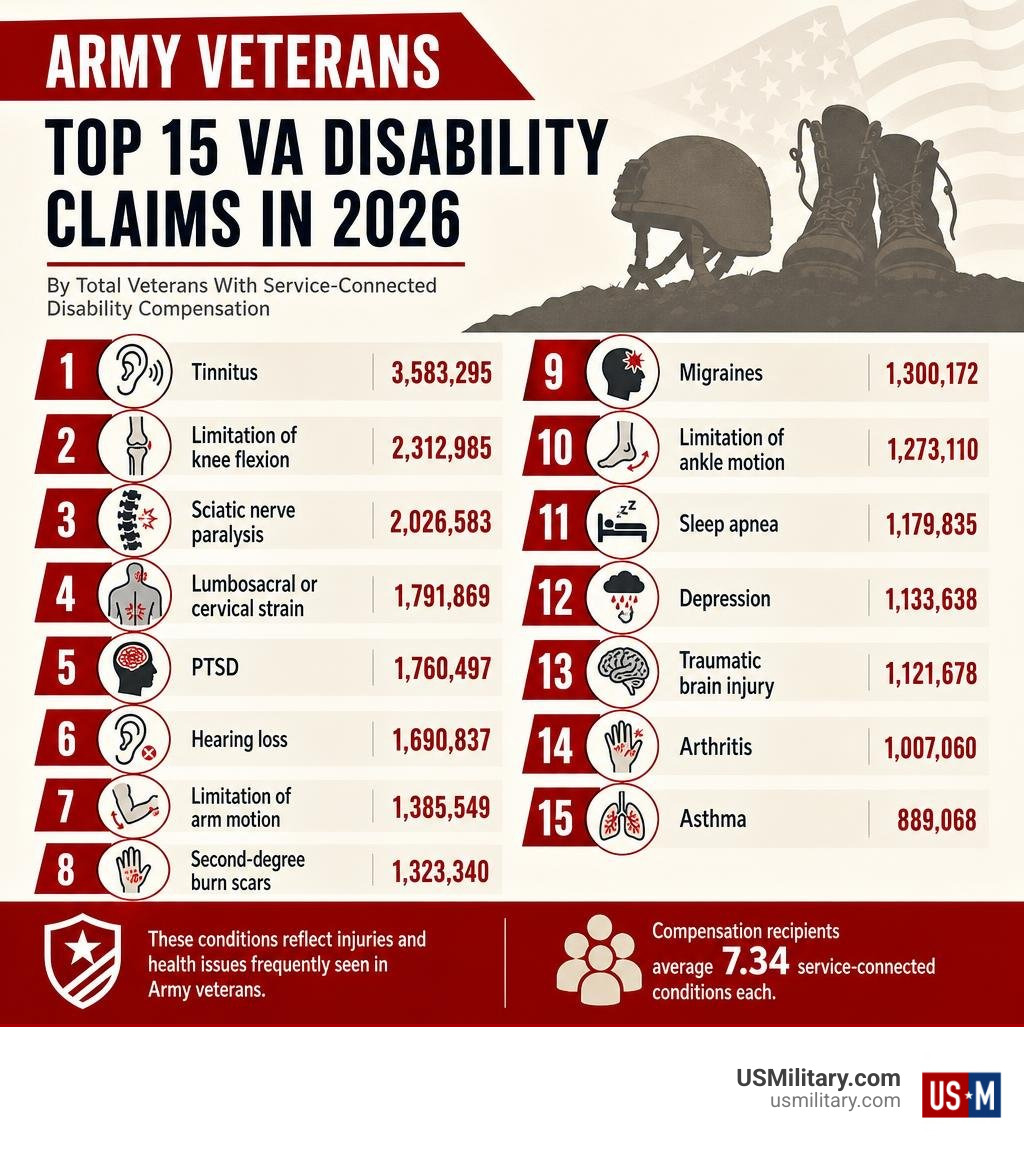
The 15 VA Disability Ratings With Highest Army Claims in 2026 are led by tinnitus, knee-flexion limits, sciatic nerve paralysis, back or neck strain, PTSD, and hearing loss. The latest VA data is for all compensation recipients, not Army-only claims, but these conditions closely reflect injuries and health issues frequently seen in Army veterans.
The top conditions include:
- Tinnitus – 3,583,295 veterans
- Limitation of knee flexion – 2,312,985
- Sciatic nerve paralysis – 2,026,583
- Lumbosacral or cervical strain – 1,791,869
- PTSD – 1,760,497
- Hearing loss – 1,690,837
- Limitation of arm motion – 1,385,549
- Second-degree burn scars – 1,323,340
- Migraines – 1,300,172
- Limitation of ankle motion – 1,273,110
The full list also examines common claims such as sleep apnea, depression, traumatic brain injury, arthritis, asthma, and sinusitis. A high claim count does not guarantee a high rating. For example, tinnitus is generally capped at 10%, while PTSD, severe migraines, serious nerve damage, and some respiratory or brain-injury conditions can support much higher evaluations when the evidence meets VA rules.
VA records show that compensation recipients average 7.34 service-connected conditions each. That matters because VA uses combined-rating math rather than simple addition. A strong claim often includes the main condition, its documented symptoms, and medically supported secondary conditions.
I am Larry Fowler, publisher of the USMilitary.com Network since 2007, where I have helped connect active-duty members and veterans with practical information on VA benefits, compensation trends, and the 15 VA Disability Ratings With Highest Army Claims in 2026. Next, review the conditions and the rating ranges veterans may see under VA’s schedule.
Easy 15 VA Disability Ratings With Highest Army Claims in 2026 glossary:
15 VA Disability Ratings With Highest Army Claims in 2026
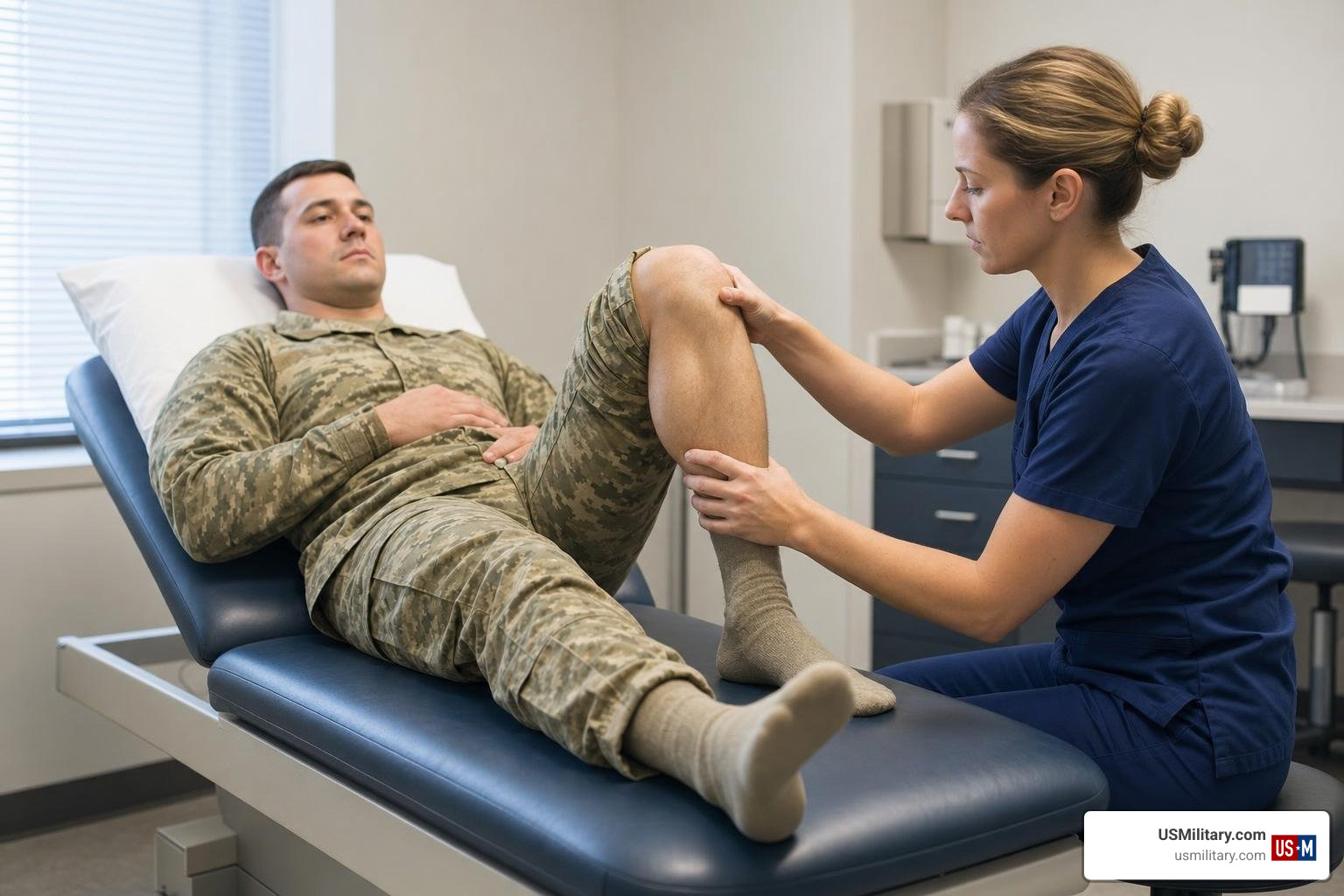
Army service places immense strain on the human body. Ruck marching with heavy loads, constant weapons firing, airborne operations, vehicle vibrations, and combat deployments take a compounding toll on soldiers.
When filing claims, the Department of Veterans Affairs evaluates conditions under the VA Schedule for Rating Disabilities (VASRD). Knowing how each condition is scheduled and rated under official diagnostic codes helps ensure you present the right medical evidence for your evaluation.
Top Musculoskeletal and Sensory Diagnoses Among the 15 VA Disability Ratings With Highest Army Claims in 2026
Musculoskeletal and sensory impairments account for the largest volume of service-connected disabilities among Army veterans. Below are the primary diagnostic codes and rating criteria for these top physical conditions:
- Tinnitus (Diagnostic Code 6260):
- Prevalence: 3,583,295 total cases (287,138 new recipients in FY 2025).
- Typical Rating: 10%.
- Details: Tinnitus provides a flat 10% rating regardless of whether the persistent ringing is in one ear or both ears.
- Limitation of Flexion of the Knee (Diagnostic Code 5260):
- Prevalence: 2,312,985 total cases (162,407 new recipients in FY 2025).
- Typical Ratings: 0%, 10%, 20%, 30%.
- Details: Evaluated using a goniometer to measure the range of motion before pain begins. Flexion limited to 45 degrees yields 10%, limited to 30 degrees yields 20%, and limited to 15 degrees yields 30%.
- Paralysis of the Sciatic Nerve / Sciatica (Diagnostic Code 8520):
- Prevalence: 2,026,583 total cases.
- Typical Ratings: 10% (mild), 20% (moderate), 40% (moderately severe), 60% (severe/incomplete), 80% (complete paralysis).
- Details: Commonly diagnosed secondary to lower back trauma, causing radiating numbness, tingling, and motor weakness down the leg.
- Lumbosacral or Cervical Strain (Diagnostic Code 5237):
- Prevalence: 1,791,869 total cases (141,191 new recipients in FY 2025).
- Typical Ratings: 10%, 20%, 40%, 50%, 100%.
- Details: Evaluated by forward flexion of the spine. Forward flexion greater than 60 degrees but not greater than 85 degrees is rated at 10%; forward flexion of 30 degrees or less warrants 40%. Full ankylosis of the entire spine qualifies for 100%. You can check the complete musculoskeletal breakdown in our VA disability rating chart guide 2026.
- Bilateral Hearing Loss (Diagnostic Code 6100):
- Prevalence: 1,690,837 total cases (104,664 new recipients in FY 2025).
- Typical Ratings: 0%, 10%, 30%, 50%, up to 100%.
- Details: Assessed using specialized pure-tone audiometry and Maryland CNC speech discrimination testing. Many veterans receive a 0% non-compensable rating, which still establishes service connection for future medical care and hearing aids.
- Limitation of Motion of the Arm (Diagnostic Code 5201):
- Prevalence: 1,385,549 total cases (123,895 new recipients in FY 2025).
- Typical Ratings: 20%, 30%, 40%.
- Details: Arm movement restricted at shoulder level is rated based on whether it affects the dominant (major) or non-dominant (minor) arm.
- Limitation of Motion of the Ankle (Diagnostic Code 5271):
- Prevalence: 1,273,110 total cases.
- Typical Ratings: 10% (moderate limitation of motion), 20% (marked limitation).
- Details: Arises from chronic sprains, airborne landings, fracture repairs, or ankle instability.
- Degenerative Arthritis of the Spine or Major Joints (Diagnostic Code 5003):
- Prevalence: Over 1,000,000 combined cases.
- Typical Ratings: 10% or 20%.
- Details: Rated based on X-ray confirmation of arthritis with painful motion across two or more major joint groups.
Mental Health and Systemic Conditions Among the 15 VA Disability Ratings With Highest Army Claims in 2026
Beyond orthopedic injuries, psychological trauma, blast wave exposure, toxic hazards, and sleep disorders represent some of the highest-rated service-connected claims:
- Post-Traumatic Stress Disorder – PTSD (Diagnostic Code 9411):
- Prevalence: 1,760,497 total cases.
- Typical Ratings: 0%, 10%, 30%, 50%, 70%, 100%.
- Details: Rated under the general rating formula for mental disorders. A 70% rating reflects occupational and social impairment in most areas (deficiencies in judgment, mood, thinking), while a 100% rating requires total occupational and social impairment.
- Scars, Burns (2nd Degree) and General Scars (Diagnostic Code 7801-7805):
- Prevalence: 1,323,340 total cases.
- Typical Ratings: 10%, 20%, 30%, up to 80%.
- Details: Rated on total surface area, depth, pain, and tissue adherence across anatomical body zones.
- Migraine Headaches (Diagnostic Code 8100):
- Prevalence: 1,300,172 total cases.
- Typical Ratings: 0%, 10%, 30%, 50%.
- Details: A 50% rating requires characteristic prostrating attacks occurring on average once a month over several months, resulting in severe economic or workplace disruption.
- Obstructive Sleep Apnea – OSA (Diagnostic Code 6847):
- Prevalence: Over 1,100,000 cases.
- Typical Ratings: 0%, 30%, 50%, 100%.
- Details: A 50% rating is awarded when a continuous positive airway pressure (CPAP) machine is medically required. Check recent diagnostic updates in our overview of 2026 VA disability changes.
- Major Depressive Disorder (Diagnostic Code 9434):
- Prevalence: Over 950,000 cases.
- Typical Ratings: 10%, 30%, 50%, 70%, 100%.
- Details: Evaluated alongside the mental health rating criteria. If a veteran already has a rating for PTSD, the VA combines the psychological symptoms into a single rating to prevent pyramiding.
- Traumatic Brain Injury – TBI (Diagnostic Code 8045):
- Prevalence: Over 450,000 cases.
- Typical Ratings: 0%, 10%, 40%, 70%, 100%.
- Details: Evaluated across 10 distinct facets of cognitive and emotional functioning, including memory, communication, visual-spatial orientation, and motor control.
- Bronchial Asthma and Chronic Sinusitis (Diagnostic Codes 6602 / 6510-6514):
- Prevalence: Over 800,000 combined cases.
- Typical Ratings: 10%, 30%, 50% (Asthma); 0%, 10%, 30%, 50% (Sinusitis).
- Details: Commonly claimed under presumptive toxic exposure rules. Asthma requiring daily inhaler therapy warrants 30%, while monthly courses of oral corticosteroids justify 50%. Chronic sinusitis with non-curative radical surgery or constant purulent discharge receives up to 50%.
2026 VA Compensation Rates and Combined Rating Calculations
VA disability payments provide tax-free financial compensation to veterans injured or sickened during military service. The official rates are adjusted annually to match the federal Cost-of-Living Adjustment (COLA) effective December 1 of the prior calendar year.
Below are the Current Veterans Disability Compensation Rates for the 2026 calendar year across standard rating brackets.
| Disability Rating | Basic Monthly Rate (Veteran Alone) | With Dependent Spouse | With Spouse & 1 Minor Child |
|---|---|---|---|
| 10% | $180.42 | N/A (No dependent rate) | N/A (No dependent rate) |
| 20% | $356.66 | N/A (No dependent rate) | N/A (No dependent rate) |
| 30% | $552.47 | $617.47 | $666.47 |
| 40% | $795.84 | $882.84 | $948.84 |
| 50% | $1,132.90 | $1,241.90 | $1,323.90 |
| 60% | $1,435.02 | $1,566.02 | $1,664.02 |
| 70% | $1,808.45 | $1,960.45 | $2,074.45 |
| 80% | $2,102.15 | $2,276.15 | $2,407.15 |
| 90% | $2,362.30 | $2,558.30 | $2,705.30 |
| 100% | $3,938.58 | $4,157.58 | $4,318.99 |
Note: Veterans with a 10% or 20% rating receive a flat monthly payout and do not qualify for additional dependent allowances. At ratings of 30% and higher, additional allowances apply for children under 18, children in qualifying school programs, dependent parents, and spouses requiring Aid and Attendance ($141.00/mo at 70%, $196.00/mo at 100%).
Monthly Payouts by Disability Percentage and Dependent Status
Monthly benefit levels step up significantly at higher tiers. The jump from 80% ($2,102.15 basic) or 90% ($2,362.30 basic) to a full 100% rating ($3,938.58 basic) is dramatic.
To review exact rates, family scenarios, and dependent calculations, consult our dedicated VA disability pay chart 2026 and our detailed breakdown of VA 100 disability pay 2026.
Average Disability Numbers and Combined Rating Thresholds
The VA does not use standard addition to total multiple disabilities. Instead, they apply a non-additive combined rating schedule known colloquially as “VA Math.”
Every veteran begins with a 100% “healthy” whole person efficiency. Each condition reduces that remaining efficiency:
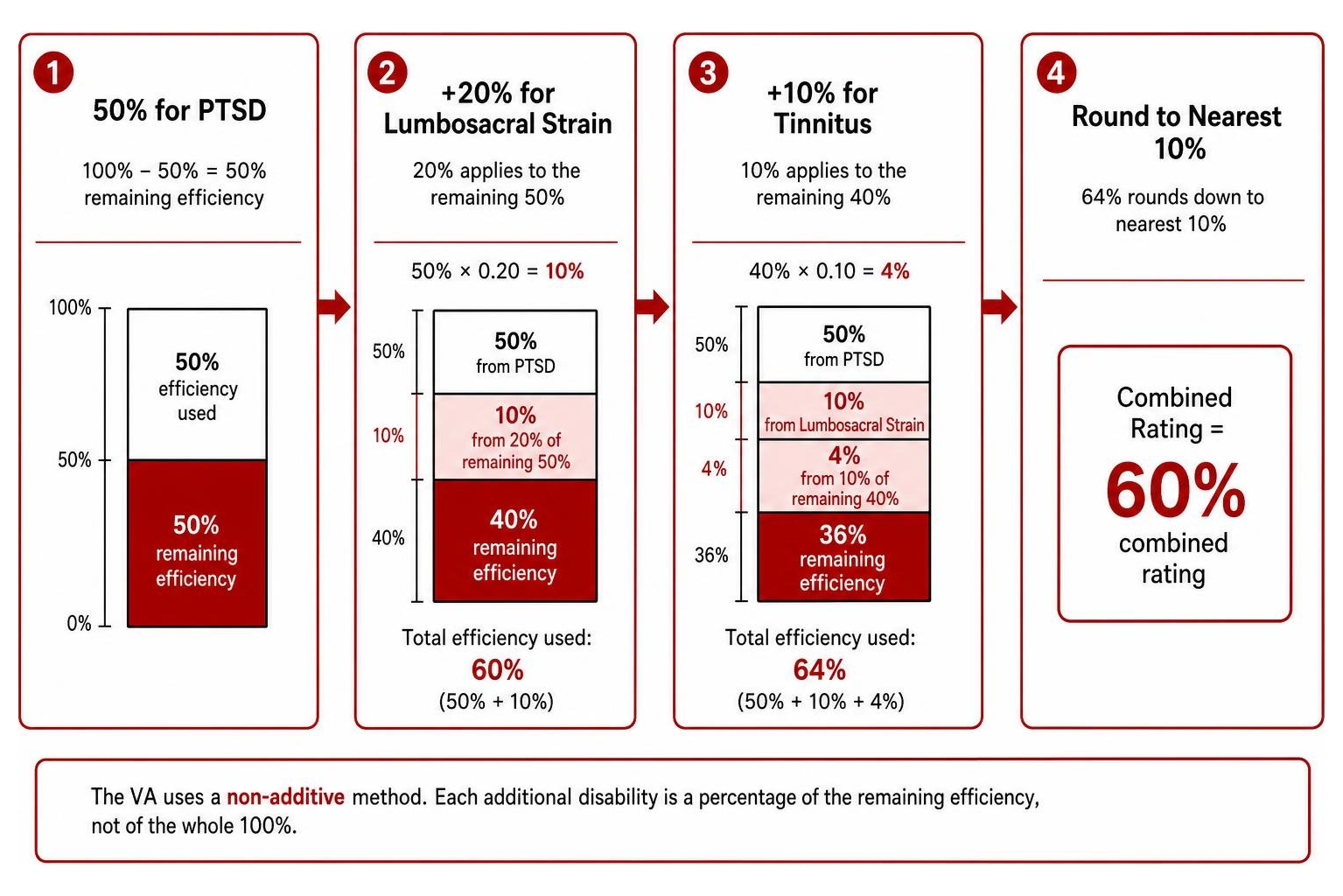
- A veteran awarded 50% for PTSD leaves 50% remaining efficiency (100 – 50 = 50).
- If awarded 20% for lumbosacral strain, that 20% applies only to the remaining 50% ($50 \times 0.20 = 10\%$). Total efficiency used: $50 + 10 = 60\%$. Remaining efficiency: 40%.
- If awarded 10% for tinnitus, that 10% applies to the remaining 40% ($40 \times 0.10 = 4\%$). Total combined score: $60 + 4 = 64\%$.
- The VA rounds $64\%$ down to the nearest 10% increment: 60% combined rating.
According to official VBA data, compensation recipients average 7.34 service-connected disabilities per veteran. For Global War on Terror (GWOT) veterans, that number rises to 9.61 disabilities. In total, 1,847,449 veterans hold a 100% combined rating—representing over 29% of all recipients and more than $93.8 billion in annual payouts.
Additionally, disabilities affecting paired extremities (such as both knees or both ankles) receive a 10% bilateral factor bonus added to the combined rating before final rounding. You can calculate your combined score quickly using the 2026 VA disability calculator.
Proven Strategies to Increase Army VA Disability Ratings

Many veterans are initially awarded low ratings (10% or 20%) for common injuries that worsen over decades. Achieving a higher rating requires structured medical documentation and clear evidence of increasing impairment.
Establishing Medical Nexus and Secondary Service Connection
Filing for secondary conditions is one of the most reliable ways to increase an overall rating. A secondary condition is a new illness or injury caused or aggravated by an existing service-connected disability.
Common secondary claims among Army veterans include:
- Sciatica and Radiculopathy secondary to service-connected lumbar spine strain.
- Migraines secondary to service-connected tinnitus, neck injuries, or PTSD.
- Obstructive Sleep Apnea or Depression secondary to service-connected PTSD or chronic joint pain.
- Degenerative Joint Disease (Opposite Limb) caused by altered gait from a service-connected knee or ankle injury.
To secure secondary service connection, you need three key elements:
- A current medical diagnosis of the secondary condition.
- An existing, service-connected primary condition.
- A formal medical nexus letter or completed Disability Benefits Questionnaire (DBQ) from a licensed medical professional stating that it is “at least as likely as not” (50% or greater probability) that the secondary condition was caused by the primary disability.
If you are currently rated at 70% or 80% and looking to bridge the gap, see our walkthrough on how to increase VA disability from 80 to 100.
PACT Act Toxic Exposure and TDIU Eligibility
The PACT Act expanded presumptive service connection for millions of veterans exposed to burn pits, airborne hazards, and toxic substances during operations in Iraq, Afghanistan, and Southwest Asia. If you have a diagnosed respiratory condition, rhinitis, sinusitis, or specific forms of cancer, the law presumes your condition is service-connected without requiring proof of an in-service incident.
If your combined rating does not reach 100% on the schedular table, you may qualify for Total Disability based on Individual Unemployability (TDIU). TDIU pays at the full 100% compensation rate ($3,938.58+ per month) if your service-connected disabilities prevent you from securing substantially gainful employment.
To qualify for standard schedular TDIU, you generally need:
- One service-connected disability rated at 60% or higher, or
- A combined rating of 70% or higher, with at least one individual condition rated at 40% or higher.
Frequently Asked Questions About Army VA Disability Claims
Which of the top 15 Army disability conditions is most likely to qualify for a 100% rating?
Post-Traumatic Stress Disorder (PTSD), severe Traumatic Brain Injury (TBI), and severe respiratory illnesses are the most likely among the top 15 to qualify for an individual 100% schedular rating. A 100% rating for PTSD requires documentation of total occupational and social impairment due to symptoms such as persistent delusions, hallucinations, gross impairment in thought processes, or disorientation to time and place. Musculoskeletal injuries rarely reach 100% on an individual joint basis unless there is complete ankylosis (total joint freezing) of the entire spine or severe limb amputation.
How does the VA calculate ratings for multiple Army musculoskeletal injuries?
The VA uses precise range of motion measurements performed with a goniometer during Compensation and Pension (C&P) examinations. Under the VA’s anti-pyramiding rule (38 CFR § 4.14), you cannot receive multiple ratings for the exact same symptom. However, you can receive separate ratings for distinct functional problems within the same limb—such as separate evaluations for knee flexion limitation (Code 5260), knee extension limitation (Code 5261), and knee instability (Code 5257). When injuries occur on both sides of the body (e.g., both legs or both shoulders), the bilateral factor adds an extra 10% to that subtotal before combining it with your overall score.
How do PACT Act presumptive rules impact Army claims for respiratory conditions in 2026?
The PACT Act removed the burden of proving that your respiratory illness was caused by a specific military event. If you served in qualifying combat zones, airspaces, or operational theaters (including Iraq, Afghanistan, Kuwait, Saudi Arabia, and the broader CENTCOM region), conditions such as chronic asthma, chronic sinusitis, chronic rhinitis, constrictive bronchiolitis, and chronic bronchitis are automatically presumed to be service-connected. Veterans need only provide a current medical diagnosis and qualifying deployment records (such as a DD-214 showing eligible campaign medals or theater service).
Conclusion
Understanding the 15 VA Disability Ratings With Highest Army Claims in 2026 helps you identify the evidence needed to receive fair compensation for your service. With average recipients holding 7.34 service-connected conditions, success depends on documenting every primary ailment, tracking physical limitations with medical imaging and range-of-motion exams, and establishing clear nexus links for secondary conditions.
Never navigate the claims and appeals process alone. Work with an accredited Veteran Service Officer (VSO) from organizations like the VFW, DAV, or American Legion, or partner with a VA-accredited attorney to structure your claim correctly. For continuous updates on military benefits, pay charts, and claims strategy, explore our complete guides across USMilitary.com.