

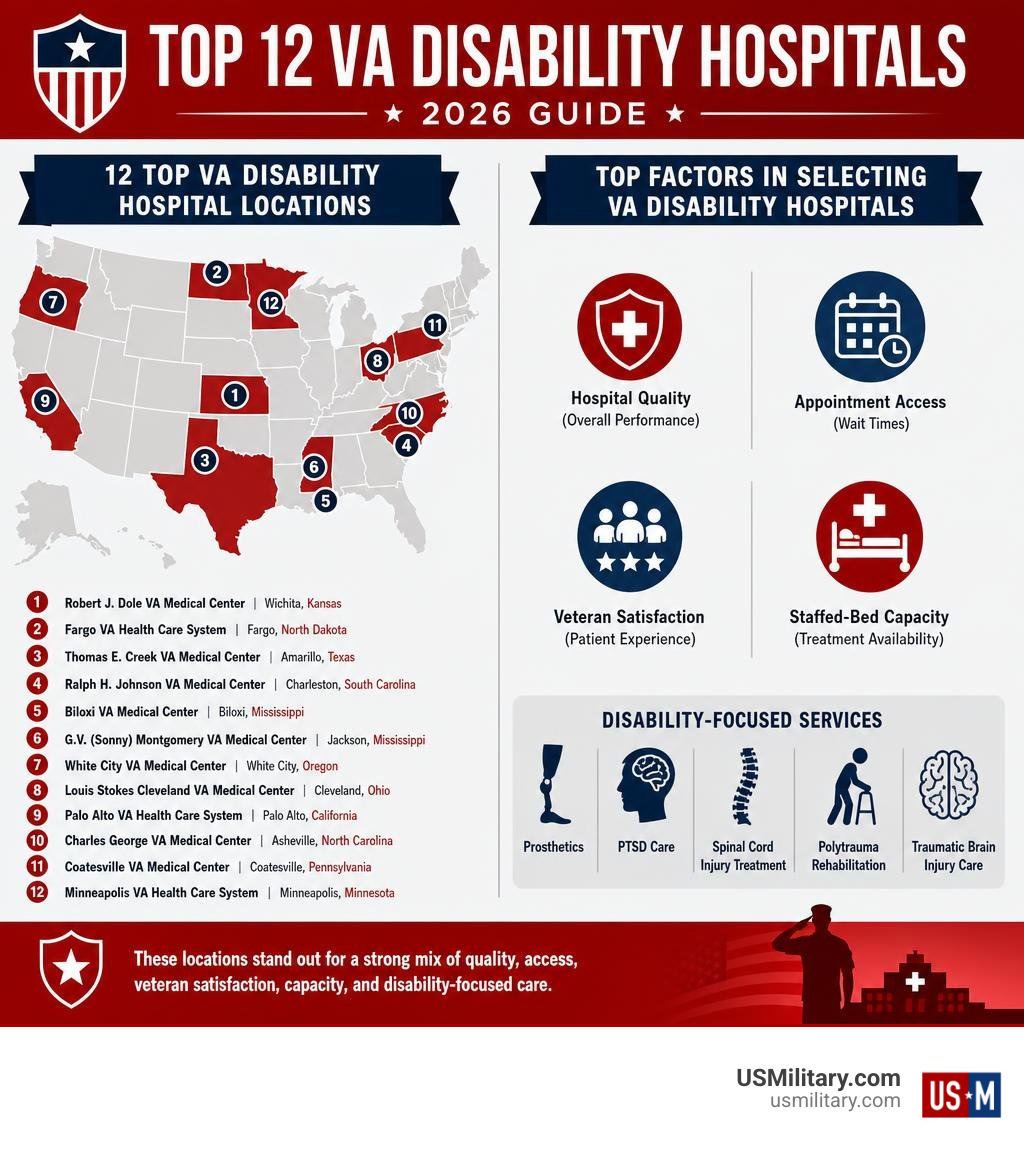
The top 12 VA disability hospitals in this guide are located in Kansas, North Dakota, Texas, Pennsylvania, South Carolina, Mississippi, Oregon, Ohio, California, North Carolina, and Minnesota. They stand out for a mix of hospital quality, appointment access, veteran satisfaction, staffed-bed capacity, and disability-focused services such as prosthetics, PTSD care, spinal cord injury treatment, polytrauma rehabilitation, and traumatic brain injury care.
The list includes the Robert J. Dole VA Medical Center in Wichita, Fargo VA Health Care System, Thomas E. Creek VA Medical Center in Amarillo, and the Ralph H. Johnson VA Medical Center in Charleston. It also covers major specialty and rehabilitation hubs in Biloxi, White City, Cleveland, Palo Alto, Asheville, and Minneapolis.
Increase Your VA Disability Rating Here!
There is no single official VA ranking for “best disability hospital.” A smart comparison looks beyond size alone. CMS quality stars, VA access-to-care wait times, patient-experience surveys, available specialty programs, and travel distance all matter. For example, Wichita ranked first in a 2025 city-level analysis of veterans’ health care access and quality, while Charleston led for primary-care access and Asheville stood out for hospital-care quality.
LARRY FOWLER is the publisher of the USArmy.com and the USMilitary.com Network and has covered VA benefits, disability trends, and military service information since 2007. In researching Where are the top 12 VA disability hospitals today, he focuses on helping veterans compare clear, practical details before choosing care.
How Top-Performing VA Medical Centers Are Evaluated
Evaluating a VA hospital requires analyzing complex healthcare metrics and translating them into practical indicators for veterans. The Veterans Health Administration (VHA) operates America’s largest integrated healthcare network, but performance varies across facilities. When measuring clinical quality, federal regulators and health analysts rely on standardized benchmarks that track patient outcomes, safety, and operational speed.
Key evaluation systems include:
- Strategic Analytics for Improvement and Learning (SAIL): The internal monitoring system used by the VA to measure clinical outcomes, staff turnover, patient safety events, efficiency, and readmissions across a 1-to-5 scale.
- Survey of Healthcare Experiences of Patients (SHEP): Direct feedback from veterans evaluating inpatient and outpatient experiences on a 0–100 scale, reflecting provider communication, respect, and scheduling ease.
- Centers for Medicare & Medicaid Services (CMS) Star Ratings: Independent federal ratings evaluating mortality, safety of care, readmission rates, patient experience, and timely clinical delivery.
- Electronic Health Record (EHR) Modernization: Digital system integration connecting the Department of Defense (DoD), community providers, and VA clinics to streamline records for complex disability care.
Core Metrics: How Where Are the Top 12 VA Disability Hospitals Today Are Evaluated
To determine where top-performing centers stand, analysts combine quantitative appointment speed with qualitative patient surveys. The national average wait time across VA facilities is roughly 12.4 days for primary care, 14.9 days for mental health, and 21.7 days for specialty consultations. Leading facilities beat these benchmarks by wide margins.
Specialty access plays a decisive role for service-disabled veterans. Rapid access to cardiology, orthopedics, physical therapy, and neurology directly affects recovery and long-term wellness. Trust scores and independent credentials also validate hospital standing. All full VA medical centers maintain accreditation from The Joint Commission, and historical recognitions like Thirty-two VA Medical Facilities Named “Top Performers” highlight facilities that sustain high-level compliance over time.
Nationally, 58% of VA medical centers earn 4- or 5-star CMS quality ratings, compared to roughly 40% of private civilian hospitals. Furthermore, 79% of VA facilities achieve 4 or 5 stars in patient satisfaction, backed by an overall veteran outpatient trust score of 92%.
Understanding Primary Base Hospital Designations and VISN Networks
The national footprint of the VA is cataloged in the Master Facility List V5.25 – U.S. Department of Veterans Affairs. Across the country, 170+ full medical centers and more than 1,100 community-based outpatient clinics (CBOCs) deliver care across 19 regional Veterans Integrated Service Networks (VISNs).
Within this network, facilities carry specific operational codes:
- VAMC (Veterans Affairs Medical Center): Comprehensive hospital campuses offering emergency care, specialized surgery, acute inpatient beds, and broad outpatient clinics.
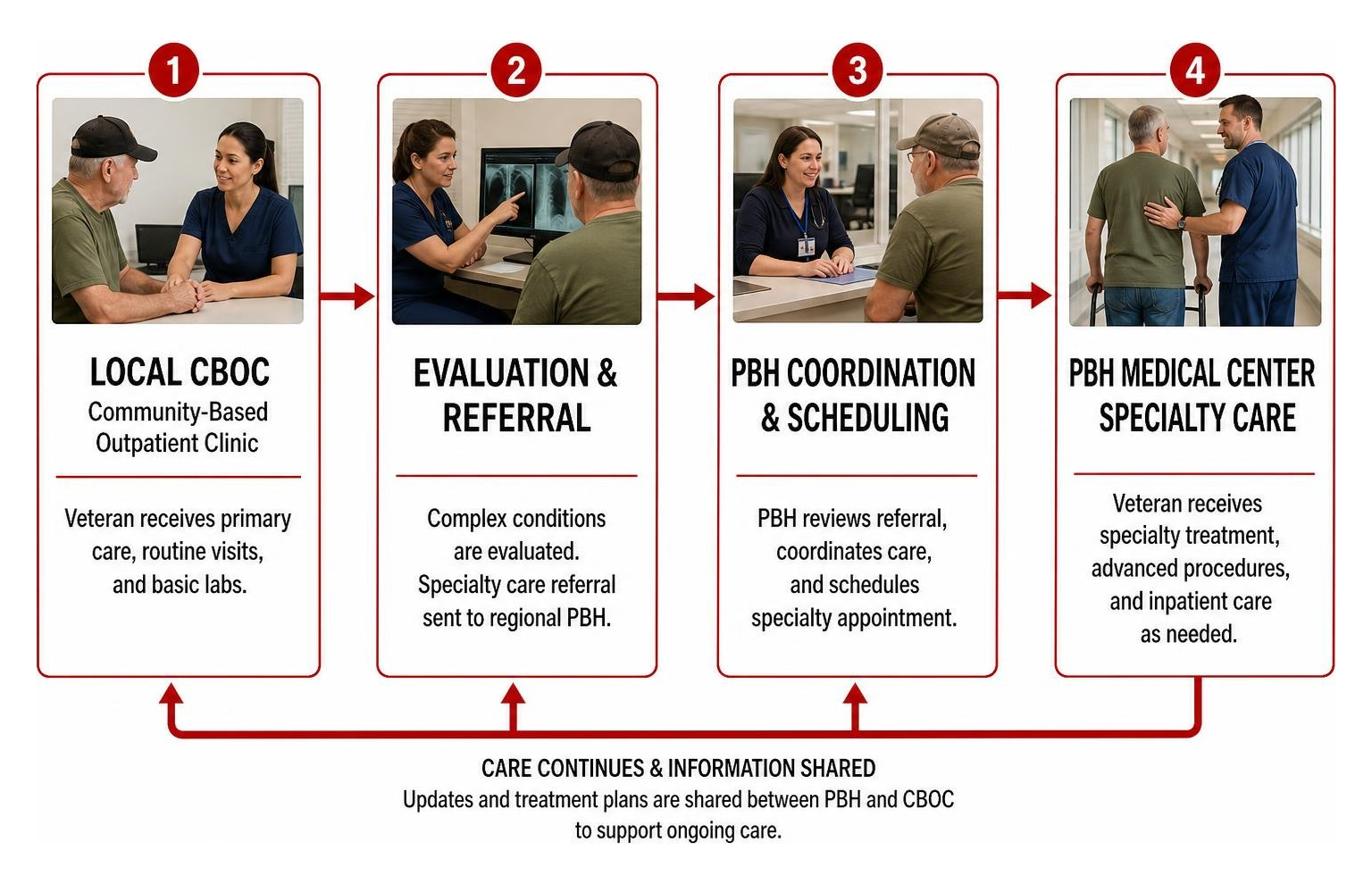
- PBH (Primary Base Hospital): A full-service medical center equipped with the advanced infrastructure required for major surgeries, inpatient rehabilitation, and specialized polytrauma care.
- CBOC & Outpatient Clinics: Local clinics that manage routine appointments, basic blood work, and primary care, referring complex conditions upward to regional Primary Base Hospitals.
Where Are the Top 12 VA Disability Hospitals Today?
Whether you are filing for service-connected compensation through The Complete Guide to VA Disability Claims or seeking care for a combat-related injury, selecting the right medical center ensures better health outcomes. Below are the top 12 VA disability hospitals evaluated across appointment speed, patient satisfaction, specialized programs, and clinical bed capacity.
1. Robert J. Dole VA Medical Center (Wichita, Kansas)
The Robert J. Dole VA Medical Center achieved a perfect 100 out of 100 score in comprehensive veterans’ healthcare evaluations, ranking as the top overall city and facility in the nation for veteran care access.
- Key Highlights: 5-star overall CMS rating; 82% top-box veteran satisfaction.
- Specialty Access: Holds the shortest cardiology wait time in the country at just 3.8 days for appointments.
- Disability Focus: Advanced prosthetic fittings, audiology evaluations, integrated mental health, and high-efficiency outpatient specialty clinics.
2. Fargo VA Health Care System (Fargo, North Dakota)
Serving veterans across North Dakota and western Minnesota, the Fargo VA Health Care System earned an impressive overall healthcare score of 96.50 out of 100.
- Key Highlights: 5-star quality metrics and high regional trust.
- Specialty Access: Orthopedic specialty access averages 14.8 days, well ahead of national standards.
- Disability Focus: Comprehensive surgical rehabilitation, primary care mental health integration (PCMHI), and rural telehealth outreach programs.
3. Thomas E. Creek VA Medical Center (Amarillo, Texas)
The Thomas E. Creek VA Medical Center in the Texas Panhandle achieved a 95.59 out of 100 overall healthcare score, setting benchmarks in neurological care delivery.
- Key Highlights: Exceptional clinical throughput and rapid provider access.
- Specialty Access: Neurology scheduling averages 17.2 days for new patients.
- Disability Focus: Compensation and Pension (C&P) exam efficiency, traumatic brain injury (TBI) screenings, and physical rehabilitation.
4. James E. Van Zandt VA Medical Center (Altoona, Pennsylvania)
Located in central Pennsylvania within VISN 4, this facility scored 92.99 out of 100 for veteran healthcare access and clinical quality.
- Key Highlights: High marks for primary care responsiveness and staff courtesy.
- Specialty Access: Rapid diagnostic imaging and low outpatient wait times.
- Disability Focus: Geriatric care coordination, chronic pain management, physical therapy, and caregiver support programs.
5. Wilkes-Barre VA Medical Center (Wilkes-Barre, Pennsylvania)
Operating in northeastern Pennsylvania, Wilkes-Barre VA Medical Center earned a 91.94 out of 100 score for veteran healthcare performance.
- Key Highlights: Strong inpatient care coordination and high diagnostic accuracy.
- Specialty Access: Fast scheduling for specialty consultations and sensory aid clinics.
- Disability Focus: Dedicated PTSD clinical teams, audiology and tinnitus treatment, and seamless community care consult processing.
6. Ralph H. Johnson VA Medical Center (Charleston, South Carolina)
The Ralph H. Johnson VA Medical Center ranks as the number one VA facility in the United States for primary care access.
- Key Highlights: Zero-day average wait times for routine and urgent primary care appointments.
- Specialty Access: Exceptional same-day clinical access and rapid surgical scheduling.
- Disability Focus: Spinal cord injury support, biomedical clinical trials, advanced prosthetics, and specialized outpatient surgery.
7. Gulf Coast Veterans Health Care System (Biloxi, Mississippi)
The Biloxi VA Medical Center is the largest VA hospital in the nation by staffed bed capacity, housing 716 staffed beds.
- Key Highlights: Massive clinical capacity serving the Gulf Coast region.
- Specialty Access: Full-spectrum inpatient medical, surgical, and psychiatric availability.
- Disability Focus: Inpatient psychiatric stabilization, long-term spinal and neurological rehabilitation, and acute traumatic brain injury recovery.
8. Southern Oregon VA Rehabilitation Center (White City, Oregon)
Operating as the second-largest VA medical facility by capacity, the Southern Oregon VA Rehabilitation Center features 600 staffed beds.
- Key Highlights: Dedicated residential rehabilitation and extended recovery hub for VISN 20.
- Specialty Access: High-capacity residential treatment beds with minimal intake backlog.
- Disability Focus: Comprehensive substance abuse rehabilitation, vocational recovery, neurological rehabilitation, and prosthetic mobility training.
9. Louis Stokes Cleveland VA Medical Center (Cleveland, Ohio)
The Louis Stokes Cleveland VAMC is the third-largest VA hospital by capacity (586 staffed beds) and a cornerstone of biomedical innovation.
- Key Highlights: Historic home of major medical breakthroughs, including the clinical cardiac pacemaker.
- Specialty Access: Comprehensive regional referral center with expansive sub-specialty clinics.
- Disability Focus: Advanced polytrauma rehabilitation, one of the VA’s premier Spinal Cord Injury Centers, and sensory aid research.
10. VA Palo Alto Health Care System (Palo Alto, California)
A leading tertiary referral center in VISN 21 affiliated with Stanford University School of Medicine, operating multiple clinical divisions with extensive bed capacity.
- Key Highlights: 4.5 SAIL quality score and 5-star clinical rating.
- Specialty Access: Cutting-edge neurological, orthopedic, and cardiovascular specialty services.
- Disability Focus: Level-1 Polytrauma Rehabilitation Center, TBI center of excellence, and advanced bionic prosthetics. For service connection ratings, review our VA Disability Rating Chart 2026 Guide.
11. Charles George VA Medical Center (Asheville, North Carolina)
The Charles George VA Medical Center achieved the highest hospital quality and patient satisfaction rating in the country, with 93% of veterans rating their experience a 9 or 10 out of 10.
- Key Highlights: Benchmark-setting surgical safety outcomes and the lowest hospital readmission rates in the VHA.
- Specialty Access: Excellent specialty scheduling with rapid referral follow-up.
- Disability Focus: Patient-centered Whole Health integration, chronic musculoskeletal therapy, and specialized PTSD recovery.
12. Minneapolis VA Health Care System (Minneapolis, Minnesota)
A powerhouse in veteran disability treatment, the Minneapolis VAMC consistently maintains a 4.5 SAIL rating and 5-star federal marks.
- Key Highlights: Flagship Midwestern tertiary referral center serving complex medical cases.
- Specialty Access: Comprehensive on-site sub-specialties with high clinical efficiency.
- Disability Focus: Regional Polytrauma Rehabilitation Center, comprehensive spinal cord network, and severe blast-injury recovery. To understand how medical evaluations map to financial compensation, consult our In-Depth Guide to VA Disability Rates for 2026.
Comparative Analysis: Capacity, Access, and Specialized Programs
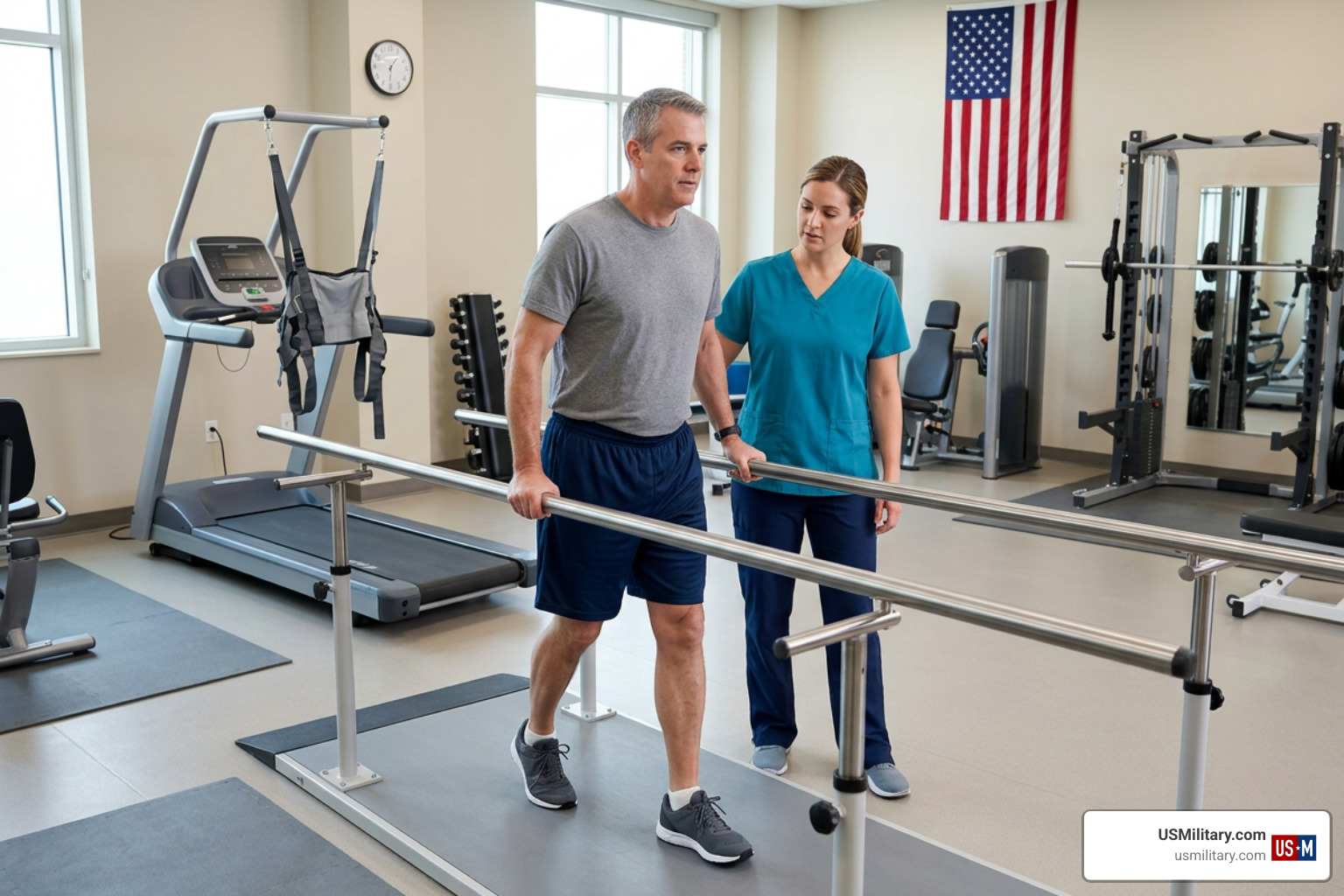
Understanding the balance between hospital bed volume, scheduling velocity, and clinical satisfaction helps veterans select the right facility for their specific medical conditions.
| VA Medical Center | Location | Staffed Beds | Notable Metric / Strength | Primary Specialty Programs |
|---|---|---|---|---|
| Robert J. Dole VAMC | Wichita, KS | 100+ | #1 Best Overall (3.8-day cardiology wait) | Specialty Outpatient, Prosthetics, Mental Health |
| Fargo VA HCS | Fargo, ND | 80+ | #2 Best Access (14.8-day orthopedic wait) | Orthopedics, Integrated Mental Health, Telehealth |
| Thomas E. Creek VAMC | Amarillo, TX | 90+ | #3 Overall (17.2-day neurology wait) | Neurology, TBI Assessment, C&P Exams |
| James E. Van Zandt VAMC | Altoona, PA | 60+ | #4 Access (Fast primary care speed) | Geriatrics, Pain Management, Caregiver Support |
| Wilkes-Barre VAMC | Wilkes-Barre, PA | 140+ | #5 Overall (High diagnostic marks) | PTSD Clinical Teams, Audiology, Diagnostics |
| Ralph H. Johnson VAMC | Charleston, SC | 150+ | #1 Primary Care Access (0-day wait) | Spinal Cord Injury, Primary Care, Surgery |
| Gulf Coast VHCS | Biloxi, MS | 716 | #1 Staffed Bed Capacity (716 beds) | Inpatient Psych, TBI Unit, Long-Term Rehab |
| Southern Oregon VARC | White City, OR | 600 | #2 Staffed Bed Capacity (600 beds) | Substance Abuse, Residential Rehab, Prosthetics |
| Louis Stokes Cleveland VAMC | Cleveland, OH | 586 | #3 Bed Capacity & Research Leader | Spinal Cord Center, Pacemaker Tech, Polytrauma |
| VA Palo Alto HCS | Palo Alto, CA | 500+ | 4.5 SAIL Rating / Stanford Affiliate | Polytrauma Hub, Bionic Prosthetics, TBI |
| Charles George VAMC | Asheville, NC | 115+ | 93% Veteran Satisfaction Score | Surgical Care, Low Readmissions, Whole Health |
| Minneapolis VA HCS | Minneapolis, MN | 280+ | 4.5 SAIL Rating / Regional Hub | Polytrauma Center, Spinal Cord, Blast Injuries |
Regional Distribution: Where Are the Top 12 VA Disability Hospitals Today Located?
Top-performing VA hospitals are concentrated in the Midwest, Mid-Atlantic, and select regional corridors across the West and South. Facilities in states like Kansas, North Dakota, and Pennsylvania consistently achieve superior wait-time metrics due to optimized patient-to-provider ratios and streamlined clinic workflows.
In contrast, high-capacity facilities like Biloxi (716 beds), Cleveland (586 beds), and Palo Alto serve as massive regional anchors. These centers absorb severe clinical cases across multi-state VISN boundaries, ensuring that veterans requiring complex surgeries or long-term inpatient rehabilitation receive specialized care.
Bed Capacity vs. Quality of Care: Key Disability Programs
A common question veterans ask is whether larger hospitals provide better medical treatment. Data indicates that bed volume and outpatient quality measure different strengths:
- High-Capacity Facilities (500+ Beds): Facilities like Biloxi, White City, and Cleveland excel at residential addiction recovery, extended inpatient psychiatric care, and severe polytrauma management.
- Mid-Sized Medical Centers (60–200 Beds): Centers like Wichita, Charleston, and Asheville excel in outpatient access, low appointment wait times, personalized care, and high veteran satisfaction.
For veterans pursuing total disability compensation due to an inability to maintain employment, explore VA TDIU Explained Eligibility Rates How to File 2026 to see how your medical records support individual unemployability.
How VA Initiatives and Disability Claims Impact Hospital Care

VA hospital performance is linked to legislative initiatives and claims processing improvements. The PACT Act expanded VA healthcare eligibility to millions of veterans exposed to burn pits, Agent Orange, and other toxic substances. Across the network, all VA medical centers now offer dedicated toxic exposure screenings.
Key updates shaping VA hospital visits include:
- VBA Claims & Medical Evidence: Clinical documentation from your VA hospital visits directly supports disability evaluations. Veterans learning How to Do the VA Claim Process the Right Way can use VA clinical records to substantiate claims. Stay informed on regulatory updates with The Complete Guide to Navigating 2026 VA Disability Changes.
- Copay Exemptions & Priority Groups: Veterans with a service-connected disability rating of 10% or higher are placed in higher priority groups (Groups 1 through 3), granting full exemptions from outpatient and inpatient copays for medical care.
- MISSION Act Standards: Under federal access standards, if your local VA hospital cannot schedule a primary care visit within 20 days (or 28 days for specialty care), or if driving distance exceeds 30–60 minutes, you qualify for approved Community Care consults with private civilian providers at zero out-of-pocket cost.
Frequently Asked Questions About Top VA Hospitals
How do VA disability hospital ratings compare to civilian private hospitals?
VA medical centers consistently match or outperform civilian private hospitals in clinical safety and patient satisfaction. According to independent CMS hospital ratings, 58% of VA medical centers receive 4- or 5-star ratings, compared to roughly 40% of civilian hospitals. Only 8% of U.S. hospitals earn 5 stars overall, and 35 VA facilities achieved this top federal tier.
Which VA medical center has the shortest wait time for specialty disability care?
The Robert J. Dole VA Medical Center in Wichita, Kansas, holds the shortest wait time for cardiology at 3.8 days. For primary care, the Ralph H. Johnson VA Medical Center in Charleston, South Carolina, leads the nation with same-day appointments (0-day average wait time).
How does a service-connected disability rating affect treatment costs at top VA hospitals?
Veterans with a service-connected disability rating of 10% or higher are exempt from copays for outpatient visits, inpatient hospital stays, and urgent care visits at VA facilities. Routine prescriptions for service-connected conditions are also covered at zero out-of-pocket cost.
Conclusion
Finding the right medical center ensures you receive high-quality clinical care, rapid appointment scheduling, and the medical documentation necessary to support your disability benefits. Whether you require spinal rehabilitation in Cleveland, fast primary care in Charleston, or specialty outpatient care in Wichita, America’s top VA facilities deliver exceptional support for those who served.
At USMilitary.com, our mission is to provide clear, reliable guidance to help veterans navigate healthcare, career transitions, and earned benefits. To calculate your monthly compensation rates and plan your financial future, visit our comprehensive VA Disability Pay Tables and Compensation Benefits resource today.