
The Short Answer on Special Forces VA Disability Claims
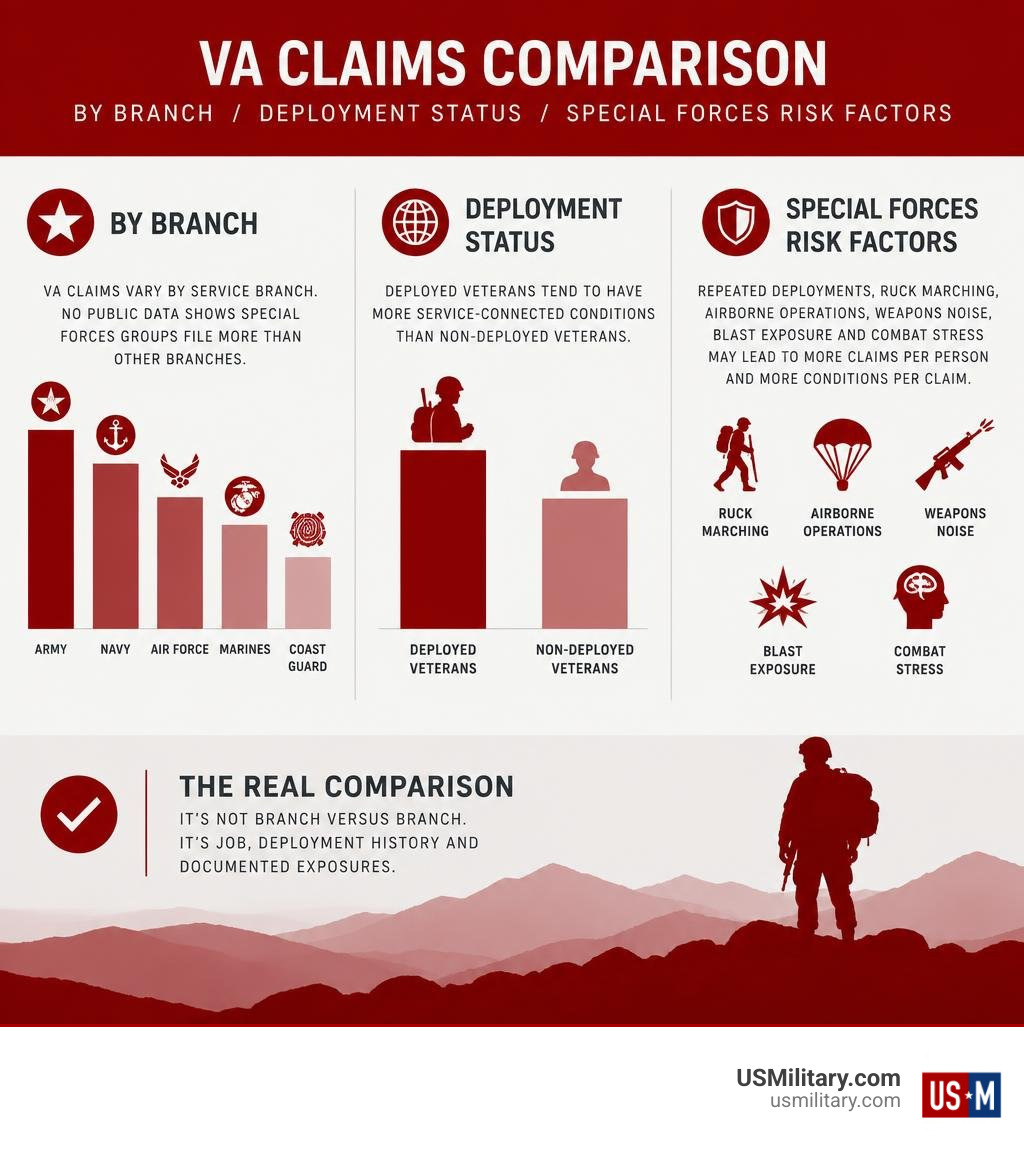
There is no public VA dataset that proves Army Special Forces Groups file more disability claims than every other branch. VA does not separately report claim totals or approval rates for 18-series Green Berets.
Still, Special Forces veterans may have more claims per person and more conditions per claim than many non-deployed veterans because of repeated deployments, ruck marching, airborne operations, weapons noise, blast exposure, and combat stress. The better comparison is not branch versus branch. It is job, deployment history, and documented exposures.
VA data supports the broader pattern: veterans who served in the Global War on Terror have more service-connected conditions on average than non-GWOT veterans. Across all VA compensation recipients, tinnitus, musculoskeletal injuries, PTSD, and hearing-related conditions are among the most common disabilities.
Larry Fowler is the publisher of the USMilitary.com Network and has covered VA benefit and disability trends for military communities since 2007. In examining Do The Army Special Forces Groups Have More VA Disability Claims Than Other Branches, he focuses on the VA evidence that matters most: service records, MOS hazards, deployments, medical proof, and service connection.
Essential Do The Army Special Forces Groups Have More VA Disability Claims Than Other Branches terms:
- 10 most common va disabilities in 2025
- What is the 5 year rule for VA Disability
- what conditions qualify for veteran disability benefits
Do The Army Special Forces Groups Have More VA Disability Claims Than Other Branches?
When answering whether Do The Army Special Forces Groups Have More VA Disability Claims Than Other Branches, we must look at the distinction between gross volume and per-capita intensity. By total volume, the United States Army leads all branches simply due to its sheer size. However, operators within Army Special Forces (18-series Military Occupational Specialties) experience cumulative physical trauma and blast exposures that place them at the very top tier of individual claim complexity.
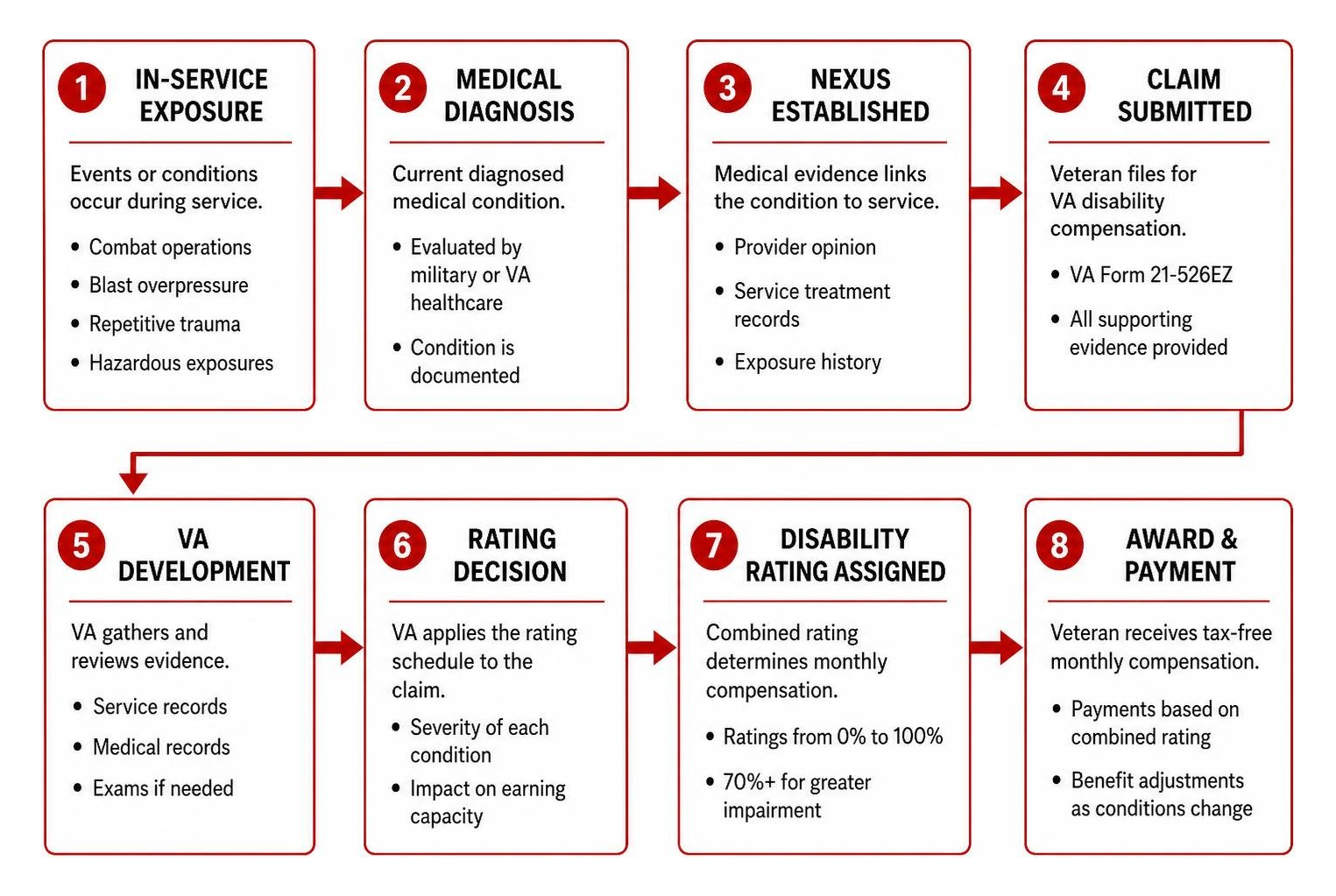
The Veterans Benefits Administration outlines the baseline rules for service connection in its VBA disability compensation overview. To receive tax-free monthly compensation, a veteran must establish an in-service event or injury, a current diagnosed medical condition, and a medical nexus linking the two.
For an elite Green Beret, meeting these criteria involves decades of jump status, thousands of heavy weapon discharges, Breacher blast overpressures, and long combat rotations. While conventional units may file for isolated injuries, Special Forces personnel frequently present multi-system disability profiles.
| Cohort / Unit Category | Primary Operational Exposures | Average Claimed Disabilities | Likelihood of 70%+ Rating |
|---|---|---|---|
| Conventional Non-Combat | Office ergonomics, baseline physical training, base noise | 3–6 conditions | Low to Moderate |
| Conventional Combat Arms | Foot patrols, mechanized transport, direct fire | 6–9 conditions | Moderate to High |
| GWOT Deployed Baseline | Burn pits, explosive hazards, operational tempo | ~9–12 conditions | High |
| Army Special Forces (18-Series) | Airborne jumps, continuous heavy rucking, CQB blasts, polytrauma | 12+ conditions | Very High |
Historical VA Cohort Data: Do The Army Special Forces Groups Have More VA Disability Claims Than Other Branches?
Historical VA research sheds light on how deployment tempo drives claim frequency. According to official VBA cohort claims comparison records, deployed service members file claims at rates vastly exceeding their non-deployed peers.
In broad cohort studies of Global War on Terror (GWOT) personnel:
- Approximately 66% of GWOT-deployed veterans filed service-connected disability claims, compared to only 28% of non-deployed veterans.
- Deployed personnel were granted an average of 12 service-connected disabilities per claimant.
- Specialized deployed cohorts (such as Karshi-Khanabad/K2 veterans) saw respiratory condition grant rates hit 67% and cancer grant rates reach 40%.
Because Army Special Forces Groups maintained some of the highest operational tempos and repeat deployment rates throughout modern conflicts, these high cohort averages directly reflect the realities of the 18-series community.
Why MOS Exposure Outweighs Branch Affiliation
Branch rivalry makes for fun banter, but the VA rating schedule does not award compensation based on your uniform. Your Military Occupational Specialty (MOS), Air Force Specialty Code (AFSC), or Navy Rating is far more predictive of disability claims than your branch of service.
An administrative specialist in the Army faces different occupational hazards than an infantryman. Likewise, the rigorous qualifications for elite special operators across all branches demand an extreme level of continuous physical output.
The VA acknowledges this through tools like the Duty MOS Noise Exposure Listing, which assigns a presumptive probability of hazardous noise exposure to combat arms and aviation specialties, removing hurdles during adjudication.
Branch-by-Branch Comparison: Claim Volumes vs. Per-Capita Disability Rates
More Than 90% Of Clients Have Increased VA Disability Ratings! Why Settle For Less Than You Deserve? Expert Priority Help With Your VA Claim! Free Evaluation Call!
When analyzing raw claims data across the Department of Veterans Affairs:
- United States Army: Boasts the largest total number of veterans receiving disability compensation (over 1.5 million recipients).
- United States Navy: Handles hundreds of thousands of claims driven by industrial hazards aboard ships and flight decks.
- United States Air Force: Experiences extensive claims linked to flight-line noise and toxic fuel handling.
- United States Marine Corps: Maintains one of the highest per-capita disability claim rates due to its combat-heavy mission design.
- United States Coast Guard: Navigates severe maritime conditions, heavy rescue operations, and physical wear.
Research on the economic impact of military disability compensation demonstrates that these benefits serve as a vital safety net to offset diminished civilian earning capacity resulting from military trauma.
Ground Combat vs. Maritime and Aviation Claim Characteristics
The physical toll varies drastically depending on the operational environment. Ground combat forces carry average rucksack weights exceeding 80 to 100 pounds, causing axial spine loading, degenerative joint disease, and chronic knee conditions.
Shifting geopolitical environments and sustained deployments—such as evolving recruitment trends during Middle East tensions—continue to influence the types of injuries service members sustain over their careers.
High-Impact Conditions and Secondary Claims for 18-Series Personnel

Special Forces soldiers regularly sustain multi-system trauma over their careers. A comprehensive breakdown of the common benefits claimed by Army Special Forces reveals key recurring conditions:
- Tinnitus: Diagnostic Code 6260, granted as a flat 10% rating for persistent ringing in the ears.
- Bilateral Hearing Loss: Diagnostic Codes 6100, evaluated using speech recognition and pure-tone thresholds.
- Lumbosacral Strain and Degenerative Disc Disease: Diagnostic Code 5237, rated between 10% and 40% based on range of motion limitations.
- Limitation of Knee Flexion and Extension: Diagnostic Codes 5260 and 5261, reflecting chronic impact damage from airborne drops and fast-roping.
- Cervical Spine Strain: Diagnostic Code 5237, often aggravated by mounting night vision goggles and heavy ballistic helmets.
Blast Exposure, Traumatic Brain Injury, and PTSD
Special operations missions, including high-risk counterterrorism operations and deep reconnaissance, expose operators to continuous concussive forces. Operating in high-stakes environments—similar to historical covert special operations missions—places extreme demands on mental and neurological resilience.
Traumatic Brain Injury (TBI) and Post-Traumatic Stress Disorder (PTSD) frequently co-occur among 18-series personnel. Repetitive low-level blast exposure from breaching charges and heavy weapon systems induces neurotrauma, which can manifest as:
- Intractable migraine headaches (Diagnostic Code 8100, rated up to 50%).
- Sleep disturbances and obstructive sleep apnea.
- Cognitive deficits, emotional regulation issues, and depression.
PACT Act Presumptive Conditions and Secondary Service Connection
The passage of the PACT Act created an expansive framework of presumptive service connection for veterans exposed to toxic burn pits, particulate matter, and airborne hazards. For Special Forces veterans who operated from remote outposts across Afghanistan, Iraq, and Syria, conditions like chronic rhinitis, chronic sinusitis, constrictive bronchiolitis, and various cancers are now granted without the need to prove a direct in-service event.
Furthermore, secondary conditions allow operators to link new medical diagnoses directly to existing service-connected disabilities:
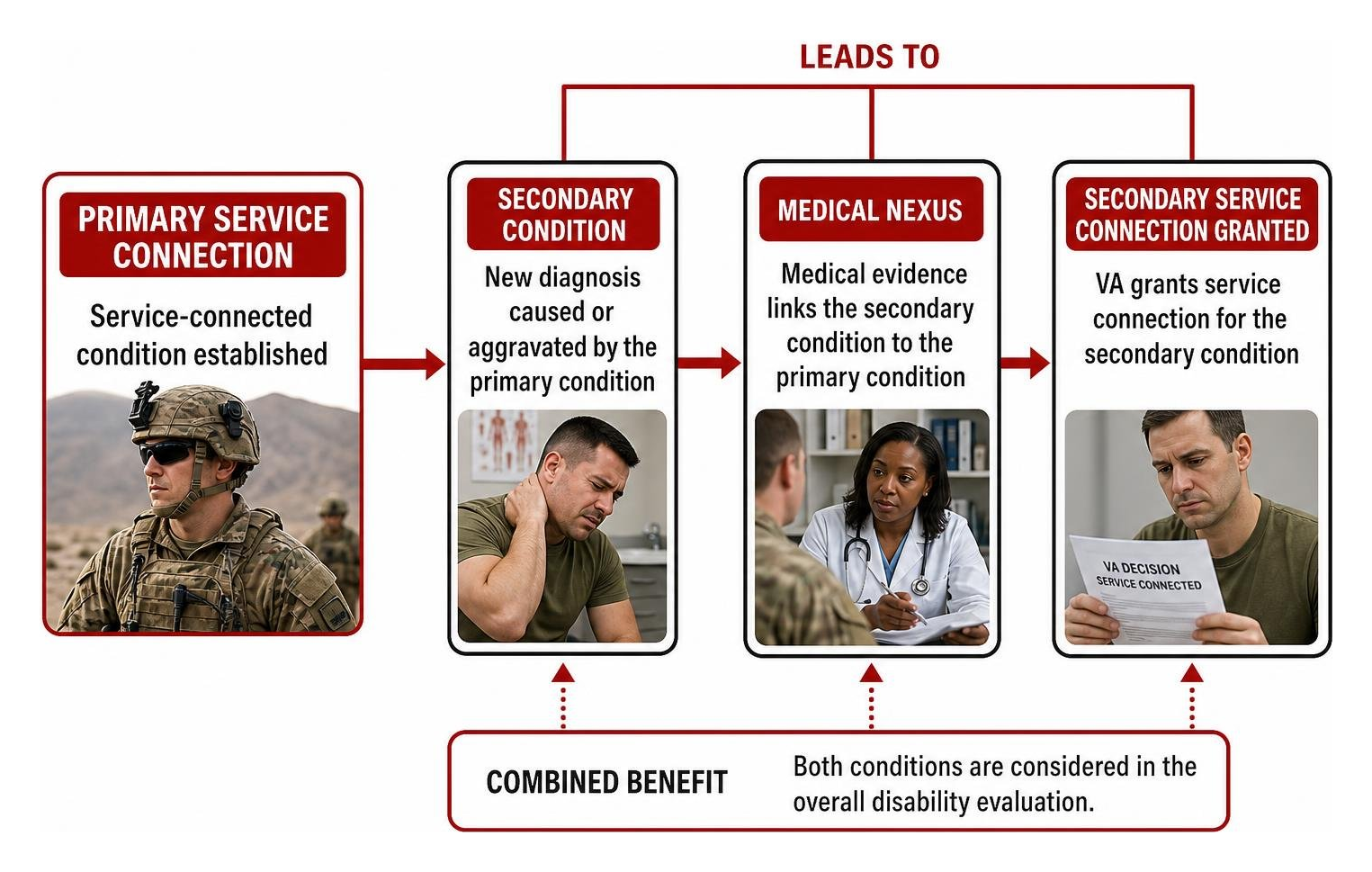
Under the VA’s non-additive combined rating system (“VA Math”), stacking primary musculoskeletal injuries with secondary radiculopathy, secondary depression, and presumptive respiratory conditions is essential for reaching an accurate rating.
Navigating Claim Denials and Maximizing Disability Ratings
Federal reporting on VA claims indicates that approximately 38.7% of all claimed issues are initially denied. The primary reasons include:
- Condition Not Incurred in Service (51.5% of denials): The VA found no documented link between active service and the injury.
- No Current Medical Diagnosis (32.7% of denials): The veteran complained of pain or symptoms but lacked a formal diagnosis from a licensed provider.
- Failure to Attend Compensation and Pension (C&P) Exams: Missing scheduled evaluations leads to automatic denials.
Medical Nexus Letters, Buddy Statements, and Classified Records
Special Forces personnel often face a distinct hurdle: the “tough-it-out” culture and classified mission profiles mean that injuries were frequently treated in the field without formal entries into official service treatment records.
To overcome these documentation gaps:
- Independent Medical Opinions (Nexus Letters): A private physician reviews military history and provides a formal opinion stating that it is “at least as likely as not” that the condition resulted from military service.
- Buddy Statements (VA Form 21-10210): Sworn statements from fellow team members describing specific training accidents, parachute malfunctions, or blast exposures.
- Statement in Support of Claim (VA Form 21-4138): Clear, unclassified descriptions of combat operations and everyday physical stressors, focusing on the mechanics of injury rather than classified operational specifics.
Frequently Asked Questions About Special Forces Disability Claims
Do The Army Special Forces Groups Have More VA Disability Claims Than Other Branches After Deployment?
While total raw claims are higher for conventional forces due to their larger personnel count, deployed Special Forces personnel exhibit a significantly higher average number of claimed conditions per veteran (averaging 12 or more service-connected conditions) compared to non-deployed cohorts across all branches.
What are the most common VA disability claims for Green Berets?
The top claims include tinnitus, bilateral sensorineural hearing loss, chronic lumbosacral strain with radiculopathy, limitation of knee motion, cervical spine degenerative disc disease, traumatic brain injury (TBI), migraine headaches, and PTSD.
What is the leading reason the VA denies disability claims for combat veterans?
The most frequent reason is the absence of an established service connection (accounting for over 50% of denials), followed closely by filing without a current, formal clinical diagnosis from an authorized medical provider.
Conclusion
Determining whether Army Special Forces groups have more VA disability claims than other branches comes down to operational intensity, physical wear, and deployment history. While the Army leads in total claim volume, 18-series operators consistently experience a higher density of multi-system physical and neurological trauma per person.
Understanding how to properly file, link secondary conditions, and document service-incurred injuries ensures that you receive the maximum compensation you earned. For full guidance on navigating the claims submission process, visit our comprehensive resource on applying for VA disability benefits at USMilitary.com.