

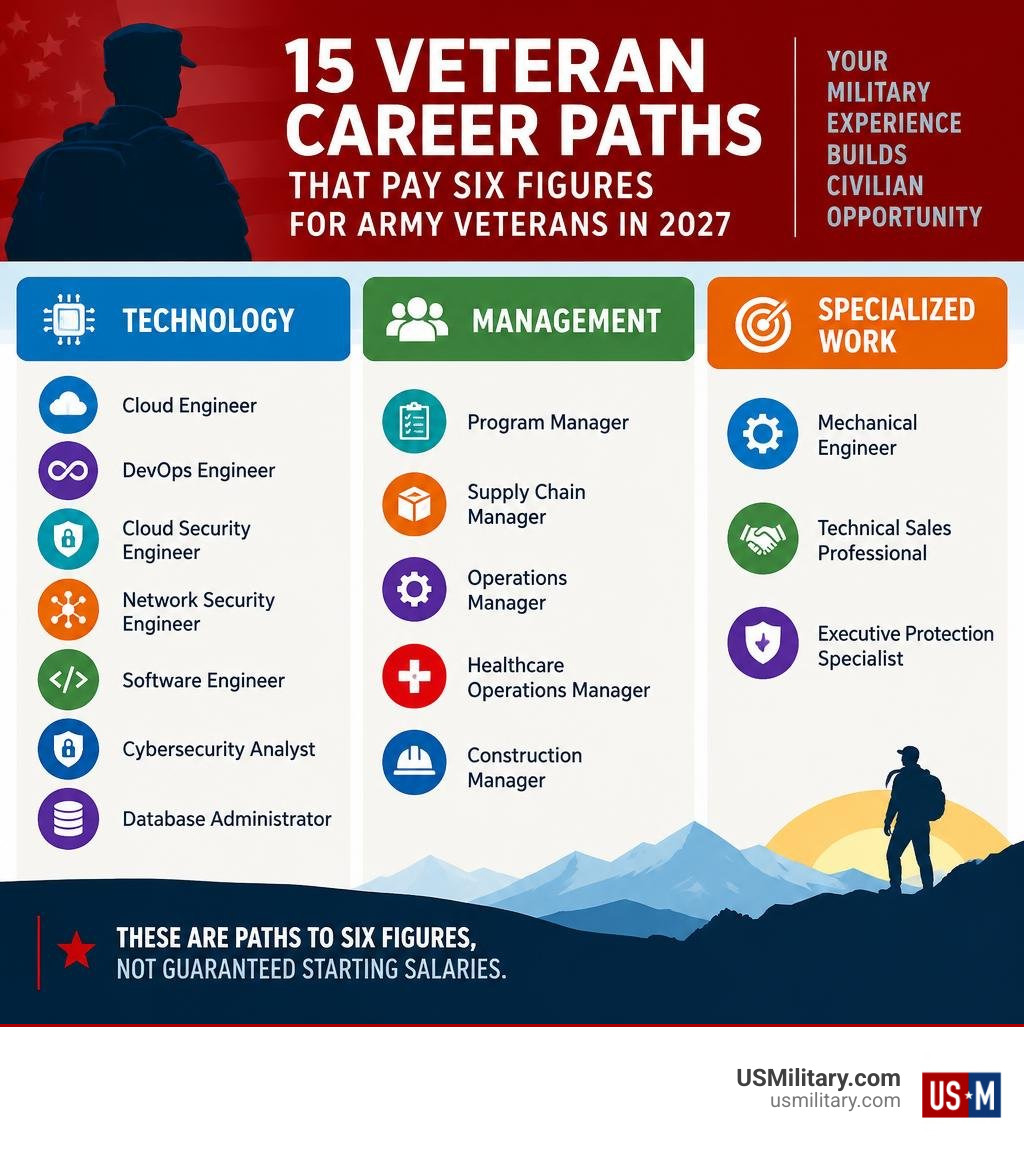
15 Careers That Pay Six Figures For Army Veterans in 2027 span technical work, management, and specialized services:
- Technology: Cloud engineer, DevOps engineer, cloud security engineer, network security engineer, software engineer, cybersecurity analyst, and database administrator.
- Management: Program manager, supply chain manager, operations manager, healthcare operations manager, and construction manager.
- Specialized work: Mechanical engineer, technical sales professional, and executive protection specialist.
These are paths to six figures, not guaranteed starting salaries. Army leadership, technical experience, and a security clearance can help you qualify faster. The right credentials and local job market still matter.
I’m Larry Fowler, a veteran, BUD/S Class 89 graduate, and publisher of USArmy.com and USMilitary.com. In this guide to 15 Careers That Pay Six Figures For Army Veterans in 2027, I’ll help you connect military experience to civilian roles with strong earning potential.
15 Careers That Pay Six Figures For Army Veterans in 2027
Navigating the civilian job market requires understanding where private and public employers place maximum financial value. Six-figure compensation follows accountability, technical complexity, risk mitigation, and operational execution. When exploring our top military jobs for six-figure civilian careers, you will find that Army veterans who combine disciplined leadership with market-aligned credentials command premium compensation packages across multiple industries.
| Career Field | 2027 Expected Salary Range | Primary Target Certifications | Clearance Impact |
|---|---|---|---|
| Cloud Engineer | $100,000 – $160,000 | AWS Solutions Architect, Azure Admin | High (+25% to +40%) |
| DevOps Engineer | $115,000 – $180,000 | CKA (Kubernetes), Terraform, Docker | High |
| Cloud Security Engineer | $105,000 – $165,000 | CompTIA Security+, CISSP, CCSP | Very High |
| Network Security Engineer | $100,000 – $145,000 | CCNP Security, CompTIA CySA+ | High |
| Software Engineer | $105,000 – $170,000 | Full-Stack Certifications, Python, Java | Moderate to High |
| Cybersecurity Analyst | $95,000 – $140,000 | CompTIA Security+, CEH, GIAC | Very High |
| Database Administrator | $95,000 – $135,000 | Oracle Certified, Microsoft Azure Data | Moderate |
| Program / Project Manager | $100,000 – $155,000 | PMP, CAPM, Lean Six Sigma Black Belt | High |
| Supply Chain Manager | $95,000 – $145,000 | CSCP (ASCM), CPIM, Six Sigma Green Belt | Moderate |
| Operations Manager | $95,000 – $150,000 | Lean Six Sigma, MBA, PMP | Moderate |
| Construction Manager | $100,000 – $155,000 | OSHA 30, CCM, PMP | Low to Moderate |
| Mechanical Engineer | $95,000 – $140,000 | FE / PE License, SolidWorks Cert | High (Defense) |
| Executive Protection | $90,000 – $160,000 | CPP, HR 218/LEOSA, Advanced Medical | High |
| Technical Sales Executive | $110,000 – $200,000+ | Vendor Accreditations, Solution Selling | Low to Moderate |
| Healthcare Operations Lead | $100,000 – $150,000 | FACHE, MHA, Lean Healthcare | Moderate (VA/Defense) |
Top Technical Paths Among the 15 Careers That Pay Six Figures For Army Veterans in 2027
Technical infrastructure and security roles represent some of the most accessible high-paying civilian careers using military training. In technical disciplines, cloud engineers with 2 to 5 years of experience earn between $100,000 and $130,000 annually, while senior cloud engineers routinely reach $130,000 to $160,000.
DevOps engineers with 2 to 5 years of practical experience earn between $115,000 and $150,000, with senior DevOps and Site Reliability Engineers (SREs) commanding $140,000 to $180,000. For soldiers with signal backgrounds, reviewing a practical 25B IT specialist to cloud engineer career guide illustrates how tactical network operations map directly to modern cloud architecture.
Specialized protection roles within IT also show exceptional demand. Cloud security engineers command $105,000 to $135,000, while senior cloud security engineers earn $130,000 to $165,000. According to national industry metrics:
- Software engineers earn a national average baseline of $108,896 per year.
- Network security engineers average $111,653 per year.
- Database administrators earn an average of $94,537 per year, scaling past six figures in enterprise settings.
- Information security analysts—who earn a national average of $90,425 and experience an explosive 33% job growth rate through 2033—routinely exceed $120,000 when working in cleared environments.
Operations and Management in the 15 Careers That Pay Six Figures For Army Veterans in 2027
Veterans do not need a computer science degree to earn six figures. Operational leadership in the civilian sector rewards leaders who manage personnel, risk, budgets, and physical assets under tight deadlines. Supply chain managers earn a national average baseline of $90,713 per year, with senior directors commanding well over $140,000. General operations managers average $71,166 initially, but veteran leaders overseeing multi-facility footprints, logistics hubs, or manufacturing plants rapidly scale into six-figure senior management.
Mechanical engineers earn a national average salary of $89,424, climbing beyond $130,000 in defense contracting and aerospace manufacturing. Technical sales roles and healthcare operations management offer similar high-ceiling outcomes for veterans who understand enterprise communication, team coordination, and complex institutional workflows. Evaluating top opportunities across the private sector reinforces that high-performing veterans thrive wherever organizational discipline determines profitability.
Translating Army MOS, Leadership, and Clearances into Civilian Value

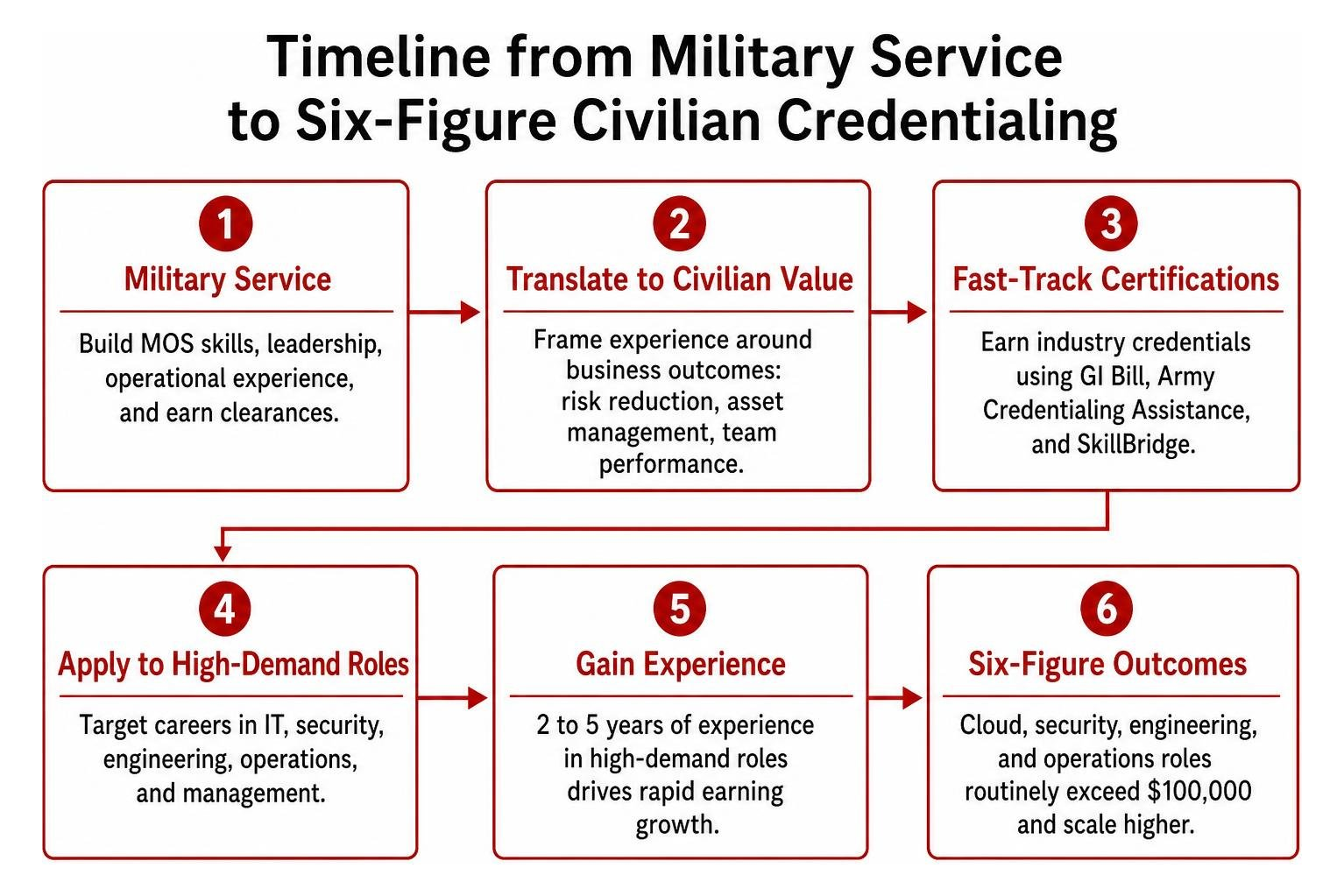
The military builds deep operational capabilities, but civilian hiring managers do not think in terms of modified tables of organization and equipment (MTOEs), tactical standard operating procedures (SOPs), or non-commissioned officer evaluation reports (NCOERs). Translating your value requires framing your service around business outcomes: risk reduction, asset management, workflow optimization, and team performance. Learning the essentials of translating military experience for civilian resumes allows you to turn command responsibilities into quantified accomplishments that enterprise recruiters recognize.
To identify direct industry equivalents for your specific MOS, you can begin by matching military job codes with civilian occupations through dedicated federal workforce tools.
Fast-Track Certifications and Credential Roadmaps
Bridging the gap between military service and civilian compensation requires industry-standard credentials. Certifications serve as the translation layer that validates your military skills to automated applicant tracking systems.
- Information Technology & Cloud: Pairing CompTIA Security+ ($370) with an AWS Solutions Architect Associate ($150) or Azure Administrator Associate ($165) creates an immediate pathway to cloud roles. Advanced practitioners should target the Certified Kubernetes Administrator (CKA, $395), which can add $20,000 to $35,000 in market value.
- Project and Operations Management: The Project Management Professional (PMP) credential transforms company-level operations, training management, and staff planning into recognized civilian authority.
- Cybersecurity: Advanced practitioners with five years of cumulative experience can leverage the CISSP to unlock senior security engineering roles.
Transitioning soldiers can utilize GI Bill benefits, the Department of Defense SkillBridge initiative, and Army Credentialing Assistance to secure these qualifications before discharge. Taking time to review how using military branches and service benefits for education can fund your transition gives you an advantage before entering the private sector.
The Clearance Advantage in Defense and Tech Sectors
An active Secret or Top Secret/Sensitive Compartmented Information (TS/SCI) clearance is a major financial asset. Clearing a civilian candidate from scratch can cost employers tens of thousands of dollars and take over a year. Consequently, defense contractors, intelligence consultancies, and enterprise tech providers offer an active clearance premium of 25% to 40% over non-cleared equivalents.
Cleared cloud engineers, cyber threat hunters, and defense project directors step into high-paying roles immediately because they can work in secure environments from day one. Developing an overarching strategy through our complete guide to long-term military career pathways ensures your clearance remains active and fully monetized as you enter the civilian workforce.
Navigating the AI Shift: Desk Roles vs. High-Paying Field Careers
Artificial intelligence is transforming traditional entry-level knowledge work, creating a projected net workforce reduction of 4% while generating 11% to 12% productivity gains across industries. However, veteran-dominated fields remain resilient. AI cannot replace human accountability, crisis intervention, physical installation, or dynamic decision-making under uncertainty. Following our career success roadmap for soldiers and veterans will help you align your transition with fields that resist automation.
Hands-On and Field-Oriented Six-Figure Paths
For soldiers who prefer working outside of a corporate cubicle, hands-on leadership roles offer fast paths to six figures:
- Construction and Critical Infrastructure Management: Managing complex commercial builds, electrical substations, and data center developments relies on safety enforcement, subcontractor coordination, and strict timeline execution.
- Executive Protection: High-level corporate and dignitary protection rewards advance planning, situational awareness, discretion, and calm judgment under pressure, with senior specialists earning well past $120,000.
- Industrial and Plant Maintenance Management: Overseeing heavy mechanical, electrical, and automation equipment in mission-critical facilities translates tactical maintenance discipline into high corporate compensation.
Selecting an environment that matches your working style is critical; our guide on finding the right military-aligned career fit helps you evaluate field-oriented versus desk-bound roles.
AI-Proof Technical and Operational Specialties
The most durable desk and hybrid roles are those where the cost of failure is catastrophic:
- Cyber Threat Hunting & Incident Response: While AI assists in monitoring, detecting advanced persistent threats and coordinating active responses requires human intuition and adversarial reasoning.
- Complex Supply Chain & Crisis Coordination: Managing global supply networks amid geopolitical disruption, natural disasters, and port congestions requires human negotiation and crisis management.
- Healthcare Operations Leadership: Directing hospital staff, regulatory compliance, and clinical resource distribution requires in-person empathy, leadership, and operational precision.
Transition Pitfalls That Keep Army Veterans Under Six Figures
Many capable Army veterans earn less than their true market value due to predictable transition mistakes. The most common error is accepting low-ceiling bridge jobs—roles that keep you busy without developing scalable, high-value skills.
Other common pitfalls include:
- Underestimating Total Military Value: Failing to account for the tax-free basic allowance for housing (BAH) and healthcare benefits causes veterans to accept civilian salaries that result in an accidental pay cut. Comparing your civilian offers against active duty pay and veteran transition guidance keeps your financial baseline clear.
- Neglecting Proactive Networking: Relying exclusively on online application portals rather than connecting directly with veteran hiring networks and industry peers.
- Failing to Negotiate Total Compensation: Leaving bonuses, equity grants, relocation packages, and certification reimbursement unnegotiated.
- Delaying Financial Preparation: Leaving active duty without an emergency fund forces you to accept the first available offer rather than waiting for the right six-figure opportunity. Working with a professional through our guide on financial planning and advisory support for veterans protects your family throughout the transition process.
Frequently Asked Questions About Six-Figure Veteran Careers
Which military careers transition most quickly to six-figure salaries?
Army veterans coming from Signal (25-series), Cyber (17-series), Intelligence (35-series), and Aviation branches transition most rapidly into six-figure roles due to direct technical crossover, active security clearances, and high commercial demand. However, combat arms NCOs and officers who secure a PMP or foundational cloud certification routinely achieve six figures within 12 to 24 months by stepping directly into operations, project management, and defense contracting leadership.
How much value does a TS/SCI clearance add to civilian compensation?
An active TS/SCI clearance adds an estimated 25% to 40% salary premium in technology, defense contracting, intelligence analysis, and federal consulting roles. Cleared professionals face significantly less labor competition because government contractors must fill specific billets with personnel who can access secure facilities immediately.
What free programs help Army veterans upskill for tech and management?
Transitioning soldiers can utilize DoD SkillBridge to intern with major defense and corporate firms during their final 180 days of active service while receiving full military pay. Additional resources include the VA’s Veteran Readiness and Employment (VR&E) program, Onward to Opportunity (O2O) for free professional certifications, and American Corporate Partners (ACP) for customized corporate mentorship.
Conclusion
Stepping out of uniform does not mean resetting your career to zero. Your years in the Army have built high-stakes decision-making capabilities, operational leadership, and a commitment to mission accomplishment that civilian organizations value. By targeting high-growth sectors, securing market-aligned credentials, and monetizing your security clearance, achieving a six-figure income in 2027 is a practical, achievable objective.
We encourage you to evaluate your current trajectory against our comprehensive military pay chart and civilian transition planning resources on USMilitary.com as you map out a prosperous, mission-driven civilian future.