
Choose an Army Job That Builds a Career Beyond Service
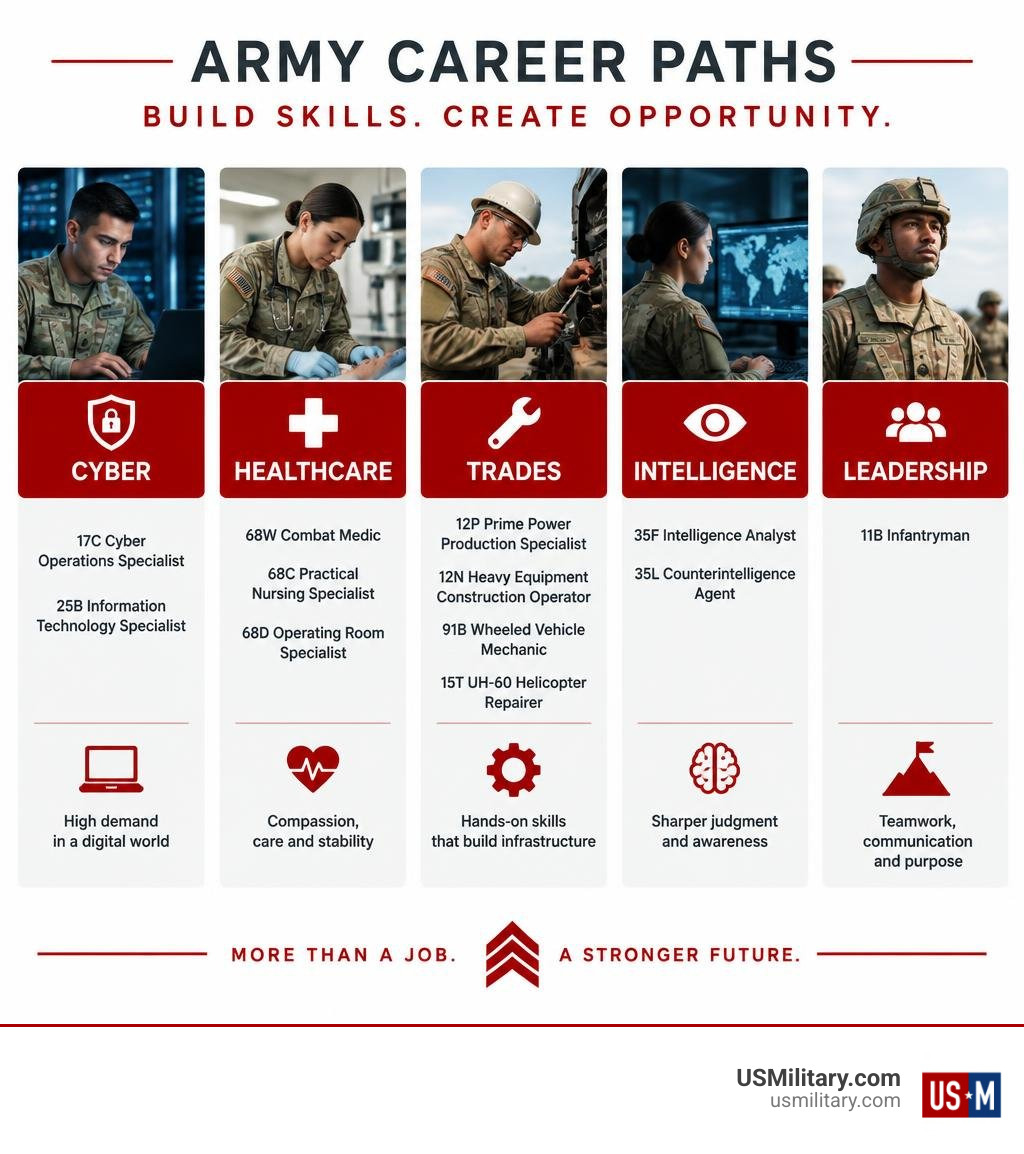
The 20 Best Army Jobs For New Recruits in 2027 are not simply the jobs with the biggest bonus. The strongest choices build skills that employers still need as AI changes work: cybersecurity, IT, healthcare, aviation, electrical power, equipment repair, construction, and leadership.
Start by targeting an MOS that matches your ASVAB scores and gives you at least one clear civilian advantage:
- Cyber and IT: 17C Cyber Operations Specialist and 25B Information Technology Specialist support careers in cybersecurity, data, and network support.
- Healthcare: 68W Combat Medic, 68C Practical Nursing Specialist, and 68D Operating Room Specialist build patient-care skills that technology is more likely to support than replace.
- Skilled trades and energy: 12P Prime Power Production Specialist, 12N Heavy Equipment Construction Operator, 91B Wheeled Vehicle Mechanic, and 15T UH-60 Helicopter Repairer develop hands-on maintenance and infrastructure skills.
- Intelligence and leadership: 35F Intelligence Analyst, 35L Counterintelligence Agent, and 11B Infantryman sharpen judgment, teamwork, communication, and leadership under pressure.
That matters because an estimated 30% of current U.S. jobs could be automated by 2030, while repair, installation, healthcare, cybersecurity, and skilled-trade work remain more resilient. Federal energy and security spending also points toward continuing demand for technical talent in power systems, nuclear security, cyber defense, and advanced computing. For broader context on how automation is reshaping employment, the Bureau of Labor Statistics tracks occupational growth projections across these fields.
I am LARRY FOWLER, publisher of the USMilitary.com Network since 2007, where I have helped connect prospective service members and veterans with clear information about military careers, benefits, and transitions. In this guide to the 20 Best Army Jobs For New Recruits in 2027, I will help you compare roles based on training, civilian value, long-term opportunity, and the realities of Army service.
20 Best Army Jobs For New Recruits in 2027 helpful reading:
Future-Proofing Your Service: Automation, Energy Priorities, and Civilian Demand

As we look at the modern economic landscape in late 2026, artificial intelligence is reshaping the workforce at an unprecedented pace. Labor market data reveals that roughly 60% of jobs will see their day-to-day tasks significantly modified by AI. While routine administrative and clerical positions face steep displacement risks, hands-on installation, complex equipment repair, patient-facing healthcare, and technical security fields continue to expand rapidly.
For instance, information security analyst positions are projected to grow by 32% through 2032, and software developers are seeing an employment increase of 17.9%. Meanwhile, healthcare professions like nurse practitioners are surging with a 52% projected growth rate from 2023 to 2033. When planning your military career paths, choosing an occupational specialty that develops low-automation-risk capabilities is the best way to safeguard your future.
At the same time, massive federal initiatives are creating historic demands for specialized technical talent. The Department of Energy’s FY 2027 budget allocates $53.91 billion to advance American energy dominance, including:
- $3.5 billion to rapidly generate and transmit baseload power (modernizing natural gas, coal, and nuclear systems).
- $1.53 billion for the Office of Nuclear Energy, featuring $226 million for advanced reactor demonstration.
- $1.12 billion for critical minerals and energy innovation.
- $32.8 billion for the National Nuclear Security Administration (NNSA) to secure nuclear infrastructure and weapons programs.
- $160 million dedicated to cybersecurity, energy security, and emergency response (CESER).
Recruits who select technical Military Occupational Specialties (MOSs) aligned with these priority sectors gain high-value certifications and clearance access. Many of these tracks are among the safest military jobs in terms of physical risk, offering predictable environments and massive private-sector utility.
Methodology Behind the 20 Best Army Jobs For New Recruits in 2027
To identify the most rewarding positions, we evaluated every active Army enlisted MOS using a multi-factor assessment framework:
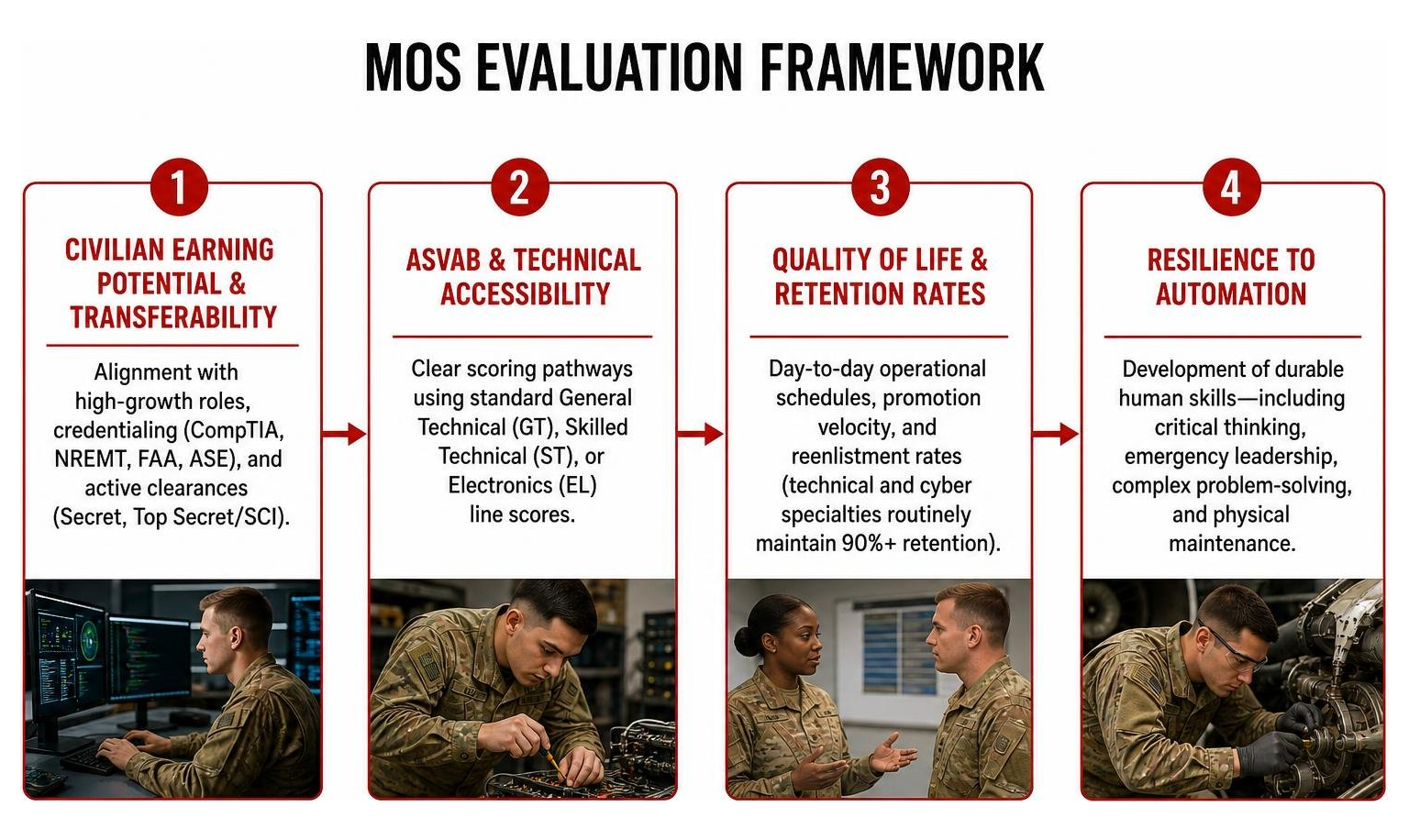
Our evaluation balances four essential pillars:
- Civilian Earning Potential & Transferability: Direct alignment with high-growth private sector roles, credentialing opportunities (CompTIA, NREMT, FAA, ASE), and active clearances (Secret, Top Secret/SCI).
- ASVAB & Technical Accessibility: Clear scoring pathways using standard General Technical (GT), Skilled Technical (ST), or Electronics (EL) line scores.
- Quality of Life & Retention Rates: Day-to-day operational schedules, promotion velocity, and reenlistment rates (technical and cyber specialties routinely maintain 90%+ retention).
- Resilience to Automation: Development of durable human skills—including critical thinking, emergency leadership, complex problem-solving, and physical maintenance.
Knowing how to find a military job that actually fits you requires looking beyond short-term enlistment bonuses to verify how that military experience positions you for long-term civilian prosperity.
Ranked: 20 Best Army Jobs For New Recruits in 2027
The table below outlines our top 20 Army MOS rankings for incoming recruits, comparing required ASVAB line scores with realistic civilian median compensation. Many of these career paths unlock six-figure earning potential within a few years of separating from active duty.
| Rank | MOS | Title | Primary ASVAB Line Score | Civilian Median Salary |
|---|---|---|---|---|
| 1 | 17C | Cyber Operations Specialist | GT: 110, ST: 112 | $115,000 – $165,000 |
| 2 | 25B | Information Technology Specialist | EL: 95, ST: 95 | $75,000 – $105,000 |
| 3 | 35F | Intelligence Analyst | ST: 101 | $85,000 – $120,000 |
| 4 | 15Q | Air Traffic Control Operator | ST: 101 | $95,000 – $140,000 |
| 5 | 12P | Prime Power Production Specialist | ST: 107, EL: 107 | $85,000 – $125,000 |
| 6 | 68W | Combat Medic Specialist | GT: 107, ST: 101 | $55,000 – $95,000 |
| 7 | 35L | Counterintelligence Agent | ST: 105 | $90,000 – $135,000 |
| 8 | 15T | UH-60 Helicopter Repairer | MM: 104 | $70,000 – $100,000 |
| 9 | 89D | Explosive Ordnance Disposal (EOD) | GM: 105 | $80,000 – $130,000 |
| 10 | 68C | Practical Nursing Specialist | ST: 101, GT: 107 | $60,000 – $85,000 |
| 11 | 12T | Technical Engineer | ST: 101 | $65,000 – $95,000 |
| 12 | 68D | Operating Room Specialist | ST: 101 | $60,000 – $90,000 |
| 13 | 91B | Wheeled Vehicle Mechanic | MM: 88, or MM: 85 & GT: 85 | $55,000 – $80,000 |
| 14 | 12N | Heavy Equipment Operator | GM: 90 | $55,000 – $85,000 |
| 15 | 27D | Paralegal Specialist | CL: 105 | $60,000 – $90,000 |
| 16 | 31B | Military Police | ST: 91 | $50,000 – $80,000 |
| 17 | 88M | Motor Transport Operator | OF: 85 | $50,000 – $75,000 |
| 18 | 74D | CBRN Specialist | ST: 100 | $55,000 – $85,000 |
| 19 | 19K | M1 Armor Crewman | CO: 87 | $50,000 – $75,000 |
| 20 | 11B | Infantryman | CO: 90 | $50,000 – $85,000 |
High-Tech and Cyber Specializations in the 20 Best Army Jobs For New Recruits in 2027
Technological roles represent the gold standard of modern military training. The military invests upwards of $300,000 to train a single 17C Cyber Operations Specialist. These soldiers conduct defensive and offensive cyberspace activities, manage network infrastructure, and analyze live vulnerabilities. Pairing advanced technical training with a Top Secret/SCI clearance allows transitioning cyber soldiers to move effortlessly into corporate information security roles or defense intelligence agencies.
Similarly, 25B Information Technology Specialists handle unified network enterprise management, hardware installation, and data routing across critical operational theaters. Through the Army Credentialing Assistance program, soldiers in these roles routinely earn industry credentials like CompTIA Security+, Network+, and Cisco Certified Network Associate (CCNA).
Intelligence specialties like 35F (Intelligence Analyst) and 35L (Counterintelligence Agent) give recruits a strong foundation in data science, quantum-era threat evaluation, and geopolitical risk analysis. These intelligence paths build lifelong data literacy, leading directly to high-paying civilian jobs with military training across federal law enforcement, the intelligence community, and global risk consulting firms.
Power, Engineering, and Low-Automation Technical Trades
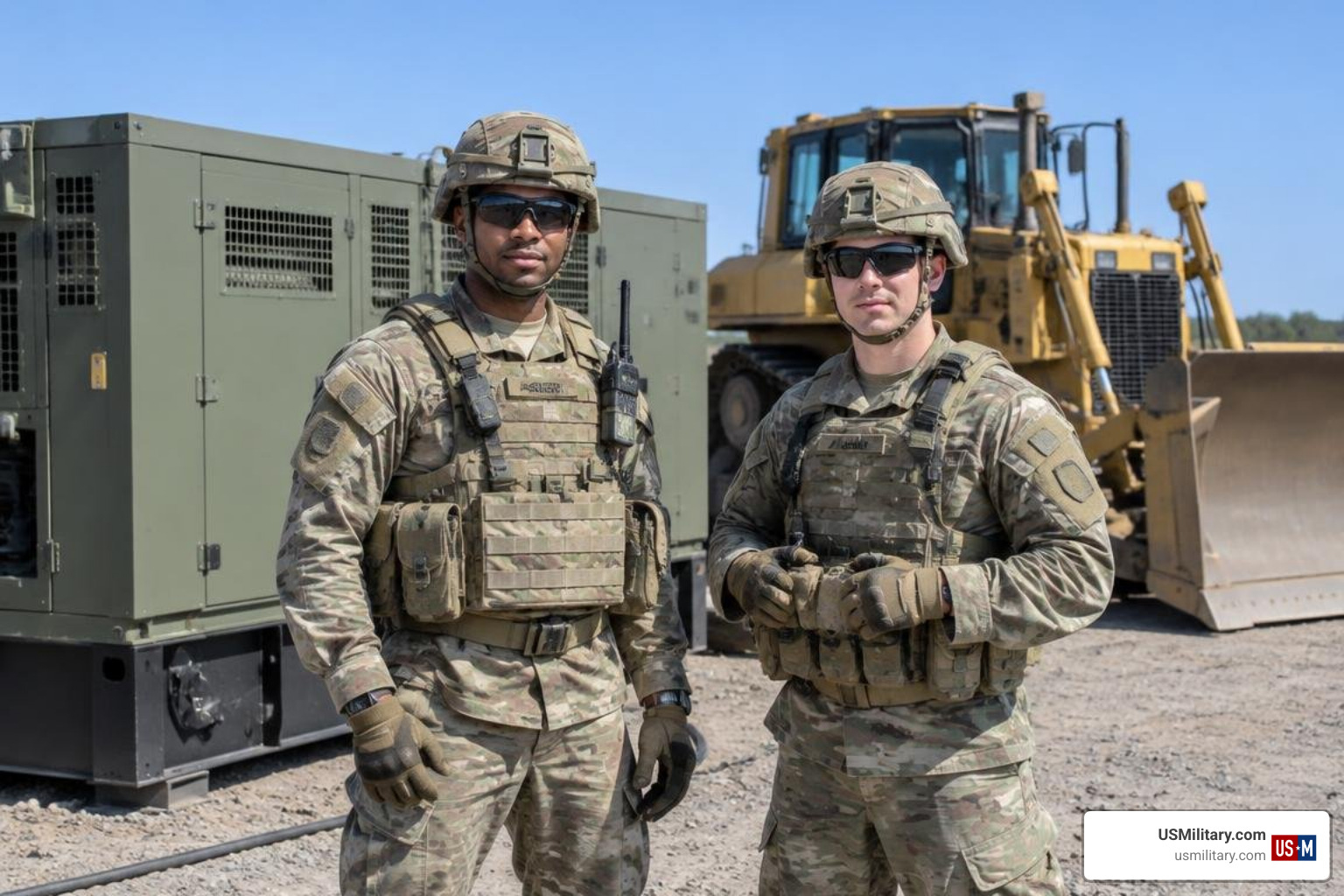
Physical trades and infrastructure maintenance remain largely immune to AI displacement. The Army’s 12P Prime Power Production Specialist is one of the military’s most technical engineering assets. 12P soldiers operate, service, and deploy massive medium-voltage electrical power plants and distribution systems across remote environments. With the federal government investing billions into baseload power infrastructure, modern electrical grid modernization, and advanced energy development, 12P veterans step directly into lucrative civilian roles as high-voltage electrical technicians and power plant operators.
Civil and mechanical engineering roles also offer unmatched durability:
- 12T Technical Engineer: Conducts land surveys, site layout drafting, and construction management using CAD software and geospatial analysis.
- 12N Heavy Equipment Construction Operator: Operates earthmovers, bulldozers, and cranes, building foundational skills for the nationwide construction boom.
- 91B Wheeled Vehicle Mechanic & 15T UH-60 Helicopter Repairer: Provide hands-on mechanical diagnostic and powertrain repair skills, easily translating into civilian diesel fleet management or FAA-certified Airframe and Powerplant (A&P) aviation maintenance.
- 89D Explosive Ordnance Disposal (EOD): An elite technical specialty handling hazardous materials, advanced robotics, and disposal operations, qualifying members for specialized government contracting and hazardous logistics roles.
- 74D CBRN Specialist: Delivers defense operations against chemical, biological, radiological, and nuclear threats, directly supporting national defense infrastructure and hazardous remediation.
Healthcare, Aviation, and Foundational Leadership Roles
Hands-on clinical specialties cannot be automated away by algorithms. The 68W Combat Medic Specialist earns National Registry of Emergency Medical Technicians (NREMT) credentials during Advanced Individual Training (AIT), creating direct pathways toward civilian paramedicine, emergency nursing, and physician assistant programs. Specialized roles such as 68C Practical Nursing Specialist and 68D Operating Room Specialist provide direct clinical patient-care hours, surgical preparation experience, and civilian licensing credentials that lead to immediate employment in hospitals nationwide.
In aviation, the 15Q Air Traffic Control Operator manages tactical airspace, terminal operations, and radar precision systems. Certified 15Q operators can transfer directly into civilian FAA air traffic management towers, where starting salaries frequently reach six figures.
Finally, combat and operational leadership roles like 11B Infantryman, 19K M1 Armor Crewman, 31B Military Police, 27D Paralegal Specialist, and 88M Motor Transport Operator build durable human qualities:
- Crisis leadership and split-second operational judgment.
- Interpersonal communication and high-stress collaboration.
- Commercial Driver’s License (CDL) qualifications (for 88M drivers).
- Cross-functional team management in unpredictable environments.
These intangible qualities remain among the most sought-after leadership traits across corporate America and public safety leadership.
Long-Term Benefits: SFL-TAP, FERS Retirement, and Civilian Transitions
Enlisting in the Army provides extensive long-term financial and educational benefits that extend well past your final day in uniform. Through the Soldier for Life – Transition Assistance Program (SFL-TAP) and the DoD SkillBridge program, departing soldiers can participate in civilian internships, apprenticeships, and credentialing programs during their last 180 days of active service while maintaining full military pay and housing allowances.
Military service is also widely recognized as one of the best military branches for education. Soldiers can utilize Tuition Assistance (up to $4,500 annually) while on active duty, preserving the full value of the Post-9/11 GI Bill—which provides 36 months of full tuition coverage, a monthly housing allowance, and a book stipend—for later undergraduate or graduate study.
For those pursuing civil service, military service awards Veterans’ Preference points when applying for competitive federal positions on USAJOBS. Furthermore, prior active-duty service can be “bought back” and applied directly toward the Federal Employees Retirement System (FERS) pension. This allows former service members to reach immediate retirement thresholds significantly faster while accumulating federal Thrift Savings Plan (TSP) investments.
Frequently Asked Questions About Army Careers in 2027
What is the highest-paying Army job for new enlisted recruits?
While basic pay is standardized across all military branches by rank and time in service (an E-1 earns a standard base pay of $2,407.20 per month following recent defense pay adjustments), technical specialties like 17C (Cyber Operations) and 89D (Explosive Ordnance Disposal) offer the highest total compensation. These fields offer enlistment bonuses up to $50,000 for critical skill specialties, special duty assignment pay, and rapid promotion velocity, alongside the highest civilian salary equivalents.
Which Army jobs offer the best protection against AI automation?
The military specialties most protected against automation involve hands-on equipment maintenance, dynamic physical troubleshooting, tactical healthcare, and direct human leadership. MOSs like 68W (Combat Medic), 12P (Prime Power Specialist), 15T (Helicopter Repairer), 12N (Heavy Equipment Operator), and 11B (Infantryman) require spontaneous physical adaptation, fine motor skills, and critical human empathy that artificial intelligence cannot replicate.
Can Army technical training transfer directly into federal civilian service?
Yes. Army veterans who complete training in cybersecurity (17C), intelligence (35F/35L), electrical infrastructure (12P), or logistics (88M) can transition directly into civilian GS-grade positions within the Department of Defense, Department of Energy, or Department of Homeland Security. Active-duty military time counts toward federal leave accrual and can be merged with the FERS pension system, ensuring your military service directly builds your civilian retirement.
Conclusion
Choosing the right Military Occupational Specialty is the single most important decision you will make when enlisting. By targeting technical MOSs that provide industry-recognized credentials, active security clearances, and resilience against AI-driven workforce changes, you establish a solid foundation for both a successful military career and post-service financial independence.
Explore your options, study for the ASVAB, and use our resources at USMilitary.com to compare service paths. When you are ready to evaluate your opportunities, find out which military branch you should join to match your strengths, career goals, and personal ambitions with the ideal branch of service.