
VA Disability Bipolar Disorder Ratings and Diagnostic Criteria

Navigating the rating system for VA disability bipolar disorder requires a solid understanding of how the Department of Veterans Affairs evaluates mental health conditions. Unlike physical disabilities that are often measured by mobility loss or range of motion, psychiatric conditions are evaluated on how severely they interfere with your ability to function at work and in daily social life.
The VA evaluates bipolar disorder using the General Rating Formula for Mental Disorders found in 38 CFR § 4.130. This standard formula applies across six distinct rating tiers: 0%, 10%, 30%, 50%, 70%, and 100%.
Bipolar ratings tend to cluster at higher percentage levels compared to conditions like unipolar depression. Data from Board of Veterans’ Appeals (BVA) decisions reveals that the modal granted rating tier for bipolar claims is 70%, followed closely by 100% schedular grants. This occurs because bipolar disorder inherently involves manic, hypomanic, or mixed episodes that cause severe judgment impairment, erratic behavior, and sudden mood shifts, which align directly with higher disability thresholds.
| VA Rating Tier | Occupational and Social Impairment Criteria | Typical Symptom Manifestations |
|---|---|---|
| 0% | No impairment; symptoms are fully controlled by continuous medication. | Transient, mild symptoms that do not interfere with work or social life. |
| 10% | Mild impairment during periods of high stress. | Slight decrease in work efficiency; controlled by medication. |
| 30% | Occasional impairment; general functioning remains satisfactory. | Depressed mood, anxiety, suspiciousness, panic attacks, sleep disturbance. |
| 50% | Moderate impairment across work and social environments. | Flattened affect, circumstantial speech, panic attacks (more than once a week), difficulty maintaining relationships. |
| 70% | Severe impairment in most functional areas. | Suicidal ideation, obsessive behaviors, severe mood swings, unprovoked irritability or aggression, spatial disorientation. |
| 100% | Total occupational and social impairment. | Persistent delusions or hallucinations, severe danger to self or others, total inability to perform activities of daily living. |
Diagnostic Codes 9431 vs 9432
When assigning a disability rating, the VA classifies bipolar conditions under specific diagnostic codes in the Schedule for Rating Disabilities:
- Diagnostic Code 9431 (Cyclothymic Disorder): Used for chronic, fluctuating mood disturbances involving numerous periods of hypomanic symptoms and depressive symptoms that do not meet the full diagnostic criteria for a major manic or major depressive episode.
- Diagnostic Code 9432 (Bipolar Disorder): The primary code applied to Bipolar I and Bipolar II disorders, including severe presentations accompanied by psychotic features such as delusions or hallucinations during intense manic or depressive phases.
Regardless of whether your claim falls under Diagnostic Code 9431 or 9432, the VA applies the exact same criteria under 38 CFR § 4.130 to determine your percentage level. Clinical guidelines, such as the joint VA DoD CPG for Management of Bipolar Disorder, highlight that proper clinical subtyping ensures your medical records accurately reflect the frequency and severity of your manic and depressive episodes.
The 38 CFR § 4.130 Mental Health Rating Scale
When evaluating your condition under the 38 CFR § 4.130 scale, rating officers look at the overall picture of your mental health. They apply the “preponderance rule” (or preponderance of symptoms tiering), which means you do not need to exhibit every single symptom listed under a specific rating percentage to qualify for that tier. If the majority or most severe of your symptoms align with a specific level, the VA must assign that rating.
- 0% Rating: This is a formal recognition of a service-connected diagnosis. While you will not receive monthly financial compensation at 0%, it grants access to VA healthcare for your mental health condition.
- 30% Rating: Assigned when manic or depressive phases cause mild decreases in work efficiency and occasional social difficulties, though you remain generally capable of maintaining employment and daily personal care.
- 50% Rating: Given when mood fluctuations cause noticeable drops in work productivity and reliability. Symptoms like frequent panic attacks, circumstantial speech, or mood instability disrupt both workplace performance and personal relationships.
- 70% Rating: Requires evidence showing deficiencies in key areas such as work, family relations, judgment, thinking, or overall mood. Symptoms frequently include active suicidal ideation, illogical speech, persistent depression or mania, severe irritability, or violent outbursts.
- 100% Rating: Reserved for cases showing total incapacity to work or function socially. It requires severe manifestations such as persistent hallucinations, continuous danger of hurting oneself or others, severe loss of memory, or complete inability to perform personal hygiene routine tasks.
Establishing Service Connection and Evidentiary Requirements
To receive monthly disability benefits, you must establish a legal “service connection” linking your diagnosed condition to your military service. To build a successful claim, review The Complete Guide to VA Disability Claims to ensure all foundational elements are met.

A winning claim requires three specific elements:
- A current, formal medical diagnosis of bipolar disorder.
- Evidence of an in-service event, injury, stressor, or onset of symptoms during active duty.
- A medical link (nexus) connecting your current diagnosis to the in-service event or active duty period.
Establishing Service Connection for VA Disability Bipolar Disorder
Veterans can establish service connection for VA disability bipolar disorder through three primary legal pathways:
- Direct Service Connection: This path applies when initial manic, hypomanic, or depressive symptoms occurred during active service. BVA case analysis shows direct service connection claims for bipolar disorder grant at a high rate (57.1%), as documented in-service onset provides a solid medical foundation. In-service disciplinary actions, performance drops, or UCMJ Article 15s recorded in service personnel files often serve as strong evidence of early manic onset before a formal clinical diagnosis was made.
- Service Aggravation: If your bipolar disorder existed prior to military service, you can claim service connection under 38 CFR § 3.306 and the landmark legal precedent Allen v. Brown. Under this rule, if military service permanently worsened the baseline severity of a pre-existing condition beyond its normal natural progression, the VA must grant service connection for the degree of aggravation.
- Secondary Service Connection: Bipolar disorder can develop as a secondary result of an existing service-connected physical or mental condition. For instance, severe head trauma sustained in combat can lead to post-traumatic bipolar symptoms. Check the VA Disability Conditions List to identify secondary linkages to your current service-connected conditions.
Essential Evidence and C&P Exam Preparation
The quality of medical and lay evidence submitted with your application directly controls the outcome of your claim.
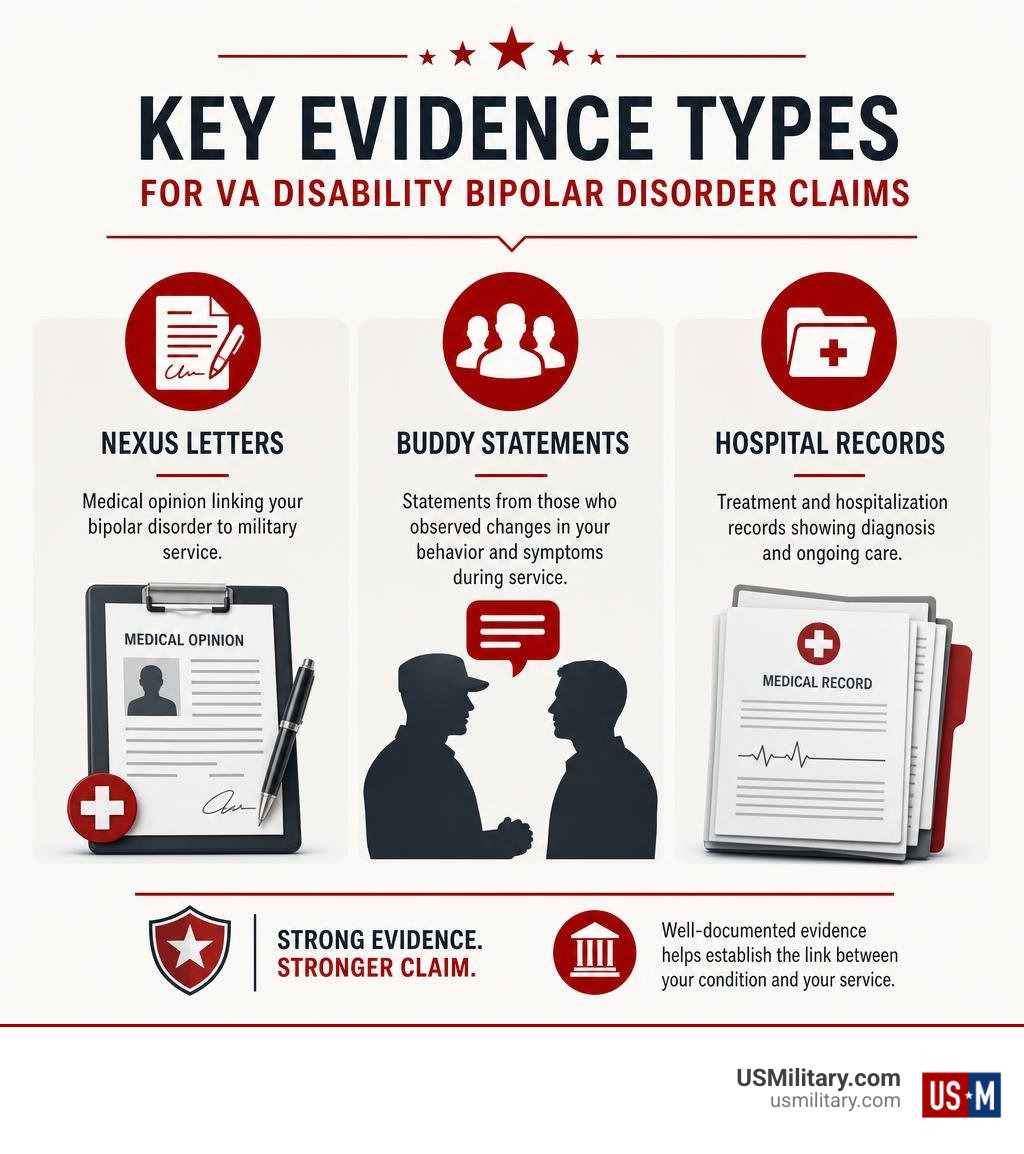
- Medical Nexus Letter: A formal opinion written by a qualified mental health professional (such as a psychiatrist or clinical psychologist) explaining how your condition is connected to service. A well-reasoned Nexus Letter for VA Claim makes a substantial difference: BVA dataset statistics show claims with strong nexus opinions grant at a 98.5% rate, whereas claims with weak or missing nexus opinions grant at 0%.
- Compensation & Pension (C&P) Exam: The VA will schedule a formal exam where a VA-appointed examiner completes a Disability Benefits Questionnaire (DBQ) for Mental Disorders. Prepare for this exam by bringing a written summary of your worst days. Do not minimize your symptoms or act as though you are having a “good day” during the exam; explain the full scope, duration, and disruption of your manic and depressive cycles.
- Buddy Statements & Lay Evidence: Third-party statements from fellow service members, spouse, family, or former supervisors are vital lay evidence. Under the Clemons lenient-claim-scope rule, lay evidence detailing observed behavioral changes, mood swings, and work disruptions must be weighed alongside medical evaluations.
- Benefit-of-the-Doubt Rule: Under 38 U.S.C. § 5107(b), if the positive and negative evidence regarding service connection are in equal balance (equipoise), the VA must resolve all reasonable doubt in your favor and grant the benefit.
TDIU Benefits and Claims Overcoming Denials
When bipolar disorder causes severe occupational disruption but falls short of a 100% schedular rating, Total Disability based on Individual Unemployability (TDIU) offers a critical financial safety net.

Qualifying for TDIU at a 70% Rating
TDIU allows veterans to be compensated at the 100% monthly pay rate even if their schedular rating is lower than 100%.
Under 38 CFR § 4.16(a), you qualify for schedular TDIU if you have:
- One service-connected disability rated at 60% or higher, OR
- A combined disability rating of 70% or higher, with at least one single disability rated at 40% or higher.
Because VA disability bipolar disorder claims frequently result in a 70% schedular rating, veterans in this tier automatically satisfy the rating threshold for TDIU. To win TDIU benefits, you must demonstrate that your service-connected bipolar disorder prevents you from securing or maintaining “substantially gainful employment.”
As demonstrated in landmark cases like BVA Decision 0306350, non-medical lay evidence describing workplace disruptions, along with official Social Security Disability Insurance (SSDI) awards, serve as persuasive evidence to establish complete unemployability.
Overcoming Denials for VA Disability Bipolar Disorder Claims
If the VA denies your initial bipolar disorder claim, do not lose hope. The two most common reasons for denial in BVA cases are:
- Severity Insufficient: The examiner found your symptoms were not severe enough to warrant a compensable rating.
- Nexus Gap: The VA found insufficient medical evidence linking your condition to military service.
If denied, you have three primary appeal pathways:
- Supplemental Claim: Submit new and relevant evidence, such as a strong medical nexus letter, updated treatment records, or detailed buddy statements.
- Higher-Level Review (HLR): Request a senior adjudicator to review the existing record for administrative or legal errors without submitting new evidence.
- Board of Veterans’ Appeals (BVA): Appeal directly to a Veterans Law Judge in Washington, D.C.
Additionally, check your historical VA rating letters. If you previously claimed mental health issues and the VA listed them on an internal codesheet but failed to address them in the formal decision narrative, the claim may remain legally “unadjudicated” (pending). Winning an unadjudicated claim can grant substantial back pay to your original filing date.
Pyramiding Rules: Bipolar Disorder vs. PTSD
Veterans frequently ask if they can receive separate disability ratings for bipolar disorder and other psychiatric conditions like Post-Traumatic Stress Disorder (PTSD) or depression.
Under 38 CFR § 4.14, known as the anti-pyramiding rule, the VA is legally prohibited from assigning separate percentage ratings for multiple mental health conditions that share overlapping symptoms. Because all mental disorders are evaluated under the same General Rating Formula in 38 CFR § 4.130, the VA combines all psychiatric conditions into a single composite rating.
| Condition | Core Symptom Focus | Overlapping Symptoms |
|---|---|---|
| Bipolar Disorder | Manic/hypomanic cycles, grandiosity, racing thoughts, extreme mood shifts | Insomnia, irritability, depression, anxiety, social withdrawal, job instability |
| PTSD | Intrusion memories, hypervigilance, trauma flashbacks, emotional numbing | Insomnia, irritability, depression, anxiety, social withdrawal, job instability |
Despite the pyramiding rule, diagnosing co-occurring conditions remains important. Clinical data shows that 42.9% of veterans with bipolar disorder also have PTSD.
As established in BVA Decision 22070240, secondary conditions like PTSD-induced sleep disruptions can trigger or aggravate manic episodes. Ensuring all conditions are noted ensures that your total symptom profile — including features covered in VA Disability for Depression and VA Disability for Anxiety — is fully accounted for under your single mental health rating.
Frequently Asked Questions
Can I get a 100% schedular rating for bipolar disorder?
Yes. To obtain a 100% schedular rating under 38 CFR § 4.130, your medical records must demonstrate total occupational and social impairment. This level requires evidence of severe, persistent symptoms such as ongoing delusions or hallucinations, inappropriate behavior, continuous danger of hurting yourself or others, or an inability to perform basic self-care tasks. Multiple inpatient psychiatric hospitalizations for severe manic or depressive episodes heavily support a 100% rating.
How does service aggravation work for pre-existing bipolar disorder?
If you had bipolar symptoms before joining the military, you can secure service connection if your military service worsened the condition. Under 38 CFR § 3.306, the VA presumes you entered service in sound condition unless a pre-existing issue was formally noted during your enlistment physical. If noted, you must present evidence showing that service conditions permanently increased the severity of your bipolar disorder beyond its natural progression.
Can bipolar disorder be claimed secondary to TBI or PTSD?
Yes. Traumatic Brain Injury (TBI) can disrupt brain chemistry and neurological pathways, directly leading to secondary mood disorders like bipolar disorder. Similarly, severe chronic stress and sleep deprivation stemming from service-connected PTSD can aggravate underlying mood instability or trigger secondary bipolar manifestations. A strong medical nexus letter from your doctor is necessary to establish this clinical link.
Conclusion
Securing a fair rating for VA disability bipolar disorder requires a clear, well-documented strategy. Because bipolar ratings cluster heavily at the 70% and 100% tiers, presenting comprehensive treatment records, detailed lay evidence, and an unequivocal medical nexus letter is essential to getting your claim approved.
At USMilitary.com, we are dedicated to helping veterans protect their legal rights and secure the compensation they have earned through service. If your condition prevents you from working, explore option pathways like TDIU or review our comprehensive VA Aid and Attendance Guide to maximize your overall benefit package. Take time to gather your evidence, consult with treating professionals, and submit a complete claim to protect your health and financial future.