
The Pros and Cons of Retiring After 20 Years in the Army

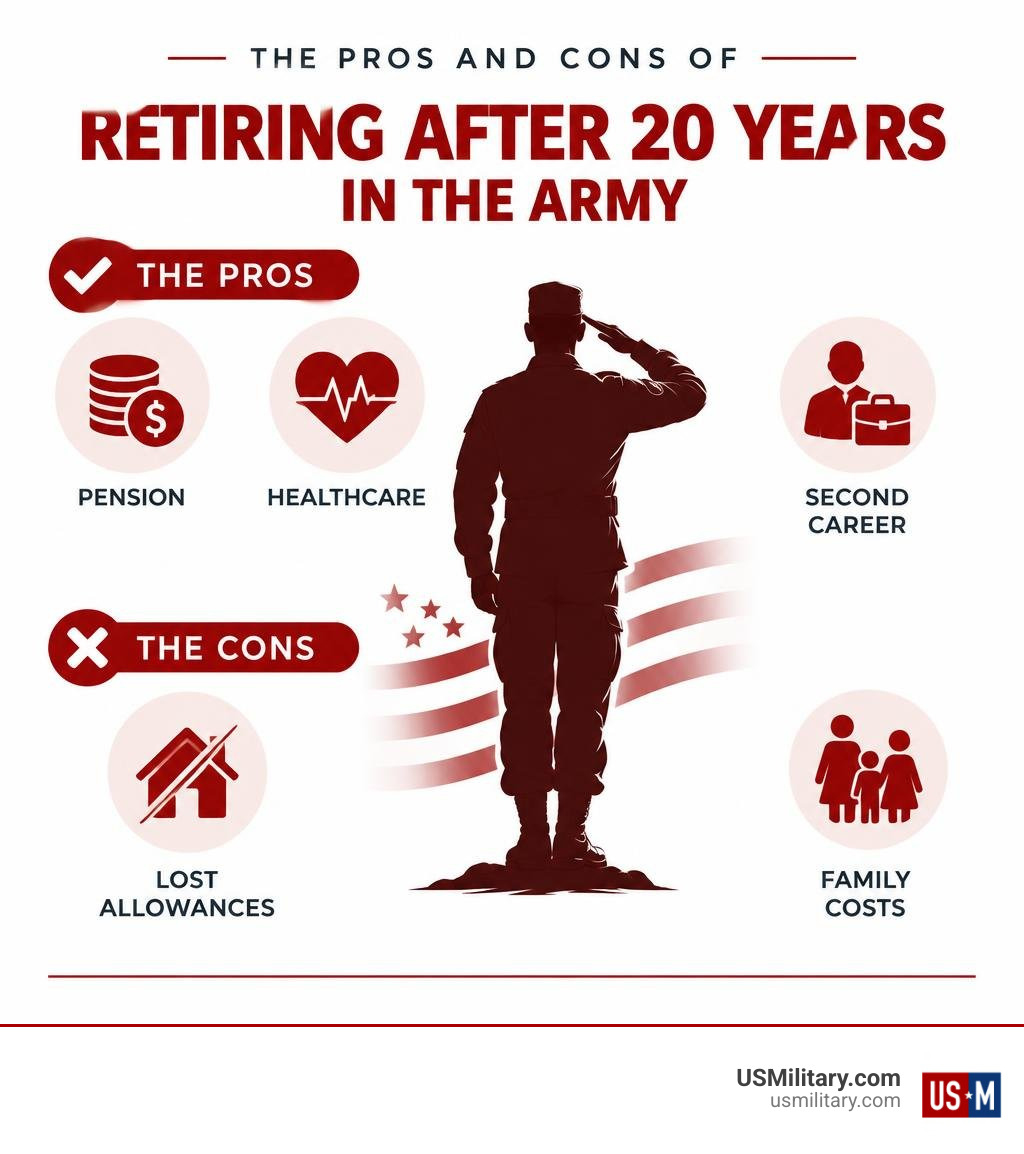
The Pros and Cons of Retiring After 20 Years in the Army come down to security versus sacrifice. A 20-year active-duty retiree can receive a lifetime pension, qualify for retiree TRICARE, and start a second career while still relatively young. At 20 years, the pension is generally 50% of the highest 36 months of basic pay under the legacy High-36 system or 40% under the Blended Retirement System.
The trade-offs are real. Housing and food allowances end, and two decades of service may mean injuries, family moves, and time away from home. For many families, the pension is a foundation for the next chapter, not enough to stop working.
I’m Larry Fowler, a veteran and publisher of the USArmy.com and the USMilitary.com Network. In this guide to The Pros and Cons of Retiring After 20 Years in the Army, I’ll draw on my experience helping service members and veterans understand military benefits and the choices ahead.
The Pros and Cons of Retiring After 20 Years in the Army terms to remember:
The Pros and Cons of Retiring After 20 Years in the Army: Key Advantages
The biggest advantage of reaching the 20-year mark is entering your late 30s or early 40s with a guaranteed monthly paycheck for life. While civilian peers must wait until age 60 or 65 to touch traditional retirement accounts, a 20-year soldier can begin collecting immediately. You can find a complete overview in our comprehensive military benefits guide.

This creates the foundation for “double-dipping.” A 38-year-old retired E-7 earning about $2,400 per month can secure an $80,000 civilian salary, for over $108,000 in total annual income. In addition, lifetime TRICARE coverage drastically slashes healthcare overhead compared to commercial plans, giving you the flexibility to take entrepreneurial risks or select lower-stress civilian positions.
| Retirement System | Service Multiplier per Year | 20-Year Pension Percentage | TSP Government Match | Lump-Sum Option |
|---|---|---|---|---|
| Final Pay (Entry before Sept 8, 1980) | 2.5% | 50% of final basic pay | None | No |
| High-36 (Legacy) (Entry 1980 to 2017) | 2.5% | 50% of highest 36-mo avg | None | No |
| CSB/REDUX (Opt-in at 15 YOS) | 2.0% (first 20 yrs) | 40% of highest 36-mo avg | None | Yes ($30k bonus) |
| Blended Retirement (BRS) (Entry 2018+) | 2.0% | 40% of highest 36-mo avg | Up to 5% basic pay | Yes (25% or 50%) |
The Pros and Cons of Retiring After 20 Years in the Army: Financial Security and Lifelong Benefits
Military pensions feature an annual Cost-of-Living Adjustment (COLA) that protects your purchasing power against inflation. To accurately project your future earnings, consult our guide on Army pension eligibility and retirement pay.
Under BRS, soldiers also retain a portable Thrift Savings Plan (TSP) with government matching up to 5%. However, setting a practical budget is essential; comparing military retirement expectations with reality helps bridge the gap between military allowances and post-service living costs.
Non-Financial Perks: Travel, Housing, and Quality of Life
The benefits of a 20-year career extend beyond monthly checks:
- Space-Available (Space-A) Travel: Fly on military cargo and passenger flights worldwide for minimal fees.
- Base Access and MWR: Retain access to commissaries, exchanges, and Morale, Welfare, and Recreation (MWR) resorts like the Hale Koa in Hawaii or Edelweiss Lodge in Germany.
- Home Financing: Leverage lifetime VA home loan eligibility to purchase properties with zero down payment.
- Education Benefits: The Post-9/11 GI Bill can be transferred to a spouse or children after completing mandatory service commitments, providing upwards of $100,000 in tax-free educational value.
The Hidden Costs, Sacrifices, and Downside Risks of a 20-Year Career
Reaching 20 years requires weathering heavy personal tolls. Decades of rucking, airborne operations, field exercises, and combat deployments leave many soldiers with chronic physical injuries, joint degeneration, and hearing loss.

Frequent permanent changes of station (PCS) disrupt spousal careers, complicate children’s schooling, and strain marriages. The lack of personal autonomy over your schedule, duty station, and personal life can also make the transition to unstructured civilian environments jarring.
The Pros and Cons of Retiring After 20 Years in the Army for Enlisted vs. Officers
Enlisted personnel and officers experience retirement differently:
- Enlisted Realities: An E-7 retiring with 20 years receives a pension of roughly $2,200 to $2,600 per month, based on rates outlined in the 2026 military pay chart for enlisted. This provides stability but rarely covers full living expenses without a second career.
- Officer Realities: An O-4 retiring at 20 years receives approximately $3,200 to $4,000 per month ($38,000 to $48,000 annually), providing a stronger financial cushion.
- Skill Transferability: Soldiers in cybersecurity, logistics, aviation, and healthcare often transition directly into six-figure corporate roles, whereas combat-arms specialties must spend additional time re-credentialing and translating tactical leadership to civilian resumes.
Financial Trade-Offs: Loss of BAH, BAS, and Civilian Opportunity Costs
A major financial hurdle upon retirement is the abrupt end of tax-free allowances. Basic Allowance for Housing (BAH) and Basic Allowance for Subsistence (BAS) provide $1,500 to $3,500 monthly in untaxed compensation.
When you retire, your entire pension is subject to federal income tax (though state tax treatment varies). Navigating these shifts requires understanding veteran tax planning strategies to prevent unexpected tax burdens on combined pension and civilian income.
Comparing Retirement Pathways: Retiring at 20 Years vs. Staying Longer
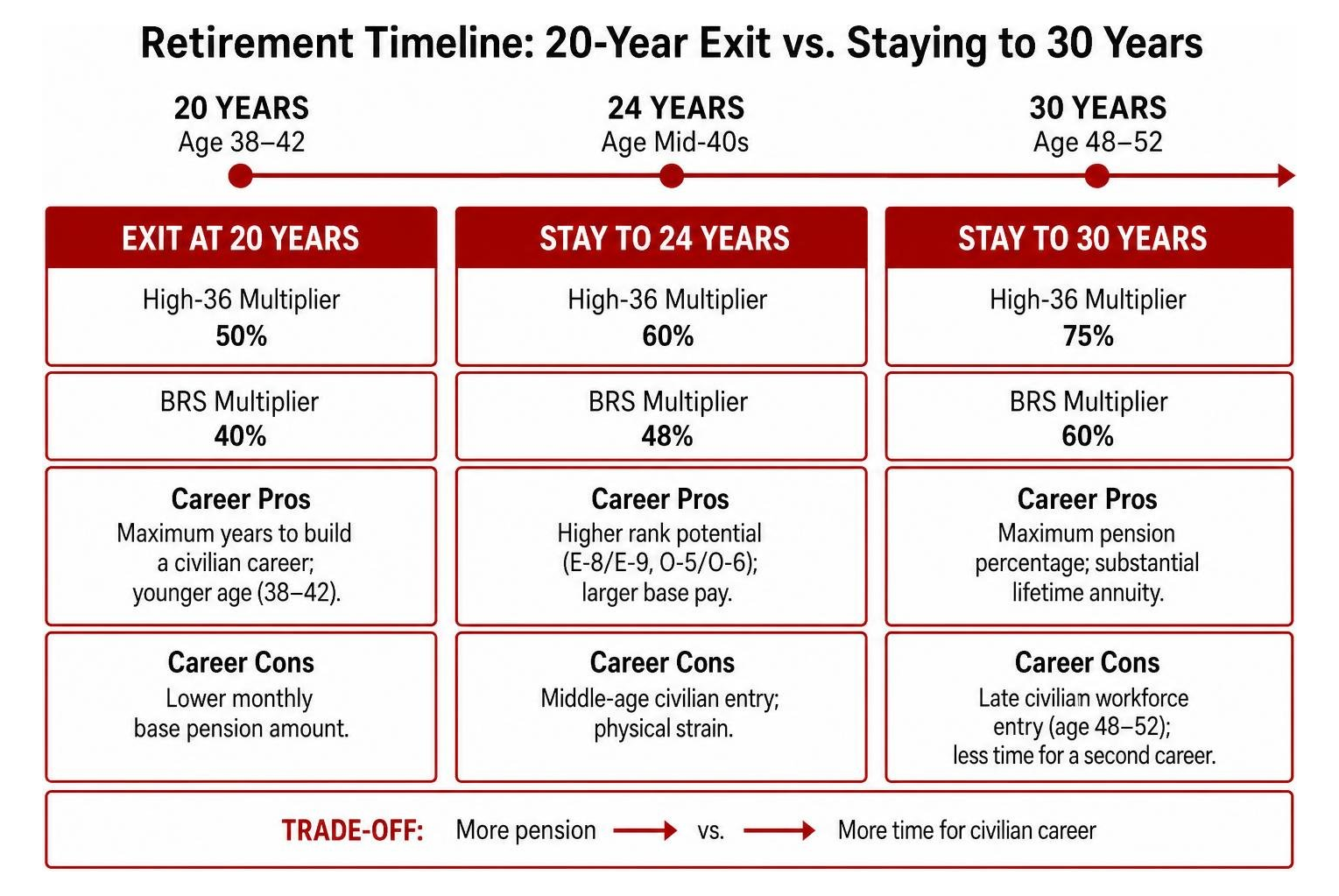
Deciding whether to punch out at 20 years or stay until 24, 26, or 30 years involves balancing pension growth against civilian career timelines. We explore these choices in our guide to navigating active duty retirement options.
| Service Duration | High-36 Multiplier | BRS Multiplier | Career Pros | Career Cons |
|---|---|---|---|---|
| 20 Years | 50% | 40% | Maximum years to build a civilian career; younger age (38-42). | Lower monthly base pension amount. |
| 24 Years | 60% | 48% | Higher rank potential (E-8/E-9, O-5/O-6); larger base pay. | Middle-age civilian entry; physical strain. |
| 30 Years | 75% | 60% | Maximum pension percentage; substantial lifetime annuity. | Late civilian workforce entry (age 48-52); less time for a second career. |
Understanding Disability, Medical Retirement, and Concurrent Receipt
Many 20-year retirees qualify for Department of Veterans Affairs (VA) disability compensation. Under Concurrent Retirement and Disability Pay (CRDP), service members with 20 or more years of service and a VA disability rating of 50% or higher can receive both their full military pension and their tax-free VA disability compensation without any offset.
For combat injuries, Combat-Related Special Compensation (CRSC) offers tax-free reimbursement for service-connected disabilities. You can review the underlying criteria in our breakdown of military pension eligibility rules.
Essential Pre-Retirement Checklist for a Seamless Transition
Preparation for retirement should begin at least 18 to 24 months before your official retirement date:
- Document All Medical Issues: Visit military clinics to ensure every injury, illness, and surgery is documented in your official service treatment records.
- Engage with the Transition Assistance Program (TAP): Attend TAP workshops early so you can repeat resume-building and interview modules.
- Review Survivor Benefit Plan (SBP) Options: Decide whether to elect SBP to provide your surviving spouse with up to 55% of your pension base.
- Initiate the VA Benefits Delivery at Discharge (BDD) Claim: Submit disability claims between 180 and 90 days prior to separation to start receiving VA payments shortly after retirement.
- Take Advantage of Credentialing: Use active-duty Tuition Assistance and Credentialing Assistance to earn civilian certifications before your discharge date, applying strategies from our guide on maximizing military benefits.
Frequently Asked Questions About Retiring After 20 Years in the Army
How much will my monthly pension be after 20 years in the Army?
Under the legacy High-36 system, your pension equals 50% of the average of your highest 36 months of basic pay. Under the Blended Retirement System (BRS), the multiplier is 2.0% per year, resulting in 40% of your high-36 average at 20 years. An E-7 typically receives $2,200 to $2,600 per month, while an O-4 receives $3,200 to $4,000 per month, subject to annual COLA adjustments.
Can I collect both military retired pay and VA disability compensation?
Yes. Under CRDP rules, active-duty soldiers who retire with 20 or more years of service and receive a VA disability rating of 50% or higher can receive full retired pay alongside tax-free VA disability compensation without dollar-for-dollar deductions.
Is it financially better to retire at 20 years or stay until 30?
Retiring at 20 is often more lucrative if you transition into a high-earning civilian career, because you collect your pension while earning a full civilian wage during your peak professional years. Staying until 30 maximizes your pension multiplier (up to 60% under BRS or 75% under High-36) and base pay, but leaves less time to build civilian seniority.
Conclusion
Retiring after 20 years in the Army is one of the most rewarding milestones a service member can reach. While it requires real trade-offs—such as managing physical wear, forfeiting tax-free housing allowances, and navigating a second career—it provides lifetime pension checks, low-cost healthcare, and financial freedom at an early age.
At USMilitary.com, we provide the calculators, VA loan guidance, and transition strategies you need to thrive in civilian life. Explore our comprehensive military benefits and resources to start mapping out your post-service journey today.