
Why Is the Army the First to Begin the Draft? Historically, the Army receives most draftees because it needs the largest number of people for sustained ground combat, support units, and replacement troops. The Navy, Marine Corps, and Air Force also can receive drafted personnel when authorized, but their smaller force sizes and more specialized training needs have often made the Army the main destination for inductees.
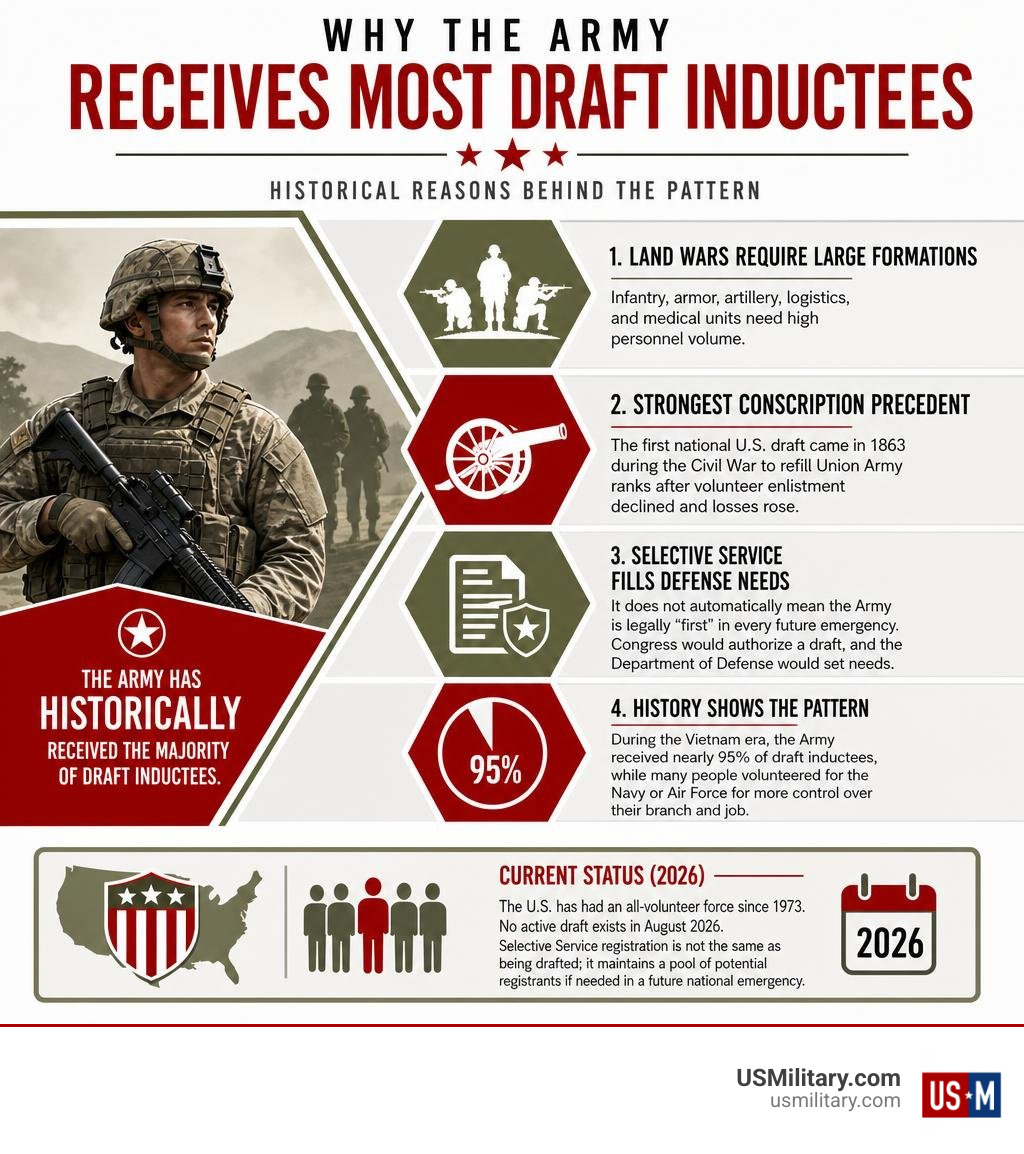
- Land wars require large formations. Infantry, armor, artillery, logistics, and medical units need high personnel volume.
- The Army has the strongest conscription precedent. The first national U.S. draft, enacted during the Civil War in 1863, was created to refill Union Army ranks after volunteer enlistment declined and losses rose.
- Selective Service fills Defense Department needs. It does not automatically mean the Army is legally “first” in every future emergency. Congress would have to authorize a draft, and the Department of Defense would set personnel requirements.
- History shows the pattern. During the Vietnam era, the Army received nearly 95% of draft inductees, while many people volunteered for the Navy or Air Force to gain more control over their branch and job.
The United States has operated an all-volunteer force since 1973, so no active draft exists in August 2026. Selective Service registration is not the same as being drafted; it maintains a pool of potential registrants if Congress and the president authorize conscription in a future national emergency.
I am LARRY FOWLER, publisher of the USArmy.com and the USMilitary.com Network since 2007, where I have helped connect service members, veterans, and prospective recruits with clear military information. My work explaining enlistment choices and military service trends helps put Why is the Army The First To Begin The Draft into practical context for people considering their options.
Quick look at Why is the Army The First To Begin The Draft:
- Which Branch of the Military Will Draft The Most
- How The Military Draft Works
- Who gets pulled first in a draft?
Historical Precedents: Why Is the Army The First To Begin The Draft
When we look back through American history, the historical answer to why the Army is the first to begin the draft comes down to land warfare demands. Ground forces absorb the physical friction of war—holding territory, protecting logistics lines, and conducting frontline infantry operations. As detailed in our breakdown on Will The Army Be The First Military Branch To Draft, whenever voluntary enlistments have faltered during large-scale military conflicts, the federal government has turned to federal conscription primarily to keep army divisions at full operational strength.
Federal draft authority was forged during the Civil War. When Union volunteer numbers plummeted in late 1862 after severe battlefield losses, Congress enacted the Civil War Enrollment Act (also known as the Conscription Act) on March 3, 1863. This was the first national draft law in U.S. history. While Confederate conscription actually started a year earlier in April 1862, the Union draft marked a huge shift in federal military policy. Of the roughly 2.2 million Union soldiers who served, approximately 2% were direct draftees and another 6% were paid substitutes. The primary purpose was actually to incentivize voluntary enlistments through local cash bounties—resulting in over one million voluntary recruits entering the Union Army to avoid being drafted.
By World War I, the United States recognized that local militias and voluntary enlistment could not supply millions of soldiers for industrial-scale trench warfare in Europe. Congress passed the Selective Service Act of 1917, registering 24 million men and inducting 2,810,296 into uniform. During World War II, the Selective Training and Service Act of 1940 created America’s first peacetime draft. Between 1940 and 1945, a staggering 49 million men registered, 36 million were classified, and over 10 million were inducted into military service. To understand how these laws functioned step-by-step, check out our background guide on How the Military Draft Works.
Evolution of Army Conscription from Civil War to Vietnam
The operational mechanics of draft selection evolved significantly across major conflicts, but the final recipient remained overwhelmingly constant: ground combat units. During the Civil War, out of 168,649 men procured for the Union Army through the federal draft, 117,986 served as paid substitutes, leaving just 50,663 who had their personal service directly conscripted.
Fast forward to the Cold War and Vietnam War eras, and the disparity between services grew dramatically. Between August 1964 and February 1973, the Selective Service inducted 1,857,304 men into the armed forces. Of these inductees, the U.S. Army accounted for nearly 95% of all draftees.

In 1966, the Department of Defense implemented “Project 100,000,” lowering mental and physical entrance standards to recruit 354,000 men who previously would not have qualified. As documented in the analysis on How the Vietnam Draft Order Determined Who Was Called to Serve, 71% of these Project 100,000 recruits were assigned directly to the Army, facing casualty rates three times higher than average service members. Land warfare consistently creates an urgent need for personnel, making troop generation for ground forces the top priority in national mobilizations.
Legal and Constitutional Foundations of Military Conscription
The authority to draft citizens stems directly from Article I, Section 8 of the United States Constitution, which grants Congress the power to “raise and support Armies” and “provide and maintain a Navy.” Early legal debates focused on whether the federal government could directly compel individual military service or if it was restricted to calling forth state militias under strict constitutional limitations.
The legal groundwork was solidified during the War of 1812 and refined by the Militia Act of 1862 and the Civil War Enrollment Act. Legal challenges eventually reached the United States Supreme Court during World War I. In the landmark Selective Draft Law Cases (1918), the Supreme Court unanimously upheld the Selective Service Act of 1917, ruling that congressional power to raise armies was broad, independent of state militia clauses, and did not violate the Thirteenth Amendment prohibition against involuntary servitude. As we discuss in our timeline of When Was the Last Draft in the US?, this constitutional foundation remains intact today under 10 U.S. Code § 246 and the Military Selective Service Act.
Manpower Demands: Ground Combat vs. Technical Military Branches
To grasp why the Army was the first to begin the draft, we must examine the operational realities and “tooth-to-tail” ratios of the military branches. The Army is designed to capture and hold physical landmass. Doing so requires vast infantry rifle squads, armor crews, artillery batteries, combat engineers, and massive tactical logistics networks. Ground operations inevitably carry higher casualty rates during major combat, creating a continuous need for trained replacement personnel.
By contrast, technical military branches like the Navy, Air Force, and Space Force rely heavily on highly complex capital platforms—such as nuclear submarines, guided-missile destroyers, aircraft carriers, stealth fighters, and satellite control networks. These branches do not scale up forces simply by adding more infantry boots on the ground; they scale up by building ultra-expensive ships and aircraft, which take years to manufacture.
For a complete breakdown of branch allocations, read our deep dive on Which Branch of the Military Will Draft the Most?.
| Military Branch | Primary Strategic Mission | Average Basic & Advanced Training Pipeline | Historical Draft Volume Reliance | Primary Method of Force Expansion |
|---|---|---|---|---|
| U.S. Army | Land Warfare & Territory Control | 10 to 22 Weeks (OSUT / BCT + AIT) | High (95% in Vietnam Era) | Mass Infantry & Ground Units |
| U.S. Marine Corps | Amphibious Assault & Expeditionary | 13 Weeks Recruit Training + Schooling | Low (Primarily Volunteer Force) | Specialized Expeditionary Forces |
| U.S. Navy | Maritime Superiority & Fleet Logistics | 10 Weeks Boot Camp + 6 to 18 Mo. Schooling | Low to Moderate (Executive Orders WWII) | Capital Ships & Technical Crews |
| U.S. Air Force | Air Superiority & Cyber Operations | 8.5 Weeks BMT + Technical Training | Very Low (High Volunteer Demand) | Aircraft Systems & Specialized Tech |
Training Pipeline Efficiencies Explaining Why is the Army The First To Begin The Draft
Training pipeline efficiency provides a major operational answer to why the Army is the first to begin the draft. An Army entry-level soldier undergoing One Station Unit Training (OSUT) or Basic Combat Training (BCT) combined with Advanced Individual Training (AIT) can reach basic combat readiness in 10 to 22 weeks. This condensed timeline allows the military to rapidly transform civilians into effective combat riflemen or motor transport operators during a national emergency.
Conversely, technical branches require extensive classroom instruction and nuclear or avionics certifications that often take 6 to 18 months before a recruit can contribute on a ship or flight line. If a conscript is inducted under a standard 24-month draft obligation, spending 18 months in technical training leaves only 6 months of active operational service, delivering a poor return on investment for the military. The Army’s shorter basic training pipeline makes conscripts far more practical for filling frontline tactical roles during wartime emergency mobilizations.
The Role of Draft-Induced Volunteerism Across Branches
Historically, the presence of an active Army draft created a powerful phenomenon known as “draft-induced volunteerism.” When young men knew an Army draft notice was imminent, thousands chose to proactively visit local military recruiters. By voluntarily enlisting before receiving an induction letter, individuals could secure 3- or 4-year enlistment contracts in the Navy, Air Force, Marine Corps, or Coast Guard—or select specific non-combat technical job specialties within the Army.
As recorded in historical surveys of Conscription in the United States, Selective Service Director General Lewis B. Hershey frequently noted that for every single man drafted into the Army, three or four others were motivated to voluntarily enlist in other services to avoid ground combat infantry roles. During the Vietnam War, between 34% (in 1964) and 50% (by 1970) of voluntary recruits across all services explicitly stated they enlisted to avoid being drafted into the Army.
Selective Service System Mechanics and Branch Allocations
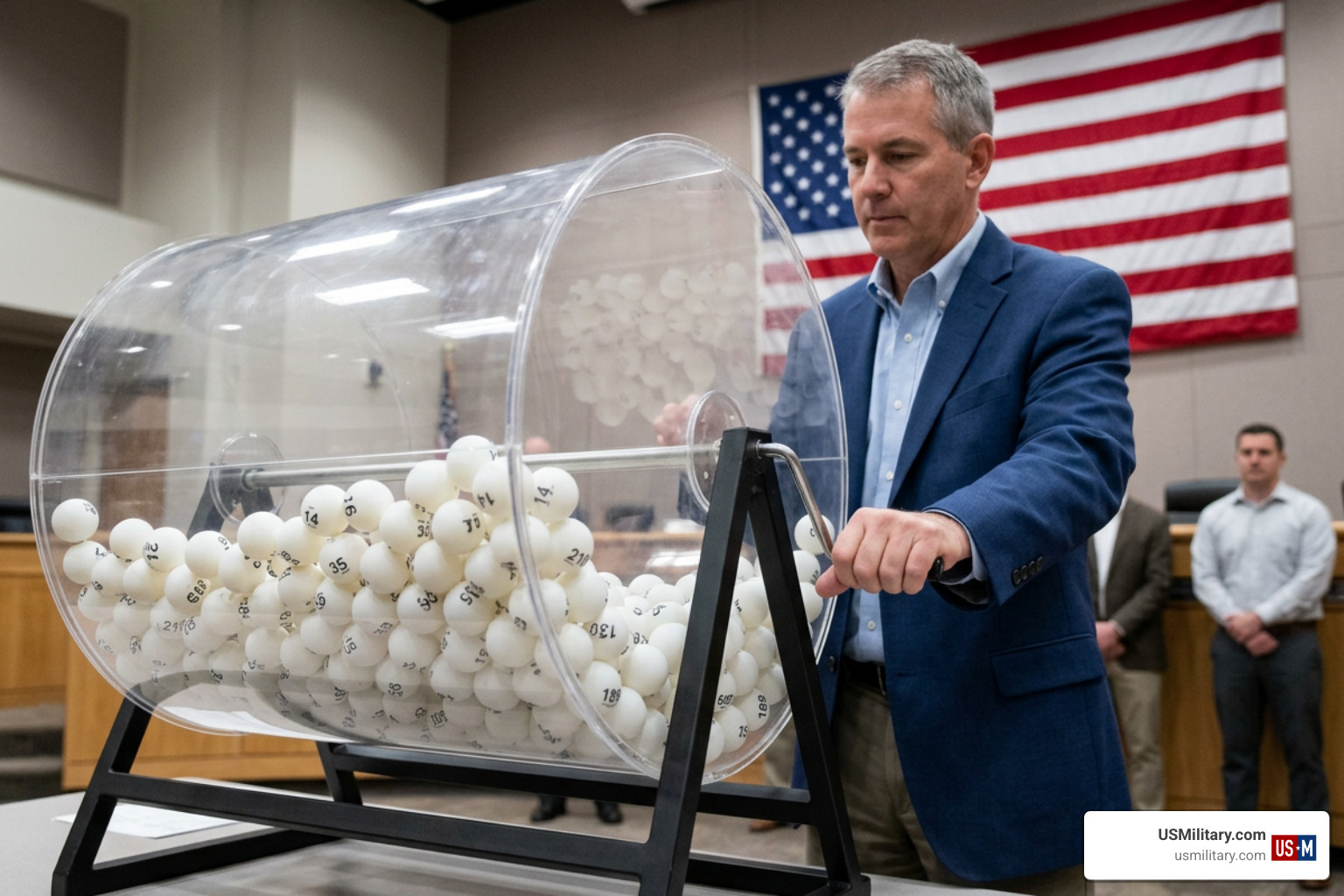
If Congress and the President were to reauthorize conscription today, the modern Selective Service System is designed to deliver the first inductees to Military Entrance Processing Stations (MEPS) within 193 days of authorization. Under current operational rules, conscription relies on a randomized birthdate lottery paired with an age-priority call-up sequence:
- 20-Year-Olds: The first group called consists of men who turn 20 during the calendar year of the lottery.
- 21- to 25-Year-Olds: Sequentially called year-by-year (21, 22, 23, 24, and 25) if additional personnel are needed.
- 18- and 19-Year-Olds: Held in reserve as the absolute last priority group.
A major statutory development shaping modern military readiness is the passage of provisions within the National Defense Authorization Act (NDAA). As detailed in A Quick Start Guide to Automatic US Draft Registration 2026, federal law transitions Selective Service registration from manual self-registration to automatic database integration. According to reports on how Automatic military draft registration takes effect in the US, automated enrollment cross-references federal databases (including federal financial aid records, state driver’s license offices, and Social Security Administration files) to automatically register draft-eligible males between ages 18 and 26.
How Modern Selective Service Protocols Prioritize Army Ground Forces
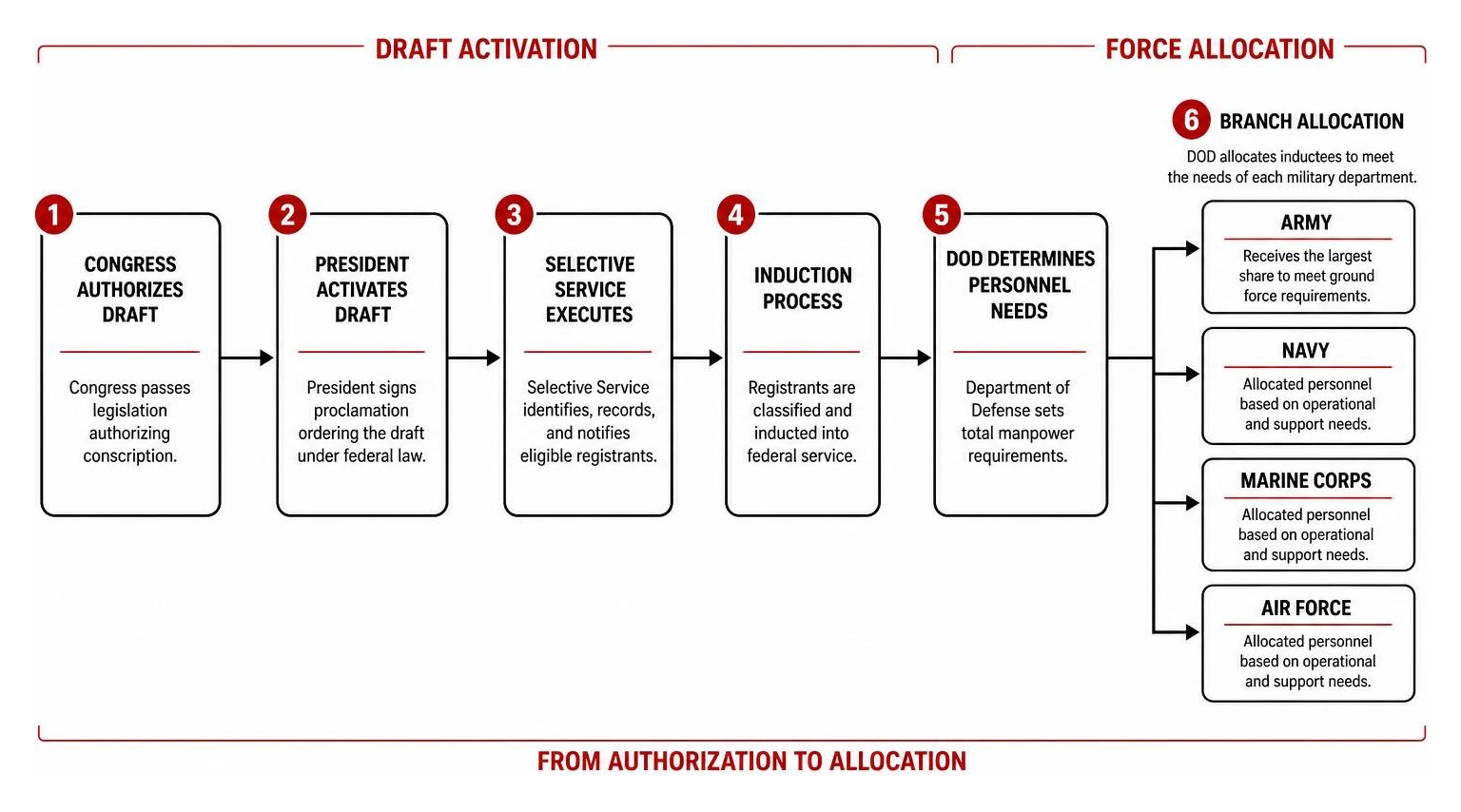
When conscription is activated, the process begins with a formal requisition order from the Secretary of Defense to the Director of the Selective Service System detailing exact manpower totals needed by service branch.
Because land combat demands represent the largest volume, the Army receives the majority allocation of inductees.
Candidates report to local Military Entrance Processing Stations (MEPS) for physical examinations, mental aptitude evaluations, and background evaluations. Local civilian draft boards—staffed by over 2,000 volunteer citizens across the nation—are activated to hear individual claims for deferments, hardship exemptions, or conscientious objector classifications. To review updated medical and physical induction criteria, refer to our detailed summary on Draft Physical Requirements.
Special Skills Draft and Non-Ground Branch Requirements
Not all drafts focus exclusively on general infantry troop generation. The Selective Service System maintains standby operational plans for specialized conscription pipelines, most notably the Health Care Personnel Delivery System (HCPDS).
If authorized by Congress, an HCPDS “Special Skills Draft” can target male and female healthcare professionals—including physicians, registered nurses, medical specialists, and trauma surgeons—in age brackets extending up to age 54. Additionally, modern defense planners have debated standby cyber technical drafts to recruit specialized information security experts, network engineers, and language analysts for branches like the Air Force, Space Force, and Navy. To see what disqualifies individuals from general and specialized draft calls, read our overview of Medical Conditions That Keep You Out of the Draft.
Organizational Impact and Public Perception of the Army Draft
Relying heavily on conscription fundamentally alters the internal culture, combat cohesion, and public perception of a military service. When the military transitioned to the All-Volunteer Force (AVF) in January 1973, military leaders recognized that professional soldiers who actively choose a military career display higher retention rates, better unit morale, and superior technical proficiency compared to reluctant draftees serving a mandatory 24 months.
Historically, because the Army receives the largest volume of conscripts, it has borne the brunt of anti-draft sentiment and civil unrest throughout American history:
- The Civil War Draft Riots (1863): Outraged by commutation fees that allowed wealthy individuals to buy draft exemptions for $300, violent anti-draft riots erupted in New York City, leading to significant destruction and requiring federal military troops to restore order.
- The Vietnam Anti-Draft Movement (1965–1973): Widespread public protests, draft-card burnings, and campus demonstrations focused heavily on Army ground combat casualties and socioeconomic inequities in draft deferments.
- Modern Public Debates: Recent national conversations regarding the draft reflect evolving societal views on national service, equitable burden-sharing, and gender inclusion in Selective Service requirements.
Cultural Impact and Draft Resistance Explaining Why is the Army The First To Begin The Draft
The cultural resistance historically tied to Why is the Army The First To Begin The Draft stems from the public perception of risk. Parents and draftees recognized that an Army induction order carried a significantly higher statistical probability of assignment to infantry rifle units engaged in direct close-quarters ground combat.
This perception was heightened by deferment policies during the Vietnam era, where college students (2-S deferments) and individuals in key occupational fields could delay induction, leaving working-class men disproportionately represented among Army conscripts. For individuals opposed to military service on religious or moral grounds, federal law provides formal legal definitions and pathways to register as conscientious objectors. To learn how these classifications work legally, consult The Essential Guide to Conscientious Objector Definitions.
Frequently Asked Questions About the Army Draft
Will the Army be the only branch to draft personnel during a national emergency?
No, the Army is not legally the sole military branch authorized to receive draftees. If Congress reinstates conscription under the Military Selective Service Act, the Department of Defense determines troop allocations for all branches based on joint operational requirements. During World War II, Executive Order 9279 suspended voluntary enlistment for men aged 18 to 37, forcing the Navy and Marine Corps to receive personnel through Selective Service alongside the Army. However, because ground combat demands remain the largest, the Army would realistically receive the highest percentage of inductees. Read our full analysis on Will There Be a Military Draft in 2026?.
Who gets called first if a draft is reinstated today?
If a national draft were enacted today, selection would be conducted via a randomized birthdate lottery. The very first group called up would be 20-year-olds (or men turning 20 during the lottery year). If additional personnel are required, the Selective Service would sequentially call men aged 21, 22, 23, 24, and 25. Men aged 18 and 19 are held as the final priority group. For a complete age-by-age breakdown of liability, see our Military Draft Age Guide.
How does automatic draft registration affect modern military readiness?
Automatic draft registration streamlines Selective Service record-keeping by integrating federal databases from the Social Security Administration, state DMVs, and federal student aid records. By automatically registering eligible 18-to-26-year-old males, the federal government eliminates administrative delays and improves data accuracy for the national registrant pool. This ensures that if Congress ever authorized conscription, the Selective Service System could rapidly execute a lottery without spending months manually gathering registrant lists.
Conclusion
Understanding why the Army was the first to begin the draft comes down to land warfare history, troop volume demands, and training efficiency. From the Civil War Enrollment Act of 1863 through World War I, World War II, the Korean War, and Vietnam, ground forces have always required the largest number of personnel to control land mass and sustain operational deployments. With basic combat pipelines designed to quickly prepare soldiers for service, the Army remains the primary service equipped to absorb and integrate draftees during a national emergency.
As of August 2026, the United States remains fully committed to an All-Volunteer Force. Selective Service registration is simply a standby administrative system ensuring national military readiness. For detailed information on military enlistment options, career comparisons, VA home loan benefits, and branch guidance, explore our complete resource guide on What Is the US Military Draft? or visit our main hub at USMilitary.com today.