
What Is the Maximum Age to Enlist in the U.S. Military in 2026?

The maximum age to enlist in us military branches varies depending on where you want to serve — and in 2026, several branches raised their limits, opening the door for more Americans than ever before.
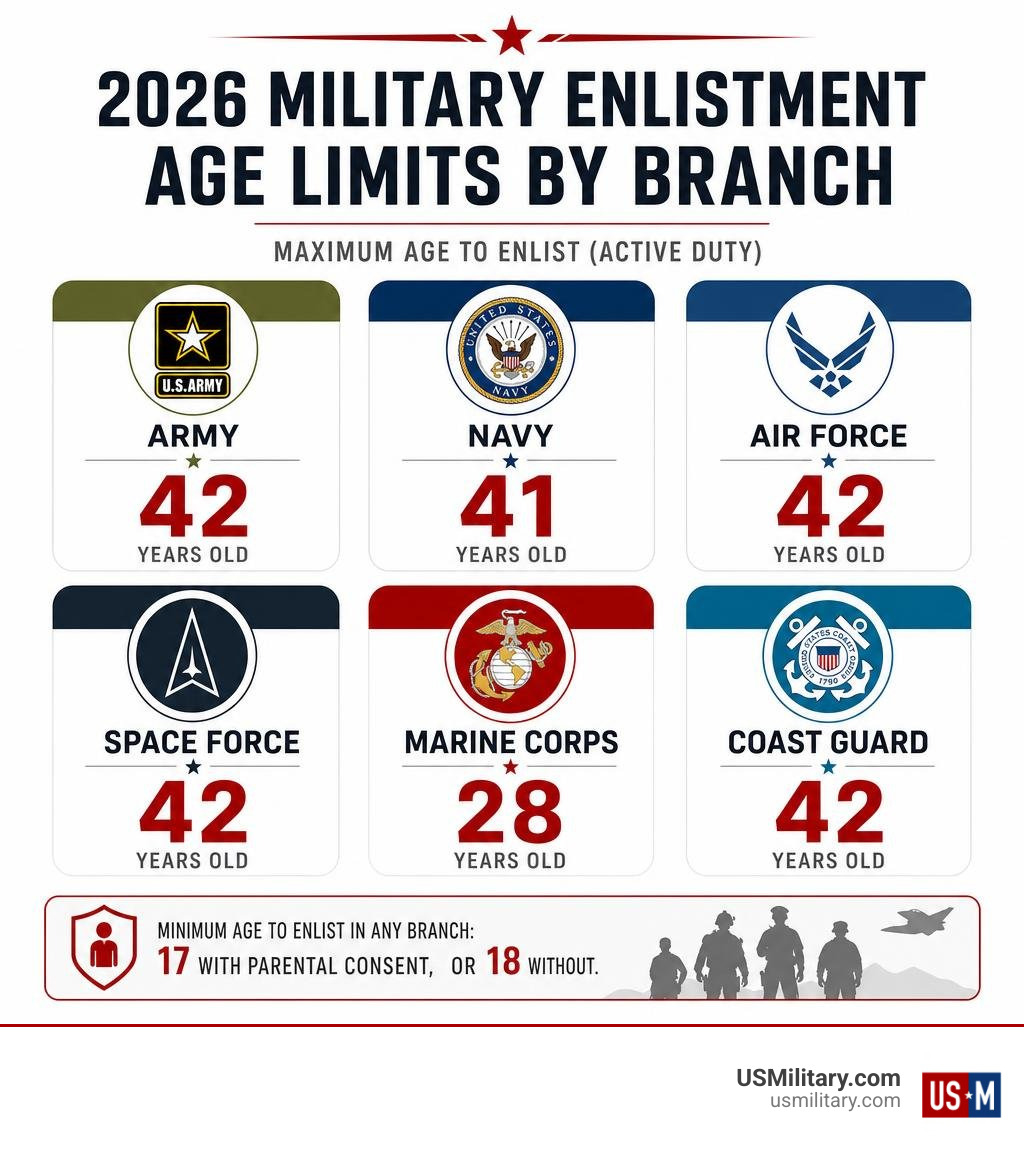
Here is a quick breakdown of the current maximum enlistment ages by branch:
| Branch | Maximum Enlistment Age (Active Duty) |
|---|---|
| Army | 42 |
| Navy | 41 |
| Air Force | 42 |
| Space Force | 42 |
| Marine Corps | 28 |
| Coast Guard | 42 |
Note: The minimum age to enlist in any branch is 17 with parental consent, or 18 without.
These numbers matter more than most people realize. Wait too long and some doors close permanently — the Marine Corps cuts off at 28, while the Army only recently raised its cap from 35 to 42 in April 2026. On the other end, the Air Force, Space Force, and Coast Guard now accept recruits all the way up to age 42 — the highest limit allowed under federal law.
The recent policy shifts are tied to a real recruiting challenge. The Army missed its recruiting goals by roughly 25% in 2022, and the Air Force missed its active-duty targets in FY23 for the first time since 1999. Raising age limits is one of the key ways branches are widening their recruiting pool — and research backs it up. Recruits between ages 25 and 35 are 15% less likely to wash out of initial training than younger recruits, according to a 2022 RAND study.
I’m Larry Fowler, publisher of USMilitary.com, and since 2007, I’ve helped hundreds of thousands of Americans navigate military enlistment decisions — including understanding the maximum age to enlist in US military branches. Whether you’re 22 or 41, this guide will walk you through exactly where you stand.
What is the Maximum Age to Enlist in US Military Branches?
When we look at the modern landscape of military service in 2026, it is clear that “old man strength” and life experience are highly valued. The Department of Defense (DoD) has had to adapt to changing demographics, a competitive civilian job market, and a persistent recruiting crisis. To combat these shortfalls, almost every branch of the armed forces has re-evaluated its age requirements.
Historically, military branches kept their age cutoffs relatively low to ensure a youthful, highly agile force. However, today’s high-tech military relies heavily on technical skills, logistics expertise, and emotional maturity. This shift has prompted a historic expansion of the recruiting pool.
If you are considering a career change or finally pursuing a lifelong dream of serving, understanding the Age Requirements for Military Branches is your first step. Each branch has set its own operational limits within the boundaries of federal law. If you are close to the cutoff, you must pay attention to the specific Cut-Off Age for Military enlistment to ensure you do not miss your window of eligibility.
Army Enlistment Age Limits
In a historic move, the U.S. Army officially raised its maximum enlistment age from 35 to 42. This change was codified in an update to Army Regulation 601-210, taking effect on April 20, 2026. While the Army had quietly utilized internal policies since 2023 to accept older recruits, this official update fully solidified the policy.
This is not the first time the Army has pushed its age limits to 42. A similar change was made in 2006 during the height of the wars in Iraq and Afghanistan to meet heavy manpower demands, before the limit was lowered back to 35 in 2016. The 2026 shift is designed to attract older, highly skilled professionals — especially those with experience in cybersecurity, logistics, and engineering.
If you are planning on Joining the Army in 2026: Check the Age Requirements First to see how these changes impact your enlistment timeline. Along with raising the age ceiling, the updated regulation also eased other restrictions. For example, the Army eliminated the requirement for a waiver for a single past conviction of marijuana or drug paraphernalia possession, making the path to enlistment much smoother. You can read more about these major updates in this Army raises enlistment age report.
Navy Enlistment Age Limits
The U.S. Navy also recognized the need to expand its talent pool, raising its maximum enlistment age from 39 to 41 in November 2022. This policy remains active today in 2026.
By raising the enlistment age, the Navy aimed to attract individuals who may have established careers in civilian maritime, engineering, or technical fields but still feel the call to serve. This change allows the Navy to bring in mature recruits who require less basic life-skills mentoring and can focus directly on mastering complex shipboard systems. For those interested in setting sail with the fleet, you can learn more about starting your journey on the USMilitary.com Navy Portal.
Air Force and Space Force Enlistment Age Limits
The Air Force and Space Force currently share the highest standard active-duty enlistment age among the DoD branches, capping entry at age 42. Both services raised their limits from 39 to 42 in 2023.
The decision to raise the age limit to 42 was mathematically strategic. The mandatory retirement age for active-duty military personnel is 62. By setting the maximum enlistment age at 42, the Air Force and Space Force ensure that an older recruit can still complete a full, honorable 20-year career to qualify for regular military retirement benefits.
Because both branches rely heavily on highly technical occupations — such as space systems operations, information technology, and advanced electronics — older recruits with civilian backgrounds in STEM are incredibly valuable. To understand the specific pathways and educational requirements for these branches, consult Your Guide to Air Force Age Requirements.
Marine Corps Enlistment Age Limits
The U.S. Marine Corps remains the strictest outlier, maintaining a maximum enlistment age of 28 for both active duty and reserve components.
The Marine Corps emphasizes youth, extreme physical conditioning, and rapid-reaction amphibious operations. Because the physical toll of Marine Corps recruit training and subsequent infantry-centric operations is incredibly demanding, the leadership believes these missions are best suited for a younger demographic. If you are approaching your late twenties and want to earn the title of Marine, you must act quickly. To check the physical requirements and age limitations, read Can You Join the Marines in 2026: Age Requirements and Limits.
Coast Guard Enlistment Age Limits
The U.S. Coast Guard, which operates under the Department of Homeland Security during peacetime, allows active-duty enlistments up to age 42. This limit was raised to match the Air Force and Space Force standards, providing a wider window for maritime law enforcement and search-and-rescue candidates.
However, if you are looking to join the Coast Guard Reserve, the limit is slightly lower at age 40. The Coast Guard offers specialized programs for older recruits who already possess civilian credentials, such as licensed captains or maritime mechanics, allowing them to bypass certain entry-level training phases.
Federal Law and the Statutory Military Age Limits

While each branch has the authority to set its own operational age limits, they must operate within the boundaries established by federal law. Under U.S.C. Title 10 – ARMED FORCES, specifically Section 505, the statutory maximum age for an original enlistment in the regular components of the U.S. military is set at 42.
Congress amended this law in 2006 to give the services the flexibility to recruit older individuals during times of high operational demand. While a branch can choose to set its operational limit lower than 42 (as the Marine Corps does at 28, and the Navy does at 41), no branch can set a standard enlistment age higher than 42 for regular active-duty recruits without utilizing specialized legal waivers.
Minimum Age to Enlist
The lower boundary of military service is also highly regulated. The statutory minimum age to enlist in any branch of the U.S. military is 17 with written parental consent, or 18 without.
For 17-year-olds, the enlistment process requires a parent or legal guardian to sign official consent forms at the Military Entrance Processing Station (MEPS). Additionally, 17-year-old recruits must have completed high school or be on track to graduate before shipping to basic training. If you want to explore the transition from high school to the military, check out The Ultimate Guide to Military Enlistment Age: What You Need to Know.
Active Duty vs. Reserve and National Guard Age Limits
If you want to serve but prefer to maintain a civilian career, the Reserve components or the National Guard offer fantastic alternatives. The age limits for these part-time service paths are generally aligned with active-duty standards, but there are some critical legal distinctions.
For the Army Reserve, Navy Reserve, Air Force Reserve, Marine Corps Reserve, and Coast Guard Reserve, the maximum enlistment ages closely mirror their active-duty counterparts. However, the National Guard operates under a distinct legal framework.
According to federal law under 32 USC 313: Appointments and enlistments: age limitations, the statutory age limit for an original enlistment in the National Guard is 17 to under 45. This means that, legally, a civilian with no prior service can enlist in the National Guard up to age 44. However, individual state governors and Guard bureaus may impose lower operational limits based on current staffing needs. To learn how these state and federal rules interact, consult our comprehensive National Guard Age Limit Guide.
Officer Commissioning vs. Enlisted Paths
The age limits we have discussed so far apply primarily to enlisted personnel. If you are pursuing a path as a commissioned officer, the age requirements are generally much stricter. Officers are expected to lead troops and manage complex operations, which requires a significant investment in training.
- Service Academies: The U.S. Military Academy (West Point), Naval Academy, Air Force Academy, and Coast Guard Academy have a strict, non-negotiable age limit. Applicants must be at least 17 and not have reached their 23rd birthday on July 1 of the year they enter the academy.
- ROTC Programs: ROTC scholarship applicants generally must complete their degree and commission before reaching age 31, though waivers can sometimes extend this to age 35 for non-scholarship students.
- Officer Candidate School (OCS/OTS): The age limits for college graduates seeking a commission through OCS vary by branch. For example, the Army requires officer candidates to commission before age 31, while the Navy and Air Force allow older candidates, sometimes up to age 35 or 42 with waivers.
- Direct Commissions: This pathway is reserved for highly specialized professionals. Doctors, dentists, nurses, chaplains, and lawyers (JAG) can receive direct commissions. Because these roles do not involve leading combat troops in the traditional sense, the military regularly waives standard age limits, allowing professionals in their late 40s or even 50s to commission.
How Age Waivers and Prior Service Adjustments Work

If you exceed the standard maximum enlistment age for your chosen branch, your military journey is not necessarily over. You may still be able to serve through age waivers or prior service adjustments.
An age waiver is an official request approved by the branch’s recruiting command. These are evaluated on a case-by-case basis. To secure an age waiver, you must prove that you are an exceptionally high-value candidate. Your chances of getting a waiver increase significantly if you:
- Score exceptionally high on the ASVAB.
- Possess a high-demand civilian skill (such as cyber security, linguistics, or medical training).
- Exceed the standard physical fitness requirements for your age bracket.
To learn more about how to present your case to a recruiter, read From 17 to 42: The Ultimate Guide to Enlisting in the US Military.
The Prior Service Adjusted Age Calculation
If you have previously served honorably in any branch of the U.S. military, your prior service acts as a “fountain of youth” when calculating your eligibility to re-enlist. Most branches use an “adjusted age” calculation to determine if you meet their requirements.
To find your adjusted age, you subtract your years of active duty service from your current physical age. The resulting number is the age the military uses to determine your eligibility.
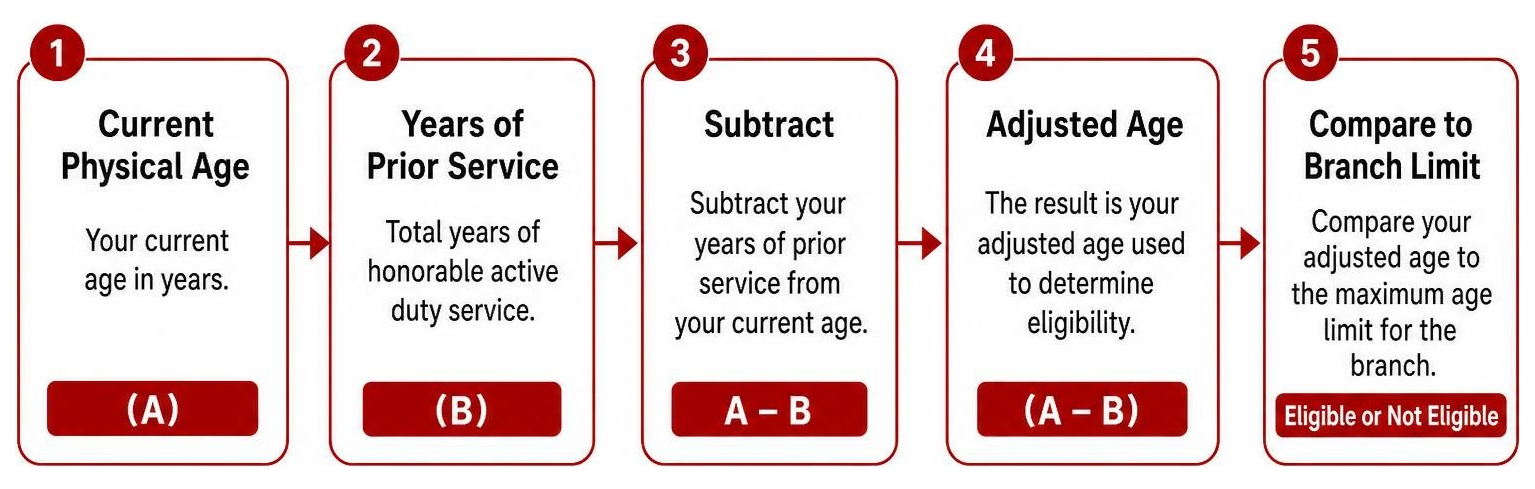
For example, let’s look at a 45-year-old veteran who previously served 6 years on active duty in the Navy.
$$\text{Current Physical Age (45)} – \text{Years of Prior Service (6)} = \text{Adjusted Age (39)}$$
Since their adjusted age is 39, they easily fall under the Army, Air Force, Space Force, and Coast Guard maximum age limit of 42, and the Navy’s limit of 41. Under 32 USC 313, prior service members can even enlist in the National Guard up to age 64 in certain specialized cases, provided they can complete enough years of service to qualify for a retirement pension before mandatory retirement.
Exceptions for Specialized Roles
The absolute oldest recruits in the military are typically found in specialized professional fields. The military has a constant, critical need for healthcare professionals, chaplains, and legal experts.
In the Air Force, for example, healthcare and ministry professionals can enlist or commission up to age 48. In many branches, specialized medical doctors, surgeons, and psychiatrists can obtain direct commissions up to age 60, as their medical expertise far outweighs standard military physical training requirements. These professionals often bypass standard basic training entirely, attending shortened officer orientation courses instead.
How Age Interacts with Other Enlistment Requirements
Age does not exist in a vacuum. As an older recruit, your application will be scrutinized much more closely in several key areas:
- Physical Fitness and Medical Screening: Let’s face it — basic training is physically punishing. While older recruits (ages 25-35) are statistically 15% less likely to wash out due to superior mental toughness, their joints, cardiovascular health, and recovery times are heavily scrutinized at MEPS. You must meet the standard height, weight, and body fat percentages for your age bracket.
- ASVAB Scores: A high score on the Armed Services Vocational Aptitude Battery (ASVAB) is your best leverage. If you are 40 years old and score a 95 on the ASVAB, a recruiter will fight much harder to secure an age waiver for you than if you score the bare minimum.
- Education and Citizenship: You must meet the standard educational requirements (a high school diploma is highly preferred over a GED, as GED slots are strictly limited). You must also be a U.S. citizen or a permanent resident with a valid Green Card. Interestingly, serving in the military can fast-track the naturalization process for Green Card holders to as little as one day.
To prepare your documentation and ensure you meet all baseline standards, review the official Requirements to join the U.S. military and the Army’s specific Eligibility & Requirements to Join guidelines.
Frequently Asked Questions About Military Age Limits
What is the maximum age to enlist in us military active duty?
As of July 2026, the maximum age to enlist on active duty is 42 for the Army, Air Force, Space Force, and Coast Guard. The Navy’s limit is 41, and the Marine Corps maintains the lowest limit at 28. To read the full investigative background behind the Army’s recent policy shift, check out this Snopes Fact Check and watch this CBS News Video Report.
Can you get a waiver for the maximum age to enlist in us military branches?
Yes. All branches have the authority to grant age waivers on a case-by-case basis. Your chances of approval are much higher if you possess specialized civilian skills (like medicine, law, or cybersecurity), score exceptionally high on the ASVAB, and are in excellent physical condition.
Why does the Marine Corps have a lower age limit than other branches?
The Marine Corps caps enlistment at 28 to preserve its specific cultural and operational standards. The service focuses heavily on rapid-reaction, amphibious, and ground-combat missions that demand extreme physical agility and youth, believing these roles are best filled by a younger demographic.
Conclusion
Whether you are 17, 27, or 41, the U.S. military offers unparalleled career paths, leadership training, and educational benefits. With several branches raising their maximum age to enlist in us military active-duty roles to 42, more doors are open today than at any point in recent history.
If you are ready to take the next step, we encourage you to gather your high school transcripts, start a solid physical conditioning program, and contact a local recruiter. For more tools, branch comparisons, and guides to help you launch your military journey, visit us at USMilitary.com.