
Green Beret vs. Delta Force: The Mission Difference in Plain English
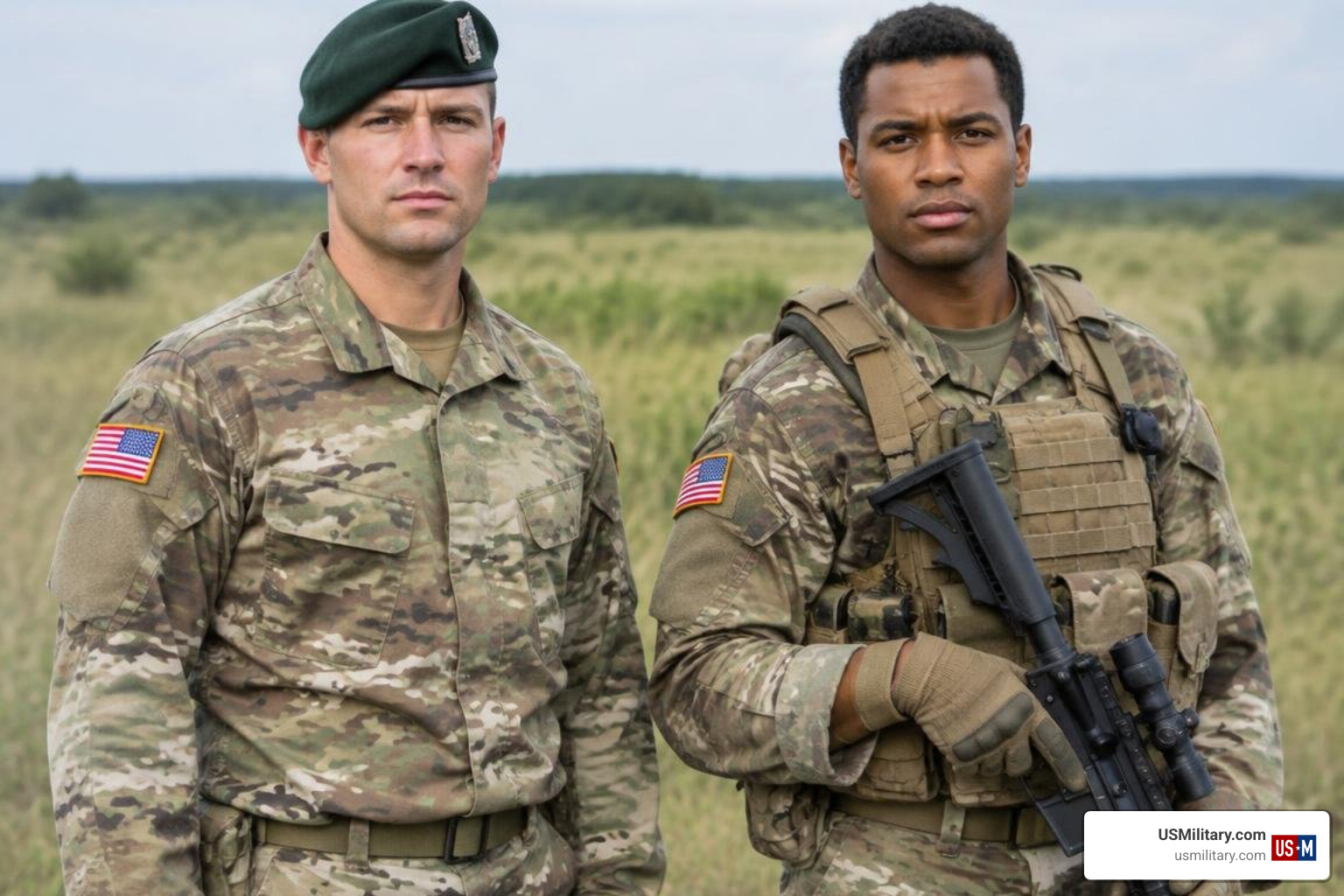
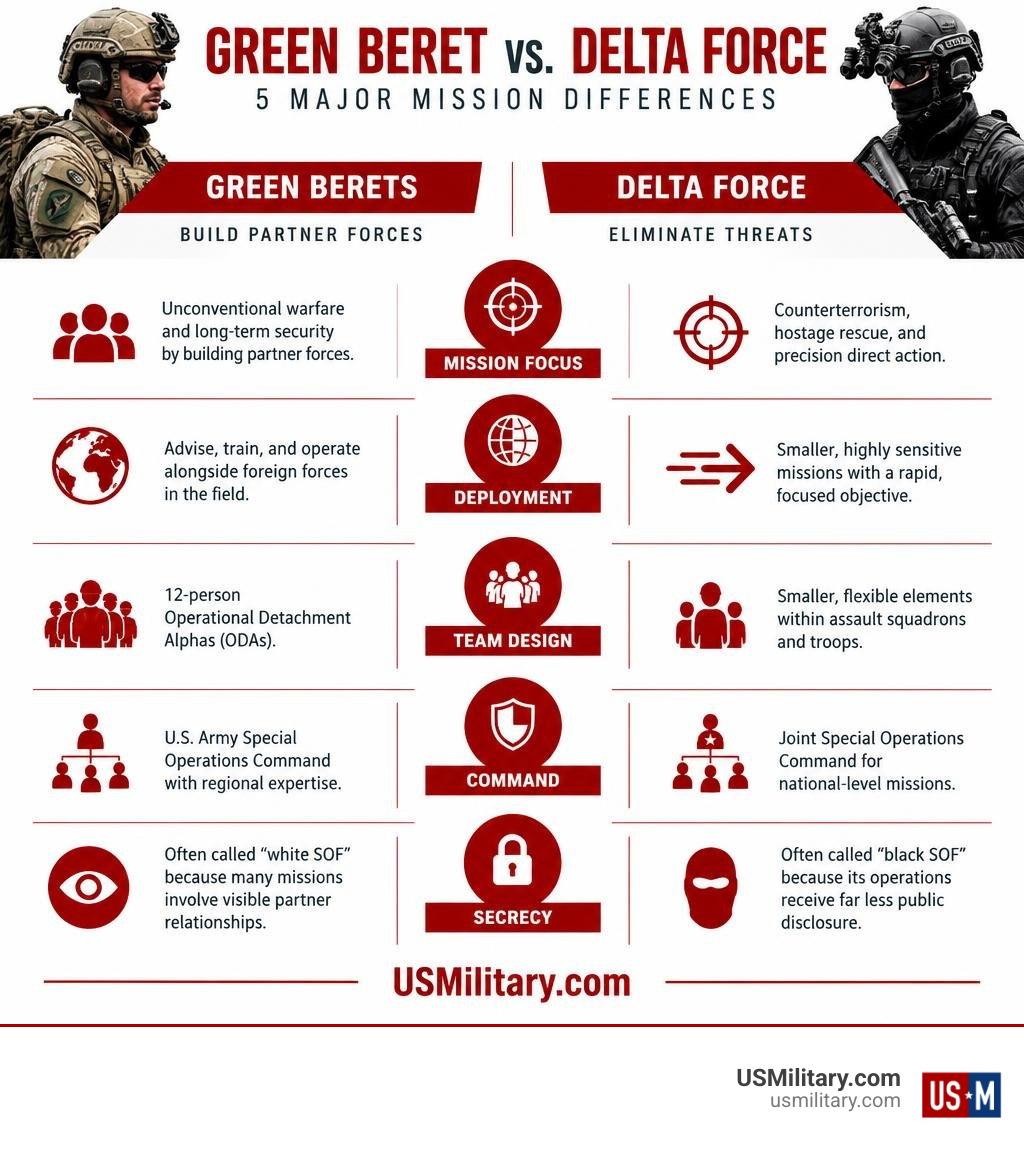
The 5 Major Mission Differences Between Army Green Berets and Delta Force come down to purpose, scale, secrecy, command, and team design:
- Green Berets build partner forces for unconventional warfare and long-term security missions. Delta Force focuses on counterterrorism, hostage rescue, and precision direct action.
- Green Berets often deploy to advise, train, and operate alongside foreign forces. Delta typically handles smaller, highly sensitive missions with a rapid, focused objective.
- Green Berets work in 12-person Operational Detachment Alphas (ODAs). Delta uses smaller, flexible elements within assault squadrons and troops.
- Army Special Forces operate under U.S. Army Special Operations Command and maintain regional expertise. Delta is a Special Mission Unit associated with Joint Special Operations Command for national-level missions.
- Green Berets are often described as “white SOF” because many missions involve visible partner relationships. Delta is commonly called “black SOF” because its operations receive far less public disclosure.
Both are elite Army organizations, but neither is simply a higher version of the other. A Green Beret may spend months building trust with an allied force, as Special Forces did alongside the Northern Alliance in Afghanistan in 2001. Delta Force is built for a different problem: a tightly controlled, high-risk mission where speed, precision, and secrecy matter most.
I am LARRY FOWLER, publisher of the USArmy.com and the USMilitary.com Network since 2007, where I have helped military audiences understand service options, benefits, and career decisions. This guide to the 5 Major Mission Differences Between Army Green Beret vs Delta Force explains the roles clearly so prospective service members can focus on mission fit, not just reputation.
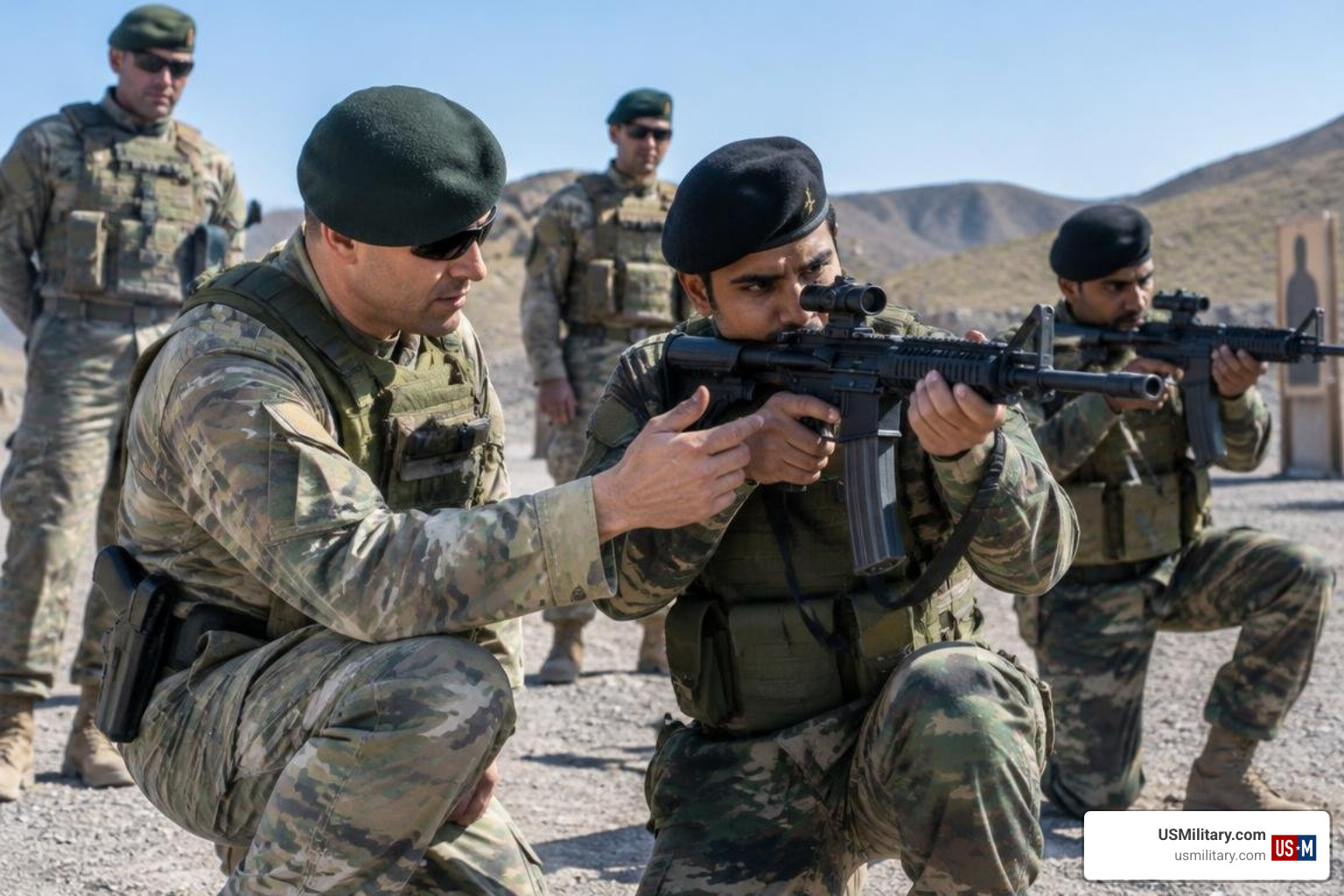
Understanding the Core Identity: Soldier-Diplomats vs. Surgical Strike Specialists
To understand modern special operations, we have to look past movie tropes and examine organizational DNA. Both the U.S. Army Special Forces (popularly called the Green Berets) and the 1st Special Forces Operational Detachment-Delta (widely known as Delta Force, CAG, or the Unit) trace their lineages to visionary leaders who recognized that conventional warfare doctrine could not solve every national security problem.
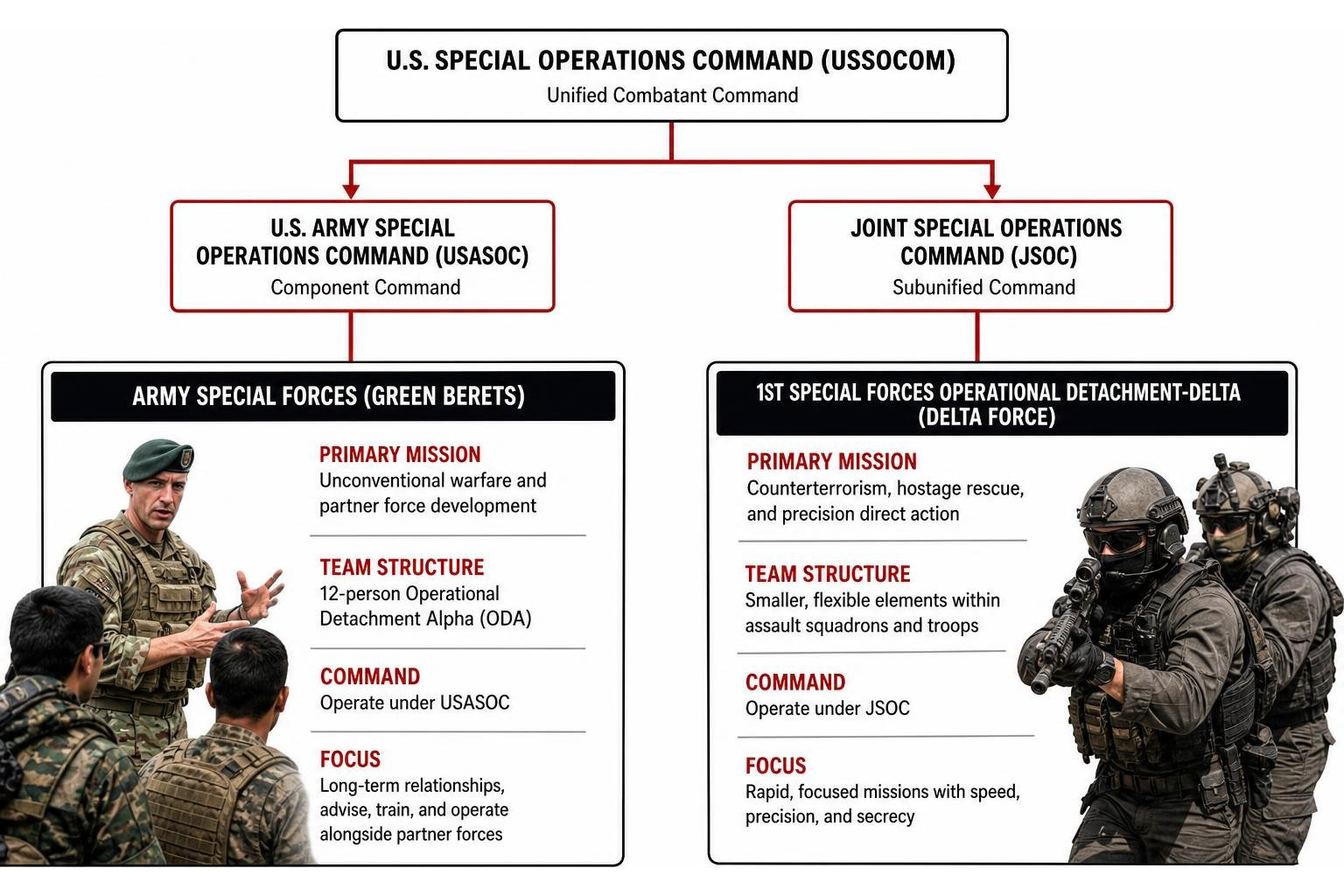
The strategic hierarchy divides responsibilities across distinct operational profiles:
While standard infantry or armor formations win through mass, firepower, and maneuver, Special Operations Forces (SOF) achieve strategic objectives through precision, placement, and specialized skill sets. The fundamental difference lies in the nature of their primary problems:
- Green Berets solve strategic problems by multiplying indigenous force capacity over extended timelines.
- Delta Force solves strategic crises by applying rapid, decisive surgical force to neutralize immediate threats.
The Green Beret Mandate: Unconventional Warfare and Partner Force Development
Established in 1952 and influenced heavily by the World War II Office of Strategic Services (OSS), the Green Berets carry the motto De Oppresso Liber (“To Free the Oppressed”). Their primary doctrinal mission is Unconventional Warfare (UW) and Foreign Internal Defense (FID).
Green Berets are fundamentally soldier-diplomats. When an Operational Detachment Alpha (ODA) deploys into an unstable theater, their job is rarely to fight a major battle alone. Instead, they embed with indigenous resistance movements, tribal militias, or host-nation military units. They teach marksmanship, small-unit tactics, land navigation, communications, and trauma medicine, transforming local recruits into an effective, self-sustaining fighting element.
This mission demands extensive language mastery, regional geopolitical literacy, and deep cross-cultural empathy. A Green Beret must be as comfortable negotiating with a village elder over tea as directing close air support in a firefight. Their operational horizon spans months or years.
The Delta Force Mandate: Tier 1 Direct Action and Counter-Terrorism Operations
Formed in 1977 by Colonel Charles Beckwith (who drew inspiration from his exchange service with the British Special Air Service), Delta Force was designed as the United States’ premier dedicated counter-terrorism strike unit. Delta operators exist to resolve national-level emergencies where failure is not an option and collateral damage must be minimized.
Delta Force’s primary mandates are Direct Action (DA), Hostage Rescue (HR), and Counter-Terrorism (CT) targeting high-value individuals (HVIs). Operating as a Tier 1 Special Mission Unit (SMU), Delta specializes in:
- High-risk dynamic entries in barricaded structures, hijacked aircraft, and maritime targets
- Clandestine vehicle interdictions and precision sniper engagements
- Rapid target exploitation to dismantle trans-regional terrorist networks
Delta operators are precision instruments. They do not deploy to build infrastructure or train foreign battalions; they train relentlessly to execute surgical raids with lethal speed and absolute technical precision.
5 Major Mission Differences Between Army Green Berets vs Delta Force
To clearly see how these two elite units diverge in real-world application, consider the comparison matrix below:
| Feature / Metric | U.S. Army Green Berets (Special Forces) | Delta Force (1st SFOD-D / CAG) |
|---|---|---|
| Primary Mission | Unconventional Warfare (UW), Foreign Internal Defense (FID), Partner Advising | Counter-Terrorism (CT), Hostage Rescue (HR), High-Value Target Direct Action |
| Operational Tier | Tier 2 (“White SOF”) | Tier 1 (“Black SOF” / Special Mission Unit) |
| Command Authority | U.S. Army Special Operations Command (USASOC) / Regional Theater SOCs | Joint Special Operations Command (JSOC) / National Command Authority |
| Deployment Horizon | Long-term (months to years embedded with partner forces) | Short-term, rapid-response (hours to weeks per operational cycle) |
| Core Team Structure | 12-Man Operational Detachment Alpha (ODA) | Modular Assault Troops, Squadrons, and Specialized Support Elements |
| Force Size | ~6,500 Active & National Guard Operators (5 Active, 2 Guard Groups) | Estimated 1,000–1,500 total personnel (assault and support squadrons) |
| Recruitment Entry | Civilian direct enlistment (18X Option) or In-Service Transfer | In-service application only (draws from Rangers, SF, and all military branches) |
| Language Mandate | Mandatory assigned foreign language proficiency | Mission-specific language familiarization |
1. Strategic Horizon: Long-Term Force Multiplication vs. Rapid Surgical Strikes
The most profound mission difference between Green Berets and Delta Force is how each interacts with time and operational space.
Green Berets measure success through sustainable relationships and force multiplication. When an ODA enters an operating area, its 12 operators might train and lead a 300-man guerrilla force. In late 2001, small Special Forces teams riding horseback in northern Afghanistan synchronized local cavalry charges with precision-guided air munitions, collapsing the Taliban regime in weeks. Their presence was designed to build enduring security frameworks from the ground up.
Conversely, Delta Force measures success by the immediate neutralization of a specific threat or the rescue of hostages. Their deployment profile follows a rapid cycle: gather actionable intelligence, conduct exhaustive mission rehearsal on exact target mock-ups, insert via specialized air or ground mobility assets, clear the target within minutes, exploit on-site intelligence, and extract immediately.
2. Operational Discretion: White SOF Diplomacy vs. Black SOF Secrecy
Green Berets are primarily designated as Tier 2 “White SOF.” While their deep-reconnaissance and direct action missions can be classified, much of their day-to-day work is overt or diplomatically acknowledged. Green Berets maintain forward presence in over 70 partner nations at any given time, wearing standard uniforms with the Special Forces tab and Green Beret, advising allied militaries, building defensive capabilities, and fostering international defense ties.
Delta Force operates as a Tier 1 “Black SOF” asset. Its existence, organizational layout, and operational records are closely compartmented. Delta operators frequently operate in civilian attire or sanitized gear without unit patches, using covert signatures and non-standard communications. Their operational directives stem from classified national security programs, meaning missions are rarely acknowledged by the Department of Defense unless public disclosure becomes unavoidable.
3. Command Authority: USASOC Regional Oversight vs. JSOC Presidential Directives
The chain of command dictates how, where, and why each unit deploys:
- Green Berets fall under the U.S. Army Special Operations Command (USASOC) and are organized into geographically aligned Special Forces Groups (1st, 3rd, 5th, 7th, 10th Active Duty, plus 19th and 20th National Guard). These groups report to Geographic Combatant Commanders (e.g., USCENTCOM, USEUCOM, USINDOPACOM). Their operations directly support theater-wide security cooperation and long-term regional stability.
- Delta Force is assigned to the Joint Special Operations Command (JSOC), an elite sub-unified command reporting directly through the Secretary of Defense to the President of the United States (the National Command Authority). JSOC maintains a constant state of global alert, enabling Delta to deploy anywhere in the world within hours to resolve hostage crises, seize weapons of mass destruction, or strike time-sensitive terrorist leadership targets.
4. Team Deployment: Autonomous 12-Man ODAs vs. Modular Assault Squadrons
A standard Green Beret team is an Operational Detachment Alpha (ODA), a self-contained 12-man cell engineered for cross-functional autonomy in isolated, austere environments:
Every MOS in an ODA is duplicated across two operators, allowing the 12-man element to split into two independent 6-man split teams without losing operational capability.
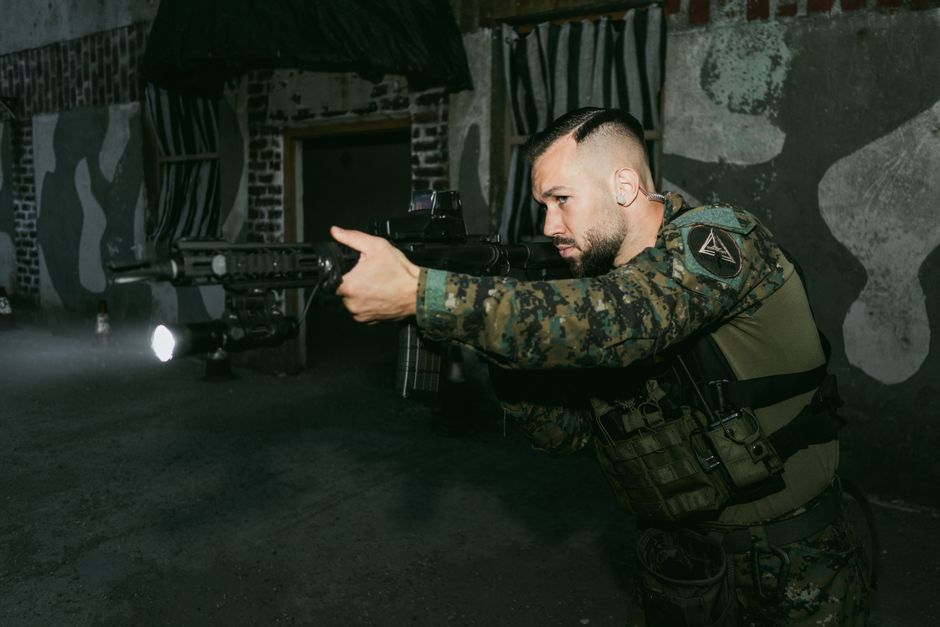
Delta Force does not utilize the ODA structure. It is organized into Assault Squadrons (further subdivided into Troops and modular Teams) alongside specialized Reconnaissance/Surveillance, Aviation, Technical Support, and Breaching elements. Delta operators train toward exceptional individual mastery in close-quarters battle (CQB), dynamic marksmanship, tactical breaching, and vehicle interdiction, allowing troop commanders to assemble custom assault packages tailored to the exact layout of a specific target.
5. Tactical Scope: Broad-Spectrum Advisory vs. Hyper-Focused Precision Raiding
While Green Berets maintain high proficiency in direct action and tactical assault, dynamic combat is only one tool in their strategic kit. An ODA might spend eight months teaching water filtration, counter-IED patrolling, and perimeter defense to an allied police force. The Green Beret’s primary weapon system is their intellectual agility, regional knowledge, and interpersonal leverage.
For Delta Force, tactical combat is the central mission focus. Delta operators spend thousands of hours each year firing tens of thousands of rounds, refining shoot-house clearance techniques, explosive entry methods, night-vision combat maneuvers, and advanced vehicle operations. Their mission profile requires rapid, high-intensity direct action where target discrimination must happen in fractions of a second under extreme stress.
Selection, Training Pipelines, and Elite Pipeline Nuances
The physical and psychological screening for both units reflects their divergent operational mandates. Neither pipeline accepts anything short of exceptional endurance, intellectual resilience, and emotional maturity.
Training Pipelines: Green Beret vs. Delta Force
The entry gateways and foundational training pipelines demonstrate how each community filters for its specific mission profile:
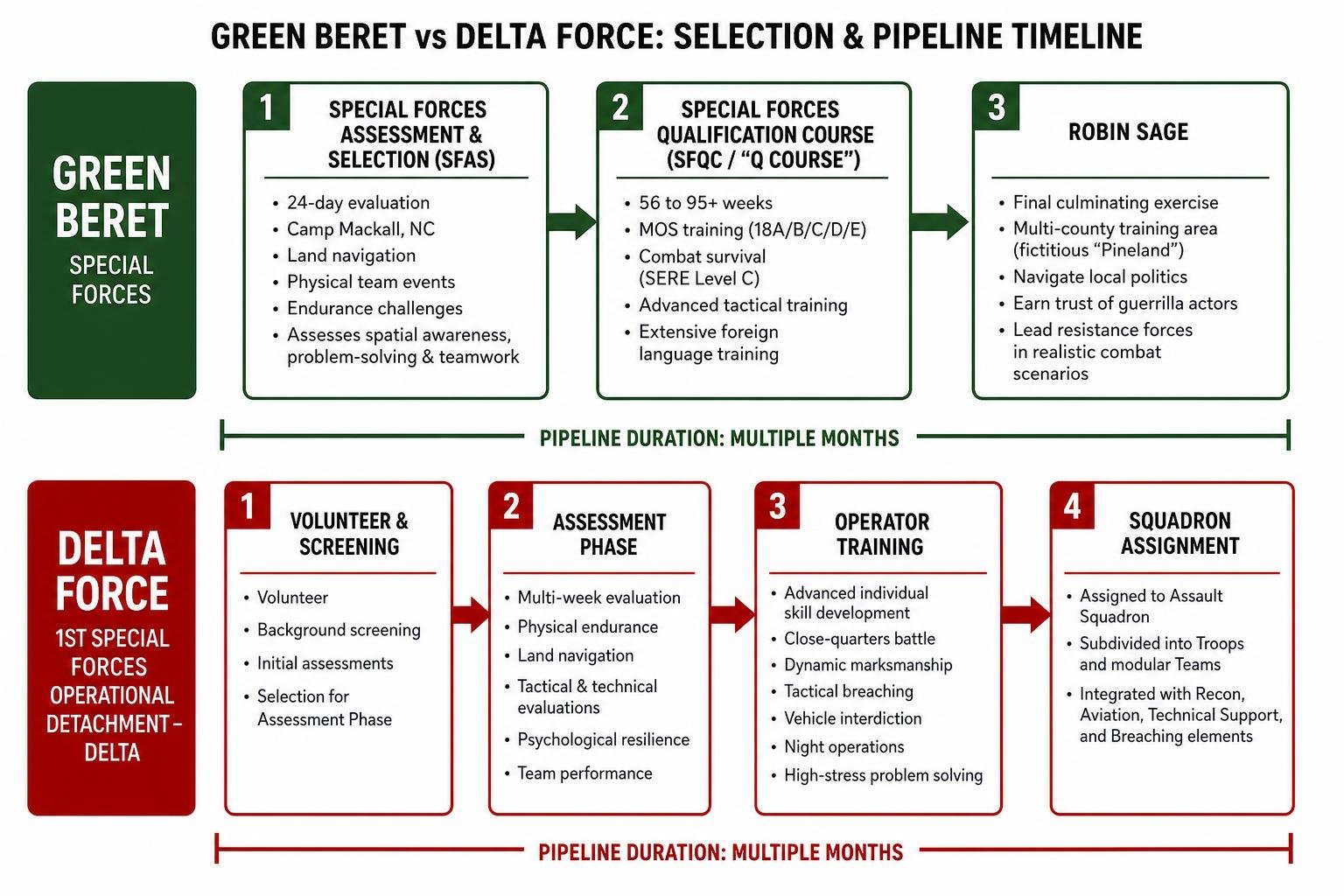
The Green Beret Pipeline (SFAS & the Q Course)
- Special Forces Assessment and Selection (SFAS): A 24-day evaluation at Camp Mackall, North Carolina. Candidates face grueling individual land navigation, physical team events, and intense endurance challenges designed to evaluate spatial awareness, problem-solving under exhaustion, and teamwork.
- Special Forces Qualification Course (SFQC / “Q Course”): Lasting from 56 to 95+ weeks, candidates specialize in their designated Special Forces MOS (18A/B/C/D/E), master combat survival (SERE Level C), complete advanced tactical training, and undergo extensive foreign language training.
- Robin Sage: The final, legendary unconventional warfare exercise spanning multiple counties in North Carolina (the fictional guerrilla nation of “Pineland”). Candidates must navigate local politics, win the trust of guerrilla actors, and lead resistance forces through realistic combat problems.
The Delta Force Pipeline (Selection & OTC)
- Delta Selection Course: Held semiannually in mountainous, austere terrain (such as West Virginia). Modeled heavily after the British SAS selection, it focuses on solitary, unsupported mental endurance. Candidates complete increasingly long, heavily weighted ruck marches over rough, unmarked terrain with zero feedback from cadre, culminating in the 40-mile solo endurance march known as “The Long Walk.” Selection features an attrition rate of roughly 90–95%, with only 12 to 14 candidates selected out of starting classes of nearly 250.
- Psychological & Board Evaluation: Candidates who finish the physical phase undergo extensive psychological profiling, stress interviews, and review boards with senior operators and psychologists to evaluate emotional stability, humility, and critical thinking.
- Operator Training Course (OTC): A six-month intensive program where selected candidates learn advanced marksmanship, dynamic CQB, precision driving, surveillance, tactical lock-picking, and specialized Tier 1 tactics before assignment to an operational assault squadron.
Career Paths and Recruitment Models
A major distinction between the two paths is how a prospective service member enters the pipeline:
- Green Berets offer the 18X Enlistment Contract, allowing qualified civilian recruits to enlist directly with an opportunity to try out for Special Forces following Basic Combat Training, Infantry OSUT, and Airborne School. Active-duty enlisted soldiers (E-3 through E-7) and officers (First Lieutenants and Captains) can also volunteer for SFAS through standard in-service transfer boards.
- Delta Force does not recruit civilians directly. There is no direct enlistment option. Candidates must already be active-duty service members, typically holding ranks from E-4 to E-8 or Captain to Major, with at least 2.5 years of service remaining. While Delta recruits from all branches of the U.S. Armed Forces—including Navy SEALs, Marine Raiders, and Air Force Combat Controllers—the vast majority of its operator candidates come from the 75th Ranger Regiment and the Army Special Forces Groups.
For service members evaluating different elite operational cultures, our comparison of Delta Force and Navy SEAL careers outlines the distinctions in maritime versus land-based Tier 1 paths.
Frequently Asked Questions About Green Berets and Delta Force
Which unit is considered more elite, Green Berets or Delta Force?
“Elite” depends entirely on mission context. In terms of tier hierarchy, direct action marksmanship, and resource priority, Delta Force is a Tier 1 Special Mission Unit, placing it at the highest level of national tactical response. However, if the national objective is to infiltrate a denied region, establish ties with indigenous fighters, and build a guerrilla army capable of overthrowing an occupying force, the Green Berets are the premier, unequaled force. Each unit is the undisputed master of its specific domain.
Can a Green Beret become a Delta Force operator?
Yes. Army Special Forces is one of the top feeder communities for Delta Force. Green Berets already possess high levels of tactical maturity, fieldcraft, and operational experience, making them strong candidates during Delta’s selection course. When a Green Beret transitions to Delta, they retain their Special Forces Tab while taking on the Tier 1 direct-action mission profile.
How do recruitment pathways differ between Green Berets and Delta Force?
Civilians can join the Green Berets through an 18X enlistment contract, meaning a qualified recruit off the street can earn the Green Beret if they complete the required pipeline. Delta Force requires prior military service, meaning you must already serve in the Armed Forces, build an exemplary record, and receive an invitation or submit a packet to attend their classified assessment course.
Conclusion: Choosing the Right Special Operations Path
Both the U.S. Army Green Berets and Delta Force represent the pinnacle of military professionalism, but they exist to solve fundamentally different strategic challenges.
If your passion lies in regional languages, cultural immersion, deep tactical autonomy, and building partner forces to shape global theaters over months and years, the Green Beret path offers an unmatched career in unconventional warfare. If you aspire to hyper-focused direct action, precision dynamic shooting, hostage rescue, and rapid-strike counter-terrorism at the highest level of national security classification, Delta Force represents the absolute sharpest edge of the direct-action spear.
For prospective recruits, active-duty service members, and veterans navigating military transitions, exploring USMilitary.com military career guides and transition resources provides clear information on benefits, career pathways, and special operations preparation.