
Army Entry Age: The 2026 Rules at a Glance
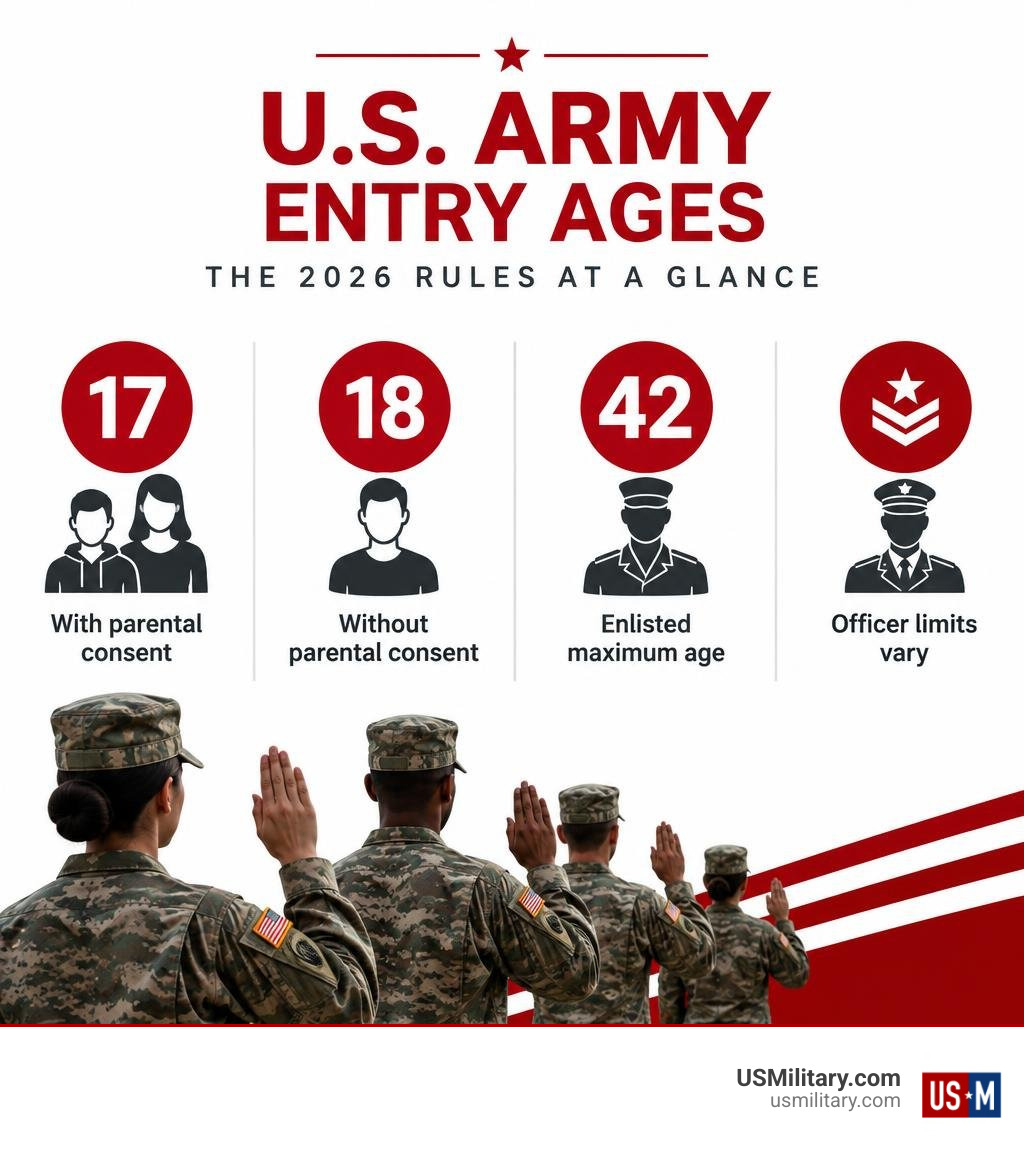
You can enlist in the U.S. Army at 18, or at 17 with parental consent. Since April 20, 2026, the standard maximum age has been 42 for both new recruits and applicants with prior service. Officer candidates follow different rules: the general standard is to be under 31 in the year they are commissioned. If you are over an age limit, ask a recruiter whether a waiver or a different service path is available.
I’m Larry Fowler, publisher of USMilitary.com. Since 2007, I’ve helped readers navigate questions about the entry age for army service and other enlistment requirements.
Handy entry age for army terms:
Current Policy and Updated Entry Age for Army Recruits

The landscape for joining the armed forces has shifted dramatically this year. Under updated accession guidance effective April 20, 2026, the U.S. Army officially raised its maximum enlistment ceiling from 35 to 42 years old. This adjustment applies across active-duty Army, the Army Reserve, and the Army National Guard for both regular incoming recruits and prior-service applicants.
For prospective soldiers who believed their window of opportunity had closed, this policy opens doors that were previously locked. While candidates must still satisfy every medical, physical, and moral baseline, the age ceiling itself no longer stands in the way of candidates in their late thirties and early forties. Before heading into a recruiting station, reviewing the official Army eligibility requirements can give you a clear picture of basic criteria. To see how these adjustments apply specifically to first-time service members, our breakdown of updated US Army enlistment age requirements outlines what documentation you will need at Military Entrance Processing Stations (MEPS).
Minimum Entry Age for Army Applicants and Minors
While the upper age limit has expanded, the floor remains firm. Under federal statutory guidelines:
- Age 17: Minors may begin processing and enlist provided they have signed consent from a parent or legal guardian. Applicants must also show proof of high school graduation or provide documentation that they are on track to graduate before shipping out to Basic Combat Training (BCT).
- Age 18: Individuals are legally recognized adults and may enlist independently without parental permission or third-party consent.
Many 17-year-old high school juniors and seniors take advantage of the Delayed Entry Program (DEP), which lets them lock in their Military Occupational Specialty (MOS) and ship date months before stepping onto the drill pad. If you are preparing for your initial recruitment meeting, verify the specifics in our guide to joining the Army in 2026 age rules.
Historical Adjustments and Policy Rationale
The decision to establish a maximum enlistment cap of 42 is not entirely unprecedented, but it reflects evolving demographic realities and recruitment challenges. In 2006, during the height of operations in Iraq and Afghanistan, the Department of the Army temporarily raised the enlistment age cap to 42 to meet heightened troop demands. A decade later, in 2016, accession policies returned the cap to 35.
Historically, the military skewed much younger. In FY 2000, roughly 87 percent of new accessions were between 18 and 24 years old, with an overall average accession age of 19.3 years. Even then, the Army accepted a broader demographic than sister services, carrying the highest proportion of recruits over age 21 (23 percent).
Today, recruiting commands face a different operating environment. Modern military career tracks increasingly demand specialized skills in fields like cyber defense, technical logistics, and complex equipment maintenance—domains where older recruits bring valuable civilian experience.
Alongside the age expansion, the Department of the Army updated its moral conduct screening. Codified within *Army Regulation 601 – 210 , the service relaxed certain non-violent conduct disqualifications, allowing applicants with a single misdemeanor conviction for cannabis possession or drug paraphernalia to enlist directly without needing a formal moral waiver.
Enlisted vs. Officer Age Requirements Across Pathways
The journey to wearing the uniform differs significantly depending on whether you enlist or pursue a commission as an officer. Enlisted soldiers focus on direct technical and tactical execution, whereas commissioned officers manage broader tactical planning, operational command, and personnel administration. Consequently, officer programs maintain distinct age caps.
| Service Pathway | Minimum Entry Age | Standard Maximum Age | Primary Education Requirement |
|---|---|---|---|
| Enlisted (Active/Reserve/Guard) | 17 (with consent) / 18 | 42 | High school diploma or GED equivalent |
| U.S. Military Academy (West Point) | 17 | Under 23 at admission (cap 27) | High school completion; congressional nomination |
| Army ROTC (Traditional) | 17 | Under 31 at commissioning | Enrolled in accredited 4-year degree program |
| Officer Candidate School (OCS) | 19 | Under 31 at commissioning | Conferral of 4-year Bachelor’s degree |
| Direct Commission (Specialized) | 21 | Up to 42+ (specialty dependent) | Professional graduate/terminal degree (MD, JD, etc.) |
Those examining leadership pipelines should explore navigating officer age requirements to evaluate how degree timelines and commissioning dates interact.
Commissioning Age Thresholds for West Point, ROTC, and OCS
Officer commissioning paths carry strict chronological boundaries:
- United States Military Academy (West Point): Candidates must be at least 17 years old but not have passed their 23rd birthday on July 1 of the year of entry. While absolute regulatory exceptions can extend eligibility up to age 27 for exceptional prior-service soldiers, West Point remains the narrowest pipeline.
- Reserve Officers’ Training Corps (ROTC): Cadets participating in college ROTC programs must complete all degree requirements and receive their commission prior to turning 31 in the year of commissioning.
- Officer Candidate School (OCS): Designed for college graduates and current enlisted soldiers possessing a bachelor’s degree, the 12-week OCS pipeline requires candidates to commission before their 31st birthday. Enlisted soldiers leveraging the Green to Gold program must balance their degree completion against this deadline.
Direct Commissioning Pathways for Specialized Careers
For civilian professionals in high-demand fields, direct commissioning provides an exception to standard age thresholds. The Army frequently awards direct commissions to:
- Medical Professionals: Physicians, surgeons, dentists, and specialized nurses.
- Judge Advocate General’s (JAG) Corps: Licensed attorneys and legal practitioners.
- Chaplain Corps: Ordained clergy and religious leaders.
- Cyber & Technical Experts: Advanced data scientists and cybersecurity professionals.
Because these individuals enter service with specialized professional credentials, the Army regularly extends commissioning age limits up to 42, with individual waivers granted beyond that for critical shortages.
Military Branch Comparison: How Army Age Limits Stack Up

When mapping out your military career, understanding how service branches set their accession ages can help you find the right fit. Read our overview of military enlistment ages for deeper context on Department of Defense guidelines, or review scientific analysis on Demographic, Physical, and Mental Health Factors Associated… across incoming personnel.
| Military Branch | Minimum Enlistment Age | Maximum Enlistment Age (Enlisted) |
|---|---|---|
| U.S. Army | 17 (with consent) / 18 | 42 |
| U.S. Air Force | 17 (with consent) / 18 | 42 |
| U.S. Space Force | 17 (with consent) / 18 | 42 |
| U.S. Navy | 17 (with consent) / 18 | 41 |
| U.S. Coast Guard | 17 (with consent) / 18 | 41 |
| U.S. Marine Corps | 17 (with consent) / 18 | 28 |
Department of the Air Force and Space Force Parity
The Army’s expansion to age 42 brings it into direct alignment with the Department of the Air Force, which instituted a 42-year cap for both the Air Force and the Space Force. Both branches elevated their age thresholds to capture technically proficient applicants who opted for civilian industry before deciding to serve. This unified standard simplifies joint operations and reserve transfers across the air, land, and space domains.
Navy, Coast Guard, and Marine Corps Age Cutoffs
Other service branches maintain their own operational cutoffs:
- U.S. Navy and Coast Guard: Both maritime branches maintain a maximum enlistment age of 41 for active-duty accessions, providing a wide window for recruits.
- U.S. Marine Corps: The Marine Corps maintains the strictest entry cap across the Department of Defense, capping enlistment at age 28. This strict standard reflects the service’s expeditionary mission and distinct physical baseline.
Army Age Waivers and Prior Service Qualifications
What happens if you have passed your 42nd birthday? While 42 represents the standard ceiling, age waivers and prior-service calculations offer viable avenues to serve. Before initiating a waiver, applicants must confirm they meet core physical baselines. Rather than relying solely on older height-and-weight charts, MEPS now utilizes a modern waist-to-height ratio (WHtR) metric, where an applicant’s WHtR must remain below 0.55. For a broader overview of how waivers operate, see our breakdown on evaluating Army age limits and eligibility.
How Prior Service Adjusts the Entry Age for Army Veterans
If you have previously served on active duty in any branch of the U.S. Armed Forces, the Army uses a standardized formula to calculate your adjusted accession age.

Under this rule, subtract your total years of creditable active-duty service from your real-world chronological age. If the resulting figure is 42 or below, you remain eligible to enlist without needing an exception to policy. Review the full guidelines on prior service age cutoff rules.
Veterans seeking part-time military commitments can also pursue Army Reserve age waiver opportunities, which offer flexible pathways for completing retirement point requirements.
Disqualification Exceptions and General Waiver Procedures
For non-prior-service applicants over 42, securing an age waiver requires a whole-person assessment conducted through U.S. Army Recruiting Command (USAREC). Approvals are typically tied to specific institutional needs, including:
- High Armed Services Vocational Aptitude Battery (ASVAB) scores.
- Professional civilian certifications matching critical MOS shortages (such as linguistics, electronics maintenance, or medical care).
- Exemplary physical fitness performance and clean medical histories.
Waiver requests originate directly with your local recruiting battalion and are reviewed on a case-by-case basis.
Frequently Asked Questions About Army Age Limits
What is the maximum age to enlist in the U.S. Army?
The standard maximum age to enlist in the active-duty Army, Army Reserve, and Army National Guard is 42. Applicants must be able to ship to Basic Combat Training before their 43rd birthday unless an age waiver or prior-service adjustment applies.
Can 17-year-olds join the Army without a high school diploma?
A 17-year-old may enlist with signed parental consent, but they must either possess a high school diploma, hold a recognized GED certificate, or produce verification that they are currently enrolled and on track to graduate before shipping out.
How does prior active duty service affect the Army enlistment age cap?
Prior active service is subtracted directly from your actual age. For example, a 46-year-old applicant with 5 years of honorable active-duty service in the Marine Corps holds an adjusted accession age of 41, making them eligible to enlist under the 42-year cap.
Conclusion
With the Army’s maximum enlistment age set at 42, military service is accessible to a wider demographic of Americans than at any point over the last decade. Whether you are a recent high school graduate mapping out your education benefits or an experienced civilian professional seeking purposeful service, understanding age ceilings and waiver parameters ensures you make informed career choices.
At USArmy.com, we provide clear guidance on VA benefits, branch transitions, and military career advancement. For detailed comparisons across all service branches, check out our comprehensive military age limit guide before scheduling your initial meeting with a recruiter.